Strategy Takes a Hardline Stance Against MSCI: What's in the 12-Page Open Letter of Defense?

marsbitОпубликовано 2025-12-11Обновлено 2025-12-11

Введение

In October 2024, MSCI proposed excluding companies with over 50% of their assets in digital assets from its global investable market indices, directly threatening Digital Asset Treasury (DAT) companies like MicroStrategy. Analysts warned this could trigger up to $8.8 billion in outflows, with MicroStrategy alone facing $2.8 billion in passive selling pressure. In response, MicroStrategy submitted a 12-page public letter to MSCI, strongly opposing the proposal as "misleading and destructive." The company argued that digital assets represent a revolutionary financial technology, comparable to historic infrastructure investments like oil or telecommunications. It emphasized that DATs are operational businesses with active revenue models, not passive funds, and criticized the 50% threshold as arbitrary, discriminatory, and impractical due to Bitcoin's volatility. MicroStrategy also accused MSCI of violating index neutrality and contradicting the U.S. government's pro-digital asset strategy. The company demanded MSCI withdraw the proposal or extend the consultation period. It is not alone—over 300 entities, including Strive and Bitcoin for Corporations, have joined opposition efforts, suggesting alternative indices instead of exclusion. The outcome, expected by January 2026, will significantly impact the integration of digital asset companies into traditional financial markets.

Original Title: Strategy Takes a Hardline Stance Against MSCI: The Ultimate Defense of DAT

Original Author: KarenZ, Foresight News

The battle concerning the development of the Digital Asset Treasury (DAT) industry continues to intensify.

In October, global index compiler MSCI put forward a proposal to exclude companies with digital asset holdings accounting for 50% or more of their total assets from its global investable market indices. This move directly threatens the market position of digital asset treasury companies like Strategy and could potentially redirect capital flows for the entire DAT sector.

According to data compiled by Bitcoin for Corporations, 39 companies could be excluded from the MSCI Global Investable Market Index. J.P. Morgan analysts previously warned that the exclusion of Strategy alone could lead to nearly $2.8 billion in passive outflows. If other index providers follow suit with similar rules, it could result in outflows of up to $8.8 billion.
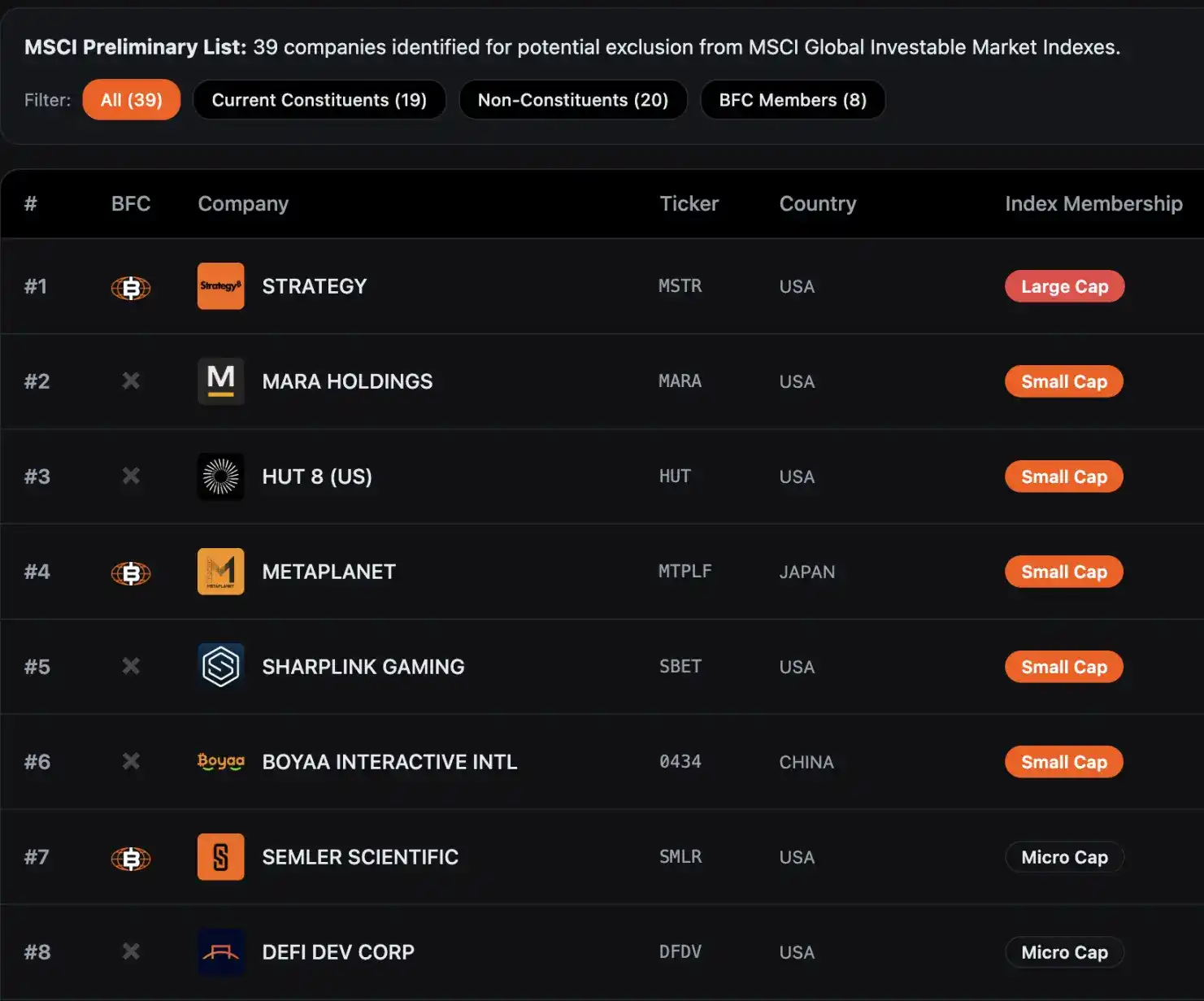
Currently, the consultation period for this MSCI proposal will last until December 31, 2025, with a conclusion expected by January 15, 2026. Any adjustments would be formally implemented during the index review in February 2026.

Facing this urgent situation, Strategy submitted a strongly worded 12-page open letter to the MSCI Equity Index Committee on December 10th. Signed jointly by Executive Chairman and founder Michael Saylor and President & CEO Phong Le, the letter clearly expresses firm opposition to the proposal. It states bluntly: "This proposal is seriously misleading and will have profoundly damaging consequences for the interests of global investors and the development of the digital asset industry. We strongly urge MSCI to completely withdraw this plan."

Strategy's Four Core Arguments for Defense

Digital Assets are a Revolutionary Foundational Technology Reshaping the Financial System

Strategy believes MSCI's proposal underestimates the strategic value of Bitcoin and other digital assets. Since Satoshi Nakamoto introduced Bitcoin 16 years ago, this digital asset has gradually grown into a key component of the global economy, with a current total market value of approximately $1.85 trillion.

In Strategy's view, digital assets are far from simple financial instruments; they represent a fundamental technological innovation capable of reshaping the global financial system—companies investing in Bitcoin-related infrastructure are building a new financial ecosystem, much like leading companies in history that deeply invested in single emerging technologies.

Just as Standard Oil in the 19th century focused on oil well extraction and AT&T in the 20th century全力 built telephone networks, these companies laid a solid foundation for subsequent economic transformations through前瞻性 investment in core infrastructure, ultimately becoming industry benchmarks. Strategy argues that companies focusing on digital assets today are following this path of "technology pioneers" and should not be simply dismissed by traditional index rules.

DATs are Operating Companies, Not Passive Funds

This is the core of Strategy's argument—Digital Asset Treasury companies (DATs) are operating businesses with complete business models, not merely investment funds passively holding Bitcoin. Although Strategy currently holds over 600,000 Bitcoin, its core value does not rely solely on Bitcoin's price fluctuations. Instead, it creates sustainable returns for shareholders by designing and launching unique "digital credit" instruments.

Specifically, Strategy issues "digital credit" instruments including various types with fixed dividend rates, floating dividend rates, different priority levels, and credit protection条款 preferred shares. It uses the funds raised from selling these instruments to acquire more Bitcoin. As long as the long-term investment return on Bitcoin exceeds Strategy's dollar-denominated financing costs, it can generate stable收益 for shareholders and clients. Strategy emphasizes that this model of "active operation + asset appreciation" is fundamentally different from the passive management logic of traditional investment funds or ETFs and should be regarded as a normal operating company.

Simultaneously, Strategy questions in the letter: Why can oil giants, real estate investment trusts (REITs), timber companies, etc., concentrate on holding单一类别 assets without being classified as investment funds and excluded from indices?Imposing special restrictions only on digital asset companies clearly violates the principle of industry fairness.

The 50% Digital Asset Threshold is Arbitrary, Discriminatory, and Impractical

Strategy points out that MSCI's proposal employs discriminatory standards. Many large companies in traditional industries also高度集中 hold单一 asset classes in their portfolios, including oil and gas companies, REITs, timber companies, and power infrastructure firms. Yet MSCI has established special exclusion criteria only for digital asset companies, constituting明显的 unfair treatment.

From an implementation feasibility perspective, the proposal also has serious issues. Due to the high volatility of digital asset prices, the same company could frequently enter and exit MSCI indices within days due to changes in asset value, causing market chaos. Furthermore, differences between accounting standards (the treatment of digital assets differs under US GAAP and international IFRS standards) will lead to differential treatment for companies with the same business model based on their jurisdiction of registration.

Violates Index Neutrality Principle, Introduces Policy Bias

Strategy believes that MSCI's proposal is essentially a value judgment on a certain asset class,violating the fundamental principle that index providers should remain neutral. MSCI claims to markets and regulators that its indices provide "exhaustive" coverage aimed at reflecting the evolution of the underlying equity market," and should not "make judgments about the goodness or appropriateness of any market, company, strategy, or investment."

By selectively excluding digital asset companies, MSCI is effectively making policy judgments on behalf of the market, which is precisely what index providers should avoid.

Contradicts US Digital Asset Strategy

Strategy特别 emphasizes that this proposal conflicts with the strategic goals of the Trump administration to advance US leadership in digital assets. The Trump administration signed an executive order in its first week to promote growth in digital financial technology and established a strategic Bitcoin reserve, aiming to make the US the global leader in the digital asset space.

However, if MSCI's proposal is implemented, it would directly prevent long-term US capital, such as pensions and 401(k) plans, from investing in digital asset companies, leading to tens of billions of dollars flowing out of the industry. This would not only hinder the development of US digital asset innovation companies but could also weaken US competitiveness in this strategic field, running counter to the government's stated policy direction.

Strategy cites analyst estimates suggesting that Strategy alone could face up to $2.8 billion in passive liquidation of its stock due to MSCI's proposal. This not only harms Strategy itself but will also have a chilling effect on the entire digital asset ecosystem. For example, it could force Bitcoin mining companies to sell assets prematurely to adjust their asset structure, thereby distorting the normal supply and demand dynamics of the digital asset market.

Strategy's Final Demands

Strategy makes two key demands in the open letter:

First, it hopes MSCI will completely withdraw the exclusion proposal, allowing the market to test the value of Digital Asset Treasury companies (DATs) through free competition, enabling indices to neutrally and faithfully reflect the development trends of next-generation financial technology.

Second, if MSCI still insists on "special treatment" for digital asset companies, it must expand the scope of industry consultation, extend the consultation period, and provide more substantial logical support to explain the rationality of the rules.

Strategy is Not Fighting Alone

Strategy is not fighting alone. According to data from BitcoinTreasuries.NET, as of December 11th,208 publicly traded companies globally hold over 1.07 million Bitcoin, exceeding 5% of Bitcoin's total supply, currently worth approximately $100 billion.
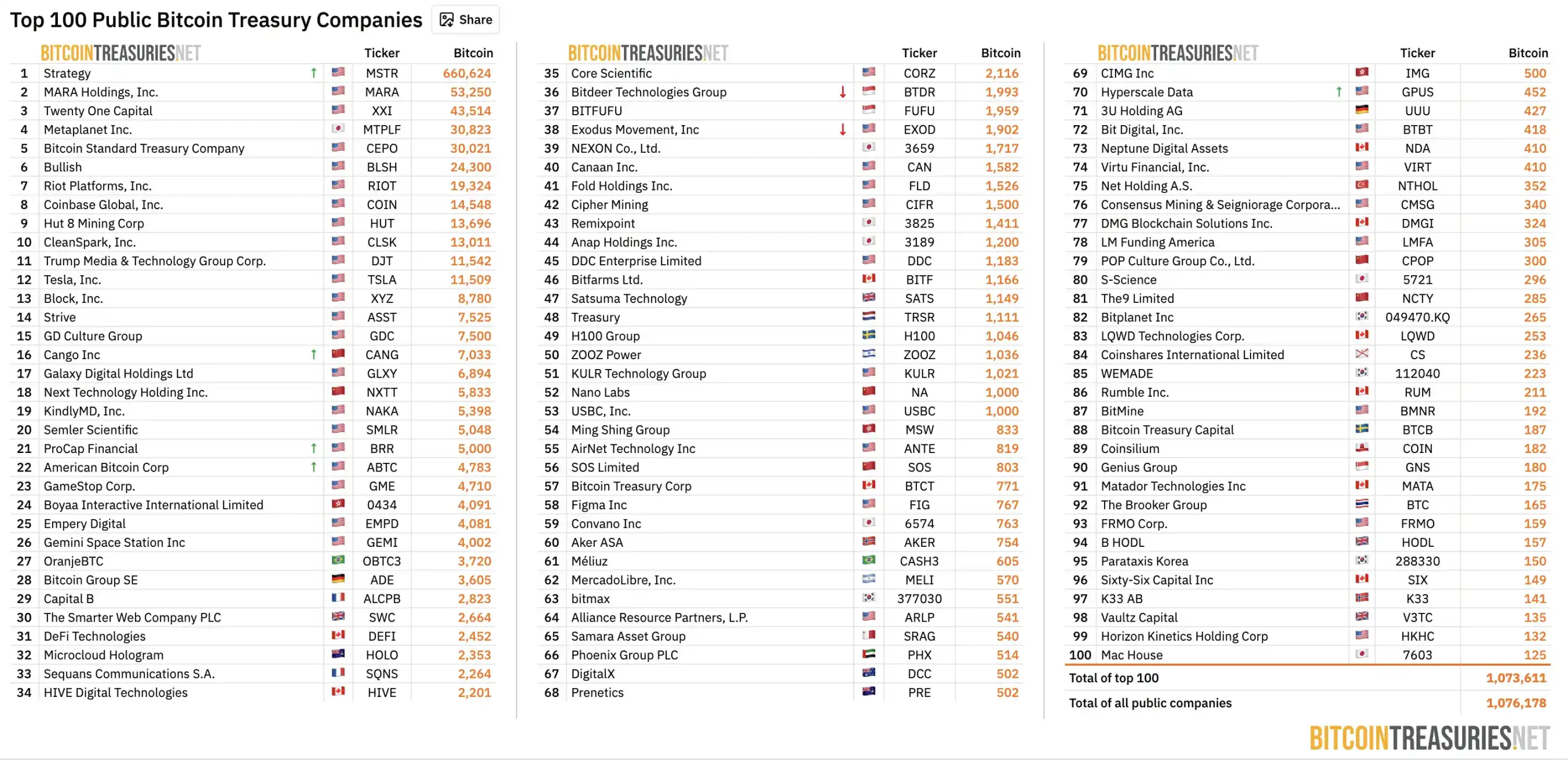
Source: BitcoinTreasuries.NET

These digital asset treasury companies have become important bridges for institutional adoption of cryptocurrencies, providing compliant indirect exposure for traditional financial institutions like pension funds and endowments.

Previously, the Bitcoin-holding public company Strive suggested that MSCI should leave the "choice" regarding digital asset companies to the market. A simple and direct solution is tocreate "ex-Digital Asset Treasuries" versions of existing indices, such as the MSCI USA ex Digital Asset Treasuries Index and the MSCI ACWI ex Digital Asset Treasuries Index. Through transparent screening mechanisms, investors can choose their tracking benchmark independently, preserving index integrity while meeting the needs of different investors.

Furthermore, the industry organization Bitcoin for Corporations has initiated a joint petition calling on MSCI to withdraw this digital asset proposal, advocating that classification should be based on a company's actual business model, financial performance, and operational characteristics, rather than simply drawing a line based on asset比例. According to the organization's website,309 companies or investors have currently signed the joint letter. Signatories include, besides Strategy, industry leaders such as Strive, BitGo, Redwood Digital Group, 21MIL, Btc inc, DeFi Development Corp, as well as numerous individual developers and investors.

Summary

The confrontation between Strategy and MSCI is essentially a fundamental debate about "how emerging financial innovations integrate into the traditional system." Digital Asset Treasury companies (DATs), as "cross-border entities" between traditional finance and the cryptocurrency world, are neither pure tech companies nor simple investment funds, but rather a new business model built upon digital assets.

MSCI's proposal attempts to use the "50% asset threshold" to categorize these complex entities as "investment funds" and exclude them from indices;而 Strategy insists that this simplified treatment is a serious misunderstanding of their business essence and a departure from the principle of index neutrality. As the January 15, 2026 decision date approaches, the outcome of this博弈 will not only determine the index "eligibility" of several Bitcoin-holding listed companies but will also define the crucial "survival boundaries" for the future地位 of the digital asset industry within the global traditional financial system.

References
https://assets.contentstack.io/v3/assets/bltf8d808d9b8cebd37/blt26a263f232aa531c/693976b64c2a191113a60111/strategy-msci-letter.pdf
https://app2.msci.com/webapp/index_ann/DocGet?pub_key=0bZz7Im3vZU%3D&lang=en&format=html
https://x.com/ColeMacro/status/1996930014441623902

Recommended Reading:

Why Isn't Asia's Largest Bitcoin Treasury Company Metaplanet Buying the Dip?

Multicoin Capital: The Era of FinTech 4.0 Has Arrived

a16z-Backed Web3 Unicorn Farcaster Forced to Pivot, Is Web3 Social a False Proposition?

Трендовые криптовалюты

Связанные с этим вопросы

QWhat is the core proposal from MSCI that has caused strong opposition from MicroStrategy and other Digital Asset Treasury (DAT) companies?

AMSCI proposed to remove companies with digital asset holdings accounting for 50% or more of their total assets from its global investable market indices.

QWhat are the four main arguments MicroStrategy presented in its 12-page open letter to MSCI?

A1. Digital assets are a revolutionary foundational technology reshaping the financial system. 2. DATs are operating companies, not passive funds. 3. The 50% digital asset threshold is arbitrary, discriminatory, and impractical. 4. The proposal violates index neutrality principles and introduces policy bias.

QAccording to the article, what significant financial impact could MicroStrategy face if MSCI's proposal is implemented?

AAnalysts estimate that MicroStrategy alone could face up to $2.8 billion in passive stock sell-offs if removed from MSCI indices.

QWhat alternative solution did the company Strive suggest to MSCI regarding the inclusion of DAT companies in its indices?

AStrive suggested creating versions of existing indices that exclude Digital Asset Treasuries, such as 'MSCI USA ex Digital Asset Treasuries' index, allowing investors to choose their preferred benchmark.

QHow does MicroStrategy argue that its business model differs from a passive investment fund or ETF?

AMicroStrategy argues it is an operating company with a complete business model, actively issuing various 'digital credit' instruments to raise capital for Bitcoin acquisition, creating sustainable returns, rather than just passively holding Bitcoin like a fund.

Похожее

Уош наносит серьезный удар по «торговле на ослабление доллара»! Золото обвалилось, биткоин рухнул, как долго продержится ликование чипмейкеров?

Ключевая сделка 2024 года на Уолл-стрит – ставка на ослабление доллара – стремительно рушится. Жесткая риторика главы ФРС Кевина Уорша усилила ожидания дальнейшего повышения ставок, что в сочетании с сильным долларом оказывает двойное давление на рынки. В результате золото упало ниже $4000 за унцию, серебро – ниже $60, а биткоин опустился ниже $60 000, обновив минимумы с конца 2024 года. Индекс доллара достиг 14-месячного максимума. Основной причиной разворота стало заявление Уорша о приоритете ценовой стабильности, что убедило рынок в его готовности агрессивно бороться с инфляцией. Сильный доллар делает драгоценные металлы дороже для иностранных покупателей, а растущие ставки повышают альтернативную стоимость владения активами, не приносящими дохода. На этом фоне значительные объемы средств перетекают из драгоценных металлов и криптовалют в полупроводниковый сектор. Отчетность Micron, превзошедшая ожидания, временно поддержала чиповые акции, включая корейские SK Hynix. Однако аналитики предупреждают, что экстремальная волатильность в секторе и признаки массовой спекуляции могут указывать на формирование рыночного пика. Рекомендуется фиксировать прибыль по полупроводниковым акциям, учитывая исторические паттерны, совпадающие с вершинами рынка.

华尔街日报3 мин. назад

Уош наносит серьезный удар по «торговле на ослабление доллара»! Золото обвалилось, биткоин рухнул, как долго продержится ликование чипмейкеров?

华尔街日报3 мин. назад

Micron заставил медведей замолчать и заставил индийского «Баффетта» пожалеть: преждевременное закрытие позиции стоило $2 млрд

Индийский инвестор Мониш Пабраи, известный как «индийский Баффет», признал крупную ошибку в своей торговой стратегии. В интервью корейской программе «Инсайдеры информации» он рассказал, что, несмотря на многолетние исследования и уверенность в олигопольной структуре рынка памяти, он преждевременно продал акции компаний Micron и SK Hynix. Пабраи купил акции Micron в 2017 году и продал их в 2023 году, получив прибыль всего около 100%. Однако после его продажи цена акций Micron выросла более чем в 15 раз за два года, что, по его оценкам, стоило ему около $20 млрд неполученной прибыли. Схожая ситуация произошла и с SK Hynix. Инвестор объяснил, что его решение о продаже было основано на опасениях по поводу расширения производства Samsung, но он не учел будущий взрывной спрос на высокопроизводительную память (HBM) после появления ChatGPT. Он назвал эти сделки нарушением своего собственного принципа: «держать вечно» компании с устойчивым конкурентным преимуществом. Пабраи подчеркнул, что барьеры для входа в отрасль памяти чрезвычайно высоки, и сохранил уверенность в долгосрочных перспективах оставшихся на рынке трёх игроков. Его совет текущим инвесторам: «Если вы уже владеете этими акциями, не продавайте. Вечеринка только начинается». В интервью также затронуты его философия инвестирования, основанная на чек-листах из 213 пунктов, и три ключевых принципа: отсутствие долгов, долговечность конкурентного преимущества (рва) и честность менеджмента. Он считает, что для более чем 99% инвесторов лучшей стратегией являются индексные фонды.

marsbit1 ч. назад

Micron заставил медведей замолчать и заставил индийского «Баффетта» пожалеть: преждевременное закрытие позиции стоило $2 млрд

marsbit1 ч. назад

Следующий протагонист miHoYo – она, играющая на фортепиано

Компания miHoYo, известная по играм Genshin Impact и Honkai, делает стратегическую ставку на искусственный интеллект для создания виртуальных миров. Соучредитель Цай Хаоюй переключился на исследовательский AI-проект Anuttacon, а компания планирует инвестировать до 100 миллиардов юаней в разработку «эмоциональной» большой языковой модели. Первый публичный продукт этого направления — бесплатное приложение B-Side: Olivia Lin для Steam. Это не игра, а интерактивный рабочий стол с персонажем Линь Ли, студенткой-пианисткой. Пользователи могут слушать, как она играет, загружать мелодии для неё, получать письма в ответ на свои. Низкочастотное взаимодействие, основанное на письмах и музыке, — осознанный дизайн-выбор, смягчающий текущие ограничения ИИ в поддержании иллюзии «живого» человека. Истоки этой цели лежат в самой основе miHoYo, названной в честь виртуальной певицы Хацунэ Мику. Теперь компания стремится преодолеть ключевое ограничение индустрии: односторонние отношения между игроком и персонажем. Их долгосрочное видение — не просто умные, а truly «ожившие» персонажи с памятью, эмоциями и устойчивой личностью, способные населить виртуальный мир для миллиардов пользователей.

marsbit1 ч. назад

Следующий протагонист miHoYo – она, играющая на фортепиано

marsbit1 ч. назад

Обзор отчета: Доходы TSMC от ИИ удвоятся к 2027 году, производственные мощности CoWoS остаются узким местом

Интерпретация отчета: доходы TSMC от искусственного интеллекта удвоятся к 2027 году, производственные мощности CoWoS остаются узким местом Согласно углубленному отчету Morgan Stanley от 23 июня о цепочке поставок TSMC, прогнозируется, что доходы TSMC, связанные с ИИ, достигнут 86,3 млрд долларов США в 2027 году, что на 218% больше по сравнению с 27,1 млрд долларов в 2026 году. Рост в основном обеспечивается доходами от передовой упаковки CoWoS (40 млрд долларов), GPU (28 млрд долларов) и пользовательских ИИ-чипов (18 млрд долларов). Хотя NVIDIA остается основным драйвером спроса на CoWoS, ожидается, что потребление AMD вырастет на 308% до 530 000 пластин в 2027 году, а чипы Google TPU могут стать вторым по величине источником спроса. Общий мировой спрос на CoWoS, по прогнозам, составит 2,694 млн пластин в 2027 году. Несмотря на планы TSMC по расширению производственных мощностей CoWoS до 200 000 пластин в месяц к концу 2027 года, и с учетом мощностей других производителей (общий объем 336 000 пластин в месяц), может сохраняться дефицит, особенно для самых передовых технологий, таких как CoWoS-L, используемых NVIDIA. Это обеспечивает TSMC преимущество в ценообразовании. В отчете также отмечается, что в выигрыше окажутся компании цепочки поставок, такие как MediaTek (партнер по проектированию TPU для Google), а также ASE и KYEC. Рост подтверждается такими факторами, как улучшение поставок подложек ABF, запуск новых CPU (NVIDIA Vera, AMD Venice) и начало массового производства следующего поколения GPU NVIDIA Rubin Ultra.

marsbit1 ч. назад

Обзор отчета: Доходы TSMC от ИИ удвоятся к 2027 году, производственные мощности CoWoS остаются узким местом

marsbit1 ч. назад

Citrini Research: Обзор 5 основных инвестиционных тем, скрытых за торговлей на тему ИИ

**Citrini Research: Пять инвестиционных тем, скрытых за ажиотажем вокруг ИИ** Все внимание рынка приковано к ИИ, что создало "налог на внимание" и привело к перегруженности инвестиций в полупроводники и центры обработки данных. Однако это игнорирует другие фундаментально улучшающиеся сектора. Citrini Research выделяет пять менее заметных тем, предлагающих потенциал для роста: 1. **Авиакомпании:** Акции ведущих перевозчиков, таких как Delta и United, были несправедливо наказаны в течение 18 месяцев из-за макроэкономических факторов (тарифы, цена на нефть), а не из-за их собственных прибылей. Их стратегия фокусировки на премиум-сегменте и рост спроса на путешествия (включая ЧМ-2026) создают потенциал для восстановления. 2. **Недвижимость для пожилых:** Демографический тренд неоспорим: число американцев старше 80 лет вырастет на 56% за следующее десятилетие. Предложение объектов (например, от REITs Welltower и Janus Living) сильно отстает от этого растущего спроса, создавая долгосрочную инвестиционную возможность. 3. **Живые развлечения:** Стремление к "реальному присутствию" делает этот сектор одним из лучших за последнее десятилетие. Спортивные франшизы, концерты, кинотеатры (Cinemark) и компании премиального опыта (IMAX) извлекают выгоду из готовности потребителей платить за уникальные впечатления. 4. **Конкуренция на биржах:** Двадцатилетняя монополия CME Group на рынке процентных деривативов США впервые сталкивается с реальным вызовом от FMX Futures Exchange. Поддержанная крупными банками, FMX предлагает более низкие fees и усилия по снижению системных рисков, бросая вызов устоявшемуся игроку. 5. **Финтех-восстановление:** Бывший одним из худших секторов в 2026 году, финтех демонстрирует признаки оживления. Такие компании, как SoFi (с запуском стейблкоина), Robinhood (рост выручки и трансформация в "суперапп") и Upstart (смена руководства), показывают улучшение фундаментальных показателей при крайне низких оценках, что создает потенциал для резкого отскока. **Вывод:** Хотя тренд на ИИ остается сильным, "усталость от ИИ" и вращение капитала могут принести пользу этим недооцененным и недостаточно изученным темам, где растущие реалии опережают забытые рыночные ожидания.

marsbit2 ч. назад

Citrini Research: Обзор 5 основных инвестиционных тем, скрытых за торговлей на тему ИИ

marsbit2 ч. назад

Торговля

Спот
Фьючерсы

Популярные статьи

Как купить S

Добро пожаловать на HTX.com! Мы сделали приобретение Sonic (S) простым и удобным. Следуйте нашему пошаговому руководству и отправляйтесь в свое крипто-путешествие.Шаг 1: Создайте аккаунт на HTXИспользуйте свой адрес электронной почты или номер телефона, чтобы зарегистрироваться и бесплатно создать аккаунт на HTX. Пройдите удобную регистрацию и откройте для себя весь функционал.Создать аккаунтШаг 2: Перейдите в Купить криптовалюту и выберите свой способ оплатыКредитная/Дебетовая Карта: Используйте свою карту Visa или Mastercard для мгновенной покупки Sonic (S).Баланс: Используйте средства с баланса вашего аккаунта HTX для простой торговли.Третьи Лица: Мы добавили популярные способы оплаты, такие как Google Pay и Apple Pay, для повышения удобства.P2P: Торгуйте напрямую с другими пользователями на HTX.Внебиржевая Торговля (OTC): Мы предлагаем индивидуальные услуги и конкурентоспособные обменные курсы для трейдеров.Шаг 3: Хранение Sonic (S)После приобретения вами Sonic (S) храните их в своем аккаунте на HTX. В качестве альтернативы вы можете отправить их куда-либо с помощью перевода в блокчейне или использовать для торговли с другими криптовалютами.Шаг 4: Торговля Sonic (S)С легкостью торгуйте Sonic (S) на спотовом рынке HTX. Просто зайдите в свой аккаунт, выберите торговую пару, совершайте сделки и следите за ними в режиме реального времени. Мы предлагаем удобный интерфейс как для начинающих, так и для опытных трейдеров.

1.5k просмотров всегоОпубликовано 2025.01.15Обновлено 2026.06.02

Как купить S

Sonic: Обновления под руководством Андре Кронье – новая звезда Layer-1 на фоне спада рынка

Он решает проблемы масштабируемости, совместимости между блокчейнами и стимулов для разработчиков с помощью технологических инноваций.

2.3k просмотров всегоОпубликовано 2025.04.09Обновлено 2025.04.09

Sonic: Обновления под руководством Андре Кронье – новая звезда Layer-1 на фоне спада рынка

HTX Learn: Пройдите обучение по "Sonic" и разделите 1000 USDT

HTX Learn — ваш проводник в мир перспективных проектов, и мы запускаем специальное мероприятие "Учитесь и Зарабатывайте", посвящённое этим проектам. Наше новое направление .

1.8k просмотров всегоОпубликовано 2025.04.10Обновлено 2025.04.10

HTX Learn: Пройдите обучение по "Sonic" и разделите 1000 USDT

Обсуждения

Добро пожаловать в Сообщество HTX. Здесь вы сможете быть в курсе последних новостей о развитии платформы и получить доступ к профессиональной аналитической информации о рынке. Мнения пользователей о цене на S (S) представлены ниже.

活动图片