Solana wins January on-chain – So why did SOL still drop 20%?

ambcryptoОпубликовано 2026-02-04Обновлено 2026-02-04

Введение

Despite leading all blockchain networks in on-chain DEX volume in January with a 20% month-on-month increase to $117.7 billion in trades, Solana's native token, SOL, experienced a significant price drop of approximately 20%. This decline, which saw SOL fall from the $120-125 range to near $100, was attributed to broader market weakness rather than a loss of interest in the Solana network itself. The network demonstrated robust health, with transaction counts and overall activity reaching all-time highs, and an improved ratio of successful to reverted transactions. Notably, Solana accounted for nearly 35% of all on-chain DEX volume at its peak, significantly outperforming competitors like Ethereum, BNB Chain, Base, and Arbitrum. Looking forward, Standard Chartered Bank adjusted its near-term price target for SOL downward from $310 to $250 but raised its long-term forecasts. The bank predicts SOL could reach $400 by the end of 2027, $700 by the end of 2028, and $1,200 by the end of 2029. This optimistic outlook is based on Solana's expanding use cases beyond meme coins, with growing dominance in stablecoin transfers and micropayments, particularly due to its high efficiency and speed compared to other networks like Ethereum. The bank believes this efficiency could unlock new AI-driven micropayment applications, solidifying Solana's long-term value proposition.

Solana is having a moment. Just… not the kind that shows up on a price chart.

In January, the network was ranked No.1 in DEX Volume rankings, while transactions and usage pushed to ATHs. However, despite it all, SOL’s price has struggled to keep pace.

Will that change?

Solana leads by a wide margin

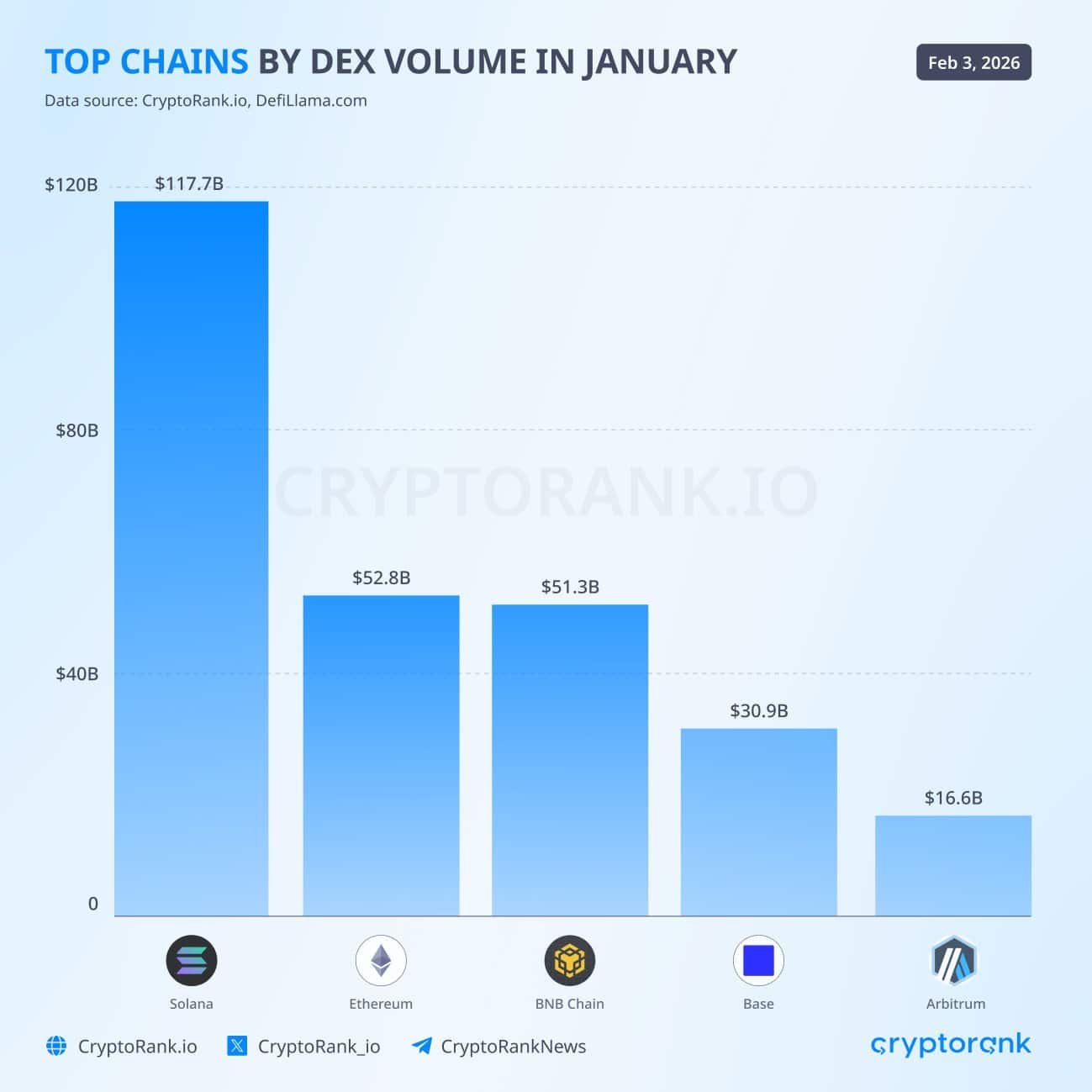
Recent data per CryptoRank showed that Solana has processed $117.7 billion in trades in January 2026.

Source: CryptoRank

That’s a 20% month-on-month increase, leaving Ethereum [ETH], BNB Chain [BNB], Base [BASE], and Arbitrum [ARB] far behind.

At its peak, Solana [SOL] accounted for nearly 35% of all on-chain DEX Volume.

Source: X

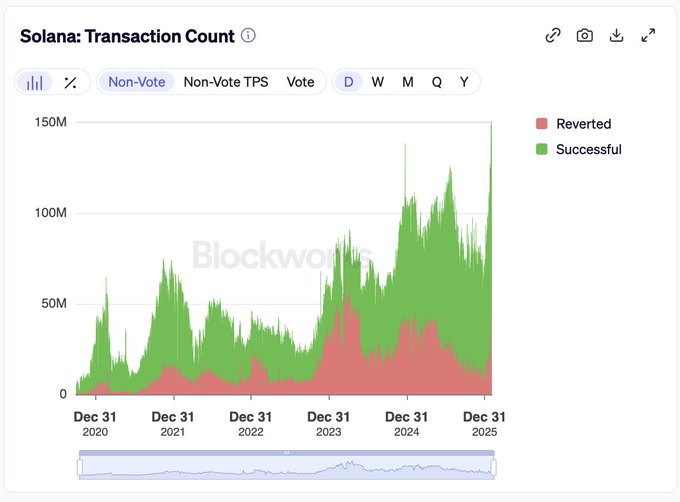
Meanwhile, Transaction Counts and overall network activity are at all-time highs, while the ratio of successful to reverted transactions improved meaningfully.

All these numbers, and yet…

…price has taken a good fall.

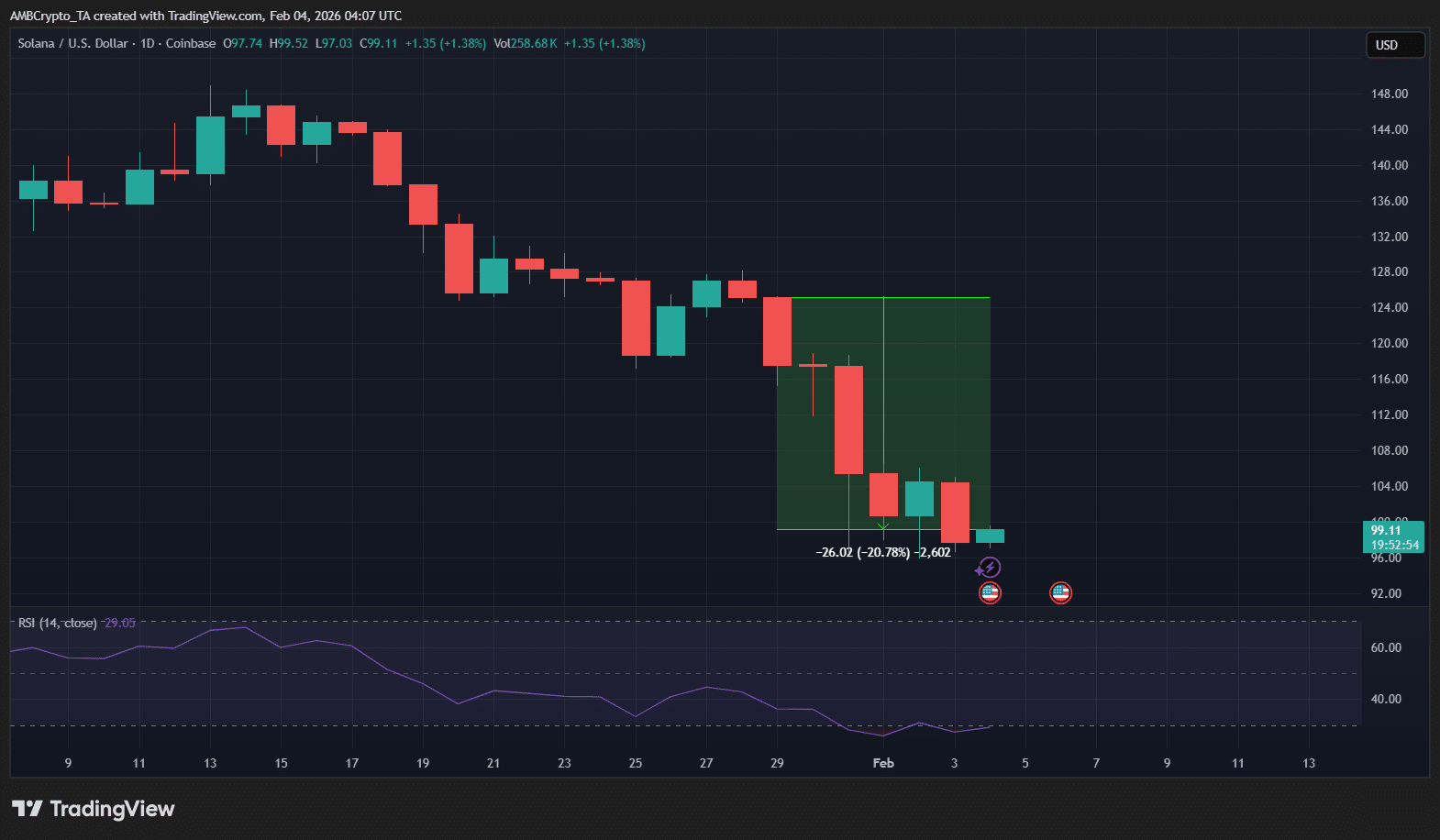
Over the past week, SOL dropped roughly 20%, retracing from the $120-125 range to trade near $100. The price dropped fast with big red candles – caused by the overall market weakness of the recent days, and NOT a loss of interest in Solana.

Source: TradingView

RSI indicated that selling pressure has been intense in a short span of time. In effect, SOL’s price has moved in the opposite direction from its on-chain growth.

The long game

That gap between activity and price is exactly where Standard Chartered sees Solana’s longer-term opportunity.

While the bank trimmed its near-term outlook for SOL from $310 to $250, it recently raised its forecasts further out.

They noted that the network is moving beyond meme coin-led trading cycles and that they will be dominant in stablecoin transfers and micropayments.

The forecasts state that SOL will reach $400 by the end of 2027, $700 by the end of 2028, and $1,200 by end-2029.

According to Geoff Kendrick, Global Head of Digital Assets Research, activity on Solana’s DEXs is moving toward SOL-stablecoin pairs, with stablecoins circulating far faster than on Ethereum.

That efficiency could unlock new use cases (particularly AI-driven micropayments), even if scale takes time to arrive.


Final Thoughts

  • Solana led January DEX volume, even as SOL fell 20%.
  • Standard Chartered’s long-term SOL target depends on stablecoins and micropayments.
Next: Stablecoin volume hit $10T in January – Here’s why it’s THE most bullish signal!
Share
  • Share
  • Tweet

Связанные с этим вопросы

QDespite leading in on-chain DEX volume in January, why did SOL's price drop by 20%?

ASOL's price dropped due to overall market weakness, not a loss of interest in Solana. The decline was characterized by big red candles and intense selling pressure in a short span, as indicated by RSI.

QWhat was Solana's ranking in DEX volume for January, and how much trade volume did it process?

ASolana was ranked No.1 in DEX volume for January, processing $117.7 billion in trades, which was a 20% month-on-month increase.

QWhat are Standard Chartered's long-term price forecasts for SOL, and what factors support these predictions?

AStandard Chartered forecasts SOL to reach $400 by end-2027, $700 by end-2028, and $1,200 by end-2029. The predictions are based on Solana's move beyond meme coin cycles, dominance in stablecoin transfers and micropayments, and faster stablecoin circulation efficiency compared to Ethereum.

QHow did Solana's network activity and transaction performance fare during this period?

ASolana's transaction counts and overall network activity reached all-time highs, with a meaningful improvement in the ratio of successful to reverted transactions.

QWhat new use cases does Standard Chartered believe Solana's efficiency could unlock?

AStandard Chartered believes Solana's efficiency, particularly in stablecoin circulation, could unlock new use cases such as AI-driven micropayments, even though scaling may take time.

Похожее

Uncovering the Truth About Agent Commerce, Payments, and Infrastructure

Decoding Agent Commerce, Payments, and Infrastructure: The Reality Over the past year, I've been building infrastructure for the Agent economy, engaging with major players like Stripe, Visa, Coinbase, Google, and dozens of startups. A clear conclusion emerges: true, large-scale demand does not yet exist. Startups face structural challenges. Data points illustrate this gap. Stripe's Agent commerce platform has over 1,000 merchants but only single-digit transacting agents. Visa's Agent payment token requires 9-month KYC and a $250M revenue threshold, accessible only to giants like Amazon. On-chain analysis reveals actual daily Agent transaction volume is around $17k, half of which are test transactions. The article analyzes four potential markets: **1. Agent-to-Merchant (A2M):** Current AI shopping UX is often inferior to traditional e-commerce for visual, comparison-heavy purchases (clothing, electronics). Chat interfaces are a step back. Real merchant interest is defensive "Agent Engine Optimization," fearing future obsolescence, not current demand. Potential exists in high-frequency, low-decision purchases (e.g., food delivery) or simplifying terrible UX (complex checkouts, non-native shoppers), but these require massive consumer distribution channels dominated by giants like DoorDash and Amazon. **2. Agent-to-API (A2A):** Developers already have subscriptions and billing for core APIs (compute, data). The argument for micro-payments via crypto for sub-dollar API calls is addressed by pre-paid balances today. The deeper issue is supplier resistance; major SaaS firms rely on enterprise contracts, not fractional cent pricing. Opportunity lies in the long tail of niche services, but this is a smaller market catering to developers, a historically low-paying group. **3. Agent-to-Agent (A2A):** This remains a theoretical long-term vision with near-zero current transaction volume. It involves unique challenges: discovery, trust, negotiation, dispute resolution. When it materializes, it will require a fundamentally new settlement infrastructure for high-speed, variable-value, multi-party transactions. It's a real long-term bet, but not the current market. **4. Agent-to-Finance (A2F):** This is the only category with existing, paying demand. Integrating AI into financial workflows (trading, portfolio management) is a natural evolution and enables new capabilities like autonomous rebalancing. However, competition favors incumbents with regulatory licenses, compliance infrastructure, and existing client relationships. **The Real Issue:** Why is infrastructure still being built? Incumbents can afford long-term bets, and payment companies see every problem as a nail for their payment hammer. However, payment is just one piece. The core challenge is *coordination*—orchestrating work between Agents and humans, verifying outcomes, and settling results. Payment is part of settlement, which is part of coordination. Companies that solve the coordination problem will subsume payments, not the other way around. Startups lack the infinite runway of giants and must find today's real market, which, after a year of exploration, lies outside these four categories—in an area with real, growing, and underserved activity.

marsbit4 ч. назад

Uncovering the Truth About Agent Commerce, Payments, and Infrastructure

marsbit4 ч. назад

Торговля

Спот
Фьючерсы

Популярные статьи

Обсуждения

Добро пожаловать в Сообщество HTX. Здесь вы сможете быть в курсе последних новостей о развитии платформы и получить доступ к профессиональной аналитической информации о рынке. Мнения пользователей о цене на SOL (SOL) представлены ниже.

活动图片