Solana Recovery Narrative Strengthens as RWA Market Hits $1.15B and Regulation Turns Positive

bitcoinistОпубликовано 2026-02-05Обновлено 2026-02-05

Введение

Solana's (SOL) recent price decline below $100 has not diminished its broader recovery narrative. Despite a 25% drop from recent highs, key support near $95–$100 is holding, with technical indicators suggesting potential for a rebound toward $150 or higher. On-chain fundamentals are strengthening, with Total Value Locked reaching a record 73.4 million SOL ($7.5 billion) and daily transactions exceeding 100 million. The real-world asset (RWA) market on Solana has grown to $1.15 billion, supported by its low-cost, high-throughput infrastructure. Standard Chartered adjusted its 2026 SOL price target to $250 but raised its 2030 forecast to $2,000, citing Solana's advantages in micropayments, stablecoin transfers, and improving regulatory clarity.

Solana’s (SOL) recent price weakness has not erased the broader recovery narrative forming around the network. While SOL continues to trade below the psychologically important $100 level after a sharp pullback from January highs, on-chain data and institutional forecasts suggest the blockchain’s long-term positioning is improving.

Related Reading: Elon Musk Revives ‘Dogecoin To The Moon’ With Hint For 2027

Growing real-world asset (RWA) activity, record network usage, and a more constructive regulatory backdrop are increasingly shaping analysts’ views of Solana’s next phase.

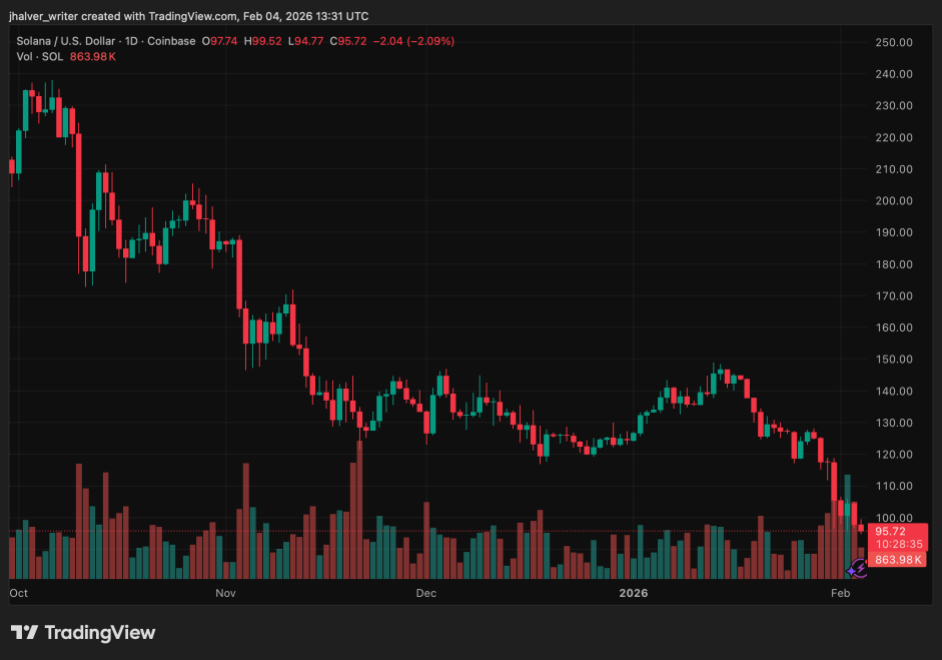
SOL's price trends to the downside on the daily chart. Source: SOLUSD on Tradingview

Price Pressure Persists, But Key Support Holds

SOL has fallen roughly 25% from recent highs near $127, slipping below $100 amid broader crypto market risk-off sentiment. Technical indicators still reflect caution, with bearish momentum dominating short-term charts and some analysts warning of a possible drop toward the $85 area if support near $95 fails.

That said, the $95–$100 zone has repeatedly acted as a major demand area in past market cycles. The daily relative strength index has dipped into oversold territory, a condition that has previously coincided with local bottoms for SOL.

Several technical analysts note that a sustained defense of this range could open the door to a recovery toward the $150 region, with more optimistic scenarios extending toward $215–$260 if resistance levels are reclaimed.

Network Activity And RWA Growth Support The Thesis

Despite price volatility, Solana’s on-chain fundamentals continue to strengthen. Total value locked recently reached an all-time high of 73.4 million SOL, equivalent to roughly $7.5 billion, marking an 18% weekly increase.

On the other hand, daily transactions have surged above 100 million, hitting multi-year highs, while decentralized exchange volumes are also at their strongest levels in months.

Beyond DeFi metrics, the real-world asset market on Solana has expanded rapidly, with tokenized RWAs on the network now estimated at around $1.15 billion. This growth aligns with Solana’s positioning as a low-cost, high-throughput settlement layer, particularly for stablecoins and tokenized financial products.

Faster, more stablecoin-friendly turnover and consistently low transaction fees have made the network increasingly attractive for high-volume use cases.

Standard Chartered Sees Long-Term Upside

Standard Chartered has reinforced this longer-term view, cutting its end-2026 SOL price target to $250 from $310 due to near-term volatility, while raising its 2030 forecast to $2,000.

The bank cited Solana’s dominance in micropayments, stablecoin transfers, and emerging real-world applications as key drivers behind its long-range projections.

According to the bank, Solana’s ability to process large transaction volumes at minimal cost gives it an advantage as regulation around digital assets becomes clearer and more supportive.

Related Reading: Ethereum Active Addresses Near All-Time High Despite Price Plunge

While short-term price action remains uncertain, the combination of rising network usage, expanding RWA activity, and improving regulatory clarity continues to underpin Solana’s recovery narrative.

Cover image from ChatGPT, SOLUSD chart on Tradingview

Связанные с этим вопросы

QWhat are the key factors supporting Solana's recovery narrative despite recent price weakness?

AThe key factors supporting Solana's recovery narrative are growing real-world asset (RWA) activity (now at $1.15B), record network usage (daily transactions above 100M), and a more constructive regulatory backdrop.

QWhat is Standard Chartered's long-term price forecast for SOL by the year 2030?

AStandard Chartered has raised its long-term price target for SOL to $2,000 by the year 2030.

QWhat technical price level is identified as a major demand area and crucial support for SOL?

AThe $95–$100 zone is identified as a major demand area that has acted as crucial support in past market cycles.

QWhat recent milestone did Solana's Total Value Locked (TVL) achieve?

ASolana's Total Value Locked (TVL) recently reached an all-time high of 73.4 million SOL, equivalent to roughly $7.5 billion.

QAccording to the bank, what are the key drivers behind Solana's long-range growth projections?

AAccording to Standard Chartered, the key drivers are Solana's dominance in micropayments, stablecoin transfers, and emerging real-world applications, enabled by its ability to process large transaction volumes at minimal cost.

Похожее

The AI Agent Era Accelerates Its Arrival: Questflow Defines a New Paradigm of Financial Intelligence with On-Chain AI Brokerage

The AI Agent era is accelerating, with the CB Insights AI 100 list highlighting global investment confidence. The focus has shifted from whether AI works to its speed of deployment and ability to manage complex workflows, with autonomous AI Agents driving this transformation. At the forefront is Questflow, a Singapore-based startup redefining financial intelligence through its on-chain AI brokerage. Unlike tools that merely provide data dashboards, Questflow deploys AI Agents that proactively scan markets, form judgments, and execute trades via a conversational interface—operating 24/7 without requiring manual confirmation for each decision. This embodies the new AI paradigm of agents capable of executing multi-step workflows autonomously. Questflow's mission is to democratize institutional-grade trading intelligence. Historically reserved for the ultra-wealthy, this capability is now accessible starting from just $1 through Questflow's "AI Clone + Copy Trade" model. The platform charges only a 1% execution fee, aligning its incentives directly with users and eliminating traditional management or performance fees. The timing is opportune, aligning with key trends identified by CB Insights: the scalable deployment of AI Agents, accelerated AI adoption in financial services, and the maturation of on-chain infrastructure. With robust liquidity on platforms like Hyperliquid and Polymarket, alongside advancements in AI reasoning and non-custodial wallet security, Questflow is positioned to merge the roles of broker, fund, and exchange into a single, accessible platform for millions.

链捕手15 мин. назад

The AI Agent Era Accelerates Its Arrival: Questflow Defines a New Paradigm of Financial Intelligence with On-Chain AI Brokerage

链捕手15 мин. назад

Why Pricing Social Interactions is Doomed to Fail?

Titled "Why Putting a Price on Social Interaction Is Doomed to Fail," this article critiques attempts to monetize social networks directly through SocialFi models, arguing their inevitable failure stems from a fundamental misunderstanding of media dynamics. Using Marshall McLuhan's theory of "hot" and "cold" media, the author posits that social networks are inherently "cold" media. Their value isn't contained in individual posts but is co-created through user participation, interpretation, and fragmented, ongoing interaction (e.g., replies, shares). This ambiguity and need for user involvement are core to their function. The article asserts that SocialFi projects like Friend.tech failed because introducing real-time, tradable financial pricing (a definitive "hot" signal) into this "cold" environment doesn't add a layer—it replaces the medium's essence. The unambiguous price signal overshadows and nullifies the nuanced, participatory social signal. Users become traders, not participants, and when speculative profits vanish, the underlying social ecosystem—never genuinely cultivated—collapses entirely. This principle extends beyond crypto. The author argues platforms like Twitter have gradually "heated up" through metrics (likes, retweets counts, algorithmically defined value), shifting users from participants to performers and eroding organic engagement. The solution isn't to abandon capital but to manage its entry point. Successful models like Substack, Patreon, or Bandcamp allow capital to "condense" at specific, isolated nodes (e.g., subscriptions, one-time payments) without permeating and "heating" every social interaction. They preserve the core "cold," participatory medium while enabling monetization at designated boundaries. The NFT boom and bust serves as a stark parallel: the ancient "cold" medium of collecting (valued for story, community, gradual accumulation) was rapidly destroyed by platforms that introduced real-time floor prices, rarity scores, and trading dashboards, transforming collectors into speculators and vaporizing cultural value when prices fell. The core lesson: "Liquidity equals heat." Injecting high liquidity and definitive pricing into a "cold" participatory medium doesn't optimize it; it fundamentally alters and destroys its value-creating mechanism. The future lies not in pricing every social gesture but in finding precise, non-invasive points for capital to condense without overheating the entire ecosystem.

marsbit23 мин. назад

Why Pricing Social Interactions is Doomed to Fail?

marsbit23 мин. назад

Jensen Huang's CMU Speech: In the AI Era, Don't Just Watch, Build

Jensen Huang, CEO of NVIDIA and a first-generation immigrant, delivered the commencement address to Carnegie Mellon University's class of 2026. He shared his personal journey from a humble background to founding NVIDIA, emphasizing resilience, learning from failure, and the responsibility that comes with leadership. Huang framed the present moment as the dawn of the AI revolution, a shift he believes is more profound than previous computing waves. He described AI as fundamentally resetting computing—moving from human-written software to machines that understand, reason, and use tools. This will create a new industry for generating intelligence and transform every sector. While acknowledging AI's potential to automate tasks and displace some jobs, Huang distinguished between the *tasks* of a job and its core *purpose*. He argued AI will augment human capability, not replace humans. The real risk, he stated, is not AI itself, but people being left behind by those who effectively use AI. He presented AI as a generational opportunity for massive infrastructure investment—in chip factories, data centers, energy grids, and advanced manufacturing—that could re-industrialize nations like the U.S. and bridge the digital divide by making computing and intelligent tools accessible to all. Huang called for a balanced approach: advancing AI safely and responsibly, establishing prudent policies, ensuring broad access, and encouraging universal participation. He urged the graduates not to fear the future but to engage with optimism and ambition, reminding them of CMU's motto, "My heart is in the work." His core message was clear: this is their moment to actively build and shape the AI-powered future, not merely observe it.

marsbit1 ч. назад

Jensen Huang's CMU Speech: In the AI Era, Don't Just Watch, Build

marsbit1 ч. назад

Торговля

Спот
Фьючерсы

Популярные статьи

Обсуждения

Добро пожаловать в Сообщество HTX. Здесь вы сможете быть в курсе последних новостей о развитии платформы и получить доступ к профессиональной аналитической информации о рынке. Мнения пользователей о цене на SOL (SOL) представлены ниже.

活动图片