Solana Labs CEO Says Ethereum-Style ‘Walkaway’ Thinking Is a Death Wish

bitcoinistОпубликовано 2026-01-19Обновлено 2026-01-19

Введение

Solana Labs CEO Anatoly Yakovenko disagrees with Ethereum co-founder Vitalik Buterin's call for Ethereum to "ossify," arguing that continuous protocol iteration is essential for Solana's survival. Buterin had stated that Ethereum should reach a state where it remains functional even without ongoing updates, passing what he calls the "walkaway test." In contrast, Yakovenko believes that stopping innovation would cause Solana to lose relevance. He emphasizes that the network must constantly adapt to developer and user needs to avoid stagnation, though upgrades shouldn't rely on any single entity. Both share skepticism toward central dependency but differ on long-term upgrade philosophy.

Over the weekend, Solana Labs CEO Anatoly Yakovenko pushed back on Vitalik Buterin’s latest case for Ethereum “ossification,” arguing that for Solana, continuous protocol iteration is not optional, it is survival.

The exchange was sparked by a Jan. 12 post in which Buterin said “Ethereum itself must pass the walkaway test,” framing Ethereum as a base layer that should remain usable even if the community largely stops making substantive protocol changes.

“It must support applications that are more like tools [...] than like services that lose all functionality once the vendor loses interest in maintaining them,” Buterin wrote. “But building such applications is not possible on a base layer which itself depends on ongoing updates from a vendor in order to continue being usable [...] Hence, Ethereum itself must pass the walkaway test.”

Why Solana Can’t Afford To Ossify

Yakovenko replied that he “actually think[s] fairly differently on this,” laying out a philosophy that treats adaptability as core to Solana’s value proposition. “Solana needs to never stop iterating,” he wrote. “It shouldn’t depend on any single group or individual to do so, but if it ever stops changing to fit the needs of its devs and users, it will die.” In Yakovenko’s framing, the risk is not merely technical stagnation; it is a network losing relevance to the people building and transacting on it.

Buterin’s “walkaway test” rests on the idea that Ethereum should reach a point where its usefulness does not “strictly depend on any features that are not in the protocol already,” even if the ecosystem continues improving via client optimizations and limited parameter changes. He also sketched a set of medium-term protocol objectives, ranging from quantum resistance and scalable architecture to long-lived state design and decentralization safeguards, aimed at making Ethereum robust “for decades” and reducing the need for frequent disruptive upgrades.

Yakovenko’s critique is less about those specific goals than the premise that a base layer should aspire to being able to “ossify if we want to.” In his view, ossification is not a neutral milestone; it risks locking in a protocol that can’t keep pace with developer and user demands. “To not die requires to always be useful,” he wrote. “So the primary goal of protocol changes should be to solve a dev or user problem.” At the same time, he emphasized prioritization over maximalism: “That doesn’t mean solve every problem, in fact, saying no to most problems is necessary.”

A key overlap in both positions is a skepticism toward dependence on a single “vendor,” though they operationalize it differently. Buterin wants Ethereum’s base layer to become sufficiently complete that it can remain dependable even if the upgrade cadence slows dramatically. Yakovenko, by contrast, argues that Solana should assume upgrades will keep coming, but not necessarily from any one core team.

“You should always count on there being a next version of solana, just not necessarily from Anza or Labs or fd,” he wrote, referencing major entities in Solana’s development orbit. He then pointed to a future where governance and funding mechanisms could directly underwrite that work, suggesting “we are likely to end up in a world where a SIMD vote pays for the GPUs that write the code,” a nod to both on-chain coordination and the growing role of AI-assisted development.

At press time, SOL traded at $133.84.
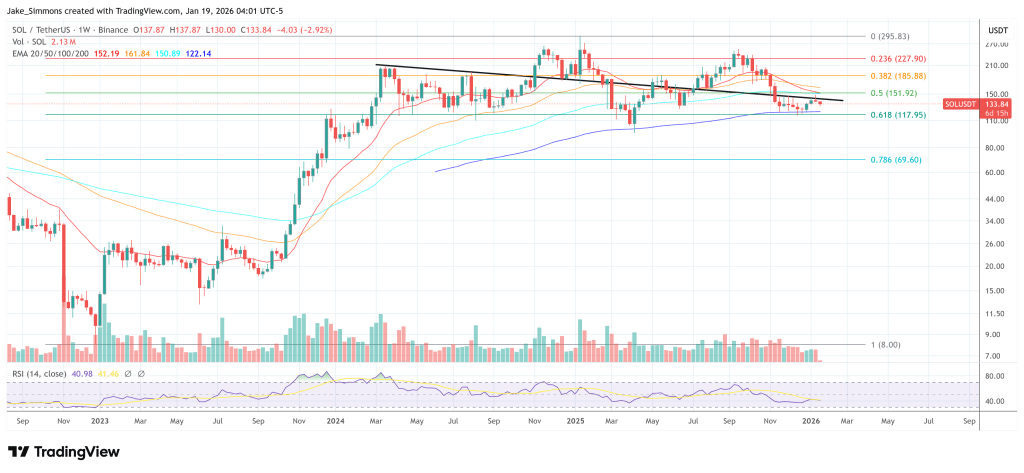
SOL remains below the black trendline, 1-week chart | Source: SOLUSDT on TradingView.com

Связанные с этим вопросы

QWhat is the core disagreement between Solana Labs CEO Anatoly Yakovenko and Ethereum's Vitalik Buterin regarding blockchain development?

AAnatoly Yakovenko believes continuous protocol iteration is essential for survival and relevance, arguing that a blockchain must constantly adapt to developer and user needs. In contrast, Vitalik Buterin advocates for Ethereum's 'ossification,' where the base layer becomes so complete and stable that it remains usable even if major protocol updates cease.

QAccording to Vitalik Buterin, what is the 'walkaway test' and why is it important for Ethereum?

AButerin's 'walkaway test' is the idea that Ethereum's base layer should reach a state where its usefulness does not depend on ongoing updates or features not already in the protocol. It is important because it ensures applications built on Ethereum remain functional like tools, not services that fail if the vendor stops maintaining them, making the network robust for decades.

QWhy does Anatoly Yakovenko argue that Solana 'needs to never stop iterating'?

AYakovenko argues that if Solana ever stops changing to fit the needs of its developers and users, it will die. He views continuous adaptation as core to its survival and value proposition, preventing technical stagnation and loss of relevance, rather than seeing ossification as a neutral or positive milestone.

QHow do Buterin and Yakovenko differ in their views on dependence on a single 'vendor' or development team?

ABoth express skepticism toward dependence on a single vendor, but operationalize it differently. Buterin wants Ethereum's base layer to become complete enough to be dependable with minimal upgrade cadence. Yakovenko agrees upgrades shouldn't depend on one team, but assumes upgrades will keep coming from a decentralized set of contributors, not necessarily a core entity like Anza or Solana Labs.

QWhat future development mechanism does Yakovenko hint at for sustaining Solana's iteration?

AYakovenko hints at a future where on-chain governance and funding mechanisms, such as a SIMD (Solana Improvement Document) vote, could directly pay for development work, potentially even utilizing AI-assisted coding, ensuring continuous innovation without reliance on a single central team.

Похожее

You Bet on the News, the Pros Read the Rules: The True Cognitive Gap in Losing Money on Polymarket

The article explains that the key to profiting on Polymarket, a prediction market platform, lies not just predicting real-world events correctly, but in meticulously understanding the specific rules that govern how each market will be resolved. It illustrates this with examples, such as a market on Venezuela's 2026 leader, where the official rules defining "officially holds" the office overruled the intuitive answer of who was in practical control. Other examples include debates over the definition of a "token" or what constitutes an "agreement." The core argument is that a "reality vs. rules" gap creates pricing discrepancies that savvy traders ("车头" or "whales") exploit. The platform has a formal dispute resolution process managed by UMA token holders to settle ambiguous outcomes. This process involves proposal submission, a challenge window, a discussion period, and a final vote. However, the article highlights a critical flaw in this system compared to a traditional court: the lack of separation between the arbiters (UMA voters) and the interested parties (traders with financial stakes in the outcome). This conflict of interest undermines the discussion phase, leads to herd mentality, and results in opaque final decisions without explanatory rulings. Consequently, the system lacks a body of precedent, making it difficult for users to learn from past disputes. The ultimate takeaway is that success on Polymarket requires a lawyer-like scrutiny of the rules to identify and capitalize on the cognitive gap between how events appear and how they are contractually defined for settlement.

marsbit14 мин. назад

You Bet on the News, the Pros Read the Rules: The True Cognitive Gap in Losing Money on Polymarket

marsbit14 мин. назад

Will the Fed Still Cut Interest Rates? Tonight's Data Is Crucial

The core debate surrounding the Federal Reserve's potential interest rate cuts is intensifying amid geopolitical conflict and rebounding inflation. The key question is whether high energy prices will cause persistent inflation or weaken consumer demand enough to force the Fed to cut rates. Citigroup presents a bullish case for cuts, arguing that oil supply disruptions from the Strait of Hormuz are temporary and will not lead to lasting inflationary pressure. They point to receding bond yields and oil prices as evidence the market is pricing in a short-lived shock. Citi's data also shows tightening financial conditions, a stabilizing labor market, and healthy tax returns, supporting their view that the path to lower rates remains open. Conversely, Deutsche Bank offers a starkly contrasting, more hawkish outlook. They argue the Fed's current policy is already neutral and expect rates to remain unchanged indefinitely. Their view is based on stalled disinflation progress and a shift toward more hawkish rhetoric from key Fed officials like Waller, who cited risks from prolonged Middle East conflict and tariffs. Other officials, including Williams and Hammack, signaled rates would likely stay on hold for a "considerable time." The market pricing has shifted dramatically, now forecasting zero cuts in 2026. The imminent release of the March retail sales "control group" data is highlighted as a critical test. This metric, which excludes gas station sales, will reveal if high gasoline prices are eroding consumer spending in other areas. A weak reading could support the case for imminent rate cuts, while a strong one would bolster the argument for the Fed to hold steady. This data is pivotal for determining the near-term policy path.

marsbit34 мин. назад

Will the Fed Still Cut Interest Rates? Tonight's Data Is Crucial

marsbit34 мин. назад

The Second Half of Macro Influencer Fu Peng's Career

Fu Peng, a prominent Chinese macroeconomist and former chief economist of Northeast Securities, has joined Hong Kong-based digital asset management firm Bitfire Group (formerly New Huo Group) as its chief economist. This move, announced in April 2026, triggered an 11% surge in Bitfire's stock price. Fu, known for his accessible macroeconomic commentary and large social media following, will focus on integrating digital assets into global asset allocation frameworks, particularly combining FICC (fixed income, currencies, and commodities) with cryptocurrencies for institutional clients. His career includes roles at Lehman Brothers and Solomon International, with significant influence gained through public communication. However, in late 2024, Fu faced temporary social media bans after a controversial private speech at HSBC on China's economic challenges, though he denied regulatory sanctions. He later left Northeast Securities citing health reasons. Bitfire, a licensed virtual asset manager serving high-net-worth clients, seeks to build trust and attract traditional capital through Fu’s expertise and credibility. The partnership represents a strategic shift for both: Fu enters the crypto sector after a traditional finance peak, while Bitfire aims to leverage his macro framework for institutional adoption. Outcomes remain uncertain regarding capital inflows and compatibility within corporate structure.

marsbit1 ч. назад

The Second Half of Macro Influencer Fu Peng's Career

marsbit1 ч. назад

Торговля

Спот
Фьючерсы

Популярные статьи

Manyu: восходящая мем-звезда на Ethereum, готовая открыть новую эру культуры Shiba

Manyu - это мемтокен на Ethereum, который приносит децентрализованную культурную и развлекательную ценность через вирусное влияние в соцсетях и вовлечённость сообщества.

1.9k просмотров всегоОпубликовано 2025.11.27Обновлено 2025.11.27

Manyu: восходящая мем-звезда на Ethereum, готовая открыть новую эру культуры Shiba

Обсуждения

Добро пожаловать в Сообщество HTX. Здесь вы сможете быть в курсе последних новостей о развитии платформы и получить доступ к профессиональной аналитической информации о рынке. Мнения пользователей о цене на ETH (ETH) представлены ниже.

活动图片