Solana AI token Ava hit by launch sniping tied to deployer: Bubblemaps

cointelegraphОпубликовано 2025-12-19Обновлено 2025-12-19

Введение

Blockchain analytics firm Bubblemaps reported that 23 wallets linked to the deployer of the Solana-based AI token Ava accumulated around 40% of the token’s supply at launch, indicating potential insider coordination. These wallets, funded via Binance and Bitget in a short timeframe, showed no prior blockchain activity before purchasing AVA. The activity, described as "sniping," involved coordinated buying at launch, leading to significant supply concentration—a red flag for potential market manipulation like rug pulls. Since its November 2024 launch, AVA’s price has fallen 79%, and it is down 96% from its January 2025 all-time high of $0.33.

Blockchain analytics firm Bubblemaps said a cluster of 23 wallets linked to the deployer of the Solana-based AI token Ava accumulated around 40% of the token’s supply at launch, raising new questions about insider coordination around the project’s debut.

The sybil wallet cluster related to the deployer shared similar patterns, including being funded in a tight time window through Bitget and Binance, receiving similar amounts of Solana (SOL) and having no blockchain activity before buying up the Ava AI (AVA) token supply at launch, Bubblemaps claimed in a Thursday X post.

“Connected to these snipers are other wallets that also bought $AVA early. Similar funding sources, sizes, and timing strongly suggest coordination across these clusters,” they said.

In crypto slang, sniping refers to employing crypto trading bots to automatically purchase new token supply as soon as the tokens become publicly available, aiming to buy at lower prices before the general public.

While the token was launched on memecoin launch platform Pump.fun, aiming for a decentralized, community-driven debut, the wallet cluster’s activity suggests acquisitions that led to a single entity holding 40% of the token’s supply.
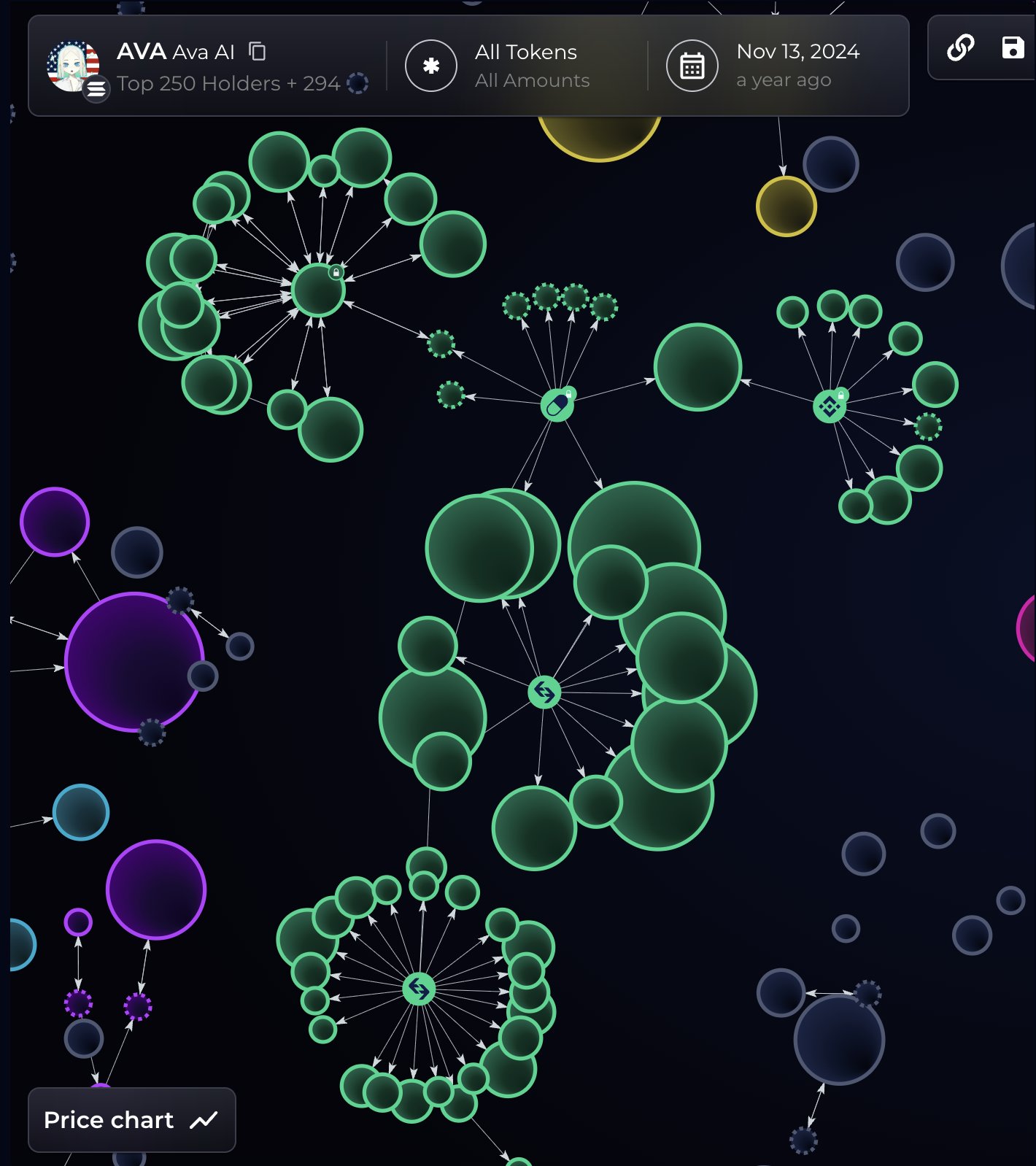
Source: Bubblemaps

Related: Crypto nears its ‘Netscape moment’ as industry approaches inflection point

A large token supply concentrated across a few wallets can help investors detect scams such as rug pulls, where insiders remove liquidity or stage a mass sell-off, resulting in a steep price collapse that leaves investors with worthless tokens.

The coordinated activity was uncovered through Bubblemaps’ Time Travel feature, a forensic-grade analytics tool launched in May that enables Web3 users to reconstruct the historical distribution of tokens, aiming to detect early insider activity.

Related: Bubblemaps challenges PEPE’s fair launch, alleges 30% of genesis supply bundled

AVA AI token falls 96% from all-time high

The coordinated buying activity was revealed over a year after the AVA token’s launch on Nov. 13, 2024. The token reached a fully diluted valuation (FDV) of $300 million by January 2025, making it a popular autonomous AI agent utility token native to Solana.

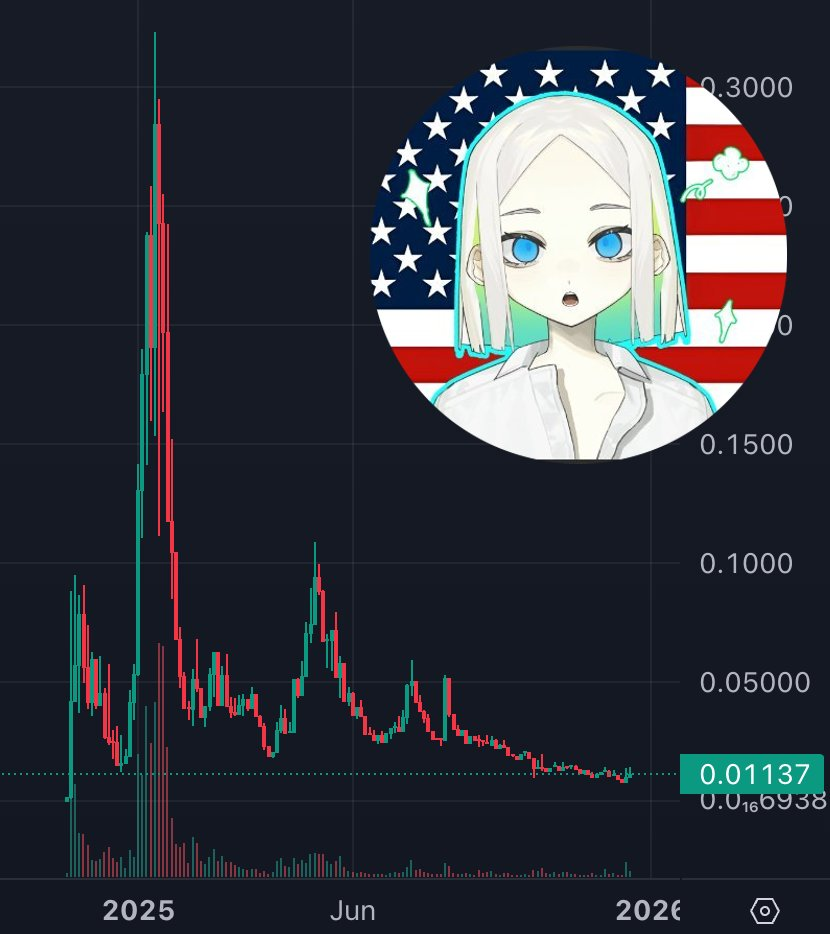
The AVA token is down over 79% since launch and over 96% from its all-time high of $0.33 breached on Jan. 15, 2025, CoinGecko data shows.

Source: Bubblemaps

Ava, also known as “the HOLO AI intern,” was the first AI agent built on the decentralized AI launchpad Holoworld AI. The platform allows users to create, play, or raise funds for agentic AI applications.

Holoworld claims to have over 1 million users and 700,000 AI “creations” to date.

Cointelegraph has approached Holoworld for comment on the sybil wallet cluster’s activity during the token launch.

Magazine: Memecoin degeneracy is funding groundbreaking anti-aging research

Связанные с этим вопросы

QWhat did blockchain analytics firm Bubblemaps discover about the Solana-based AI token Ava's launch?

ABubblemaps discovered that a cluster of 23 wallets linked to the token's deployer accumulated around 40% of the token's supply at launch, indicating potential insider coordination.

QWhat are the common patterns identified in the sybil wallet cluster related to the AVA token deployer?

AThe wallets were funded in a tight time window through Bitget and Binance, received similar amounts of Solana (SOL), and had no prior blockchain activity before buying the AVA tokens.

QWhat is 'sniping' in the context of crypto token launches?

ASniping refers to using crypto trading bots to automatically purchase a new token supply as soon as it becomes available, aiming to buy at lower prices before the general public.

QHow much has the AVA token fallen from its all-time high, according to CoinGecko data?

AThe AVA token is down over 96% from its all-time high of $0.33, which was reached on January 15, 2025.

QWhat is the potential risk associated with a large token supply being concentrated in a few wallets?

AIt can indicate potential scams like rug pulls, where insiders remove liquidity or stage a mass sell-off, causing a steep price collapse and leaving investors with worthless tokens.

Похожее

The 'VVV' Concept Soars 9x in Half a Year, The New AI Narrative on Base Chain

"The article explores the 'VVV' concept as the new AI-focused narrative within the Base ecosystem, centered around the token $VVV of the privacy-focused, uncensored generative AI platform Venice, led by crypto veteran Erik Voorhees. Venice has seen significant growth in 2026, with its API users surging, partly attributed to exposure from OpenClaw. The platform now boasts over 2 million total users and 55,000 paid subscribers. Correspondingly, the $VVV token price has risen over 9x this year. Key to its performance are tokenomics designed for value accrual: reduced annual emissions, subscription revenue used for buyback-and-burn, and a unique staking mechanism. Staking $VVV yields $sVVV, which can be used to mint $DIEM tokens. Each staked $DIEM provides a daily $1 credit for using Venice's API services, creating tangible utility. The article also highlights other tokens associated with the 'VVV' narrative. $POD, the token of distributed AI network Dolphin (which co-developed Venice's default AI model), saw a massive price surge. $cyb3rwr3n, a project for a Venice credit auction market, gained attention due to perceived connections to Venice's team despite official denials. Finally, $SR of robotics platform STRIKEROBOT.AI rose after announcing a partnership with Venice for robot vision-language model development. Overall, the 'VVV' ecosystem combines AI platform growth, deflationary tokenomics, and innovative utility mechanisms, driving significant investor interest and price action in related tokens."

marsbit8 мин. назад

The 'VVV' Concept Soars 9x in Half a Year, The New AI Narrative on Base Chain

marsbit8 мин. назад

Anthropic and OpenAI Have Single-Handedly Severed the Logic of Pre-IPO Stock Tokenization

The pre-IPO stock token market is experiencing significant turmoil following strong statements from AI giants Anthropic and OpenAI. Both companies have updated their official policies, declaring that any transfer of their company shares—including sales, transfers, or assignments of share interests—without prior board approval is "invalid" and will not be recognized in their corporate records. This means buyers in such unauthorized transactions would not be recognized as shareholders and would have no shareholder rights. A major point of contention is the use of Special Purpose Vehicles (SPVs), which are legal entities commonly used by pre-IPO token platforms to pool investor funds and indirectly acquire shares from employees or early investors. The companies explicitly state they do not permit SPVs to acquire their shares, and any such transfer violates their restrictions. They warn that third parties selling shares through SPVs, direct sales, forward contracts, or stock tokens are likely engaged in fraud or are offering worthless investments due to these transfer limits. This stance directly threatens the core model of many pre-IPO token platforms, which rely on SPV structures. The announcement revealed additional risks within this model, such as complex "SPV-within-SPV" layering that obscures legal transparency, increases management fees, and creates a chain reaction risk of invalidation. Following the news, tokens like ANTHROPIC and OPENAI on platforms like PreStocks fell sharply (over 20%). The market reaction highlights a divergence: while asset-backed pre-IPO tokens plummeted, purely speculative pre-IPO futures contracts, which are bilateral bets on future IPO prices with no claim to actual shares, remained relatively stable as they are unaffected by the transfer restrictions. The industry is split on the implications. Some believe the fundamental logic of pre-IPO token trading is broken if leading companies reject SPV-held shares, potentially causing a domino effect. Others, like Rivet founder Nick Abouzeid, argue that buyers of such unofficial tokens always knowingly accepted the risk of non-recognition by the company. The statements serve as a stark risk warning and a corrective measure for a market where valuations for some AI-related pre-IPO tokens had soared to irrational levels, far exceeding recent funding round valuations.

marsbit1 ч. назад

Anthropic and OpenAI Have Single-Handedly Severed the Logic of Pre-IPO Stock Tokenization

marsbit1 ч. назад

Anthropic and OpenAI Personally Sever the Logic of Pre-IPO Crypto-Stocks

The pre-IPO token market has been rocked by strong statements from Anthropic and OpenAI. Both AI giants have updated official warnings, declaring that any sale or transfer of their company shares without explicit board approval is "invalid" and will not be recognized on their corporate records. This directly targets Special Purpose Vehicles (SPVs), the common legal structure used by pre-IPO token platforms. These platforms typically use an SPV to acquire shares from employees or early investors, then issue blockchain-based tokens representing a claim on the SPV's economic benefits. Anthropic and OpenAI's position means that if an SPV's share purchase lacked authorization, the underlying asset could be deemed worthless, nullifying the token's value. Anthropic explicitly warned that any third party selling its shares—via direct sales, forwards, or tokens—is likely fraudulent or offering a valueless investment. The crackdown highlights risks in the popular SPV model, including complex multi-layered "Russian doll" SPV structures that obscure legal ownership, add fees, and concentrate risk. If one layer is invalidated, the entire chain could collapse. Following the announcements, tokens like ANTHROPIC and OPENAI on platforms like PreStocks fell sharply (over 20%). In contrast, purely speculative pre-IPO prediction contracts remained stable, as they involve no actual share ownership. The move is seen as a corrective measure amid a market frenzy where some pre-IPO token valuations (e.g., Anthropic's token hitting a $1.4 trillion implied valuation) far exceeded recent official funding rounds. Opinions are split: some believe this undermines the core logic of pre-IPO token trading if top companies reject SPVs, while others argue buyers always assumed this legal risk when accessing unofficial channels. The statements serve as a stark warning and a potential catalyst for market de-leveraging and clearer boundaries.

Odaily星球日报1 ч. назад

Anthropic and OpenAI Personally Sever the Logic of Pre-IPO Crypto-Stocks

Odaily星球日报1 ч. назад

The Waged Worker Driven to Poverty by AI Subscriptions

"AI Membership: The Hidden Cost Pushing Workers Toward 'Poverty'" The widespread corporate push for AI adoption is creating a hidden financial burden for employees. Companies, from giants like Alibaba to small firms, are mandating AI use, often tying token consumption to KPIs, but frequently refuse to cover the costs. Workers are forced to pay for subscriptions out of pocket to stay competitive and avoid being replaced. Front-end developer Long Shen spends up to 2000 RMB monthly on tools like Cursor and ChatGPT Plus, seeing it as a necessary 3% salary investment to handle 90% of his coding tasks. While it boosted his performance and led to promotions, he now faces idle time at work, pretending to be busy. Designer Peng Peng navigates strict company firewalls by using personal devices and accounts for AI image generation tools like Midjourney, spending hundreds monthly without reimbursement, while her boss demands faster, more numerous revisions. The pressure creates workplace anxiety and suspicion. Programmer Li Huahua, after a friend's experience of raised KPIs following AI success, fears being branded a "traitor" for using it yet worries about falling behind if she doesn't. The dynamic allows management to demand results without understanding the tools or covering expenses, treating employees like AI "agents." While some, like entrepreneur Jin Tu, find high value in paid AI, building entire systems and winning competitions, for most, it's a trap. Free tools like Kimi and Doubao are introducing fees, closing off alternatives. The initial efficiency gains individual advantage, but as AI becomes ubiquitous, the personal edge disappears, workloads increase, and a cycle of dependency begins. Workers like Long Shen realize they cannot maintain AI-generated code without AI, making stopping harder than continuing to pay. The tool promising liberation is instead becoming a compulsory, costly chain in the modern workplace.

marsbit2 ч. назад

The Waged Worker Driven to Poverty by AI Subscriptions

marsbit2 ч. назад

Торговля

Спот
Фьючерсы

Популярные статьи

Неделя обучения по популярным токенам (2): 2026 может стать годом приложений реального времени, сектор AI продолжает оставаться в тренде

2025 год — год институциональных инвесторов, в будущем он будет доминировать в приложениях реального времени.

1.8k просмотров всегоОпубликовано 2025.12.16Обновлено 2025.12.16

Неделя обучения по популярным токенам (2): 2026 может стать годом приложений реального времени, сектор AI продолжает оставаться в тренде

Обсуждения

Добро пожаловать в Сообщество HTX. Здесь вы сможете быть в курсе последних новостей о развитии платформы и получить доступ к профессиональной аналитической информации о рынке. Мнения пользователей о цене на AI (AI) представлены ниже.

活动图片