SociFi Dream Shattered? Farcaster Pivots to Bet on Wallet Track

marsbitОпубликовано 2025-12-09Обновлено 2025-12-09

Введение

Farcaster, a decentralized social network protocol, has announced a major strategic shift after 4.5 years, abandoning its "social-first" approach to adopt a "wallet-first" growth model. Co-founder Dan Romero acknowledged that despite initial success—such as a surge to 100,000 daily active users (DAU) in early 2024 driven by features like Frames and the DEGEN airdrop—user engagement and revenue sharply declined later that year. By October 2025, monthly revenue had dropped 99% from its peak. The platform will now prioritize building a high-quality wallet within its official app, Warpcast, focusing on the intersection of wallets and social interaction. The new user journey emphasizes wallet funding and utility as key activation points. Farcaster is also enhancing its financial infrastructure through the acquisition of token launch platform Clanker and offering incentives like a 10% reward on USDC deposits. Frames, interactive mini-apps within the social feed, enable "content as transaction" capabilities, allowing users to mint, trade, and pay directly in their feeds. Despite raising $150 million in a 2024 Series A round at a $1 billion valuation, the move has drawn criticism. Some argue it signals the end of the SocialFi dream and a return to a transaction-focused model reminiscent of the 2017 ICO era. Others note challenges in a competitive wallet market and potential feature bloat. Farcaster remains an open protocol, and users can choose alternative clients, but the shift ...

Author:zhou, ChainCatcher

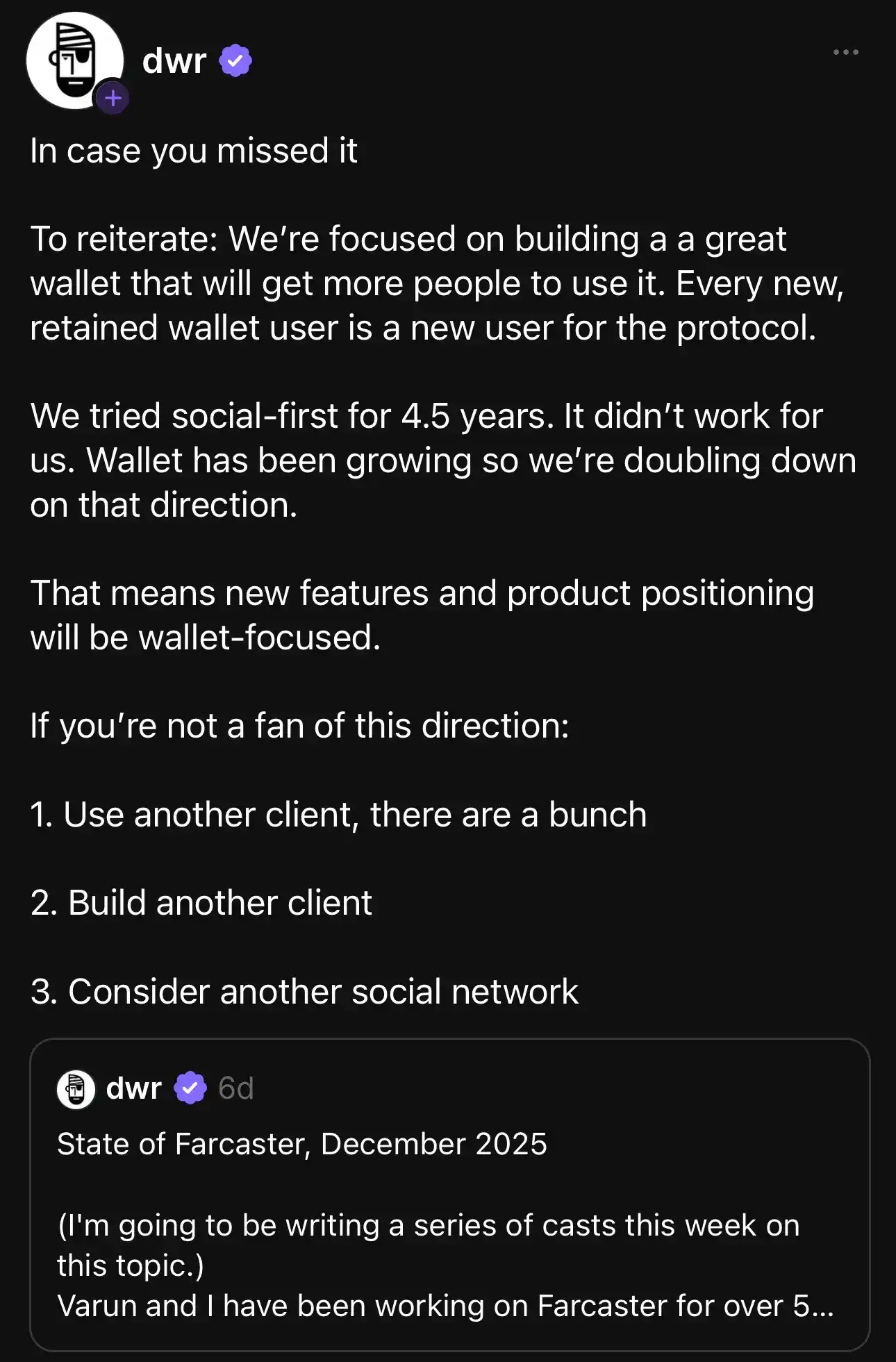
Farcaster co-founder Dan Romero(dwr) recently announced that the platform will undergo a major strategic adjustment, officially abandoning the "social-first" path it has adhered to for the past 4.5 years and instead embracing a growth model driven by "wallet-core".

It is reported thatFarcaster was initially positioned as a decentralized social network where developers could build novel social networks. It is an open protocol that can support many clients, just like email. Users will always be free to move their social identities between applications, and developers will always be free to build applications with new features on the network.

Dan Romero stated that under the social-first strategy, the platform released a fully functional version of the protocol, which is sufficiently decentralized and allows multiple independent teams to build and integrate on it. However, data proved that despite tremendous efforts, the social-first strategy ultimately proved unsustainable.

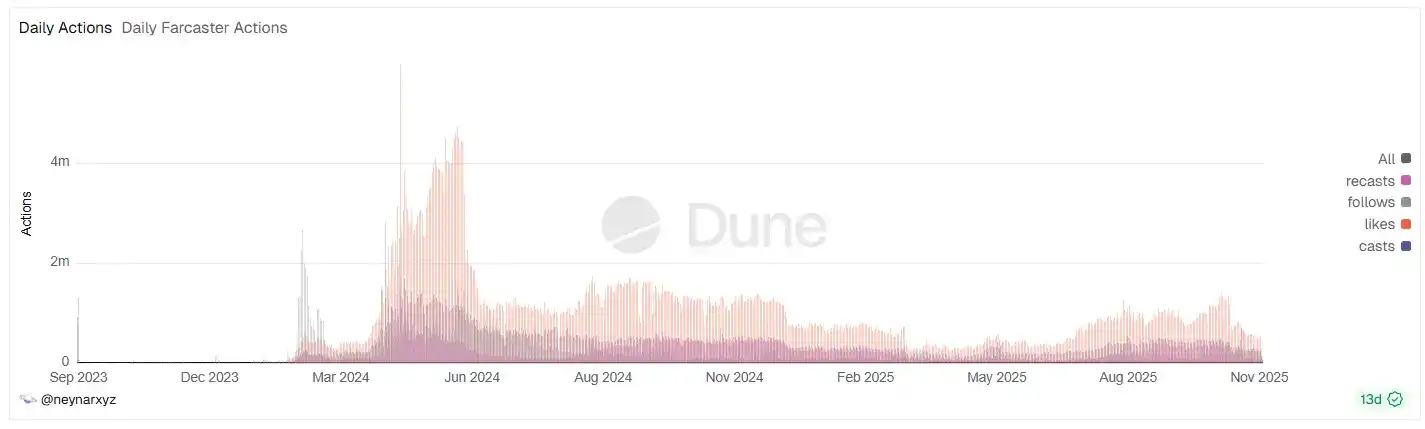
In early 2024, boosted by the Frames feature and the DEGEN airdrop, daily active users (DAU) surged from around 2000 to 100,000, and registered users exceeded 350,000, with a monthly growth rate once exceeding 400%.

However, the peak lasted less than three months. Starting from September 2024, the data plummeted:DAU fell back to around 60,000, monthly active users decreased by 40% month-on-month, and daily new user registrations dropped from a peak of 15,000 to just a few hundred.

Entering 2025, the situation continued to deteriorate. Social-side daily activity once dropped by nearly 40%. It wasn't until October, when the USDC deposit 10% reward activity was launched, that the overall daily activity was pulled back to the range of 50,000 to 60,000 by relying on wallet functions.

At the same time, the protocol's revenue also plummeted: by October 2025, monthly revenue fell to about $10,000, the lowest level in four months, a drop of about 99% from the peak.

Facing this harsh reality,Dan Romero admitted that it has always failed to find a sustainable growth mechanism for a Twitter-like social network.

Therefore,Farcaster's decision to pivot this time is a pragmatic choice, no longer pursuing a pure social narrative but instead betting resources on the rapidly growing wallet function: use the tool (wallet) first, then build the network (protocol).

The team observed that the wallet function launched earlier this year in the App expanded rapidly and is the module that has come closest to product-market fit in their five years. The new user flow has been redesigned: user registration - wallet top-up - using the wallet, with wallet top-up and tool usage as activation points.

Dan Romero concluded that every new, retained wallet user is a new user for the protocol. As users commented,SocialFi is a combination of Social and Finance, and combining it with a wallet is the real beginning.

At the product level, the core goal ofFarcaster's official application Warpcast has shifted to building an excellent wallet, focusing on expanding the intersection capabilities of wallet and social.DWR believes that adding a wallet to a social network is easier than adding a social network to a wallet. This integration is achieved through Farcaster Mini App, which are lightweight Web applications based on the Farcaster protocol and can be seamlessly integrated into clients like Warpcast.

At the same time,Farcaster is also actively deploying financial infrastructure:

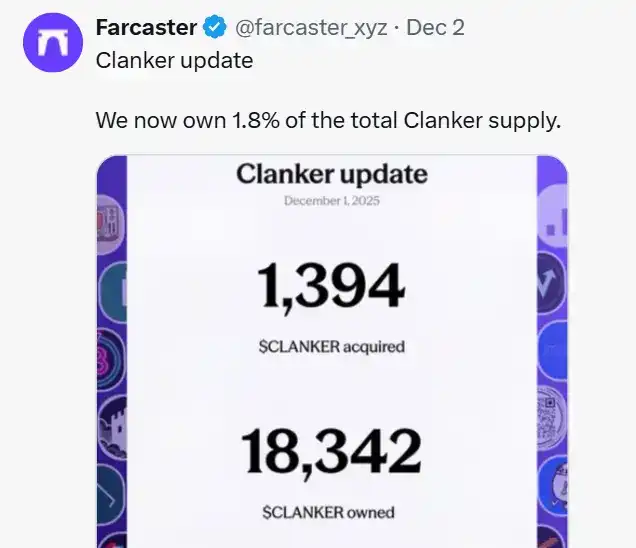
  • Asset Issuance: By acquiring the token issuance platform Clanker,Farcaster has equipped its wallet-core strategy with asset issuance capabilities and now holds 1.8% of Clanker's total supply.
  • Financial Incentives: In October, launched the USDC deposit activity offering an additional 10% reward, directly accelerating the conversion of users into on-chain asset holders through financial incentives.

At the content level,Frames(interactive mini-apps) are the form in which Mini App is displayed in the information flow and are the key hub for realizing the mechanism of"content as transaction". Users can directly complete financial behaviors such as minting, trading, and payment within the information flow. Each interaction directly drives the use of the built-in wallet. This model transforms Farcaster from an information consumption field into a value circulation field, accelerating the financialization process of the ecosystem.

Of course, this strategic pivot is based on Farcaster's strong resource foundation and elite team background. The platform has gained favor from top institutions including Paradigm,a16z, andUnion Square Ventures. In the 2024 Series A funding round, it raised $150 million at a valuation of $1 billion. In terms of the team, co-founders Dan Romero(former VP of Operations at Coinbase) and Varun Srinivasan, as well as developer ecosystem lead Linda Xie(early employee of Coinbase) and other core members, have deep Coinbase backgrounds. Meanwhile,Coinbase Ventures also participated inFarcaster's early seed round financing.

However, this pivot is accompanied by industry skepticism about "maximalist decentralization". Well-known crypto researcher CM believes thatFarcaster's shift to a wallet route and abandonment of the social-first strategy means that the last dream of SocialFi has also ended, and the entire Crypto field seems to have returned to the 2017 ICO era where "trading and issuance" were the main themes.

Other comments pointed out thatFarcaster's early products had issues like low usability and slow Android system login, and criticized it for making some pragmatic decisions that did not please decentralization maximalists regarding decentralization and user experience.

Dan Romero clearly stated in his post that this does not mean the protocol has become a casino.Farcaster protocol is still an open system, and developers are free to choose to use the parts they find most useful. The official application (Warpcast) has simply chosen to focus on the "intersection of wallet and social", while other clients like Uno,Recaster, andCura are taking different approaches.

That is to say, if users disagree with this direction, they can choose to use other clients, build their own client, or consider another social network.CM also added that theoretically, building other clients is possible, but it is estimated that few would attempt it now.

Furthermore, some comments pointed out that the wallet track is already highly competitive, withBase App and others actively developing, andFarcaster still faces certain challenges. At the same time, the winner in the wallet track competition must correctly answer one question: What wallet functions do people really want? Piling on features may lead to feature bloat, ultimately making the wallet cumbersome.

In summary,Farcaster's pivot is driven by harsh market data and pragmatic execution. It reveals the essence of the current SociFi track and sets a key tone: pure Web3 social may be difficult to succeed; it requires high-value, high-frequency financial tools as an entry point, and content-driven financialization mechanisms as the core of network stickiness and value沉淀 (precipitation/sedimentation).

Click to learn about ChainCatcher's open positions

Связанные с этим вопросы

QWhat major strategic shift did Farcaster recently announce, and what was the primary reason behind this change?

AFarcaster announced a shift from its 'social-first' strategy, which it had pursued for 4.5 years, to a 'wallet-first' growth model. The primary reason was that the social-first approach proved unsustainable, as the platform failed to find a sustainable growth mechanism for a Twitter-like social network, leading to a dramatic drop in daily active users (DAU) and protocol revenue.

QWhat key feature and event initially drove a significant surge in Farcaster's user growth in early 2024, and what was the subsequent trend?

AThe initial surge in user growth in early 2024 was driven by the launch of the Frames feature and the DEGEN airdrop. Daily active users (DAU) skyrocketed from around 2,000 to 100,000, and registered users exceeded 350,000. However, this peak lasted less than three months, and by September 2024, the data showed a cliff-like decline, with DAU falling back to around 60,000.

QHow does Farcaster's new user onboarding process work under its wallet-core strategy?

AThe new user process is redesigned as: user registration -> wallet top-up -> use the wallet. The activation point for new users is now wallet top-up and using it as a tool, rather than social features.

QWhat are some of the financial infrastructure deployments Farcaster is making to support its new strategy?

AFarcaster is deploying financial infrastructure by acquiring the token issuance platform Clanker (giving it 1.8% of Clanker's total supply) and launching financial incentives like the USDC deposit campaign in October 2025, which offered a 10% bonus reward to accelerate user conversion to on-chain asset holders.

QAccording to the article, what criticism did the crypto researcher CM level against Farcaster's strategic shift?

ACrypto researcher CM criticized that Farcaster's pivot to a wallet-focused route and abandonment of its social-first strategy signifies the end of the SocialFi dream. CM stated that it seems the entire Crypto field is returning to the 2017 ICO era, where 'everything is mainly about trading and issuance'.

Похожее

Warsh's First Day in Office, Markets Deliver a 'Wake-up Call': Rate Hike Expected This Year

On his first day in office, newly inaugurated Federal Reserve Chairman Warsh received a stark market warning, with expectations now fully pricing in a 25-basis-point interest rate hike this year. The shift was triggered by hawkish remarks from Fed Governor Waller, who stated that inflation is now the key policy "driver" and that the odds of a hike or cut are evenly split. This sent short-term Treasury yields higher. Waller signaled a significant pivot in his stance, citing disappointing inflation and labor data. He suggested removing "easing bias" language from Fed statements and did not rule out future rate increases if inflation fails to recede, though he noted immediate action isn't warranted without signs of unanchored inflation expectations. Chairman Warsh faces immediate pressure at his first FOMC meeting in June. With the preferred inflation gauge at a three-year high, analysts warn that failing to hike could be interpreted as an implicit easing of policy. The geopolitical situation in the Middle East is adding to existing price pressures. The market's expectation for a hike contrasts sharply with earlier forecasts for multiple cuts. While long-term Treasury yields have been contained by lower energy prices recently, analysts note they remain under structural upward pressure. Warsh's swearing-in at the White House highlights political scrutiny over Fed independence. However, the market has made it clear that inflation is the most urgent challenge, leaving the new chairman little time to settle in.

marsbit1 ч. назад

Warsh's First Day in Office, Markets Deliver a 'Wake-up Call': Rate Hike Expected This Year

marsbit1 ч. назад

Has Microsoft Lost Its Way in the AI Race, and Can Copilot Bring It Back on Track?

Microsoft, once seen as an early AI frontrunner due to its investment in OpenAI, is navigating a strategic shift amid increased competition. Its initial reliance on OpenAI’s GPT models has been complicated by OpenAI’s growing ambitions as a direct competitor, rapid advancements from rivals like Claude and Gemini, and the disruptive rise of AI agents, which challenge its traditional SaaS business model. These factors contributed to stock declines and slower-than-expected adoption of its flagship Copilot products. In response, CEO Satya Nadella has taken a hands-on role in product development, signaling the urgency of change. Microsoft is pivoting from a model-centric strategy to a "model-agnostic" enterprise platform approach. It aims to become the foundational layer connecting various AI models—from OpenAI, Anthropic, or its own new "Superintelligence" team—with enterprise workflows, data, security, and cloud services. Recent organizational changes merged consumer and enterprise Copilot teams to accelerate innovation, exemplified by new products like Copilot Tasks and Copilot Cowork. However, this transformation comes at a high cost. Microsoft faces massive capital expenditures, potentially reaching ~$190 billion by 2026, to support AI infrastructure. While its platform strategy shows early signs of traction with growing Azure AI revenue, it must balance startup-like agility with the reliability expected by enterprise clients. The core challenge is no longer being the sole AI winner but defending its position as the essential enterprise software entry point amidst rapid technological commoditization and the shift towards always-on AI agents.

marsbit2 ч. назад

Has Microsoft Lost Its Way in the AI Race, and Can Copilot Bring It Back on Track?

marsbit2 ч. назад

Why Haven't Forex Stablecoins Taken Off?

Why FX Stablecoins Never Took Off: A Path Forward via Synthetic FX Despite the explosive growth of stablecoin-powered digital banking, which has seen ~$6B in VC investment and a 24x surge in crypto card spending in under a year, a major limitation persists: these banks are essentially dollar-only accounts. This leaves 95-99% of global accounts, which are denominated in non-USD currencies, underserved. Attempts to create native foreign currency (FX) stablecoins (like EURC) have largely failed, with total FX stablecoin TVL at ~$600M compared to $400B for USD stablecoins—a 700x gap. These FX tokens face critical challenges: fragile pegs due to low liquidity, limited exchange/FinTech acceptance, poor on/off-ramps, complex regional compliance, and a chicken-and-egg adoption problem. The article argues that the solution lies not in competing with entrenched USD stablecoin networks (USDT/USDC), but in adopting a synthetic FX model inspired by traditional finance. Specifically, it advocates for Mark-to-Market Non-Deliverable Forwards (NDFs)—cash-settled FX derivatives that allow users to maintain underlying USD stablecoin holdings while having their account balance and P&L denominated in a foreign currency. This approach offers key advantages: strong oracle-based pegs, retention of deep USD stablecoin liquidity and yield, superior on/off-ramps, scalability to any currency with a reliable feed, and capital efficiency. It mirrors how modern institutional FX markets operate. Primary use cases for on-chain NDFs include: 1. **Digital Banks/Wallets:** Enabling multi-currency accounts for international users without leaving the USD stablecoin ecosystem, boosting deposits and retention. 2. **FX Carry Trade Vaults:** Offering access to sovereign interest rate differentials (e.g., earning yield on BRL) in a more stable and scalable format than crypto-native products like Ethena. 3. **Global Enterprise Payments:** Allowing merchants to receive payments in local currency equivalents while settling in USD stablecoins, similar to services offered by Stripe for fiat. The conclusion is that synthetic FX, not native FX stablecoins, is the viable path to integrating foreign exchange into the growing stablecoin digital banking landscape, potentially unlocking the next phase of institutional DeFi and multi-trillion-dollar global adoption.

链捕手2 ч. назад

Why Haven't Forex Stablecoins Taken Off?

链捕手2 ч. назад

Торговля

Спот
Фьючерсы
活动图片