Second Largest Whale Cuts Losses and Liquidates, Can AAVE Still Be Bought Amid Deepening Divisions?

marsbitОпубликовано 2025-12-22Обновлено 2025-12-22

Введение

The second-largest AAVE whale, excluding the project team, protocol contracts, and CEXs, has sold 230,000 AAVE tokens at a significant loss of $13.45 million, causing a 12% price drop. This sell-off reflects growing tensions between Aave Labs and the community over governance and fund allocation. The conflict began when Aave switched its default swap aggregator to Cow Swap, redirecting front-end transaction fees—previously sent to the Aave DAO treasury—to Aave Labs instead. Community members estimated this change could divert over $10 million annually from the DAO to the team, raising concerns about transparency and control. Aave Labs argued that front-end products are separate from the protocol and that the team has the right to monetize them. In response, a proposal was made to transfer control of Aave’s brand assets (domains, social accounts, etc.) to token holders. Founder Stani Kulechov opposed the proposal, citing its oversimplification of complex legal and operational issues, further escalating community backlash. The situation highlights deeper structural challenges in DeFi governance, where protocol value, team control, and community rights intersect. The outcome of an ongoing snapshot vote on the proposal may determine AAVE’s short-term price direction and long-term community trust. If the conflict signals fundamental misalignment between Aave Labs and the DAO, this could mark the start of continued tension rather than an isolated incident.

Author|Azuma(@azuma_eth)

The leading lending protocol Aave is embroiled in a public opinion storm. The escalating tensions between the team and the community have objectively shaken the confidence of token holders in the AAVE token itself.

In the early hours of today, the second-largest AAVE whale, excluding the project team, protocol contracts, and CEXs, cut losses and liquidated 230,000 AAVE (worth approximately $38 million), causing AAVE to drop 12% short-term. It is reported that this "number two big brother" purchased their AAVE holdings from late last year to early this year at an average price of $223.4. The average selling price today was about $165, resulting in a final loss of $13.45 million.

  • Odaily Note: The whale address is https://debank.com/profile/0xa923b13270f8622b5d5960634200dc4302b7611e.

Origin of the Incident: Dispute Over Fee Flow

To understand the current community crisis at Aave, we need to start with a recent change to the Aave frontend.

n

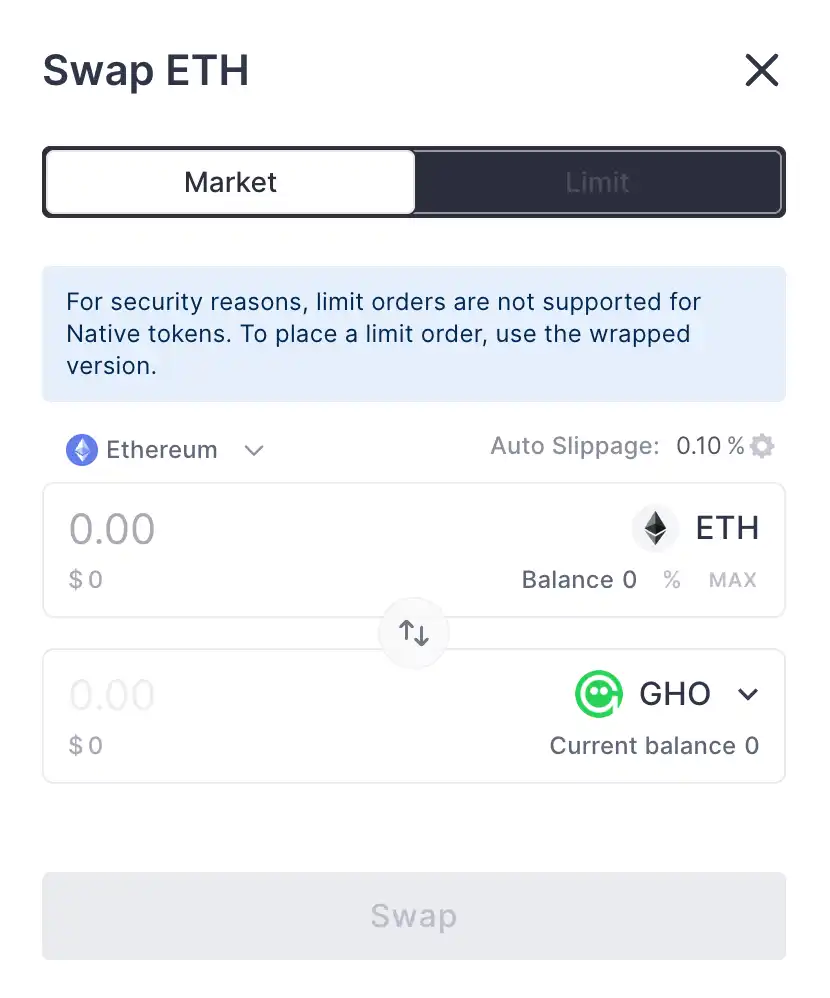
On December 4th, Aave announced a partnership with Cow Swap, adopting the latter as the default trading path for the swap function on the Aave frontend (Odaily Note: previously ParaSwap), utilizing its anti-MEV features for better quotes.

This seemed like a normal functional upgrade, but the community soon discovered that while the additional fees generated by this function (including referral fees or positive slippage surplus fees) previously flowed to the Aave DAO treasury address when using ParaSwap, after switching to Cow Swap, they were redirected to the Aave Labs address.

Community representative EzR3aL was the first to notice this unannounced change. They questioned the Aave team in the governance forum and estimated that, just tracking the income flow on Ethereum and Arbitrum, this change could generate approximately $200,000 in weekly revenue, corresponding to an annualized income of over $10 million — meaning Aave had quietly redirected at least tens of millions of dollars in revenue from the community address to the team address.

Core Controversy: Who Really Owns the Aave Brand?

As EzR3aL's post gained traction, a large number of AAVE holders felt betrayed, especially considering Aave made this change without community communication or any disclosure, seemingly intending to conceal it.

In response to community concerns, Aave Labs replied directly under EzR3aL's post, stating that there should be a clear distinction between the protocol layer and the product layer. The swap function interface on the Aave frontend is entirely operated by Aave Labs, which is responsible for the capital investment, construction, and maintenance. This function is completely independent of the DAO-managed protocol, therefore Aave Labs has the right to independently decide how to operate and profit... The revenue previously flowing to the Aave DAO address was a donation from Aave Labs, but not an obligation.

In short, Aave Labs' stance is that the frontend interface and its ancillary functions are essentially team products, and the revenue generated should be considered company property, not to be conflated with the protocol and its revenue controlled by the DAO.

This statement quickly sparked heated debate within the community regarding the ownership of the Aave protocol versus its products. A well-known DeFi analyst wrote an article titled "Who Really Owns 'Aave': Aave Labs vs Aave DAO," which Odaily Planet Daily also translated into Chinese for supplementary reading.

On December 16th, the conflict intensified further. Former Aave CTO Ernesto Boado initiated a proposal in the governance forum requesting the transfer of control over Aave brand assets (including domain names, social media accounts, naming rights, etc.) to AAVE token holders. These assets would be managed through a DAO-controlled entity (the specific form to be determined later) with strict anti-encroachment protection mechanisms.

The proposal received nearly ten thousand views and hundreds of high-quality replies within the Aave governance forum, with various participants in the Aave ecosystem weighing in. Although some voices felt the proposal's execution plan was imperfect and risked exacerbating divisions, the majority of responses expressed support.

Founder's Statement Fails to Placate Community

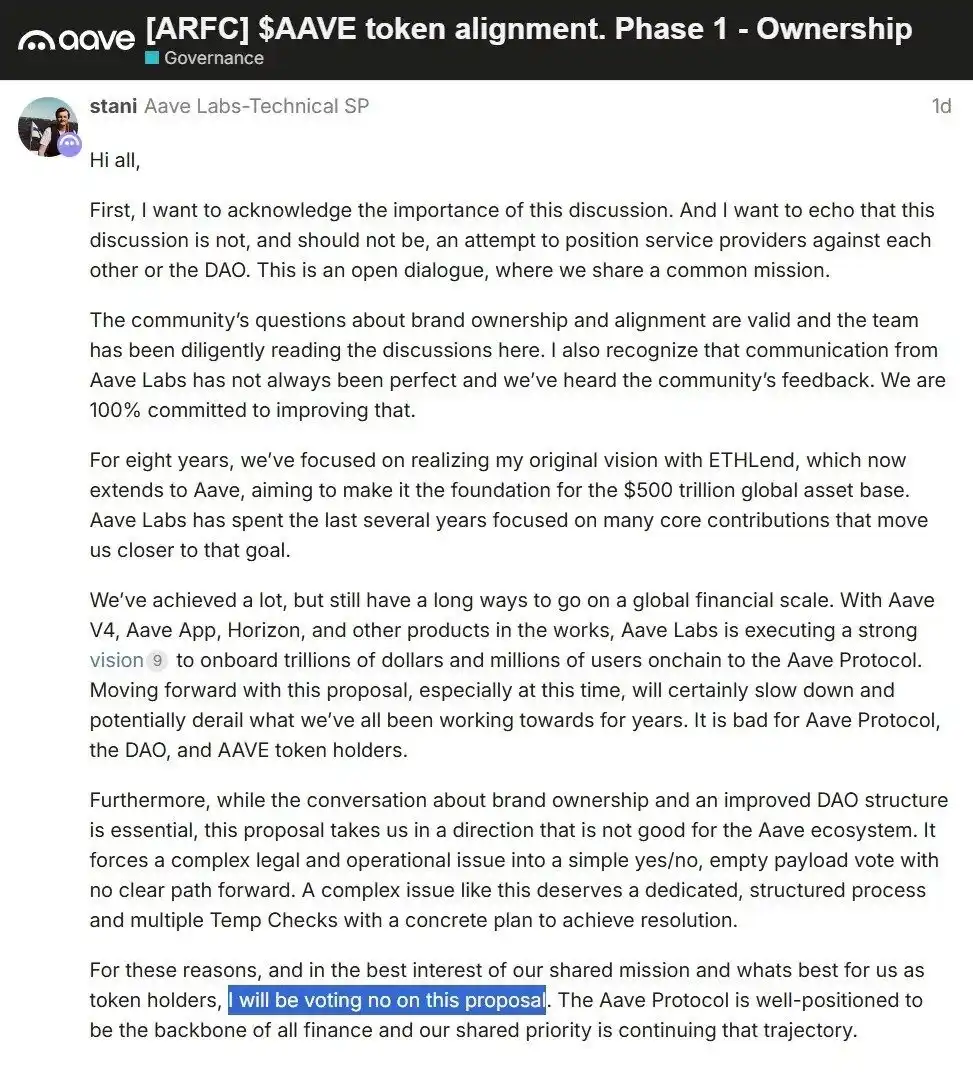
As community sentiment heated up, Aave founder Stani responded in the forum: "...This proposal leads us in a direction unfavorable to the Aave ecosystem. It attempts to reduce a complex legal and operational issue to a simple 'yes/no' vote without providing a clear execution path. Handling such a complex issue should involve a specially designed, structured process, achieving consensus through multiple interim checks accompanied by specific solutions. For the reasons above, I will vote against this proposal..."

From a business operations perspective, Stani's claim that the proposal is too rash might not be wrong. However, in the current discussion atmosphere, this statement was easily interpreted as 'the Aave founder disagrees with transferring brand assets to token holders,' which obviously further intensified the对立情绪 (oppositional sentiment) between the community and the team.

After Stani's statement, even some aggressive comments targeting Stani appeared under the original post. More users expressed their discontent via the forum or social media. An OG user mentioned it was the first time they considered liquidating their AAVE, and a loyal AAVE believer stated: "AAVE holders should realize this is just another DeFi shitcoin. It's neither better nor worse than the others."

The latest community activity is the "number two big brother" cutting losses and exiting with millions in losses mentioned at the beginning of this article.

Can AAVE Still Be Bought?

Just two weeks ago, Odaily Planet Daily wrote an article titled "What Do the Smart Money Frantically Buying AAVE at Lows See?". At that time, AAVE was still a favorite of top institutions like Multicoin Capital. Its优质的信誉 (high-quality brand reputation),雄厚沉淀资金 (substantial deposited funds),清晰的扩展路径 (clear expansion path),强劲的收入与回购流水 (strong revenue and buyback flow) all proved AAVE was a 'true value token' different from other altcoins.

But in just two weeks, a舆论危机 (public opinion crisis) spanning fee ownership, brand control, and team-community relations has rapidly plunged AAVE from "value token representative" into the center of controversy, even landing it on the short-term top decliners list due to emotional impact.

As of writing, Aave Labs has stated under Ernesto's proposal that they have initiated an ARFC snapshot vote on the proposal, allowing AAVE token holders to formally express their stance and clarify the future direction. The outcome of this vote and the subsequent handling attitude of the Aave Labs team will undoubtedly significantly impact Aave's community faith and AAVE's short-term price performance.

It is important to emphasize that this incident is not merely "bad news" or a "performance change," but a集中拷问 (集中拷问 - concentrated interrogation) of Aave's existing governance structure and the boundaries of rights.

If you believe Aave Labs will still maintain高度一致 (high alignment) with Aave DAO regarding long-term interests, and the current friction is more of a communication and process失误 (mistake), then the price pullback led by emotion might be a good entry window. But if you believe this controversy exposes not an occasional problem, but a结构性矛盾 (structural contradiction) of long-term unclear rights between the team and the protocol, lacking institutional constraints, then this storm might just be the beginning.

From a broader perspective, Aave's controversy is not an isolated case. As DeFi matures, protocol revenue becomes substantial and real, and brands and frontends begin to possess commercial value, structural contradictions between protocols and products, teams and communities will surface. Aave is under the spotlight this time not because it is more wrong, but because it has gone further.

This debate over fees, brand, and control rights poses a question that needs answering not just by AAVE, but is an inevitable question the entire DeFi industry must eventually face.

Связанные с этим вопросы

QWhat was the main reason behind the community crisis and whale selling AAVE tokens?

AThe crisis stemmed from a change in Aave's front-end that redirected fees from the swap function to Aave Labs instead of the Aave DAO treasury, which the community perceived as a lack of transparency and a shift of value away from token holders.

QHow much did the second-largest AAVE whale lose after selling their holdings?

AThe second-largest AAVE whale sold 230,000 AAVE tokens at a loss of approximately $13.45 million, after buying at an average price of $223.4 and selling at around $165 per token.

QWhat was Aave Labs' justification for redirecting the swap fees to their own address?

AAave Labs argued that the front-end swap function is their product, built and maintained independently from the DAO-managed protocol, and therefore they have the right to decide how to operate and profit from it, considering previous donations to the DAO as voluntary, not obligatory.

QWhat proposal did Aave's former CTO Ernesto Boado make to address the community's concerns?

AErnesto Boado proposed transferring control of Aave's brand assets, including domains, social accounts, and naming rights, to AAVE token holders through a DAO-controlled entity with anti-takeover protections.

QHow did Aave's founder Stani Kulechov respond to the proposal, and what was the community's reaction?

AStani Kulechov opposed the proposal, stating it oversimplified a complex legal and operational issue without a clear execution path. The community perceived this as resistance to decentralizing control, further escalating tensions and leading to increased criticism and selling pressure.

Похожее

SpaceX, OpenAI, Anthropic: The Three AI Giants Racing for IPO, Which One Is Worth Betting On?

SpaceX, OpenAI, and Anthropic are poised for historic IPOs within weeks, potentially raising a combined $180 billion—a sum exceeding the entire internet bubble's fundraising. The hosts of the Limitless Podcast argue this isn't just individual company financing but an unprecedented capital concentration for AI infrastructure, driven by an insatiable need for compute, data centers, power, and chips. SpaceX's IPO is notable for reportedly changing market index rules to allow faster inclusion, potentially funneling trillions in passive retirement funds into its stock, despite its unproven space-based data center business model. In contrast, Anthropic demonstrates explosive growth, with ARR reportedly hitting $45 billion and approaching profitability, fueled by strong enterprise adoption of products like Claude Code. Google's separate $80 billion raise highlights the immense capital pressure, even for giants. The discussion acknowledges bubble risks but leans optimistic. The hosts contend the massive spending is building essential physical infrastructure for the next technological era. A key bottleneck isn't capital but the real-world limits of chip manufacturing and construction speed. As long as demand for AI compute outstrips supply, this investment cycle represents a foundational build-out rather than a purely financial bubble. All three companies are seen as foundational bets on the future, with Anthropic often cited as the most immediately compelling due to its proven revenue trajectory.

marsbit1 ч. назад

SpaceX, OpenAI, Anthropic: The Three AI Giants Racing for IPO, Which One Is Worth Betting On?

marsbit1 ч. назад

From 'Old Guys' to 'New Favorites': How AI Is Revaluing Old Infrastructure from Dell to Nokia?

From "Vintage Tech" to "New AI Darlings": How AI Revalues Old Infrastructure One year ago, tech giants like Dell, Nokia, Cisco, and Western Data were seen as slow-growth, low-valuation stories, far from the AI spotlight dominated by players like Nvidia. Now, these legacy tech stocks are gaining market attention, sparking debate on whether this is genuine industry revaluation or a temporary narrative. As AI moves from model parameters to real-world data centers, the market is recognizing companies with proven delivery and infrastructure capabilities. This shift marks a change in the AI investment thesis: from pure model and GPU focus to the complex systems engineering required for deployment. Companies like Dell, HPE, and Corning are being revalued not for being "sexy" AI innovators, but for their decades of accumulated expertise in supply chains, enterprise delivery, and infrastructure—assets that have become critical in the AI buildout phase. The revaluation is unfolding across three key infrastructure lines: 1. **Servers & System Integration:** Dell and HPE are emerging as crucial system integrators or "general contractors" for AI data centers, translating GPU orders into complete, deployable server racks integrated with power, cooling, and networking. 2. **Networking & Connectivity:** AI's scale demands robust high-speed connections. Corning (fiber optics), Nokia (AI-RAN, 6G), and Cisco (data center switches) are gaining importance for enabling efficient data transfer within and between AI clusters. 3. **Storage:** Beyond high-speed memory (HBM/DRAM), the AI data explosion is driving demand for high-capacity hard drives (HDDs) from companies like Western Digital and Seagate to handle training data, logs, and cold storage cost-effectively. For this revaluation to be substantive and not just a narrative, three criteria are key: 1) Concrete AI-related order and revenue growth (e.g., Dell's AI server sales), 2) Upward revisions to company financial guidance, and 3) Sustainable improvements in profit quality, not just top-line revenue spikes. In essence, AI's transition to a real construction phase is re-pricing "old assets" against "new demand." The opportunity, however, is selective. Only those legacy firms that are demonstrably integrated into the capital expenditure chains of data center and enterprise AI deployment are likely to experience a true "logic re-rating" rather than just a temporary valuation bounce.

marsbit2 ч. назад

From 'Old Guys' to 'New Favorites': How AI Is Revaluing Old Infrastructure from Dell to Nokia?

marsbit2 ч. назад

The Merger of Codex and ChatGPT Marks the Beginning of a Major Reshuffle in Programming Tools

OpenAI is shifting its strategic focus from ChatGPT to Codex, merging them along with the browser tool Atlas into a unified desktop super-app. This move signals an internal belief that Codex, originally a programming tool, represents the next evolution of AI more than conversational models like ChatGPT. Over the past year, Codex's weekly active users have surged past 5 million. The key distinction is that while ChatGPT answers questions, Codex executes tasks. Enterprises increasingly value this ability to get work done over simply receiving advice. Consequently, Codex is attracting professionals beyond developers, including analysts, bankers, marketers, and product managers. OpenAI's reorganization and increased investment in Codex stem from recognizing that the future of AI competition lies in execution capabilities, not just conversation. The company is launching role-specific plugins (e.g., for data analysis, sales, design) to transform Codex into a broad knowledge work platform that automates and redefines white-collar workflows. Beyond being a tool, Codex reflects OpenAI's ambition to redefine software. New features like "Sites"—which generates interactive websites from documents—and collaborative "Annotations" aim to create a paradigm where the AI understands the goal and handles the tools and steps, functioning more like a digital colleague than traditional software. The ultimate goal is a unified experience where the user cares only about the completed task.

marsbit2 ч. назад

The Merger of Codex and ChatGPT Marks the Beginning of a Major Reshuffle in Programming Tools

marsbit2 ч. назад

Торговля

Спот
Фьючерсы

Популярные статьи

Как купить AAVE

Добро пожаловать на HTX.com! Мы сделали приобретение Aave Protocol (AAVE) простым и удобным. Следуйте нашему пошаговому руководству и отправляйтесь в свое крипто-путешествие.Шаг 1: Создайте аккаунт на HTXИспользуйте свой адрес электронной почты или номер телефона, чтобы зарегистрироваться и бесплатно создать аккаунт на HTX. Пройдите удобную регистрацию и откройте для себя весь функционал.Создать аккаунтШаг 2: Перейдите в Купить криптовалюту и выберите свой способ оплатыКредитная/Дебетовая Карта: Используйте свою карту Visa или Mastercard для мгновенной покупки Aave Protocol (AAVE).Баланс: Используйте средства с баланса вашего аккаунта HTX для простой торговли.Третьи Лица: Мы добавили популярные способы оплаты, такие как Google Pay и Apple Pay, для повышения удобства.P2P: Торгуйте напрямую с другими пользователями на HTX.Внебиржевая Торговля (OTC): Мы предлагаем индивидуальные услуги и конкурентоспособные обменные курсы для трейдеров.Шаг 3: Хранение Aave Protocol (AAVE)После приобретения вами Aave Protocol (AAVE) храните их в своем аккаунте на HTX. В качестве альтернативы вы можете отправить их куда-либо с помощью перевода в блокчейне или использовать для торговли с другими криптовалютами.Шаг 4: Торговля Aave Protocol (AAVE)С легкостью торгуйте Aave Protocol (AAVE) на спотовом рынке HTX. Просто зайдите в свой аккаунт, выберите торговую пару, совершайте сделки и следите за ними в режиме реального времени. Мы предлагаем удобный интерфейс как для начинающих, так и для опытных трейдеров.

954 просмотров всегоОпубликовано 2024.04.12Обновлено 2026.06.02

Как купить AAVE

Обсуждения

Добро пожаловать в Сообщество HTX. Здесь вы сможете быть в курсе последних новостей о развитии платформы и получить доступ к профессиональной аналитической информации о рынке. Мнения пользователей о цене на AAVE (AAVE) представлены ниже.

活动图片