SBI CEO Calls Ripple Stake A ‘Hidden Asset,’ Hints It Could Be Much Bigger

bitcoinistОпубликовано 2026-02-16Обновлено 2026-02-16

Введение

SBI Holdings CEO Yoshitaka Kitao refuted a viral claim that the company holds $10 billion in XRP, clarifying that its true "hidden asset" is its 9% equity stake in Ripple Labs. He emphasized that Ripple's overall valuation—including its ecosystem—could be enormous, making SBI's stake significantly more valuable than its XRP holdings. Community estimates suggest Ripple's valuation could exceed $50 billion, valuing SBI's stake at over $4.5 billion with substantial future upside. SBI's long-term strategic partnership with Ripple, including investments dating back to 2016, underpins this position. At the time of reporting, XRP traded at $1.46.

SBI Holdings CEO Yoshitaka Kitao pushed back on a viral claim that the Japanese financial group holds $10 billion worth of XRP, arguing instead that SBI’s more consequential exposure sits in its equity position in Ripple Labs, a stake he suggested the market may be underappreciating.

The exchange began after an X account described SBI as “a major partner of Ripple” and “holder of $10 billion in XRP,” tying the claim to SBI’s growing footprint in Asia through the acquisition of Coinhako, a regulated crypto platform based in Singapore. Kitao replied directly, disputing the framing and pointing to SBI’s ownership in Ripple rather than a headline XRP number.

“Not $10 bil. in XRP but around 9% of Ripple Lab. So our hidden asset could be much bigger,” Kitao wrote in a Feb. 15 post.

SBI CEO Dials Up Ripple Valuation Speculation

Kitao’s response effectively reframed the conversation from balance-sheet token inventory to private-market ownership. Rather than validate a specific XRP figure, he emphasized SBI’s stake in Ripple Labs, a detail that matters because equity value is ultimately a function of Ripple’s overall valuation, not the spot price of XRP.

In a separate post the same day, Kitao went further, explicitly tying his view to Ripple’s broader footprint. “When it comes to Ripple Lab’s total valuation which obviously include its ecosystem that Ripple has created, that would be enormous,” he wrote. “SBI owns more than 9 % of that much.”

Community member “BankXRP” amplified the implications by referencing recent reports that place Ripple’s valuation at “$50B+,” arguing that such a mark would put SBI’s 9% stake at “$4.5B+,” with “massive future upside as the CEO hints.”

While Kitao did not put a dollar figure on SBI’s stake, the 9% number sets a clean valuation yardstick. If SBI’s Ripple ownership were worth more than $10 billion, Ripple’s implied valuation would need to exceed roughly $111 billion, because $10 billion divided by 0.09 equals about $111.1 billion.

Put differently, at a $90 billion Ripple valuation, a 9% stake would be about $8.1 billion; at $50 billion, it would be about $4.5 billion. The threshold for “more than $10 billion” is therefore not a subtle rounding error, it requires a triple-digit billions valuation for Ripple.

Notably, SBI’s roughly 9% position appears to be the product of a long-running strategic relationship rather than a single headline trade: SBI’s own investor materials describe the Ripple relationship as having been “established” in September 2012, with the group later investing in Ripple in March 2016 and then deepening operational ties through the SBI Ripple Asia joint venture (SBI 60%, Ripple 40%) launched in May 2016.

SBI also participated as an investor in Ripple’s $200 million Series C financing announced in December 2019, a round that included SBI alongside other backers, one of the clearer public datapoints showing continued equity exposure as Ripple raised capital.

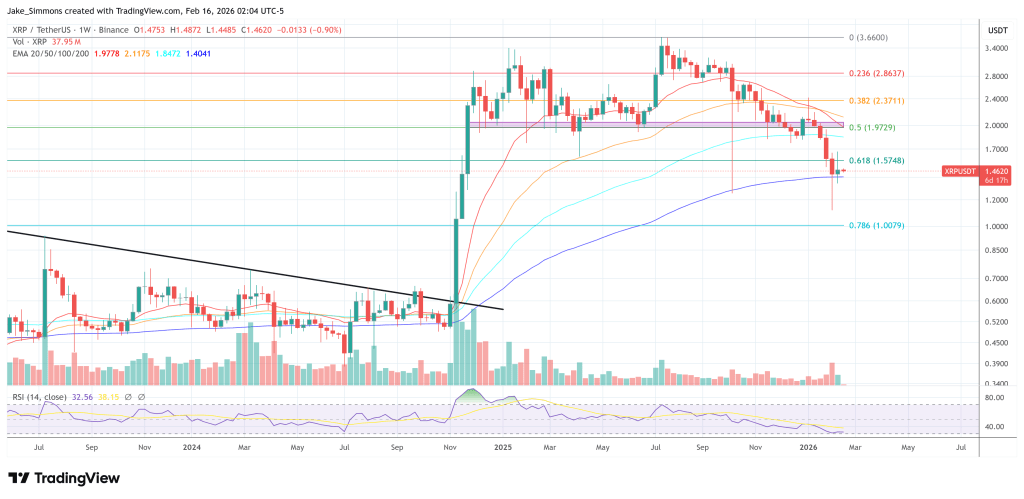
At press time, XRP traded at $1.46.

XRP remains above the 200-week EMA, 1-week chart | Source: XRPUSDT on TradingView.com

Связанные с этим вопросы

QWhat did SBI Holdings CEO Yoshitaka Kitao dispute regarding SBI's holdings?

AYoshitaka Kitao disputed the viral claim that SBI Holdings holds $10 billion worth of XRP, emphasizing instead that the company's more significant exposure is its equity stake in Ripple Labs.

QWhat percentage of Ripple Labs does SBI own, according to the CEO?

ASBI owns approximately 9% of Ripple Labs, as stated by CEO Yoshitaka Kitao.

QHow did the CEO describe SBI's stake in Ripple Labs?

AThe CEO described SBI's stake in Ripple Labs as a 'hidden asset' that could be much bigger than the market appreciates.

QWhat would Ripple's valuation need to be for SBI's 9% stake to be worth over $10 billion?

AFor SBI's 9% stake to be worth over $10 billion, Ripple's implied valuation would need to exceed roughly $111 billion.

QWhen did SBI first establish its relationship with Ripple, and what key investment did it make in 2016?

ASBI established its relationship with Ripple in September 2012 and made an investment in Ripple in March 2016, later deepening ties through the SBI Ripple Asia joint venture launched in May 2016.

Похожее

Raising Interest Rates Is Not a Tech Killer, EPS Is: A Strategy for Discarding the Weak and Retaining the Strong After the AI Theme's Sharp Decline

**Summary: Rising Interest Rates Are Not the Killer of Tech; EPS Is: The "Keep the Strong, Ditch the Weak" Strategy After the AI Theme Plunge** The author argues that the sharp sell-off in tech and AI-related stocks, triggered by a strong US jobs report that heightened Fed rate hike fears, represents a "pullback to pick up passengers" rather than a "car crash." The true end of a tech bull market is not determined by an extra 25 basis point hike, but by industry overcapacity and the disproval of earnings per share (EPS) expectations. Historical analysis shows that during past rate hike cycles, the Nasdaq-100 often outperformed, provided EPS growth remained strong. The current phase is seen as a shift from a "broad narrative-driven rally" to a "focused verification stage" for AI. The investment strategy should be to "keep the strong, ditch the weak." * **Retain exposure** to high-conviction AI infrastructure leaders with clear order visibility, stable margins, strong cash flow, and upward EPS revisions (e.g., AI servers, advanced packaging, optical modules, key cloud suppliers). * **Reduce exposure** to high-beta, narrative-driven stocks with unclear profit paths (e.g., some quantum computing, space, or speculative chip stocks), especially on rebounds. Valuation concerns should focus on whether earnings can catch up to high multiples, not on high P/E alone. Crowded positioning signals a concentration into quality assets, not necessarily a market top. The upcoming Q2 earnings season will be a key validation point. The core principle is to hold stocks with proven EPS, while using macro events (CPI data, central bank meetings) to manage timing and risk.

marsbit4 ч. назад

Raising Interest Rates Is Not a Tech Killer, EPS Is: A Strategy for Discarding the Weak and Retaining the Strong After the AI Theme's Sharp Decline

marsbit4 ч. назад

Торговля

Спот
Фьючерсы
活动图片