Saylor Names Solana And Ethereum As Future Of Digital Credit

bitcoinistОпубликовано 2026-02-27Обновлено 2026-02-27

Введение

In his keynote at Strategy World 2026, Michael Saylor outlined a vision where Bitcoin serves as the foundational capital base for digital credit products, with Solana and Ethereum acting as key distribution platforms. He explained that his company, MicroStrategy, is shifting from merely accumulating Bitcoin to converting it into structured credit products like its Stretch (STRC) offering. This approach aims to extract steady yield from Bitcoin’s volatility and deliver it as programmable financial instruments. Saylor emphasized that digital credit can be tokenized and distributed across various platforms—including traditional exchanges like NASDAQ and crypto networks like Solana and Ethereum. He argued that if Bitcoin appreciates significantly, it can back large volumes of investment-grade credit. Solana and Ethereum are positioned not as the reserve asset but as scalable rails for deploying tokenized credit, yield, and liquidity products to a broader market.

Michael Saylor used his Strategy World 2026 keynote on Feb. 25 to argue that Bitcoin-backed “digital credit” is moving beyond Wall Street wrappers and toward programmable distribution on crypto rails, naming Solana and Ethereum as part of that future. The pitch matters because it pushes Strategy’s Bitcoin treasury model into a broader product thesis: use Bitcoin as the capital base, then package credit, yield and liquidity for corporates, retail investors and eventually tokenized markets.

Bitcoin Capital, Credit Product

Saylor framed Bitcoin as the foundation of the stack and Strategy’s Stretch (STRC) as the credit layer built on top of it. In his telling, the company’s business is no longer just accumulating Bitcoin, but “converting capital into credit” by using long-duration capital structures to strip cash flow from a volatile asset and deliver it as a steadier yield product.

“What is Strategy doing? Our company is converting capital into credit. We’re converting economic wealth into a stream of cash flows,” Saylor said. “You need an operating company in order to take a block of economic energy and turn it into a currency, peg it to a currency, strip away the risk, damp the volatility, extract the cash flows in the form of yield and compress the duration to now.”

That framework sits at the center of his case for STRC. Saylor said Strategy arrived there only after working through what he described as increasingly durable forms of leverage, from exchange leverage and margin loans to senior debt, junior debt, convertibles and preferred structures.

The key variable, in his view, is not just headline maturity, but the “stochastic duration” of capital, how long a company can realistically rely on it before covenants, mark-to-market stress or refinancing pressure force a problem.

He argued that variable preferred credit offered the best compromise short of common equity because it maximized optionality and reduced the risk of getting squeezed out of the position during a drawdown.

Saylor also laid out a simple quantitative case for digital credit. Strategy, he said, uses three internal metrics: BTC rating, or collateral coverage; BTC risk, the probability that collateral falls below required levels by the end of the term; and the implied credit spread needed to compensate investors. He contrasted current benchmarks of 78 basis points for investment-grade bonds and 288 basis points for high-yield debt with what he said digital credit could deliver if Bitcoin compounds faster than traditional assets.

His model depends heavily on a constructive view of Bitcoin’s long-run returns. If Bitcoin appreciates at 30% annually, Saylor said, sizable volumes of investment-grade credit can be created against it. If Bitcoin goes nowhere, the same structure starts to look like distressed debt.

He used recent performance to sharpen that distinction. Since Bitcoin’s all-time high about four and a half months ago, Saylor said, Bitcoin had fallen 45%, while STRC had lost “0% of its value” and paid 4.5% in dividends through the drawdown. That, he argued, is the commercial opening: offer a less volatile yield instrument to buyers who want Bitcoin-linked economics without owning the asset outright.

Solana And Ethereum As Distribution Rails

The keynote’s most consequential turn came when Saylor described digital credit as “programmable.” He was not using the term narrowly.

“Programmable means I take the credit and I create it. I turn it into a token, a private fund, a public fund, an ETF, an ETP. I make it a bank account. I make it a crypto account,” he said. “Then I put it on a platform — the NASDAQ, the London Stock Exchange, Solana, Ethereum, Binance, Coinbase Base. There are a lot of different platforms I can put that on.”

He went further, arguing that once credit is packaged as a modular product, issuers can tune volatility, liquidity, staking periods, payout frequency and currency exposure. In that framework, Solana and Ethereum are not the capital base (Bitcoin remains that in Saylor’s model) but potential rails for distributing tokenized versions of the credit product.

That leaves Strategy with a larger ambition than simply selling preferred stock. Saylor said the company intends to deepen STRC liquidity and scale the underlying asset base, while partners build “digital money” and “digital yield” products around it.

If that thesis holds, Strategy is betting Bitcoin-backed credit can move from a public-market niche into a cross-platform product category spanning brokerages, ETFs and on-chain ecosystems.

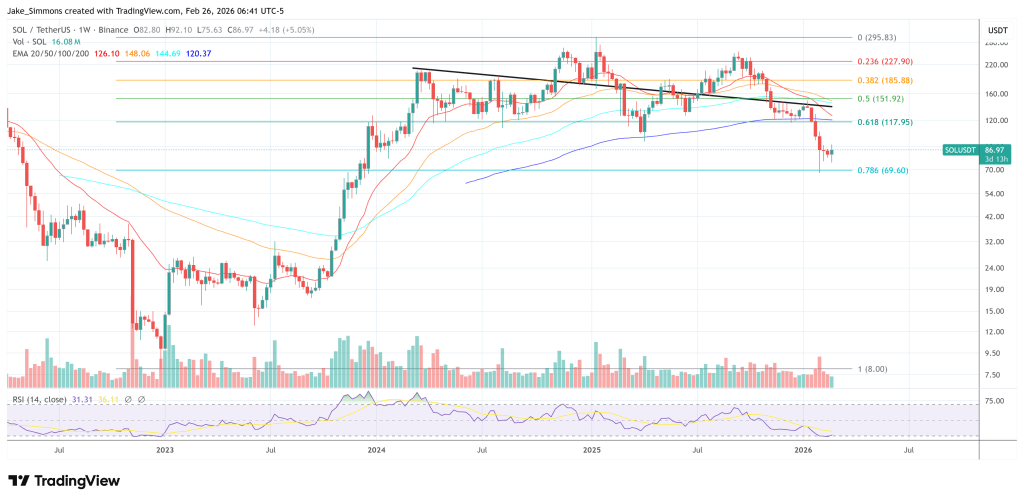
At press time, Solana traded at $86.97.

Solana must reclaim the 0.618 Fib, 1-week chart | Source: SOLUSDT on TradingView.com

Связанные с этим вопросы

QWhat did Michael Sayer name as the future platforms for distributing programmable digital credit?

AMichael Saylor named Solana and Ethereum as future platforms for distributing programmable digital credit.

QAccording to Saylor, what is the role of Bitcoin in MicroStrategy's new business model?

ASaylor framed Bitcoin as the foundation of the capital stack, with MicroStrategy's Stretch (STRC) acting as the credit layer built on top of it. The company is converting capital into credit to create steadier yield products.

QWhat three internal metrics does MicroStrategy use to evaluate its digital credit model?

AThe three internal metrics are: BTC rating (collateral coverage), BTC risk (the probability collateral falls below required levels), and the implied credit spread needed to compensate investors.

QHow did Saylor contrast the performance of Bitcoin and STRC during the recent drawdown?

ASaylor stated that since Bitcoin's all-time high, it had fallen 45%, while STRC had lost '0% of its value' and paid 4.5% in dividends through the drawdown.

QWhat is the broader ambition for MicroStrategy's Bitcoin-backed credit, beyond selling preferred stock?

AThe broader ambition is to deepen STRC liquidity, scale the underlying asset base, and have partners build 'digital money' and 'digital yield' products, moving it from a public-market niche into a cross-platform product category spanning brokerages, ETFs, and on-chain ecosystems.

Похожее

The Tao (τ) Law Makes EDA Go Viral

In May 2026, Huawei's semiconductor division introduced the "Tao (τ) Law" at IEEE ISCAS, shifting the industry focus from Moore's Law's geometric scaling to "time scaling." Unlike traditional approaches relying on transistor miniaturization, τ Law optimizes the time constant (τ) across device, circuit, chip, and system levels to improve information processing speed and efficiency. Huawei has already applied this principle, mass-producing 381 chips across various applications, with a target to achieve performance equivalent to 1.4nm technology by 2031. The implementation of τ Law, involving techniques like Chiplet, 3DIC, and Logic Folding, places new demands on EDA tools, highlighting gaps in current offerings. Traditional 2D or pseudo-3D EDA flows lack native support for true 3D design, cross-layer co-optimization (STCO), and coupled multi-physics analysis (thermal, power, stress), which are crucial for advanced integration. Chinese EDA companies, such as Empyrean Software, Primarius Technologies, and Xpeedic, are evolving from point-tool specialists to providing full-flow, system-level solutions. For instance, Peking University has developed a prototype "true 3D" EDA tool showing significant improvements in wirelength and timing. Empyrean Software has also launched a comprehensive 3DIC design and verification platform. The τ Law framework presents an opportunity for the domestic EDA industry to transition from achieving basic functionality to developing robust, integrated toolsets essential for next-generation chip design.

marsbit18 мин. назад

The Tao (τ) Law Makes EDA Go Viral

marsbit18 мин. назад

It's Not Jensen Huang Who Wants to Change the PC, But the PC That's Revolting Against Itself

The 40-year-old PC industry is undergoing a fundamental transformation, driven by the rise of AI PCs. At the GTC Taipei 2026 event, NVIDIA, backed by Microsoft and major PC OEMs, announced the RTX Spark super chip for Windows PCs, marking its official entry into the PC core processor market. This move aims to redefine the AI PC by shifting its core from the CPU to an AI-focused SoC (System on Chip). NVIDIA envisions the PC evolving from a personal computer to a "personal AI"—a platform where local AI Agents can autonomously perform tasks. While Intel pioneered the AI PC concept earlier in 2026, NVIDIA's aggressive push, leveraging its vast CUDA developer ecosystem of 6 million, positions it to potentially reshape the industry's long-standing Wintel (Windows-Intel) power structure. NVIDIA's strategy extends beyond hardware; it's about embedding its CUDA, RTX, and AI software stack into the PC platform itself. The article identifies key shifts: 1) The move from a CPU-centric to an AI SoC-centric architecture, similar to Apple's approach with its M-series chips. 2) The PC's evolution from a human-operated tool to a platform for human-Agent collaboration. 3) The extension of NVIDIA's data center-centric CUDA ecosystem to personal devices via RTX Spark. Ultimately, the change is driven by the broader trend of AI moving to personal devices. Companies like Intel, AMD, Qualcomm, and Apple are all participating in this shift. NVIDIA's entry accelerates the competition, but the core driver is the technology itself finding its optimal expression in the PC. The industry is reinventing itself, with the outcome hinging on execution, ecosystem development, and the creation of compelling local AI applications.

marsbit2 ч. назад

It's Not Jensen Huang Who Wants to Change the PC, But the PC That's Revolting Against Itself

marsbit2 ч. назад

Торговля

Спот
Фьючерсы
活动图片