Prediction Markets Hit Record Highs As Bets Explode On Global Conflict

bitcoinistОпубликовано 2026-03-31Обновлено 2026-03-31

Введение

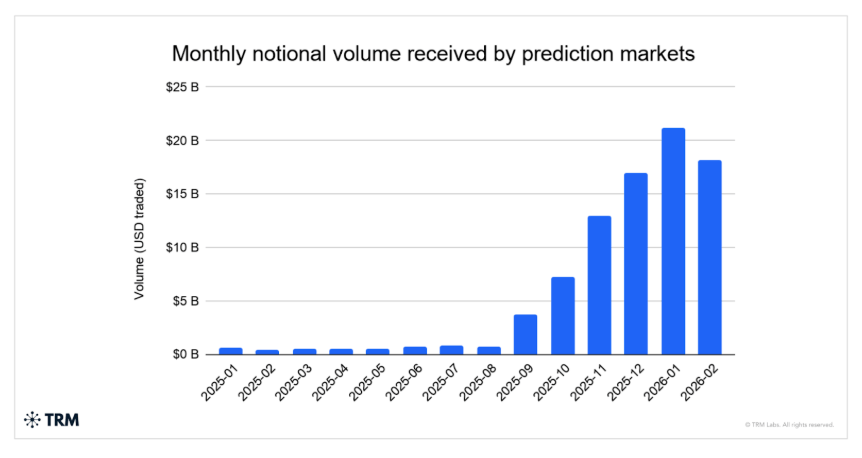
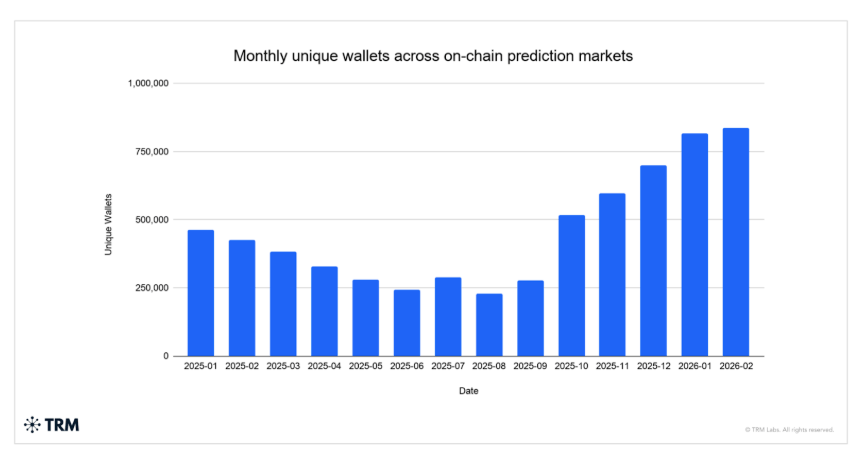
Prediction markets are experiencing unprecedented growth, driven by automated AI agents and high-frequency trading bots that extracted approximately $40 million from market inefficiencies in a single month. These markets are increasingly dominated by bets on geopolitical events, such as the US-Israeli conflict with Iran, and major political events like the 2028 US Presidential primary, rather than cryptocurrency prices. TRM Labs reported a 2,800% year-over-year increase, with March 2026 seeing 191 million transactions totaling nearly $24 billion. This surge has attracted regulatory scrutiny over potential insider trading, leading to bipartisan efforts to ban "casino-style" event contracts. Platforms like Kalshi and Polymarket are implementing internal restrictions to preempt stricter regulations, as the industry balances its role as a forecasting tool with concerns over speculation on global conflicts.

Prediction markets are being dominated by automated AI agents and high-frequency trading bots, which extracted around $40 million from market inefficiencies within a single month.

These digital traders look for news of global unrest and respond in milliseconds, often moving the price of a contract before the rest of us can even think about the headline.

This new world of professionalized, machine-based speculation has turned what was once a niche hobby for crypto enthusiasts into a high-stakes financial arena.

Blockchain analytics company TRM Labs reported that prediction markets have seen substantial growth, fueled by greater accessibility, regulatory progress, and integration with mainstream platforms like Google Finance.

The firm noted that these markets are increasingly serving as real-time indicators for geopolitical and macroeconomic events, gaining attention from major media outlets.

War And Elections Drive Unprecedented Volume

The primary catalyst for this massive activity is no longer the price of digital coins. Instead, traders are putting money on the line over the US-Israeli conflict with Iran and other international flashpoints.

The political implications are also significant, with huge monetary stakes riding on the 2028 US Presidential primary nominations. It has been suggested that such platforms are now being used as a measure of the way in which public opinion is shifting, with their probabilities featured on Google Finance and in the news as a more fluid alternative to traditional political polling.

The extent to which this industry is growing can be quantified by recent figures, which showed an increase of over 2,800% compared to the previous year. Indeed, in March 2026, there were over 191 million transactions in the space.

BTCUSD currently trading at $67,503. Chart: TradingView

To put that in perspective, that figure equates to almost $24 billion in total value for that month alone, representing a staggering increase from the $1.85 billion in March 2025. This indicates that people and investors are viewing these markets as crucial in hedging against any changes in economic policies or shifts in interest rates.

Prediction Markets: Lawmakers Target Event Based Betting

However, the sudden increase in value has caught the attention of regulators in Washington. The regulators have expressed concerns that people may be using inside information to make profits from military actions and other government decisions.

These suspicions of insider trading have led to a bipartisan push for new legislation. US President Donald Trump and members of Congress are looking at a bill that would effectively ban contracts tied to “casino-style” events, potentially stripping the industry of its most popular categories.

Platforms Introduce New Trading Guardrails

In an effort to stave off a total shutdown, major platforms like Kalshi and Polymarket are beginning to implement their own internal restrictions. These measures aim to curb the most controversial types of betting while maintaining the market’s role as a forecasting utility.

Data shows that the outcome of these regulatory battles will determine if the sector stays a permanent fixture of the financial world. For now, the industry remains in a volatile state, balancing between its value as a source of truth and its reputation as a venue for speculating on global tragedy.

Featured image from Unsplash, chart from TradingView

Связанные с этим вопросы

QWhat is the primary catalyst for the massive growth in prediction market activity according to the article?

AThe primary catalyst is no longer the price of digital coins, but traders betting on geopolitical events like the US-Israeli conflict with Iran and other international flashpoints, as well as major political events like the 2028 US Presidential primary nominations.

QHow much value did automated AI agents and trading bots extract from market inefficiencies in a single month?

AAutomated AI agents and high-frequency trading bots extracted around $40 million from market inefficiencies within a single month.

QWhat are US lawmakers concerned about regarding prediction markets, and what action are they considering?

AUS lawmakers are concerned that people may be using inside information to profit from military actions and government decisions. They are considering a bipartisan bill that would ban contracts tied to 'casino-style' events.

QWhat was the reported percentage increase in prediction market transactions in March 2026 compared to the previous year?

AThe reported increase was over 2,800% compared to the previous year, with over 191 million transactions in March 2026.

QHow are major prediction market platforms like Kalshi and Polymarket responding to regulatory pressure?

AThey are implementing their own internal restrictions to curb the most controversial types of betting in an effort to stave off a total shutdown and maintain the market's role as a forecasting utility.

Похожее

70% of the Public Opposes AI, Americans Hope the U.S. Loses the AI War

70% of Americans believe AI development is moving too fast, with growing public resistance evolving from online criticism to real-world protests and violence. This widespread anti-AI sentiment stems from fears of job losses, rising utility costs, environmental damage, threats to democracy, and financial instability. Key incidents illustrate the backlash: Google's former CEO Eric Schmidt was loudly booed at a graduation for promoting AI; AI company ads are vandalized; protests and even violent attacks target AI firms and data centers. Polls show deep public pessimism and strong local opposition to data center construction, often surpassing resistance to nuclear power plants. The core grievances are economic and practical: AI is seen as automating jobs, concentrating wealth, and increasing household electricity and water bills due to massive data center resource demands. Environmentalists also oppose AI's high energy use and carbon emissions. This opposition has turned AI into a major political issue in the US. While the Trump administration prioritizes AI innovation for global competition, bipartisan pushback is growing. Democrats and factions within the MAGA movement are forming temporary alliances to support stricter regulations and local bans on new data centers, pressuring the administration to choose between its tech industry backers and its voter base. The situation highlights a profound national divide over AI's future.

marsbit10 мин. назад

70% of the Public Opposes AI, Americans Hope the U.S. Loses the AI War

marsbit10 мин. назад

Agents Take Over Traffic Distribution Power: What Are Tencent, ByteDance, and Alibaba Competing For?

In the race to dominate the AI era's entry point, China's tech giants—Tencent, ByteDance, and Alibaba—are aggressively deploying AI Agents to control the future of traffic distribution. Alibaba is pursuing a dual-track "closed loop + openness" strategy. Its Qianwen app is evolving into a super-Agent integrated across its ecosystem (Taobao, Alipay, etc.) to handle complex tasks like travel planning. Concurrently, it is opening its platform to external brands (Luckin Coffee, KFC) and has launched a B2B Agent platform, "Wukong," targeting enterprise automation. Its other flagship, Quark, aims to be an "AI super search box" for information and tasks. ByteDance is executing an omnipresent "sprawl strategy." Its Doubao app boasts over 300 million monthly active users and is evolving into a default AI entry point for daily life, with plans for paid versions and e-commerce integration. Its core weapon is the Kouzi platform, a visual "AI assembly factory" for developers to build custom Agents. ByteDance is also pushing hardware integration, collaborating on AI phones and developing smart glasses to embed Doubao everywhere. Tencent is playing its long-held "ultimate card" by quietly embedding an AI Agent directly into WeChat. This Agent, accessible via a swipe, can understand user commands and automatically execute tasks by calling upon WeChat's millions of mini-programs (e.g., finding and ordering coffee). This leverages WeChat's unparalleled 1.4-billion-user ecosystem to position the app as an AI-powered "service operating system," a move that could dramatically reshape the competitive landscape. The core battleground is shifting from competing for "user screen time" to competing to be the "default execution layer" for user intent. The business model is evolving from an "attention economy" to an "intent economy," where the Agent that can most efficiently fulfill a user's need gains control over service access and token flow. This represents a fundamental change in how users connect with digital services, making the fight for the Agent入口 (entry point) a pivotal moment for redefining industry leadership in the AI age.

marsbit2 ч. назад

Agents Take Over Traffic Distribution Power: What Are Tencent, ByteDance, and Alibaba Competing For?

marsbit2 ч. назад

Торговля

Спот
Фьючерсы

Популярные статьи

Неделя обучения по популярным токенам (2): 2026 может стать годом приложений реального времени, сектор AI продолжает оставаться в тренде

2025 год — год институциональных инвесторов, в будущем он будет доминировать в приложениях реального времени.

1.8k просмотров всегоОпубликовано 2025.12.16Обновлено 2025.12.16

Неделя обучения по популярным токенам (2): 2026 может стать годом приложений реального времени, сектор AI продолжает оставаться в тренде

Обсуждения

Добро пожаловать в Сообщество HTX. Здесь вы сможете быть в курсе последних новостей о развитии платформы и получить доступ к профессиональной аналитической информации о рынке. Мнения пользователей о цене на AI (AI) представлены ниже.

活动图片