
"Poor Man's Gold" Is No Longer Cheap!

marsbitОпубликовано 2026-01-23Обновлено 2026-01-23

Введение

"Silver, once known as 'poor man's gold,' is undergoing a fundamental revaluation as it shifts from a financial derivative of gold to a critical industrial material facing a structural supply deficit. The market is no longer treating silver as just a cheaper alternative to gold. Since 2021, the global silver market has experienced a sustained physical deficit, not from financial cycles, but from booming industrial demand. Key drivers include the photovoltaic (PV) sector, where silver is essential and difficult to substitute, with demand reaching 198 million ounces in 2024. Electric vehicles and AI infrastructure further contribute to this inelastic, high-reliability demand. Crucially, supply cannot keep pace. Over 70% of silver production is a by-product of mining for base metals like copper, zinc, and lead, meaning its output is unresponsive to silver price signals. Mine production grew less than 1% in 2024. With visible inventories covering only 1-1.5 months of consumption—below the 3-month safety threshold—the market is moving from cyclical shortage to structural tightness. Silver has shed its identity as gold's shadow and is now a strategically consumed industrial commodity, making its historic undervaluation a thing of the past."

Author: Yan Wai Zhi Yi, Wall Street Insights

In the past, silver was called "poor man's gold" not because it was truly cheap, but because the market never took its scarcity seriously.

Ample supply, adjustable inventories, and dispersed uses—for a long time, the market firmly believed that no matter how demand fluctuated, silver could always be quickly replenished. Because of this, it could be repeatedly traded as a shadow of gold but was almost never seriously allocated.

But this premise has been shattered by reality.

Since 2021, the global silver market has experienced a physical supply-demand deficit for several consecutive years. Unlike the short-term tightness amplified by previous financial cycles, this deficit stems directly from the industrial side: demand for silver in key sectors such as photovoltaics, electrification, and high-end electronics is expanding rapidly and simultaneously, while supply can hardly keep pace.

More critically, silver's supply system is highly unresponsive to price signals.

Over 70% of global silver production comes as a by-product of other metals, with production rhythms determined by the investment cycles of copper, lead, and zinc, not by the price of silver itself. This means that even if prices rise, supply cannot quickly increase; when buffer inventories are continuously depleted, the market faces not temporary fluctuations but sustained constraints.

It is at this moment that silver truly begins to break free from the "poor man's gold" narrative. It is no longer just a cheap alternative when gold rises but is becoming a material that is continuously consumed by key industries and is difficult to replace.
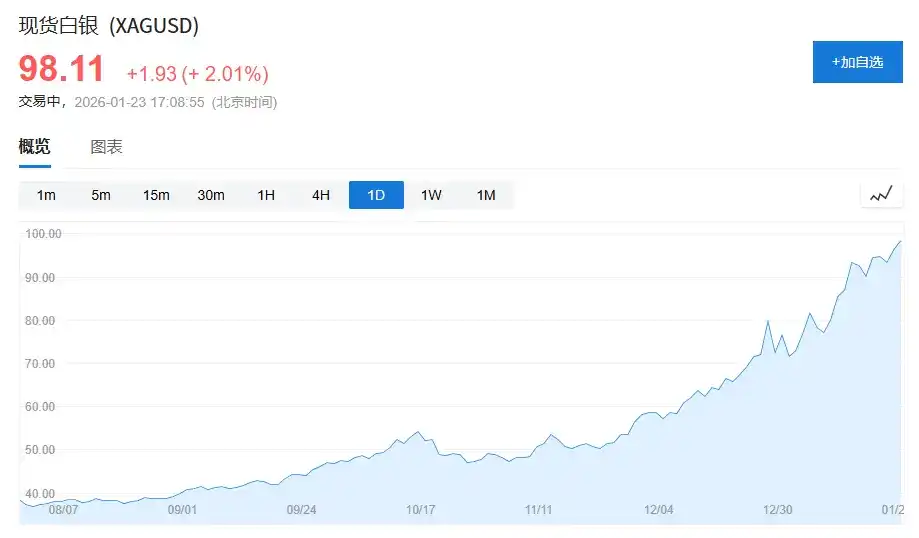
(Silver prices approach $100 per ounce. In mid-October last year, silver was only $50/ounce, nearly doubling in 3 months.)

1. Silver's "Identity Dilemma": Stuck Between Gold and Industrial Metals

To understand why silver has long been undervalued, one must first understand its "identity dilemma."

In the modern commodity system, assets can be broadly divided into two categories:

One is credit-based assets, typically represented by gold. Gold's value anchor does not come from industrial use but from the credit system and reserve demand. Even in the weakest years of demand, global central banks' net gold purchases still account for 15%–25% of total demand, providing a stable foundation for its price.

The other is growth assets, such as copper, crude oil, and iron ore. These metals have almost no financial attributes; their prices are mainly driven by economic cycles, infrastructure, and manufacturing investment.

Silver, however, is stuck between these two.

According to the "World Silver Survey 2025," global silver demand in 2024 was 1.164 billion ounces (approx. 36,200 tons), of which:

Industrial demand was 681 million ounces, accounting for about 58%;

Jewelry and silverware demand was 263 million ounces, accounting for about 23%;

Investment demand (bars, coins, ETFs) was about 191 million ounces, accounting for about 16%.

The problem is that these three types of demand have completely different behavioral patterns:

Industrial demand relies on the industry cycle, jewelry demand is highly price-sensitive, and investment demand is highly susceptible to macro sentiment.

This structural split has long left silver without a stable, single, dominant pricing anchor.

The result is reflected in the price: silver has long been forced to price itself relative to gold.

A clear indicator is the gold-silver ratio. Over the past half-century, the historical average of this ratio has been roughly 55–60; but between 2018–2020, it once exceeded 90, and at the peak of the pandemic shock, it even approached 120.

Even against the backdrop of silver's industrial demand hitting a record high in 2024, the gold-silver ratio has long remained in the 80–90 range, significantly higher than the long-term average.

This is not because silver is "useless," but because the market is still pricing silver using gold's financial logic.

2. Silver's Repositioning: From "Dispersed Use" to "Locked In by Industry"

The real change did not start in the financial markets but occurred quietly on the industrial side.

To summarize the current change in one sentence: Silver is shifting from an industrial metal with dispersed uses to a functional material locked in by key industries.

1. Photovoltaics: Silver Becomes "Indispensable" for the First Time

Photovoltaics are the most critical factor in the change of silver's demand structure.

In 2015, global new PV installations were about 50GW; by 2024, this number exceeded 400GW, an increase of over 8 times in less than a decade.

The industry is indeed continuously "de-silvering." Silver usage per watt has dropped from about 0.3 grams in the early days to around 0.1 grams with current mainstream technology.

But the expansion speed of installation scale is far faster than the decline in unit usage.

According to the "World Silver Survey 2025," the actual demand for silver from the PV industry in 2024 reached 198 million ounces, an increase of over 160% compared to 2019, accounting for about 17% of global silver demand.

More critically, silver's position in photovoltaics is not "easily replaceable." In terms of key indicators such as conductive efficiency, long-term stability, and reliability, silver remains the optimal choice overall. Technological progress changes the method of use, not the status.

This gives silver, for the first time, a source of demand that is large-scale, fast-growing, and price-inelastic.

2. Electric Vehicles and AI Infrastructure: Usage Not Exaggerated, but Extremely Difficult to Substitute

If photovoltaics bring certainty in demand scale, then electric vehicles and digital infrastructure bring a change in the nature of demand.

A traditional internal combustion engine vehicle uses about 15–20 grams of silver on average; a new energy vehicle typically uses 30–40 grams.

Against the backdrop of limited overall growth in global auto sales, the penetration rate of new energy vehicles has risen from less than 3% in 2019 to nearly 20% in 2024, structurally increasing silver demand.

Meanwhile, the demand for silver from data centers, AI servers, and high-end electronic devices is reflected more in its irreplaceability than in absolute volume.

In 2024, silver demand from electrical and electronic related fields reached 461 million ounces, setting new historical records for many consecutive years.

These application scenarios are relatively price-insensitive but are extremely sensitive to supply stability.
3. The Reality on the Supply Side: Silver Is Not a Metal That "Can Increase Production Just Because Prices Rise"

In stark contrast to the certainty on the demand side is the rigidity on the supply side.

In 2024, global silver mine production was approximately 820 million ounces, with a year-on-year growth rate of less than 1%.

More importantly, over 70% of global silver production comes as a by-product, mainly依附于 (attached to) lead, zinc, copper, and gold mines. This structure has hardly changed substantially over the past two decades.

Primary silver mine production is only about 228 million ounces, accounting for less than 30%, and is still in a long-term downward trend.

This means that silver production is not determined by the silver price but is主导 (led) by the investment cycles of base metals.

4. From Cyclical Shortage to Structural Tightness

Looking back at history, silver has experienced bull markets before, but past rallies were mostly derivatives of financial cycles.

The difference is that since 2021, the silver market has experienced a physical supply-demand deficit for several consecutive years.

According to the "World Silver Survey 2025," the average annual physical deficit in the global silver market from 2021–2024 was about 150–200 million ounces, with a cumulative deficit接近 (approaching) 800 million ounces.

And silver's visible inventories themselves are not ample. Current global流通 (circulating) inventories can only cover about 1–1.5 months of consumption, significantly below the 3-month safety line typically considered for commodities.

Once a large amount of silver enters PV modules, electrical equipment, and infrastructure, it is difficult to return to the流通市场 (circulating market).

5. Silver Is No Longer Just Gold's Shadow

Silver has not suddenly become scarce; it is just the first time it simultaneously satisfies three conditions:

Demand scale is real and sustained

Key uses are difficult to替代 (substitute)

Supply growth is highly constrained

In the past, these three points never appeared simultaneously.

While the market still understands silver as "poor man's gold," the industrial chain has already begun to re-examine it by the standards of a key functional material.

Silver may still be volatile, but it is certain that it is no longer just gold's shadow.

And this is the most important, yet most easily underestimated, underlying change in this round of market activity.


Связанные с этим вопросы

QWhy has silver historically been called 'poor man's gold' and what has changed recently?

ASilver was called 'poor man's gold' because it was seen as a cheaper, more accessible alternative to gold, and the market never took its scarcity seriously, assuming supply could always meet demand. This has changed because the market is now experiencing a sustained physical deficit driven by industrial demand from sectors like photovoltaics, electrification, and high-end electronics, while supply remains constrained and unable to keep pace.

QWhat is the main reason silver supply cannot quickly respond to price increases?

AOver 70% of global silver production comes as a by-product of mining other metals like copper, lead, and zinc. This means silver output is determined by the investment cycles of these base metals, not by the price of silver itself, making supply highly inelastic to silver price signals.

QWhich industry is the most significant driver of the new structural growth in silver demand, and why is it so important?

AThe photovoltaic (solar) industry is the most significant driver. It is important because, despite efforts to reduce silver use per watt (de-silverization), the massive expansion in global solar installations (from ~50GW in 2015 to over 400GW in 2024) has caused demand to surge. Silver's role is also crucial as it remains the optimal material for conductivity and reliability in solar cells, making it difficult to replace.

QHow does the 'identity dilemma' of silver affect its pricing in the commodity market?

ASilver's 'identity dilemma' refers to its split between being a credit asset (like gold, with financial and store-of-value properties) and a growth asset (like copper, driven by industrial cycles). This split means it lacks a single, stable pricing anchor. Consequently, its price has historically been heavily influenced by and correlated with gold (as seen in the gold-silver ratio), rather than being driven solely by its own industrial fundamentals.

QWhat evidence suggests the current silver market deficit is structural rather than just a cyclical shortage?

AThe evidence includes: 1) The deficit has been persistent, lasting for multiple consecutive years (2021-2024) with an average annual shortfall of 150-200 million ounces. 2) The deficit is driven by fundamental, long-term industrial demand growth (e.g., photovoltaics, EVs) rather than short-term financial speculation. 3) Supply is structurally rigid and cannot be quickly increased due to its by-product nature. 4) Once used in industrial applications like solar panels, silver is effectively 'consumed' and removed from the market, reducing available above-ground stocks.

Похожее

Неправомерно пострадавшие A-акции: Устойчивость, ожидания и основание

В июле глобальные технологические акции столкнулись с коррекцией, начавшейся с распродаж в Южной Корее и затронувшей рынки США, Японии и Китая (A-shares). Однако китайский рынок продемонстрировал устойчивость благодаря нескольким факторам. Во-первых, базовые показатели технологического сектора Китая остаются прочными. Такие подотрасли, как оптические модули и оптическое волокно, показывают высокий рост прибыли (например, New Eastsoft, Changfei Optical Fiber). В отличие от южнокорейского рынка, сильно зависящего от полупроводников памяти, китайский технологический сектор диверсифицирован (компьютеры, связь, электроника) и опирается как на глобальные цепочки поставок (например, для NVIDIA), так и на политику импортозамещения. Во-вторых, государственные институты («команда страны») активно поддерживают рынок, выделив сотни миллиардов юаней на выкуп акций и ETF через такие компании, как China Reform Holdings и China Chengtong. Этот шаг направлен на стабилизацию ликвидности и формирование позитивных ожиданий, сигнализируя о возможном достижении локального дна. В-третьих, другие ключевые секторы A-shares демонстрируют внутренний потенциал для восстановления: * **Потребительский сектор:** CPI стабильно превышает 1%, указывая на улучшение маржи. Ключевые игроки, такие как Kweichow Moutai, повышают цены, а розничные продажи алкоголя растут. * **Сырьевой сектор (например, алюминий):** Высокая рентабельность, сохраняющийся дефицит предложения и низкие оценки создают потенциал для роста. * **Финансовый сектор:** Банки предлагают высокие дивиденды, а брокеры и страховщики выигрывают от оживления на рынке капитала. Таким образом, текущая коррекция в основном вызвана внешними факторами, а не ухудшением фундаментальных показателей. При поддержке государства и наличии внутренних драйверов роста в нескольких секторах рынок A-shares обладает значительной устойчивостью для возвращения к стабильности.

marsbit30 мин. назад

Неправомерно пострадавшие A-акции: Устойчивость, ожидания и основание

marsbit30 мин. назад

Квантовые компьютеры ещё не пришли, а 1,1 миллион биткоинов Сатоши Накамото уже стали проблемой

**Квантовые компьютеры еще не прибыли, а 1,1 миллион биткоинов Сатоши уже стали проблемой** Инструмент на основе доказательств с нулевым разглашением (ZK) от Project Eleven обещает помочь владельцам современных кошельков (после 2012 года) безопасно мигрировать активы перед квантовой атакой. Однако для ранних биткоинов, включая примерно 1,1 миллион монет, добытых Сатоши Накамото и хранящихся в устаревших адресах P2PK, этот инструмент бесполезен. У этих «старых» монет нет иерархической структуры ключей (HD), что делает их криптографически незащищенными. Сообщество Bitcoin столкнулось с политической, а не технической дилеммой: как защитить сеть, не нарушая ее основные принципы? Предлагается четыре спорных пути, каждый со своими последствиями: бездействие (риск массовой кражи), принудительная заморозка старых монет (нарушение прав собственности), ограничение их расходования («песочные часы») или принудительное перераспределение (разрушение неизменности реестра). Рынок уже реагирует на этот кризис управления. Например, Jefferies сократил свои биткоин-холдинги, ссылаясь именно на неопределенность в вопросе уязвимых монет. Угроза не только в будущих атаках, но и в «отложенном» взломе: злоумышленники уже сейчас сохраняют данные блокчейна для последующей расшифровки. Ключевой вопрос остается без ответа: как Bitcoin может пережить смену технологических эпох, не отказавшись от своих фундаментальных основ? Квантовый вызов уже породил кризис доверия.

marsbit39 мин. назад

Квантовые компьютеры ещё не пришли, а 1,1 миллион биткоинов Сатоши Накамото уже стали проблемой

marsbit39 мин. назад

Где будет главное поле битвы следующего бычьего рынка? Ответ скрыт в этих двух классах активов

Крипторынок показывает признаки достижения дна. С 1 июля биткойн вырос на 9%, тогда как индекс Nasdaq 100 упал на 6%. Вопрос о том, какие активы возглавят следующий бычий цикл, становится актуальным. По мнению Мэтта Хоугена, главным нарративом следующего бума криптовалют станет слияние традиционных финансов (TradFi) и ончейн-финансов (DeFi). Это будет включать стейблкоины, токенизацию активов, круглосуточную торговлю, мгновенные расчеты и рост институционального DeFi до масштаба в триллионы долларов. Два ключевых направления для инвестиций выделяются в этой тенденции: 1. **Нативные криптопроекты с реальными доходами и качественной токеномикой**, такие как Hyperliquid (HYPE). Эта L1-сеть для деривативов привлекает пользователей удобством и быстро расширяется на торговлю традиционными активами (нефть, индексы). Платформа генерирует значительные доходы, 99% из которых направляются на выкуп и сжигание токена HYPE. 2. **Устоявшиеся традиционные компании, активно внедряющие криптоинфраструктуру**, такие как Robinhood (HOOD). Брокер не только предлагает торговлю криптовалютами, но и запустил собственную L2-сеть Robinhood Chain для круглосуточной торговли токенизированными акциями и использования DeFi-протоколов в 120 странах, демонстрируя серьезные намерения. Автор считает, что будущий бычий рынок, движимый реальной полезностью и нацеленный на глобальные финансы, может стать крупнейшим в истории. Инвесторам стоит обратить внимание на проекты и компании, которые уже сегодня активно строят мосты между двумя мирами финансов.

Foresight News43 мин. назад

Где будет главное поле битвы следующего бычьего рынка? Ответ скрыт в этих двух классах активов

Foresight News43 мин. назад

Путь к принятию закона Clarity: Дорога двухпартийных компромиссов в США усыпана терниями

Закон о регулировании крипторынка Clarity сталкивается со значительными трудностями на пути к принятию в Конгрессе США. Несмотря на двухпартийное согласие о необходимости законодательства, ключевые разногласия по этическим нормам для избранных лиц, вопросам «доходности» и защите разработчиков блокируют прогресс. В мае законопроект прошел комитет Сената по сельскому хозяйству без поддержки демократов, которые настаивают на строгих этических гарантиях. К июлю давление возросло: республиканцы стремятся к голосованию, а демократы и некоторые республиканцы, а также правоохранительные органы выражают озабоченность по поводу потребительских рисков и отмывания денег. Хотя работа над поиском компромисса продолжается, включая переговоры с Белым домом, сенаторы-демократы четко дают понять, что без приемлемых этических положений их поддержки не будет. Несмотря на оптимизм в отрасли, путь к принятию закона остается крайне сложным и зависит от способности сторон найти взаимоприемлемое решение по спорным вопросам.

marsbit51 мин. назад

Путь к принятию закона Clarity: Дорога двухпартийных компромиссов в США усыпана терниями

marsbit51 мин. назад

Основатели Kalshi и Polymarket враждуют? Эта бизнес-война оказалась гораздо ожесточеннее, чем можно представить

В 2024 году основатель Polymarket Шейн Коплан столкнулся с обыском ФБР, который, по мнению его команды, мог быть инициирован его главным конкурентом — CEO Kalshi Тареком Мансуром. Два основателя предсказательных рынков, оба ставшие миллиардерами, ведут ожесточенную борьбу, выходящую далеко за рамки обычной бизнес-конкуренции и переходящую в личную вражду. Их противостояние основано на разных подходах: Kalshi делает ставку на полное соблюдение правил США, в то время как Polymarket долгое время работал через офшорную платформу, доступную американским пользователям через VPN. Мансур публично осуждает методы Polymarket как «незаконные и неэтичные». Конфликт проявляется во всем: в попытках сорвать сделки друг друга (как в случае с переговорами о финансировании от Intercontinental Exchange), в переманивании сотрудников, в публичных нападках и даже в предположениях о слежке. Kalshi неоднократно жаловалась регуляторам на Polymarket. Несмотря на давление, Polymarket, получившая крупные инвестиции и купившая лицензированную платформу, вернулась на рынок США. Сейчас Kalshi лидирует по объему торгов и оценке, но война за доминирование на быстрорастущем рынке предсказаний продолжается, привлекая все больше внимания регуляторов.

marsbit58 мин. назад

Основатели Kalshi и Polymarket враждуют? Эта бизнес-война оказалась гораздо ожесточеннее, чем можно представить

marsbit58 мин. назад

Торговля

Спот
活动图片




