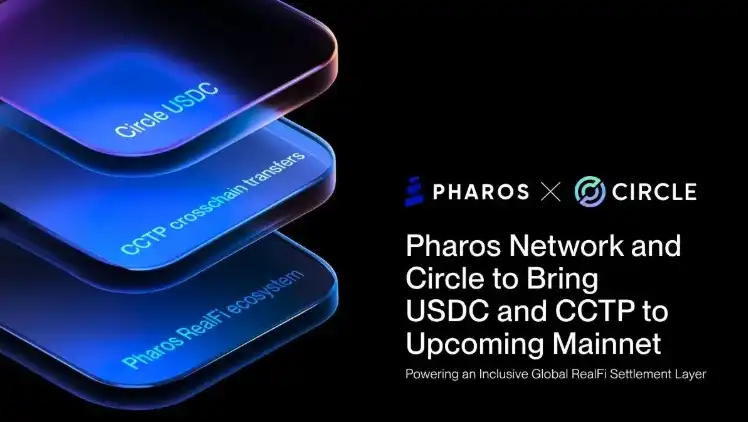
Pharos Network Partners with Circle to Promote the Construction of an Open and Inclusive Global RealFi Settlement System

marsbitОпубликовано 2026-03-27Обновлено 2026-03-27

Введение

Pharos Network, a financial-grade Layer1 blockchain, has announced the integration of USDC and Circle's Cross-Chain Transfer Protocol (CCTP) into its mainnet, The Pacific Ocean. This move introduces institutional-grade stablecoin settlement capabilities and enables seamless cross-chain liquidity across more than 20 supported blockchains. USDC, a fully reserved and transparent dollar-backed stablecoin, will serve as a core asset for real-world asset (RWA) tokenization, DeFi trading, lending, and global payments. By eliminating the need for third-party bridges or wrapped assets, CCTP enhances security and capital efficiency. The integration allows developers to build lending markets, structured products, and global payment networks on Pharos Network. It also gain access to compliant on-chain RWA markets, while users benefit from broader real-world financial opportunities. Additionally, Pharos Network has launched a $10 million ecosystem incubation program to support native application development. The foundation aims to build an open, transparent, and inclusive global RealFi settlement infrastructure, facilitating the flow of institutional-grade assets on-chain.

Pharos Network, a financial-grade Layer 1 blockchain, announced today that USDC and the Circle Cross-Chain Transfer Protocol (CCTP) will be deployed on its mainnet, The Pacific Ocean. This integration will introduce mainstream stablecoin settlement capabilities to the network and enable seamless cross-chain fund flows. This move marks a significant step forward in Pharos Network's mission to build an open and inclusive global RealFi settlement system.

The introduction of USDC brings an institutional-grade stablecoin to the Pharos Network ecosystem. As a transparent, 100% reserve-backed dollar stablecoin, USDC will serve as a core settlement and collateral asset in real-world asset tokenization (RWA), DeFi trading and lending, and global payment scenarios. Simultaneously, CCTP will establish native cross-chain connectivity between Pharos Network and over 20 supported blockchains, providing more than 400 secure transaction paths. By eliminating the reliance on third-party cross-chain bridges or wrapped assets, CCTP helps enhance asset integrity and capital efficiency.

With USDC integrated at the protocol layer for settlement, developers can build lending markets, structured financial products, and a 24/7 global payment network on Pharos Network. Institutional funds can access on-chain RWA markets through compliant infrastructure, while global users will gain access to real-world financial opportunities.

The integration of USDC and CCTP is expected to unlock diverse financial application scenarios within the Pharos Network ecosystem. In tokenized financial markets, USDC can serve as the primary settlement and collateral tool for assets such as government bonds, private credit, and commodities, while providing liquidity support for DeFi trading and lending. Beyond trading, merchants and payment service providers can leverage USDC for efficient settlement, benefiting from its transparent reserves and redemption mechanisms. Meanwhile, CCTP will support the seamless transfer of USDC between Pharos Network and other chains, enabling funds to flow freely across different ecosystems, thereby improving liquidity management efficiency and facilitating the distribution of RWA across chains.

Wish Wu, a member of the Pharos Network Foundation, stated: "RealFi requires both a trusted settlement system and global accessibility. The integration of USDC and CCTP will bring institutional-grade reliability to Pharos Network while making this reliability more accessible to global developers and users. Our vision has always been to build truly inclusive infrastructure to support the development of real-world financial markets."

With the deployment of USDC and CCTP completed, Pharos Network is now fully open to developers, financial institutions, and enterprises, providing compliant, stable, and high-performance infrastructure to support the development of real-world financial applications. To further drive ecosystem growth, Pharos Network has also launched a $10 million ecosystem incubation program to support developers in building native applications.

By introducing USDC and CCTP to enable secure cross-chain fund flows, Pharos Network is building the underlying infrastructure for RealFi, enabling institutional-grade assets to circulate on-chain while being accessible to global users, accelerating the transition of real-world finance towards openness, transparency, and inclusion.

About Pharos Network

Pharos Network is a Layer 1 blockchain designed for real-world financial applications, dedicated to enabling seamless interaction between on-chain systems and institutional-grade assets. The network features a modular architecture and supports deeply parallel execution in both EVM and WASM environments, with built-in compliance capabilities to support the next generation of global financial infrastructure. Pharos Network is developed by an engineering team from Ant Group and is backed by globally renowned investment institutions such as Hack VC and Faction VC.

Связанные с этим вопросы

QWhat is the significance of USDC and Circle's Cross-Chain Transfer Protocol (CCTP) being deployed on Pharos Network?

AThe deployment of USDC and CCTP on Pharos Network introduces mainstream stablecoin settlement capabilities and enables seamless cross-chain fund flows. This integration is a major step in Pharos Network's mission to build an open and inclusive global RealFi settlement system.

QHow does the CCTP benefit the Pharos Network ecosystem in terms of connectivity?

ACCTP establishes native cross-chain connectivity between Pharos Network and over 20 supported blockchains, providing more than 400 secure transaction paths. It eliminates the need for third-party bridges or wrapped assets, enhancing asset integrity and capital efficiency.

QWhat role does USDC play within the Pharos Network's RealFi applications?

AUSDC serves as a core settlement and collateral asset in RealFi applications, including real-world asset (RWA) tokenization, DeFi trading and lending, and global payment scenarios. It provides liquidity and is backed by transparent, 100% reserve-backed dollars.

QWhat did the Pharos Network Foundation member, Wish Wu, say about the integration?

AWish Wu stated that the integration of USDC and CCTP brings institutional-grade reliability to Pharos Network and makes this reliability more accessible to global developers and users. The vision is to build truly inclusive infrastructure to support the development of real-world financial markets.

QWhat additional initiative has Pharos Network launched to support ecosystem growth?

APharos Network has launched a $10 million ecosystem incubation program to support developers in building native applications on its network, further promoting ecosystem growth alongside the new infrastructure.

Похожее

Anthropic Cries Wolf: Is the AGI Threat Real, or Just an IPO Story?

Anthropic has published an article titled "When AI builds itself," discussing the emerging concept of "recursive self-improvement," where AI begins to actively participate in designing, training, testing, and optimizing its own subsequent versions. The company presents internal data showing that by May 2026, over 80% of code merged into its codebase was written by Claude, its AI model. Claude's capabilities have expanded to handling complex, open-ended engineering tasks, achieving a 76% success rate in such areas, and even contributing to research processes, such as optimizing code performance and conducting AI safety experiments. Anthropic outlines an evolution from human-driven development to AI-assisted workflows, culminating in the current stage where AI agents can autonomously write, run, and delegate code. The company cautions that the path toward a "closed loop," where AI continuously improves itself, is becoming visible. It calls for coordinated global mechanisms to potentially slow or pause frontier AI development to allow safety research and societal structures to catch up. However, the timing of this warning coincides with Anthropic's preparations for an IPO, framing the narrative not just as a safety concern but also as a demonstration of Claude's advanced capabilities and its integral role in accelerating Anthropic's own R&D—creating a potential "flywheel" effect for competitive advantage. This contrasts with OpenAI's recent, more policy-oriented discussion of the same risks, highlighting the competitive dynamics in the AI industry as companies position themselves in both the technological and regulatory landscape.

marsbit33 мин. назад

Anthropic Cries Wolf: Is the AGI Threat Real, or Just an IPO Story?

marsbit33 мин. назад

BIT Research: ETF Purchases Have Slowed, Strategy (MicroStrategy) Has Slowed, What Else Can Drive Bitcoin's Rise?

Market Refocus on Inflation and Rate Expectations Weighs on Bitcoin Currently, the market is in a phase of macro-repricing dominated by inflation and interest rate expectations. Bitcoin, which previously benefited from easy liquidity and low inflation, is seeing its core bullish drivers weaken. These drivers were market expectations for interest rate cuts and strong inflows from Bitcoin ETFs and institutions like MicroStrategy (referred to as "Strategy" in the text). The logic has shifted. Recent high inflation data (e.g., CPI hitting 3.8% in a May 2026 report) has caused the market to sharply reduce its rate cut expectations for 2025 and even price in potential hikes. This is a key constraint for Bitcoin, as it lacks cash flows and is highly sensitive to rate expectations. Concurrently, institutional capital flows have slowed significantly. Following the hot CPI data, Bitcoin ETFs saw accelerated outflows, with around $4.3 billion leaving over a period. MicroStrategy's ability to keep adding substantial Bitcoin to its balance sheet is also diminishing. Together, ETF and MicroStrategy holdings total roughly $110 billion, but their momentum as growth engines is cooling. In summary, Bitcoin's current pressure stems not from its own fundamentals but from a changing macro environment. As long as inflation stays elevated, Bitcoin is likely to remain in a consolidating phase. However, historically, inflation eventually peaks. Once it recedes and rate cut expectations rebuild, institutional capital could return, potentially fueling a new and more robust recovery phase for Bitcoin.

marsbit41 мин. назад

BIT Research: ETF Purchases Have Slowed, Strategy (MicroStrategy) Has Slowed, What Else Can Drive Bitcoin's Rise?

marsbit41 мин. назад

Earning 1000 Trillion in Half a Year, 'Pocketing' 20 Million per Capita: This Round of Wealth Creation in the Korean Stock Market is Unprecedented in Scale

The South Korean stock market is experiencing an unprecedented wealth surge in 2026, with household equity and fund asset values soaring by over 1,000 trillion KRW (~$730bn) year-to-date. This translates to an average per capita wealth increase of roughly 20 million KRW, fueled by a historic 109% rally in the KOSPI index. The boom is driven by three converging forces: an AI-driven semiconductor supercycle boosting giants like Samsung and SK Hynix; the government's "Value-Up" market reforms addressing long-standing corporate governance issues; and aggressive real estate regulations that have locked capital within financial markets, preventing profits from flowing back into property. This has triggered a wealth effect, boosting high-end consumption significantly. However, the gains are highly concentrated. The two semiconductor behemoths account for over half the index's value, but retail investors own relatively low stakes in them, systematically missing the biggest rallies. Wealth and consumption benefits are skewed towards luxury goods and imported cars, bypassing mainstream retail. Further risks stem from excessive leverage, with high trading volume in leveraged ETFs, and a market sentiment heavily reliant on the AI sector's fortunes and speculative rumors. While this cycle marks a potential shift from real estate to equities as a primary wealth generator for Koreans, its sustainability, amid structural imbalances and leverage, remains a critical test.

marsbit46 мин. назад

Earning 1000 Trillion in Half a Year, 'Pocketing' 20 Million per Capita: This Round of Wealth Creation in the Korean Stock Market is Unprecedented in Scale

marsbit46 мин. назад

Behind ZEC's Over 30% Plunge: An 'Unlimited Minting' Vulnerability with No Way to Prove if It Was Ever Exploited

A critical vulnerability was discovered in Zcash's Orchard privacy pool, allowing for the theoretical creation of undetectable counterfeit ZEC. Researcher Taylor Hornby found the flaw on May 29th, 2024, within the Orchard circuit's cryptographic constraints, which could let an attacker bypass asset conservation rules. Although a rapid emergency fix was deployed within days via a coordinated soft and hard fork, a core uncertainty remains: due to Orchard's privacy features, it is impossible to cryptographically prove whether this "unlimited mint" flaw was exploited in the nearly four years since the pool's 2022 launch. This uncertainty, rather than the patched flaw itself, triggered a market panic, causing ZEC's price to drop over 30%. While the Zcash Foundation stated no evidence of exploitation was found, independent entity Shielded Labs emphasized the impossibility of definitively proving no counterfeit ZEC was ever created. The incident highlights the unique trust challenge in privacy systems. To address this, developers are proposing a new network upgrade with enhanced auditing to allow verifiable proof of supply integrity. Notably, the researcher utilized the newly released AI model Claude Opus 4.8 as a tool during the security review, signaling the growing role of advanced AI in uncovering complex cryptographic vulnerabilities.

marsbit48 мин. назад

Behind ZEC's Over 30% Plunge: An 'Unlimited Minting' Vulnerability with No Way to Prove if It Was Ever Exploited

marsbit48 мин. назад

Торговля

Спот
Фьючерсы

Популярные статьи

Как купить LAYER

Добро пожаловать на HTX.com! Мы сделали приобретение Solayer (LAYER) простым и удобным. Следуйте нашему пошаговому руководству и отправляйтесь в свое крипто-путешествие.Шаг 1: Создайте аккаунт на HTXИспользуйте свой адрес электронной почты или номер телефона, чтобы зарегистрироваться и бесплатно создать аккаунт на HTX. Пройдите удобную регистрацию и откройте для себя весь функционал.Создать аккаунтШаг 2: Перейдите в Купить криптовалюту и выберите свой способ оплатыКредитная/Дебетовая Карта: Используйте свою карту Visa или Mastercard для мгновенной покупки Solayer (LAYER).Баланс: Используйте средства с баланса вашего аккаунта HTX для простой торговли.Третьи Лица: Мы добавили популярные способы оплаты, такие как Google Pay и Apple Pay, для повышения удобства.P2P: Торгуйте напрямую с другими пользователями на HTX.Внебиржевая Торговля (OTC): Мы предлагаем индивидуальные услуги и конкурентоспособные обменные курсы для трейдеров.Шаг 3: Хранение Solayer (LAYER)После приобретения вами Solayer (LAYER) храните их в своем аккаунте на HTX. В качестве альтернативы вы можете отправить их куда-либо с помощью перевода в блокчейне или использовать для торговли с другими криптовалютами.Шаг 4: Торговля Solayer (LAYER)С легкостью торгуйте Solayer (LAYER) на спотовом рынке HTX. Просто зайдите в свой аккаунт, выберите торговую пару, совершайте сделки и следите за ними в режиме реального времени. Мы предлагаем удобный интерфейс как для начинающих, так и для опытных трейдеров.

667 просмотров всегоОпубликовано 2025.02.11Обновлено 2026.06.02

Как купить LAYER

Обсуждения

Добро пожаловать в Сообщество HTX. Здесь вы сможете быть в курсе последних новостей о развитии платформы и получить доступ к профессиональной аналитической информации о рынке. Мнения пользователей о цене на LAYER (LAYER) представлены ниже.

活动图片