On the Same Day Aave Introduced rsETH, Why Did Spark Choose to Exit?

marsbitОпубликовано 2026-04-20Обновлено 2026-04-20

Введение

On April 18, Kelp DAO's cross-chain bridge was exploited, resulting in the malicious minting of 116,500 unbacked rsETH. The attacker deposited these into Aave and borrowed WETH, creating a potential bad debt of approximately $195 million. Aave’s Guardian quickly froze the market, but the protocol’s insurance could only cover about 25% of the loss. In contrast, SparkLend, a lending protocol in the MakerDAO ecosystem, suffered no direct losses. This was not due to superior foresight but rather a preemptive governance decision. On January 29, Spark executed a governance action to discontinue new rsETH supply, citing low usage and high concentration from a single wallet. The same day, Aave expanded its rsETH market by enabling E-Mode with a 93% LTV to attract more deposits. Spark’s risk management framework is designed to remove assets with low usage or poor risk-adjusted returns, regardless of external security concerns. Aave’s decision was growth-oriented, aiming to boost WETH utilization and attract capital. Spark also employs additional safeguards: rate-limited supply and borrow caps that would have limited the scale of such an attack, and a robust oracle system using the median of three price feeds. These mechanisms systemically contain the maximum exposure to any single risk event, demonstrating a fundamentally different approach to risk than Aave’s growth-first model.

On April 18, Kelp DAO's cross-chain bridge was attacked, with the attacker minting 116,500 rsETH without real asset backing, which were then deposited into Aave to borrow WETH. The Aave Guardian initiated an emergency freeze within hours. According to on-chain estimates by Lookonchain, the potential bad debt faced by Aave V3 and V4 is approximately $195 million.

In contrast, SparkLend, the lending protocol under the MakerDAO (Sky) ecosystem, suffered no losses.

This is not because Spark's team is smarter than Aave's, nor because they identified the vulnerability in this cross-chain bridge in advance. Spark's reason for exiting rsETH was written in a governance forum post three months ago and has nothing to do with the security of the bridge contract.

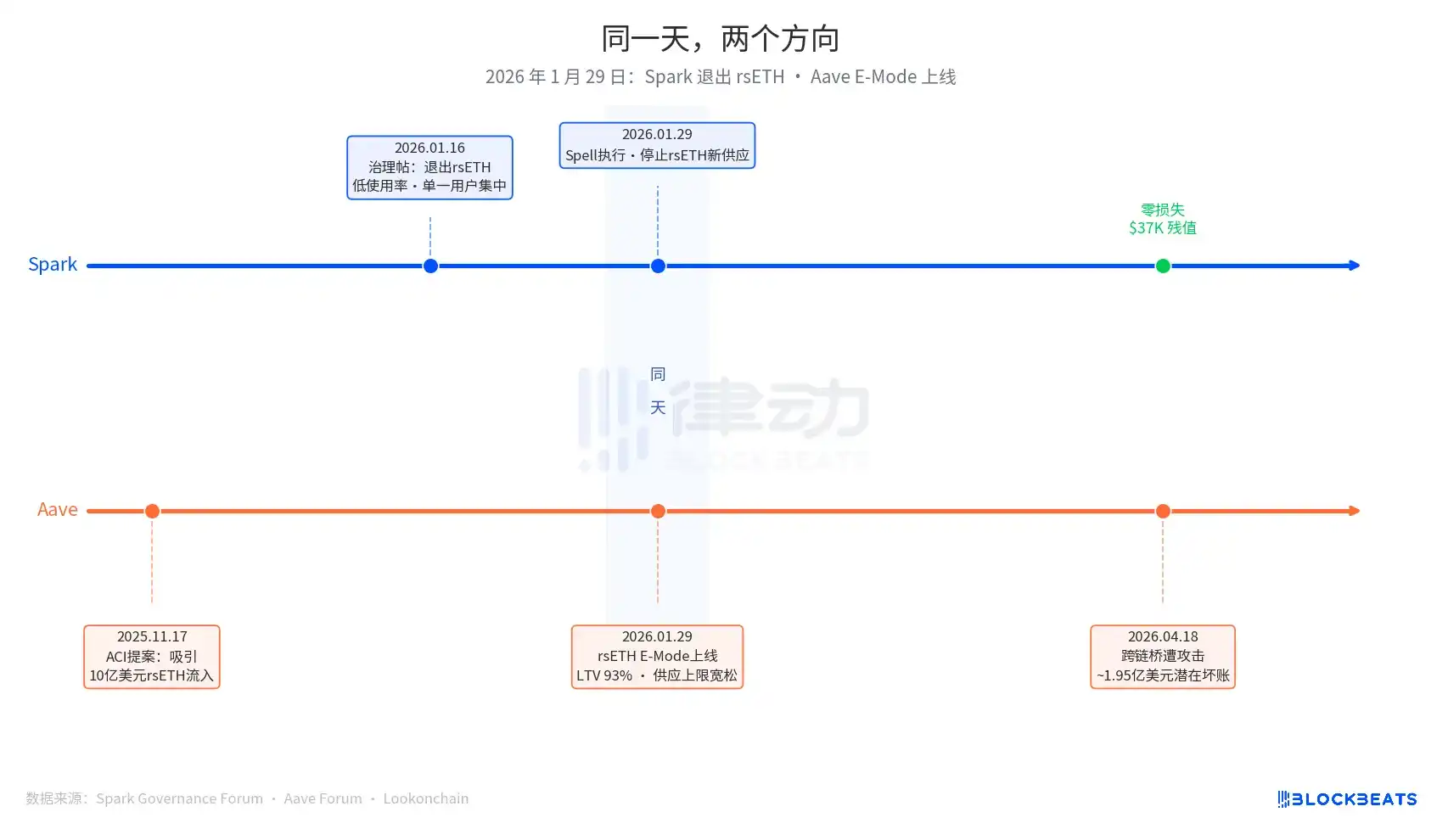
January 29, 2026, is the core date of this article. On this day, Spark executed a governance operation called Spell, halting new supply of rsETH. On the same day, Aave's rsETH E-Mode officially launched, allowing users to use rsETH as collateral to borrow WETH with a maximum loan-to-value (LTV) ratio of 93%.

One exited, the other expanded, both on the same day.

Spark's decision to exit began with a governance post submitted by PhoenixLabs (Spark's ecosystem execution body) on January 16, 2026. The reason was straightforward: low utilization of rsETH, with almost all usage coming from a single wallet (on-chain address 0xb99a), and the holder of this wallet had expressed willingness to use alternative collateral like wstETH or weETH. The original governance post stated, "Exiting rsETH can improve SparkLend's safety margin and enhance risk-adjusted returns." This was a periodic asset cleanup; other assets exited in the same batch included tBTC, ezETH, and the entire Gnosis Chain market, all for the unified reason of "low utilization."

Aave's expansion decision started earlier, from a proposal initiated by ACI (Aave Chan Initiative, a governance proposal body led by Marc Zeller) on November 17, 2025. The motivation was clear: "Restore WETH utilization, expected to attract $1 billion in rsETH inflows." Chaos Labs completed risk parameter confirmation in January, setting the E-Mode LTV at 93% and the liquidation threshold at 95%. Entities involved in the decision included ACI, Chaos Labs, LlamaRisk, and Aave community voters. This was an expansion decision driven by multiple parties, not a mistake by a single entity.

Three months later, the market delivered the result.

In Aave's current Umbrella insurance mechanism, available funds are approximately $50 million, covering only about 25% of the potential $195 million bad debt. The loss absorption order is: aWETH stakers bear the loss first, followed by WETH depositors proportionally, then stkAAVE and the DAO treasury. Aave's TVL dropped from $26.4 billion to $19.8 billion, including panic withdrawals. The USDT market utilization reached 100% within hours, with new borrowing amounting to approximately $300 million.

In SparkLend's rsETH market, the current frozen residual value is $37,300, equivalent to 15.32 rsETH. Wallet 0xb99a had almost entirely migrated to wstETH and weETH after new supply was prohibited on January 29, exactly matching the prediction in the governance post.

Spark co-founder Sam MacPherson (@hexonaut) pointed out on April 19: Protocols claiming no exposure to rsETH does not mean they truly have no exposure. If users have collateral in affected lending markets, indirect exposure still exists. Spark had no direct losses, but indirect risks are still being assessed.

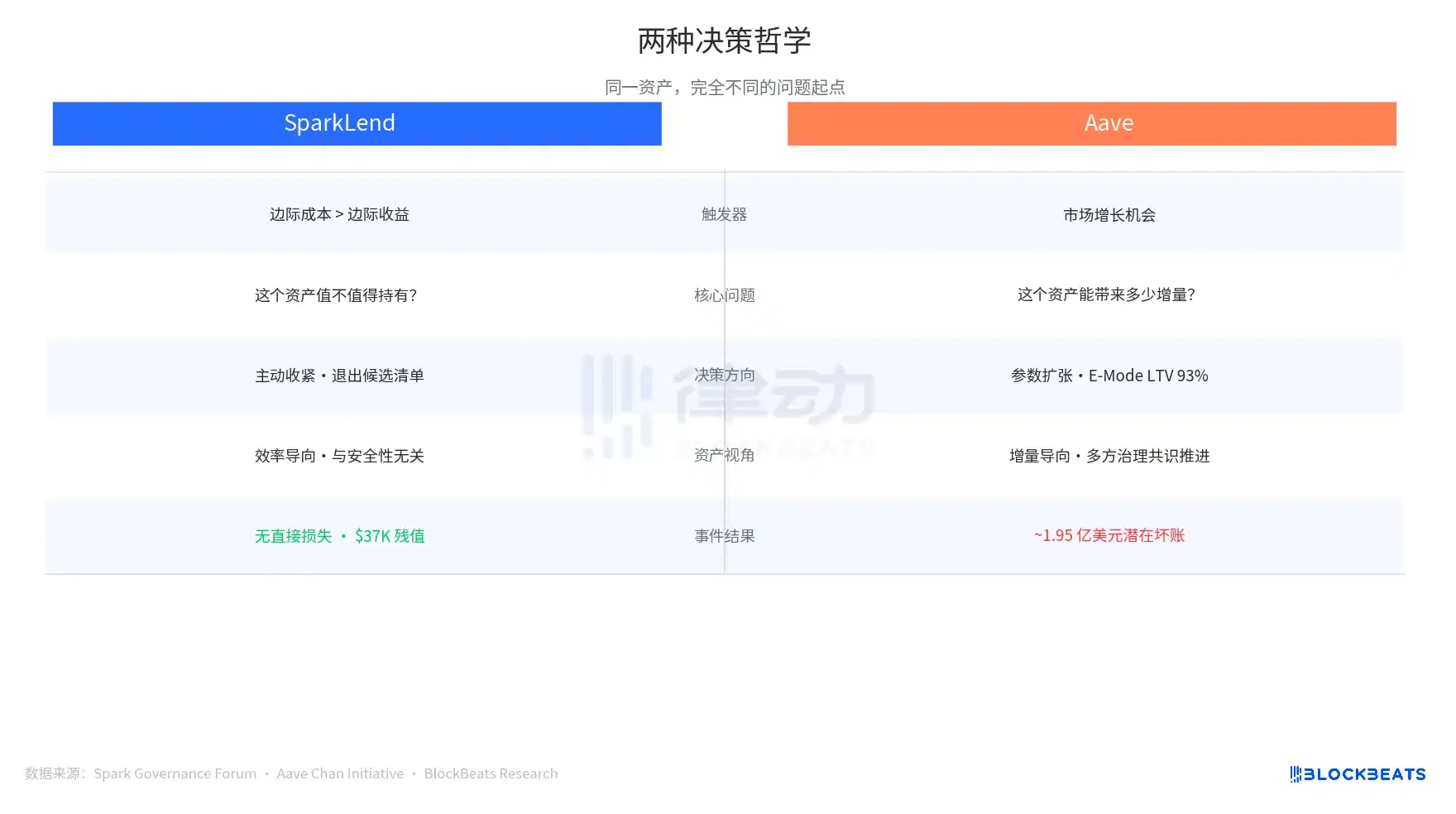
Both protocols made opposite decisions on the same day. This is not about whether Spark or Aave made the right decision; the starting points of the two systems were completely different.

Spark's risk control logic is triggered by "whether marginal cost exceeds marginal benefit." If utilization falls below a threshold, single-user concentration exceeds the standard, or risk-adjusted returns are subpar, any hit places the asset on the exit candidate list. This is a proactive, efficiency-oriented tightening mechanism, unrelated to whether the asset itself has security risks.

Aave's logic is triggered by "market growth opportunities." WETH utilization was relatively low, the rsETH market was large enough, and E-Mode could attract incremental funds. Starting from this entry point, the parameter direction was expansion: LTV 93%, loose supply cap, and promotion by multiple governance entities.

These two protocols answer completely different questions: "Is this asset worth continuing to hold?" versus "How much incremental value can this asset bring?" Before a risk event is triggered, both approaches are reasonable business logics. The referee only appears after the trigger.

Spark's safety outcome has another layer of support.

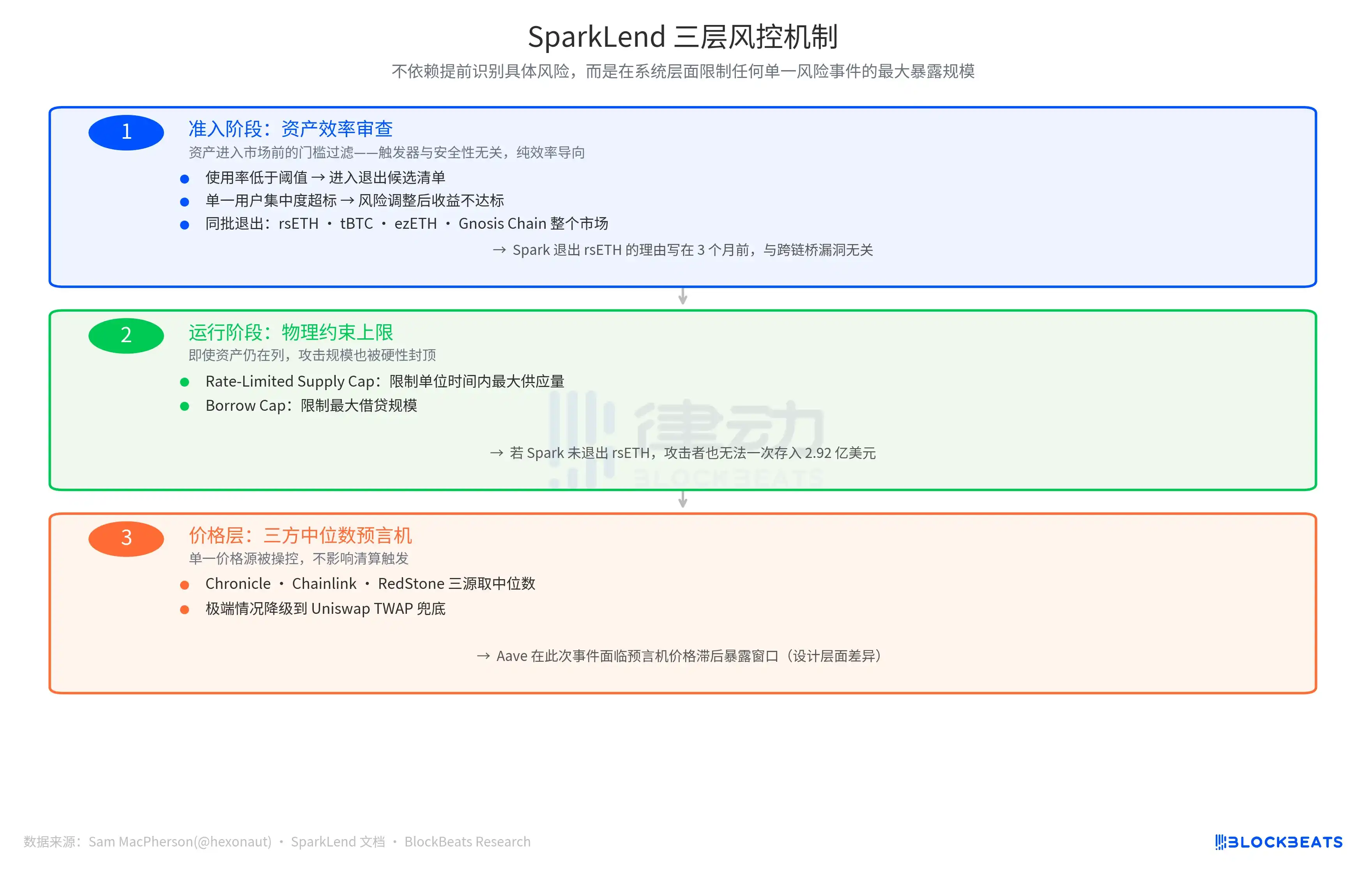
In his April 19 X post announcing the "exit from rsETH," Sam MacPherson mentioned: "SparkLend has rate-limited supply and borrow caps. Its oracle mechanism also uses a three-median system." This points to two other lines of defense in Spark's risk control system.

One is the physical constraint during operation. The Rate-Limited Supply Cap limits the maximum supply per unit time, and the Borrow Cap limits the maximum borrowing scale. The implication of these two designs is that even if Spark had not exited rsETH, the attacker could not have deposited $292 million worth of rsETH in one go as they did on Aave; the loss scale would have been compressed by a hard cap.

The other line is at the price information layer: a 3-median oracle, taking the median from three independent price sources—Chronicle, Chainlink, and RedStone—with Uniswap TWAP as a fallback in extreme cases. Manipulation of a single price source does not affect liquidation triggers. In contrast, Aave faced an exposure window during this event due to lagging oracle prices, a design-level difference rather than an execution-level mistake.

The design logic of these three lines of defense is consistent: they do not rely on identifying specific risks in advance but instead limit the maximum exposure scale of any single risk event at the system level.

The final loss figure depends on Kelp DAO's loss distribution plan. Currently, there are three options: socializing the loss among all-chain rsETH holders (reducing the bad debt scale), having L2 rsETH holders bear the loss alone (mainnet Aave bad debt remains unchanged), or a snapshot rollback (extremely difficult to execute). This number will be answered in the coming weeks.

But the results of the two decision-making philosophies can already be quantified: a gap of approximately $195 million, triggered on the same date, written into the governance operations on the same day.

Связанные с этим вопросы

QWhy did Spark choose to exit rsETH on the same day Aave introduced it?

ASpark exited rsETH due to low usage and high concentration from a single wallet, aiming to improve security margins and risk-adjusted returns, as part of a periodic asset cleanup.

QWhat was the financial impact of the rsETH attack on Aave?

AThe attack resulted in approximately $195 million in potential bad debt for Aave V3 and V4, with its insurance mechanism covering only about 25% of the losses.

QHow did Spark's risk management system help avoid losses from the rsETH incident?

ASpark had preemptive measures like rate-limited supply and borrow caps, a median-of-three oracle system, and had already exited rsETH due to low usage, minimizing exposure.

QWhat were the key differences in Spark and Aave's decision-making processes regarding rsETH?

ASpark focused on efficiency and risk-adjusted returns, exiting low-usage assets, while Aave prioritized market growth opportunities, expanding with high LTV and E-Mode to attract capital.

QWhat additional risk controls does SparkLend have in place beyond asset selection?

ASparkLend uses rate-limited supply and borrow caps to restrict deposit and loan sizes, and a median-of-three oracle system with fallback mechanisms to prevent price manipulation and limit max exposure.

Похожее

Blocked Its Own Treasure, WeChat AI Steps Up

Tencent's stock surged over 10% on June 2nd amid reports that WeChat, with 1.43 billion monthly users, is finalizing tests for a native AI Agent. The reported feature, accessible by swiping right from the main interface, allows users to issue commands in natural language. The AI then decomposes tasks and automatically calls upon relevant Mini Programs within WeChat to complete actions like ordering food, booking tickets, or making payments, creating a closed-loop service execution system. This strategic shift follows the internal conflict and subsequent "blocking" of Tencent's standalone AI app, Yuanbao, by WeChat for violating sharing rules during a 2026 Spring Festival promotion. The incident highlighted a lack of internal consensus and exposed the weakness of competing in the standalone AI assistant arena against rivals like ByteDance's Doubao (345M MAU) and Alibaba's Qianwen. The new WeChat AI Agent aims to leverage WeChat's unique assets—its massive user base, standardized Mini Program APIs, WeChat Pay, and identity system—to move from simple content generation to actual task execution. Analysts note this changes the competitive landscape from model benchmarks to which AI can connect to more real-world services. However, success depends on key variables: the capability of Tencent's underlying Hunyuan model, managing massive inference costs, and redesigning incentives for Mini Program developers whose traffic might be bypassed. The move is seen as an attempt to keep user service intent within WeChat's ecosystem as AI begins to redefine how users access services.

marsbit14 мин. назад

Blocked Its Own Treasure, WeChat AI Steps Up

marsbit14 мин. назад

ByteDance Adopts Arm CPUs, Jensen Huang: So Sad I Didn't Buy Arm

**Summary:** At Computex 2026, Arm CEO Rene Haas announced that ByteDance and Oracle have adopted Arm's self-designed Arm AGI data center CPU. The company expects significant revenue growth from this product, projecting $20 billion in demand for the 2027/2028 fiscal years. Haas noted that restricting AI-capable CPUs from the US to China is nearly impossible due to their widespread applications. Arm's stock has surged dramatically this year, notably rising 16% after NVIDIA's Arm-based Vera CPU and RTX Spark announcements. A highlight was the informal, humorous on-stage conversation between Haas and NVIDIA CEO Jensen Huang. Huang joked about NVIDIA's failed attempt to acquire Arm and playfully lamented selling his Arm shares. Both executives showed a clear sense of camaraderie and shared regret over the missed merger. Key technical topics were discussed: 1. **AI PC Design:** Huang explained NVIDIA's RTX Spark superchip (with a 20-core Arm CPU) is designed for future AI agents that will autonomously run and use tools on PCs, blending local and cloud processing. 2. **Agent vs. OS:** Huang emphasized the operating system remains crucial, as AI agents rely on its APIs and tools to function. 3. **Growth Constraints:** He identified the shift to "useful AI" that generates profitable tokens as a primary driver for immense, almost limitless, computational demand. Haas outlined Arm's strategy across PC and data centers. For PCs, Arm collaborates with partners like NVIDIA and MediaTek, offering its compute subsystem (CSS) for custom SoCs. In data centers, its Arm AGI CPU (built on TSMC's 3nm process) has gained major partners including OpenAI, Meta, and now ByteDance and Oracle. Arm presented a multi-year roadmap for its in-house CPU line. The article concludes that while GPUs dominated the AI training race, the explosion of AI agents is shifting significant focus to CPUs for inference, state management, and tool orchestration. The industry is trending towards vertical integration, with companies like cloud providers designing chips and chip/IP firms offering full solutions, all competing to deliver more efficient computing per watt.

marsbit34 мин. назад

ByteDance Adopts Arm CPUs, Jensen Huang: So Sad I Didn't Buy Arm

marsbit34 мин. назад

New Wall Street Play: Yen Shorts Still Adding, But Japan Stocks Don't Rely on Carry Trade Unwinding

On June 3rd, USD/JPY hit 160.44, its highest level since July 2024, while the Nikkei 225 surged past 68,000 points. Contrary to popular narratives of an imminent "carry trade unwind" akin to August 2024, data reveals a more complex picture. Speculative net short positions in yen futures have actually increased, reaching -114,667 contracts by late May, suggesting traders are doubling down rather than retreating. Meanwhile, Japan's Finance Ministry conducted its largest-ever single-round FX intervention (11.73 trillion yen) in April-May but failed to hold the 160 yen line. The Nikkei's rally is not driven by carry trade dynamics. Foreign investors are aggressively buying Japanese stocks, with net purchases in 2026 running nearly 16 times higher than 2025 levels. This inflow is concentrated in AI and semiconductor-related stocks like SoftBank and Socionext, fueled by positive sector outlooks, rather than being a flight from unwinding yen shorts. Furthermore, the Nikkei has continued climbing despite the Bank of Japan's (BOJ) rate hikes to 0.75%. This disconnect exists because the current equity boom is fueled by AI-driven foreign investment, not reliant on cheap yen funding. However, this relationship remains fragile. Should the BOJ hike rates further (e.g., to 1.0%) while dollar weakness increases carry trade costs, the trajectories of the yen and Japanese stocks could reconverge, potentially triggering volatility.

marsbit38 мин. назад

New Wall Street Play: Yen Shorts Still Adding, But Japan Stocks Don't Rely on Carry Trade Unwinding

marsbit38 мин. назад

Broadcom's Q3 Guidance Misses Expectations by $12 Billion, After-Hours Trading Plummets Over 13%, AI Narrative "Cooling"?

On June 3, Broadcom released record Q2 FY26 results with revenue of $22.19B, up 48% YoY, and AI chip sales of $10.8B, up 143%. Adjusted EPS of $2.44 beat estimates. However, its Q3 AI semiconductor revenue guidance of $16B, while up over 200% YoY, fell roughly $1.2B (7%) short of analyst consensus expectations of $17.2B. This miss, coupled with slightly weaker-than-expected software revenue, triggered a severe market reaction. CEO Hock Tan maintained the FY26 AI revenue outlook of over $100B but did not raise it, disappointing investors who had priced in more robust growth. The stock plummeted over 13% in after-hours trading, erasing roughly $270B in market cap. The sell-off extended to peers like Marvell. A key concern for markets, particularly for Chinese optical module suppliers, was Tan's comment that the contribution of AI networking (e.g., Ethernet switches, optical interconnect chips) to AI revenue, currently near 40%, is expected to normalize to around 30% over time, signaling a potential peak in growth for that segment. Despite the guidance shortfall, Tan reiterated that AI demand remains "insatiable" and reaffirmed the long-term target of exceeding $100B in AI revenue by FY27. The reaction highlights the heightened sensitivity and premium valuation placed on AI-exposed stocks, where anything less than stellar guidance can prompt significant profit-taking. The broader question is whether this represents a cooling AI narrative or a correction in overstretched valuations.

marsbit39 мин. назад

Broadcom's Q3 Guidance Misses Expectations by $12 Billion, After-Hours Trading Plummets Over 13%, AI Narrative "Cooling"?

marsbit39 мин. назад

Торговля

Спот
Фьючерсы

Популярные статьи

Как купить S

Добро пожаловать на HTX.com! Мы сделали приобретение Sonic (S) простым и удобным. Следуйте нашему пошаговому руководству и отправляйтесь в свое крипто-путешествие.Шаг 1: Создайте аккаунт на HTXИспользуйте свой адрес электронной почты или номер телефона, чтобы зарегистрироваться и бесплатно создать аккаунт на HTX. Пройдите удобную регистрацию и откройте для себя весь функционал.Создать аккаунтШаг 2: Перейдите в Купить криптовалюту и выберите свой способ оплатыКредитная/Дебетовая Карта: Используйте свою карту Visa или Mastercard для мгновенной покупки Sonic (S).Баланс: Используйте средства с баланса вашего аккаунта HTX для простой торговли.Третьи Лица: Мы добавили популярные способы оплаты, такие как Google Pay и Apple Pay, для повышения удобства.P2P: Торгуйте напрямую с другими пользователями на HTX.Внебиржевая Торговля (OTC): Мы предлагаем индивидуальные услуги и конкурентоспособные обменные курсы для трейдеров.Шаг 3: Хранение Sonic (S)После приобретения вами Sonic (S) храните их в своем аккаунте на HTX. В качестве альтернативы вы можете отправить их куда-либо с помощью перевода в блокчейне или использовать для торговли с другими криптовалютами.Шаг 4: Торговля Sonic (S)С легкостью торгуйте Sonic (S) на спотовом рынке HTX. Просто зайдите в свой аккаунт, выберите торговую пару, совершайте сделки и следите за ними в режиме реального времени. Мы предлагаем удобный интерфейс как для начинающих, так и для опытных трейдеров.

1.4k просмотров всегоОпубликовано 2025.01.15Обновлено 2026.06.02

Как купить S

Sonic: Обновления под руководством Андре Кронье – новая звезда Layer-1 на фоне спада рынка

Он решает проблемы масштабируемости, совместимости между блокчейнами и стимулов для разработчиков с помощью технологических инноваций.

2.3k просмотров всегоОпубликовано 2025.04.09Обновлено 2025.04.09

Sonic: Обновления под руководством Андре Кронье – новая звезда Layer-1 на фоне спада рынка

HTX Learn: Пройдите обучение по "Sonic" и разделите 1000 USDT

HTX Learn — ваш проводник в мир перспективных проектов, и мы запускаем специальное мероприятие "Учитесь и Зарабатывайте", посвящённое этим проектам. Наше новое направление .

1.8k просмотров всегоОпубликовано 2025.04.10Обновлено 2025.04.10

HTX Learn: Пройдите обучение по "Sonic" и разделите 1000 USDT

Обсуждения

Добро пожаловать в Сообщество HTX. Здесь вы сможете быть в курсе последних новостей о развитии платформы и получить доступ к профессиональной аналитической информации о рынке. Мнения пользователей о цене на S (S) представлены ниже.

活动图片