On the Same Day Aave Introduced rsETH, Why Did Spark Choose to Exit?

marsbitОпубликовано 2026-04-20Обновлено 2026-04-20

Введение

On April 18, Kelp DAO's cross-chain bridge was exploited, resulting in the malicious minting of 116,500 unbacked rsETH. The attacker deposited these into Aave and borrowed WETH, creating a potential bad debt of approximately $195 million. Aave’s Guardian quickly froze the market, but the protocol’s insurance could only cover about 25% of the loss. In contrast, SparkLend, a lending protocol in the MakerDAO ecosystem, suffered no direct losses. This was not due to superior foresight but rather a preemptive governance decision. On January 29, Spark executed a governance action to discontinue new rsETH supply, citing low usage and high concentration from a single wallet. The same day, Aave expanded its rsETH market by enabling E-Mode with a 93% LTV to attract more deposits. Spark’s risk management framework is designed to remove assets with low usage or poor risk-adjusted returns, regardless of external security concerns. Aave’s decision was growth-oriented, aiming to boost WETH utilization and attract capital. Spark also employs additional safeguards: rate-limited supply and borrow caps that would have limited the scale of such an attack, and a robust oracle system using the median of three price feeds. These mechanisms systemically contain the maximum exposure to any single risk event, demonstrating a fundamentally different approach to risk than Aave’s growth-first model.

On April 18, Kelp DAO's cross-chain bridge was attacked, with the attacker minting 116,500 rsETH without real asset backing, which were then deposited into Aave to borrow WETH. The Aave Guardian initiated an emergency freeze within hours. According to on-chain estimates by Lookonchain, the potential bad debt faced by Aave V3 and V4 is approximately $195 million.

In contrast, SparkLend, the lending protocol under the MakerDAO (Sky) ecosystem, suffered no losses.

This is not because Spark's team is smarter than Aave's, nor because they identified the vulnerability in this cross-chain bridge in advance. Spark's reason for exiting rsETH was written in a governance forum post three months ago and has nothing to do with the security of the bridge contract.

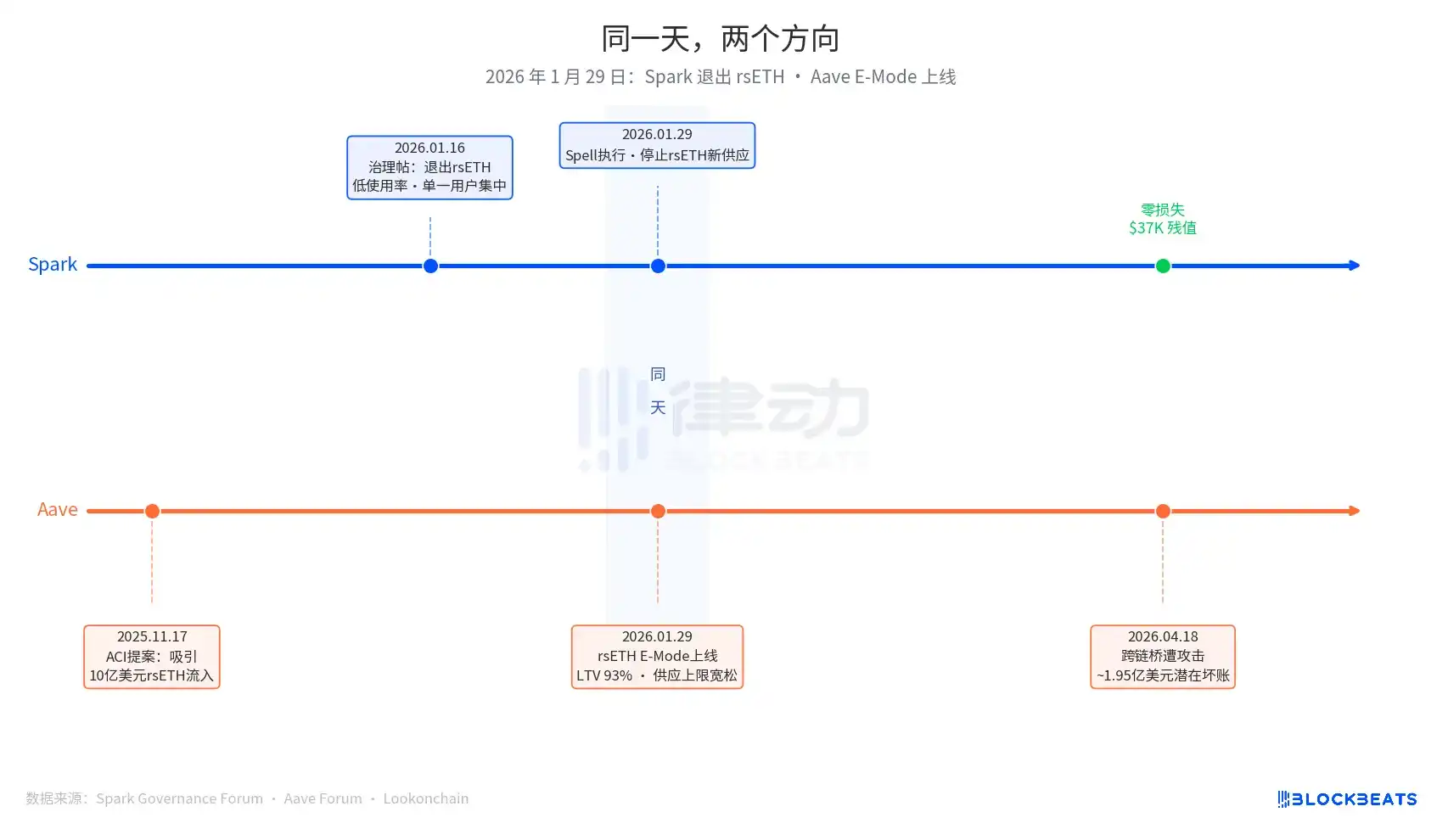
January 29, 2026, is the core date of this article. On this day, Spark executed a governance operation called Spell, halting new supply of rsETH. On the same day, Aave's rsETH E-Mode officially launched, allowing users to use rsETH as collateral to borrow WETH with a maximum loan-to-value (LTV) ratio of 93%.

One exited, the other expanded, both on the same day.

Spark's decision to exit began with a governance post submitted by PhoenixLabs (Spark's ecosystem execution body) on January 16, 2026. The reason was straightforward: low utilization of rsETH, with almost all usage coming from a single wallet (on-chain address 0xb99a), and the holder of this wallet had expressed willingness to use alternative collateral like wstETH or weETH. The original governance post stated, "Exiting rsETH can improve SparkLend's safety margin and enhance risk-adjusted returns." This was a periodic asset cleanup; other assets exited in the same batch included tBTC, ezETH, and the entire Gnosis Chain market, all for the unified reason of "low utilization."

Aave's expansion decision started earlier, from a proposal initiated by ACI (Aave Chan Initiative, a governance proposal body led by Marc Zeller) on November 17, 2025. The motivation was clear: "Restore WETH utilization, expected to attract $1 billion in rsETH inflows." Chaos Labs completed risk parameter confirmation in January, setting the E-Mode LTV at 93% and the liquidation threshold at 95%. Entities involved in the decision included ACI, Chaos Labs, LlamaRisk, and Aave community voters. This was an expansion decision driven by multiple parties, not a mistake by a single entity.

Three months later, the market delivered the result.

In Aave's current Umbrella insurance mechanism, available funds are approximately $50 million, covering only about 25% of the potential $195 million bad debt. The loss absorption order is: aWETH stakers bear the loss first, followed by WETH depositors proportionally, then stkAAVE and the DAO treasury. Aave's TVL dropped from $26.4 billion to $19.8 billion, including panic withdrawals. The USDT market utilization reached 100% within hours, with new borrowing amounting to approximately $300 million.

In SparkLend's rsETH market, the current frozen residual value is $37,300, equivalent to 15.32 rsETH. Wallet 0xb99a had almost entirely migrated to wstETH and weETH after new supply was prohibited on January 29, exactly matching the prediction in the governance post.

Spark co-founder Sam MacPherson (@hexonaut) pointed out on April 19: Protocols claiming no exposure to rsETH does not mean they truly have no exposure. If users have collateral in affected lending markets, indirect exposure still exists. Spark had no direct losses, but indirect risks are still being assessed.

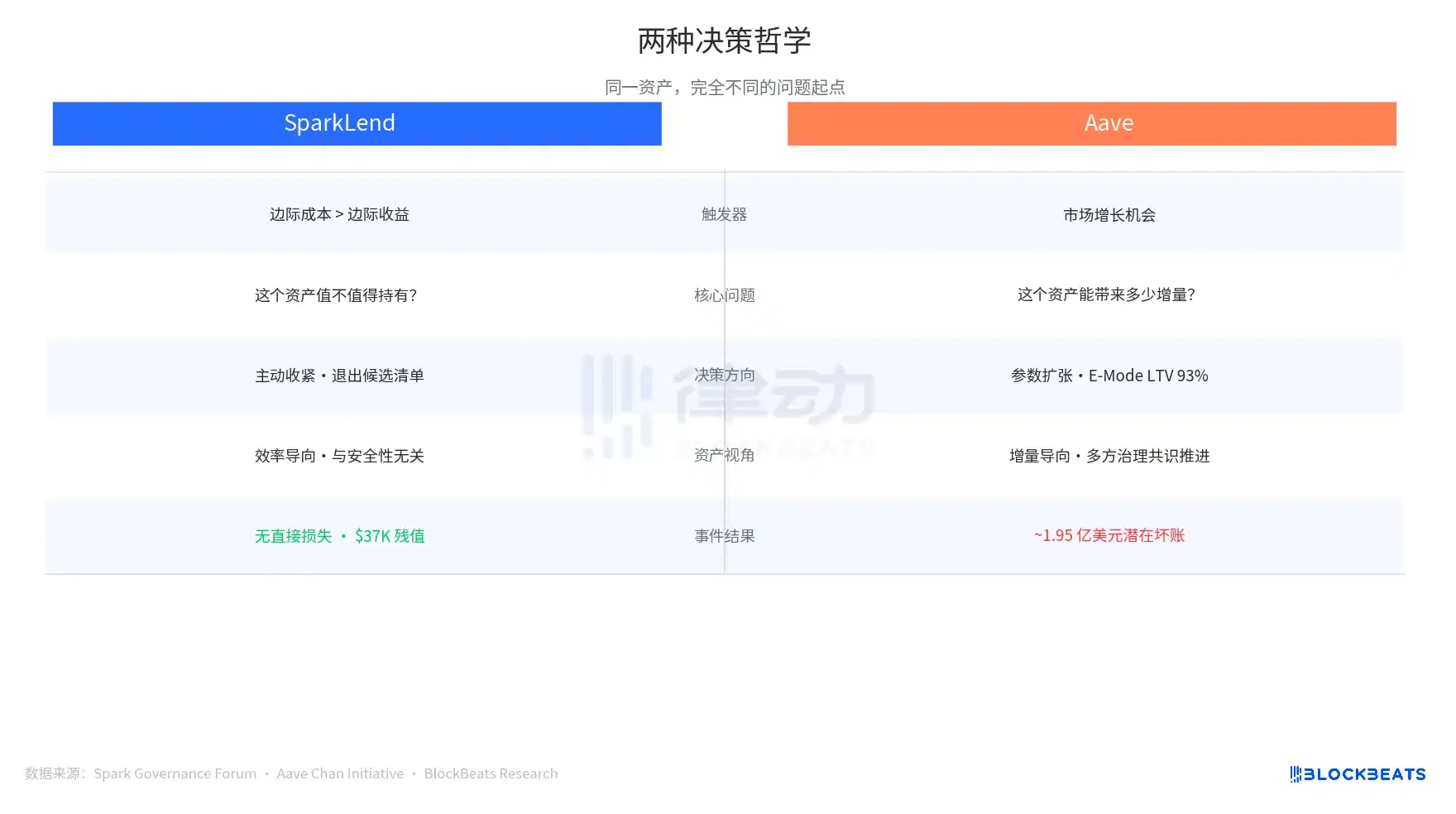
Both protocols made opposite decisions on the same day. This is not about whether Spark or Aave made the right decision; the starting points of the two systems were completely different.

Spark's risk control logic is triggered by "whether marginal cost exceeds marginal benefit." If utilization falls below a threshold, single-user concentration exceeds the standard, or risk-adjusted returns are subpar, any hit places the asset on the exit candidate list. This is a proactive, efficiency-oriented tightening mechanism, unrelated to whether the asset itself has security risks.

Aave's logic is triggered by "market growth opportunities." WETH utilization was relatively low, the rsETH market was large enough, and E-Mode could attract incremental funds. Starting from this entry point, the parameter direction was expansion: LTV 93%, loose supply cap, and promotion by multiple governance entities.

These two protocols answer completely different questions: "Is this asset worth continuing to hold?" versus "How much incremental value can this asset bring?" Before a risk event is triggered, both approaches are reasonable business logics. The referee only appears after the trigger.

Spark's safety outcome has another layer of support.

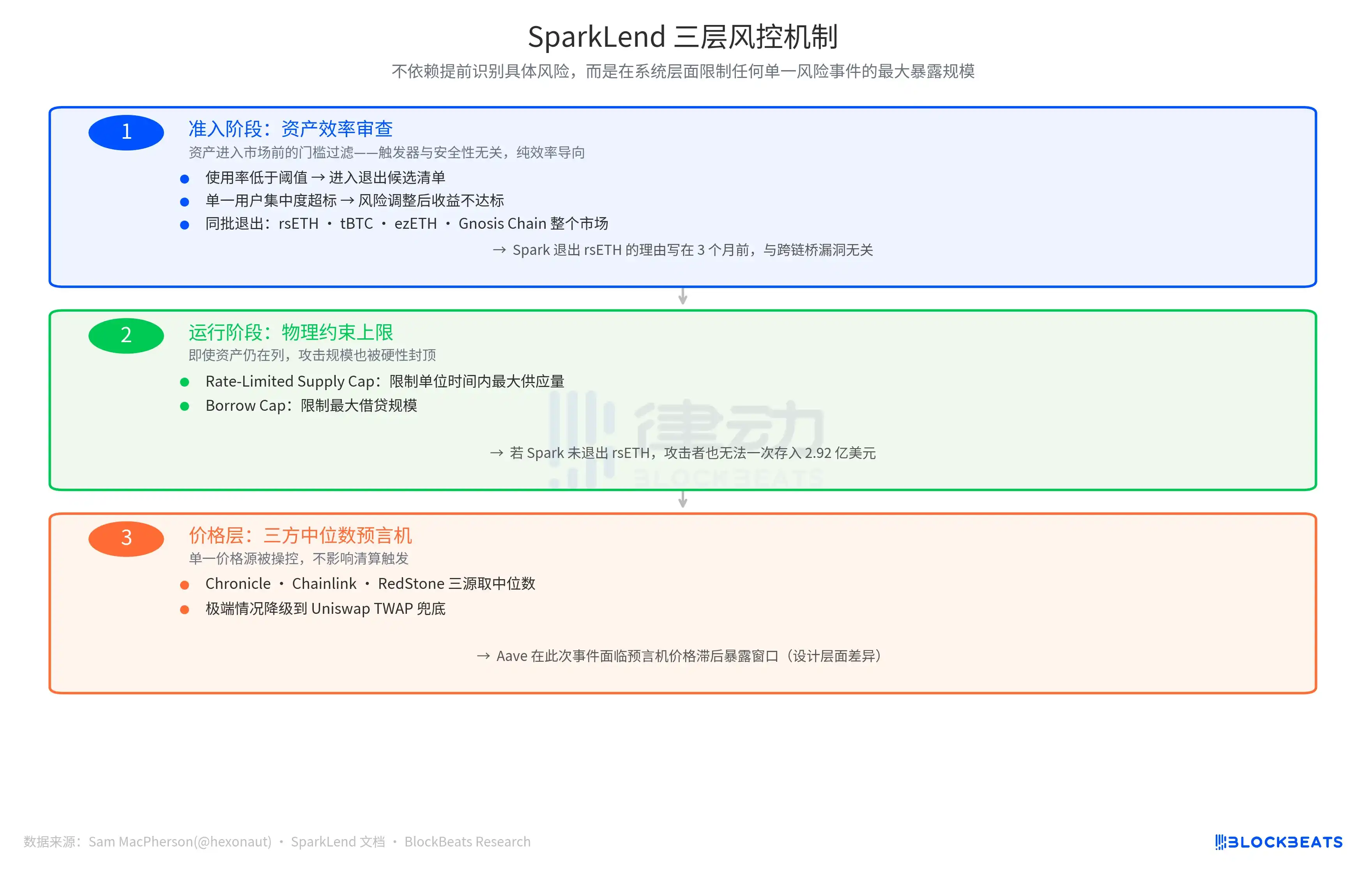
In his April 19 X post announcing the "exit from rsETH," Sam MacPherson mentioned: "SparkLend has rate-limited supply and borrow caps. Its oracle mechanism also uses a three-median system." This points to two other lines of defense in Spark's risk control system.

One is the physical constraint during operation. The Rate-Limited Supply Cap limits the maximum supply per unit time, and the Borrow Cap limits the maximum borrowing scale. The implication of these two designs is that even if Spark had not exited rsETH, the attacker could not have deposited $292 million worth of rsETH in one go as they did on Aave; the loss scale would have been compressed by a hard cap.

The other line is at the price information layer: a 3-median oracle, taking the median from three independent price sources—Chronicle, Chainlink, and RedStone—with Uniswap TWAP as a fallback in extreme cases. Manipulation of a single price source does not affect liquidation triggers. In contrast, Aave faced an exposure window during this event due to lagging oracle prices, a design-level difference rather than an execution-level mistake.

The design logic of these three lines of defense is consistent: they do not rely on identifying specific risks in advance but instead limit the maximum exposure scale of any single risk event at the system level.

The final loss figure depends on Kelp DAO's loss distribution plan. Currently, there are three options: socializing the loss among all-chain rsETH holders (reducing the bad debt scale), having L2 rsETH holders bear the loss alone (mainnet Aave bad debt remains unchanged), or a snapshot rollback (extremely difficult to execute). This number will be answered in the coming weeks.

But the results of the two decision-making philosophies can already be quantified: a gap of approximately $195 million, triggered on the same date, written into the governance operations on the same day.

Связанные с этим вопросы

QWhy did Spark choose to exit rsETH on the same day Aave introduced it?

ASpark exited rsETH due to low usage and high concentration from a single wallet, aiming to improve security margins and risk-adjusted returns, as part of a periodic asset cleanup.

QWhat was the financial impact of the rsETH attack on Aave?

AThe attack resulted in approximately $195 million in potential bad debt for Aave V3 and V4, with its insurance mechanism covering only about 25% of the losses.

QHow did Spark's risk management system help avoid losses from the rsETH incident?

ASpark had preemptive measures like rate-limited supply and borrow caps, a median-of-three oracle system, and had already exited rsETH due to low usage, minimizing exposure.

QWhat were the key differences in Spark and Aave's decision-making processes regarding rsETH?

ASpark focused on efficiency and risk-adjusted returns, exiting low-usage assets, while Aave prioritized market growth opportunities, expanding with high LTV and E-Mode to attract capital.

QWhat additional risk controls does SparkLend have in place beyond asset selection?

ASparkLend uses rate-limited supply and borrow caps to restrict deposit and loan sizes, and a median-of-three oracle system with fallback mechanisms to prevent price manipulation and limit max exposure.

Похожее

US Stocks Suffer Worst Plunge Since 2025: Three Triggers Ignite Tech Stock Valuation Reset

The US stock market experienced its most severe sell-off since the 2025 tariff crisis on June 5th, 2025. The Nasdaq Composite plummeted 4.18%, the S&P 500 fell 2.64%, and the Dow Jones dropped 695 points. The panic stemmed from three converging factors. First, Broadcom's earnings report ignited fears of a slowdown in AI growth. While its AI chip revenue surged 143% YoY to $10.8B, its Q3 AI revenue guidance of $16B fell short of the $17.2B consensus. This triggered a massive sector-wide sell-off, with the Philadelphia Semiconductor Index crashing 10.26% and semiconductor stocks losing roughly $1.3 trillion in market value in a single day. Second, a shockingly strong May jobs report crushed hopes for Federal Reserve rate cuts. Non-farm payrolls added 172,000 jobs, doubling expectations. This robust data, combined with persistently high oil prices above $92/barrel due to the ongoing Iran war and blockade of the Strait of Hormuz, drastically increased market expectations for a potential Fed rate hike instead of a cut. Higher interest rates compress the valuations of growth-heavy tech stocks. Third, the prolonged Iran conflict continues to fuel inflationary pressures, complicating the Fed's policy decisions and undermining the "inflation is tamed" narrative. Together, these events challenged the twin pillars of the market rally: the "limitless AI growth" story and expectations for imminent monetary easing. The sell-off spread globally, impacting Asian and European markets and cryptocurrencies. The article posits this is likely a severe "valuation repricing" rather than the end of the AI story. The underlying demand for AI remains strong, but investor expectations for growth speed and the prices they are willing to pay are being recalibrated. Key upcoming factors include the June FOMC meeting, future AI company earnings, and developments in the Iran conflict.

marsbit6 мин. назад

US Stocks Suffer Worst Plunge Since 2025: Three Triggers Ignite Tech Stock Valuation Reset

marsbit6 мин. назад

From Madison Square Garden to Kalshi: Prediction Markets Break into the NBA Finals

From Madison Square Garden to Kalshi: Prediction Markets Break into the NBA Finals Prediction markets are playing a significant role in the 2026 NBA Finals, particularly around the New York Knicks' unexpected 2-0 series lead. Platforms like Kalshi and Polymarket have seen massive trading volumes, exceeding hundreds of millions of dollars on championship and related markets. Their influence extends beyond online trading. Kalshi's official partnership with Madison Square Garden has given it prominent physical branding at the arena. Furthermore, local businesses like The Jeffrey bar are using prediction market contracts to hedge the risk of game-result-based promotions, turning potential losses into manageable costs—a concept similar to the famous "Mattress Mack" strategy from traditional sports betting. These markets differentiate themselves by offering a wider, more entertainment-focused range of "event contracts" beyond typical game outcomes, such as predicting celebrity attendance. They also have broader accessibility across the U.S. compared to age- and location-restricted traditional sportsbooks. However, their rapid integration into sports raises regulatory and ethical questions. The NBA is cautiously engaging, discussing integrity frameworks with regulators like the CFTC. While the league permits minor investments like Giannis Antetokounmpo's stake in Kalshi, it advocates for strict rules to prevent insider trading. Many fans express concern on platforms like Reddit, fearing that the close ties between prediction markets, the league, and players could compromise the game's integrity. The NBA Finals has thus become a high-stakes testing ground, showcasing prediction markets' commercial potential while challenging traditional boundaries between financial trading, entertainment, and gambling.

marsbit2 ч. назад

From Madison Square Garden to Kalshi: Prediction Markets Break into the NBA Finals

marsbit2 ч. назад

Recursive Self-Improvement AI Gains Traction, Google Pours Cold Water, While DeepSeek and Others Approach the Fringes

The term "recursive self-improvement" (RSI), where AI improves itself autonomously, is gaining momentum in the AI industry. Startups like Recursive Superintelligence and projects such as Andrej Karpathy's Auto-Research aim to create systems where AI designs, implements, and validates its own research, moving toward superintelligence. While Google CEO Sundar Pichai cautions that such exponential acceleration is not yet a reality, progress is evident. For instance, Anthropic reported its Claude Code writes nearly 100% of the team's code, though it still lacks true self-direction. Analysts frame RSI development in stages: "adequacy" (systems functioning without humans), "parity" (matching human research quality), and "supremacy" (exceeding human-AI collaboration). Reaching parity could trigger rapid, unpredictable advancement due to AI's continuous operation. In China, companies like DeepSeek and Baidu incorporate self-optimization techniques without explicitly branding them as RSI, focusing on algorithmic efficiency and reinforcement learning. However, challenges remain, including "model collapse" from training on AI-generated data and the immense computational and open-collaboration requirements. Ultimately, RSI represents a trend of increasing automation in AI development, potentially reducing human oversight in the creation process itself.

marsbit2 ч. назад

Recursive Self-Improvement AI Gains Traction, Google Pours Cold Water, While DeepSeek and Others Approach the Fringes

marsbit2 ч. назад

Торговля

Спот
Фьючерсы

Популярные статьи

Как купить S

Добро пожаловать на HTX.com! Мы сделали приобретение Sonic (S) простым и удобным. Следуйте нашему пошаговому руководству и отправляйтесь в свое крипто-путешествие.Шаг 1: Создайте аккаунт на HTXИспользуйте свой адрес электронной почты или номер телефона, чтобы зарегистрироваться и бесплатно создать аккаунт на HTX. Пройдите удобную регистрацию и откройте для себя весь функционал.Создать аккаунтШаг 2: Перейдите в Купить криптовалюту и выберите свой способ оплатыКредитная/Дебетовая Карта: Используйте свою карту Visa или Mastercard для мгновенной покупки Sonic (S).Баланс: Используйте средства с баланса вашего аккаунта HTX для простой торговли.Третьи Лица: Мы добавили популярные способы оплаты, такие как Google Pay и Apple Pay, для повышения удобства.P2P: Торгуйте напрямую с другими пользователями на HTX.Внебиржевая Торговля (OTC): Мы предлагаем индивидуальные услуги и конкурентоспособные обменные курсы для трейдеров.Шаг 3: Хранение Sonic (S)После приобретения вами Sonic (S) храните их в своем аккаунте на HTX. В качестве альтернативы вы можете отправить их куда-либо с помощью перевода в блокчейне или использовать для торговли с другими криптовалютами.Шаг 4: Торговля Sonic (S)С легкостью торгуйте Sonic (S) на спотовом рынке HTX. Просто зайдите в свой аккаунт, выберите торговую пару, совершайте сделки и следите за ними в режиме реального времени. Мы предлагаем удобный интерфейс как для начинающих, так и для опытных трейдеров.

1.4k просмотров всегоОпубликовано 2025.01.15Обновлено 2026.06.02

Как купить S

Sonic: Обновления под руководством Андре Кронье – новая звезда Layer-1 на фоне спада рынка

Он решает проблемы масштабируемости, совместимости между блокчейнами и стимулов для разработчиков с помощью технологических инноваций.

2.3k просмотров всегоОпубликовано 2025.04.09Обновлено 2025.04.09

Sonic: Обновления под руководством Андре Кронье – новая звезда Layer-1 на фоне спада рынка

HTX Learn: Пройдите обучение по "Sonic" и разделите 1000 USDT

HTX Learn — ваш проводник в мир перспективных проектов, и мы запускаем специальное мероприятие "Учитесь и Зарабатывайте", посвящённое этим проектам. Наше новое направление .

1.8k просмотров всегоОпубликовано 2025.04.10Обновлено 2025.04.10

HTX Learn: Пройдите обучение по "Sonic" и разделите 1000 USDT

Обсуждения

Добро пожаловать в Сообщество HTX. Здесь вы сможете быть в курсе последних новостей о развитии платформы и получить доступ к профессиональной аналитической информации о рынке. Мнения пользователей о цене на S (S) представлены ниже.

活动图片