Nic Carter Says Bitcoin Has 3 Ways To Handle Satoshi’s Coins

bitcoinistОпубликовано 2026-04-17Обновлено 2026-04-17

Введение

Nic Carter, founding partner at Castle Island Ventures, outlines three potential approaches for Bitcoin regarding early coins vulnerable to future quantum computing attacks. He estimates 1.7 million BTC in old pay-to-pubkey outputs could be at risk if quantum computers advance and Bitcoin transitions to post-quantum cryptography. The first option is to freeze non-migrated coins, a move likely supported by institutions and custodians to prevent market destabilization. The second is to leave them untouched, upholding Bitcoin's immutability principle, as favored by ideological purists. Carter's preferred "third way" is a legal salvage process: a U.S. quantum leader, under court authority, would recover the coins into a trust-like structure to return them to rightful owners or hold them neutrally, avoiding protocol-level confiscation. He believes the freeze camp may prevail due to Bitcoin's increased institutional dominance but warns such an action would fundamentally change Bitcoin.

Founding partner at Castle Island Ventures Nic Carter has laid out what he sees as three plausible paths for Bitcoin as the industry moves toward post-quantum cryptography: freeze vulnerable early coins, leave them untouched and accept the consequences, or pursue a legal “salvage” process that avoids a protocol-level confiscation.

The debate matters because, in Carter’s framing, roughly 1.7 million BTC in old pay-to-pubkey outputs could become exposed if Bitcoin eventually deprecates elliptic curve signatures and a cryptographically relevant quantum computer arrives.

The Third Option In Bitcoin’s Satoshi Coin Battle

In a post on X, Carter argued that the Overton window around quantum risk has shifted quickly. What was recently treated as a fringe concern, he wrote, is now increasingly being discussed as an eventual engineering and governance problem for Bitcoin itself. “The thing about the PQ transition is, it’s impossible as a Bitcoiner to claim that this protocol is cutting edge technology if Bitcoin, a monetary system predicated entirely on cryptography, is a laggard,” he wrote, adding that betting the fate of the network on the hope that the technology does not advance would be both reckless and embarrassing.

From there, Carter sketched the upgrade path he expects. After a soft fork, Bitcoin would likely move through an intermediate phase in which users could sign with existing ECC-based schemes or with new post-quantum signatures. Eventually, he wrote, legacy signatures such as ECDSA and Schnorr would be disallowed entirely. That transition, in his telling, is the easy part. The harder question comes later: what to do with coins that never migrate.

He framed that dispute as a clash between two camps already taking shape. On one side are institutions, custodians, exchanges, and fiduciaries that would view a freeze of non-migrated coins as the only acceptable option. Carter’s argument is that these actors cannot tolerate the risk that dormant holdings, including Satoshi’s coins, might suddenly be recovered by a hostile quantum-capable party and dumped into the market or otherwise used to destabilize Bitcoin.

On the other side are hardcore Bitcoiners and ideological purists who see any such freeze as a fundamental breach of the system’s monetary and political principles. Carter described their position in stark terms: “Satoshi set 21 million as the monetary parameter, and no one alive has the authority to arbitrarily modify that to 19.x million. Bitcoin doesn’t engage in selective ‘irregular state changes’ like Ethereum did after the DAO was hacked in 2016. Even after 850k BTC were lost to Mt Gox, nothing was done at the protocol layer to recover the funds.”

Carter said he believes the freeze camp is more likely to win than many Bitcoiners assume, largely because the structure of the market has changed since the 2015-2017 blocksize wars. In his view, today’s Bitcoin is far more concentrated in corporate entities, ETF issuers, custodians and large asset managers, giving “economic nodes” much more leverage than they had a decade ago. He also noted that some influential technical figures have already taken the side of freezing vulnerable coins if a genuine threat emerges.

Still, Carter’s preferred outcome is neither a freeze nor a laissez-faire approach. His “secret third thing” is a legal salvage framework. Under that scenario, a US quantum leader such as Google, IBM or another domestic firm would build the first cryptographically relevant quantum computer and, under court authority, recover the vulnerable coins into trust-like structures rather than take ownership outright.

“It would go like this,” Carter wrote. “A US firm, whether it’s Google, or IBM, or one of the other quantum leaders... acquires a CRQC first, and contracts with the US government to lawfully recover the 1.7m p2pk coins. They do not obtain ownership of these coins, but are rather appointed by a court as a neutral receiver or court-authorized custodian, tasked with securing and returning the assets to their rightful owners where possible and otherwise holding them in trust pending judicial disposition.”

In Carter’s ordering, lawful salvage is the best result, a freeze is second-best, and a no-freeze outcome ranks far behind. “If Bitcoin really does freeze the coins, then something about Bitcoin will truly have died,” he wrote. “It would survive, but it will be forever changed.”

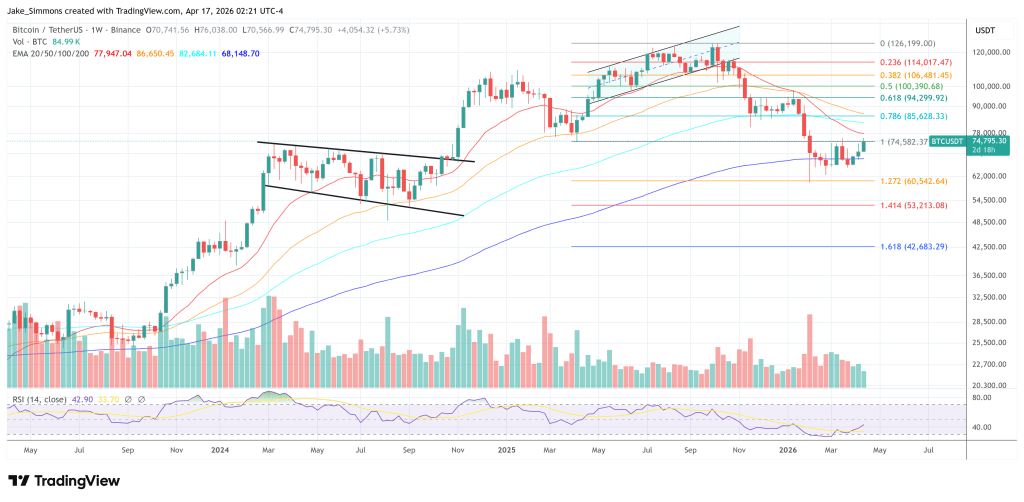
At press time, Bitcoin traded at $74,795.

Bitcoin close above the 1.0 Fib, 1-week chart | Source: BTCUSDT on TradingView.com

Связанные с этим вопросы

QAccording to Nic Carter, what are the three potential ways Bitcoin could handle Satoshi's coins in a post-quantum future?

AThe three potential ways are: freezing the vulnerable early coins, leaving them untouched and accepting the consequences, or pursuing a legal 'salvage' process that avoids a protocol-level confiscation.

QWhy is the quantum risk debate for Bitcoin significant, as framed by Nic Carter?

AThe debate is significant because approximately 1.7 million BTC in old pay-to-pubkey outputs could become exposed if Bitcoin eventually deprecates elliptic curve signatures and a cryptographically relevant quantum computer is developed.

QWhat are the two opposing camps in the dispute over how to handle non-migrated coins, as described by Carter?

AOne camp consists of institutions, custodians, and fiduciaries who favor freezing non-migrated coins. The other camp consists of hardcore Bitcoiners and ideological purists who oppose any such freeze, viewing it as a breach of the system's monetary and political principles.

QWhat is Nic Carter's preferred outcome for handling the vulnerable coins, and how would it work?

ACarter's preferred outcome is a legal salvage framework. In this scenario, a U.S. quantum leader like Google or IBM would, under court authority, recover the vulnerable coins into trust-like structures as a neutral receiver, tasked with securing and returning the assets to rightful owners where possible, rather than taking ownership outright.

QHow does Nic Carter rank the three potential outcomes for handling the coins, and what does he most concerned about?

ACarter ranks lawful salvage as the best result, a freeze as second-best, and a no-freeze outcome as the worst. He is concerned that if Bitcoin freezes the coins, 'something about Bitcoin will truly have died,' and it will be 'forever changed.'

Похожее

From Theft to Re-entry: How Was $292 Million "Laundered"?

A sophisticated crypto laundering operation was executed following the $292 million hack of Kelp DAO on April 18. The attack, attributed to the North Korean Lazarus group, began with anonymous infrastructure preparation using Tornado Cash to fund wallets untraceably. The hacker exploited a vulnerability in Kelp’s cross-chain bridge, stealing 116,500 rsETH. To avoid crashing the market, the attacker used Aave and Compound as laundering tools—depositing the stolen rsETH as collateral to borrow $190 million in clean, liquid ETH. This move triggered a bank run on Aave, causing an $8 billion drop in TVL. After consolidating funds, the attacker fragmented them across hundreds of wallets to evade detection. A major breakpoint was THORChain, where over $460 million in volume—30 times its usual activity—was processed in 24 hours, converting ETH into Bitcoin. This shift to Bitcoin’s UTXO model exponentially increased tracing complexity by shattering funds into countless untraceable fragments. The final destination was Tron-based USDT, the primary channel for illicit crypto flows. From there, funds were cashed out via OTC brokers in China and Southeast Asia, using unlicensed underground banks and UnionPay networks outside Western sanctions scope. Ultimately, the laundered money supports North Korea’s weapons programs, which rely heavily on crypto hacking for foreign currency. The incident underscores structural challenges in DeFi: its openness, composability, and lack of central control make such laundering not just possible, but inherently difficult to prevent.

marsbit1 ч. назад

From Theft to Re-entry: How Was $292 Million "Laundered"?

marsbit1 ч. назад

Google and Amazon Simultaneously Invest Heavily in a Competitor: The Most Absurd Business Logic of the AI Era Is Becoming Reality

In a span of four days, Amazon announced an additional $25 billion investment, and Google pledged up to $40 billion—both direct competitors pouring over $65 billion into the same AI startup, Anthropic. Rather than a typical venture capital move, this signals the latest escalation in the cloud wars. The core of the deal is not equity but compute pre-orders: Anthropic must spend the majority of these funds on AWS and Google Cloud services and chips, effectively locking in massive future compute consumption. This reflects a shift in cloud market dynamics—enterprises now choose cloud providers based on which hosts the best AI models, not just price or stability. With OpenAI deeply tied to Microsoft, Anthropic’s Claude has become the only viable strategic asset for Google and Amazon to remain competitive. Anthropic’s annualized revenue has surged to $30 billion, and it is expanding into verticals like biotech, positioning itself as a cross-industry AI infrastructure layer. However, this funding comes with constraints: Anthropic’s independence is challenged as it balances two rival investors, its safety-first narrative faces pressure from regulatory scrutiny, and its path to IPO introduces new financial pressures. Globally, this accelerates a "tri-polar" closed-loop structure in AI infrastructure, with Microsoft-OpenAI, Google-Anthropic, and Amazon-Anthropic forming exclusive model-cloud alliances. In contrast, China’s landscape differs—investments like Alibaba and Tencent backing open-source model firm DeepSeek reflect a more decoupled approach, though closed-source models from major cloud providers still dominate. The $65 billion bet is ultimately about securing a seat at the table in an AI-defined future—where missing the model layer means losing the cloud war.

marsbit7 ч. назад

Google and Amazon Simultaneously Invest Heavily in a Competitor: The Most Absurd Business Logic of the AI Era Is Becoming Reality

marsbit7 ч. назад

Торговля

Спот
Фьючерсы

Популярные статьи

Как купить S

Добро пожаловать на HTX.com! Мы сделали приобретение Sonic (S) простым и удобным. Следуйте нашему пошаговому руководству и отправляйтесь в свое крипто-путешествие.Шаг 1: Создайте аккаунт на HTXИспользуйте свой адрес электронной почты или номер телефона, чтобы зарегистрироваться и бесплатно создать аккаунт на HTX. Пройдите удобную регистрацию и откройте для себя весь функционал.Создать аккаунтШаг 2: Перейдите в Купить криптовалюту и выберите свой способ оплатыКредитная/Дебетовая Карта: Используйте свою карту Visa или Mastercard для мгновенной покупки Sonic (S).Баланс: Используйте средства с баланса вашего аккаунта HTX для простой торговли.Третьи Лица: Мы добавили популярные способы оплаты, такие как Google Pay и Apple Pay, для повышения удобства.P2P: Торгуйте напрямую с другими пользователями на HTX.Внебиржевая Торговля (OTC): Мы предлагаем индивидуальные услуги и конкурентоспособные обменные курсы для трейдеров.Шаг 3: Хранение Sonic (S)После приобретения вами Sonic (S) храните их в своем аккаунте на HTX. В качестве альтернативы вы можете отправить их куда-либо с помощью перевода в блокчейне или использовать для торговли с другими криптовалютами.Шаг 4: Торговля Sonic (S)С легкостью торгуйте Sonic (S) на спотовом рынке HTX. Просто зайдите в свой аккаунт, выберите торговую пару, совершайте сделки и следите за ними в режиме реального времени. Мы предлагаем удобный интерфейс как для начинающих, так и для опытных трейдеров.

1.2k просмотров всегоОпубликовано 2025.01.15Обновлено 2025.03.21

Как купить S

Sonic: Обновления под руководством Андре Кронье – новая звезда Layer-1 на фоне спада рынка

Он решает проблемы масштабируемости, совместимости между блокчейнами и стимулов для разработчиков с помощью технологических инноваций.

2.2k просмотров всегоОпубликовано 2025.04.09Обновлено 2025.04.09

Sonic: Обновления под руководством Андре Кронье – новая звезда Layer-1 на фоне спада рынка

HTX Learn: Пройдите обучение по "Sonic" и разделите 1000 USDT

HTX Learn — ваш проводник в мир перспективных проектов, и мы запускаем специальное мероприятие "Учитесь и Зарабатывайте", посвящённое этим проектам. Наше новое направление .

1.8k просмотров всегоОпубликовано 2025.04.10Обновлено 2025.04.10

HTX Learn: Пройдите обучение по "Sonic" и разделите 1000 USDT

Обсуждения

Добро пожаловать в Сообщество HTX. Здесь вы сможете быть в курсе последних новостей о развитии платформы и получить доступ к профессиональной аналитической информации о рынке. Мнения пользователей о цене на S (S) представлены ниже.

活动图片