New Wall Street Play: Yen Shorts Still Adding, But Japan Stocks Don't Rely on Carry Trade Unwinding

marsbitОпубликовано 2026-06-04Обновлено 2026-06-04

Введение

On June 3rd, USD/JPY hit 160.44, its highest level since July 2024, while the Nikkei 225 surged past 68,000 points. Contrary to popular narratives of an imminent "carry trade unwind" akin to August 2024, data reveals a more complex picture. Speculative net short positions in yen futures have actually increased, reaching -114,667 contracts by late May, suggesting traders are doubling down rather than retreating. Meanwhile, Japan's Finance Ministry conducted its largest-ever single-round FX intervention (11.73 trillion yen) in April-May but failed to hold the 160 yen line. The Nikkei's rally is not driven by carry trade dynamics. Foreign investors are aggressively buying Japanese stocks, with net purchases in 2026 running nearly 16 times higher than 2025 levels. This inflow is concentrated in AI and semiconductor-related stocks like SoftBank and Socionext, fueled by positive sector outlooks, rather than being a flight from unwinding yen shorts. Furthermore, the Nikkei has continued climbing despite the Bank of Japan's (BOJ) rate hikes to 0.75%. This disconnect exists because the current equity boom is fueled by AI-driven foreign investment, not reliant on cheap yen funding. However, this relationship remains fragile. Should the BOJ hike rates further (e.g., to 1.0%) while dollar weakness increases carry trade costs, the trajectories of the yen and Japanese stocks could reconverge, potentially triggering volatility.

On June 3, USD/JPY touched 160.44 intraday, a new high since July 2024. On the same day, the Nikkei 225 index broke through 68,000 points for the first time, reaching a high of 68,634.74 points. These two figures together immediately triggered a familiar market narrative: 'The carry trade is about to collapse, August 2024 will repeat.'

This narrative is half right. The other half tells a completely opposite story according to the data.

Shorts Not Retreating, But Adding Instead

The most direct measure of the crowdedness of yen carry trades is the weekly Commitments of Traders (COT) report published by the US Commodity Futures Trading Commission (CFTC). It records the net long or net short positions of speculative traders in the yen futures market.

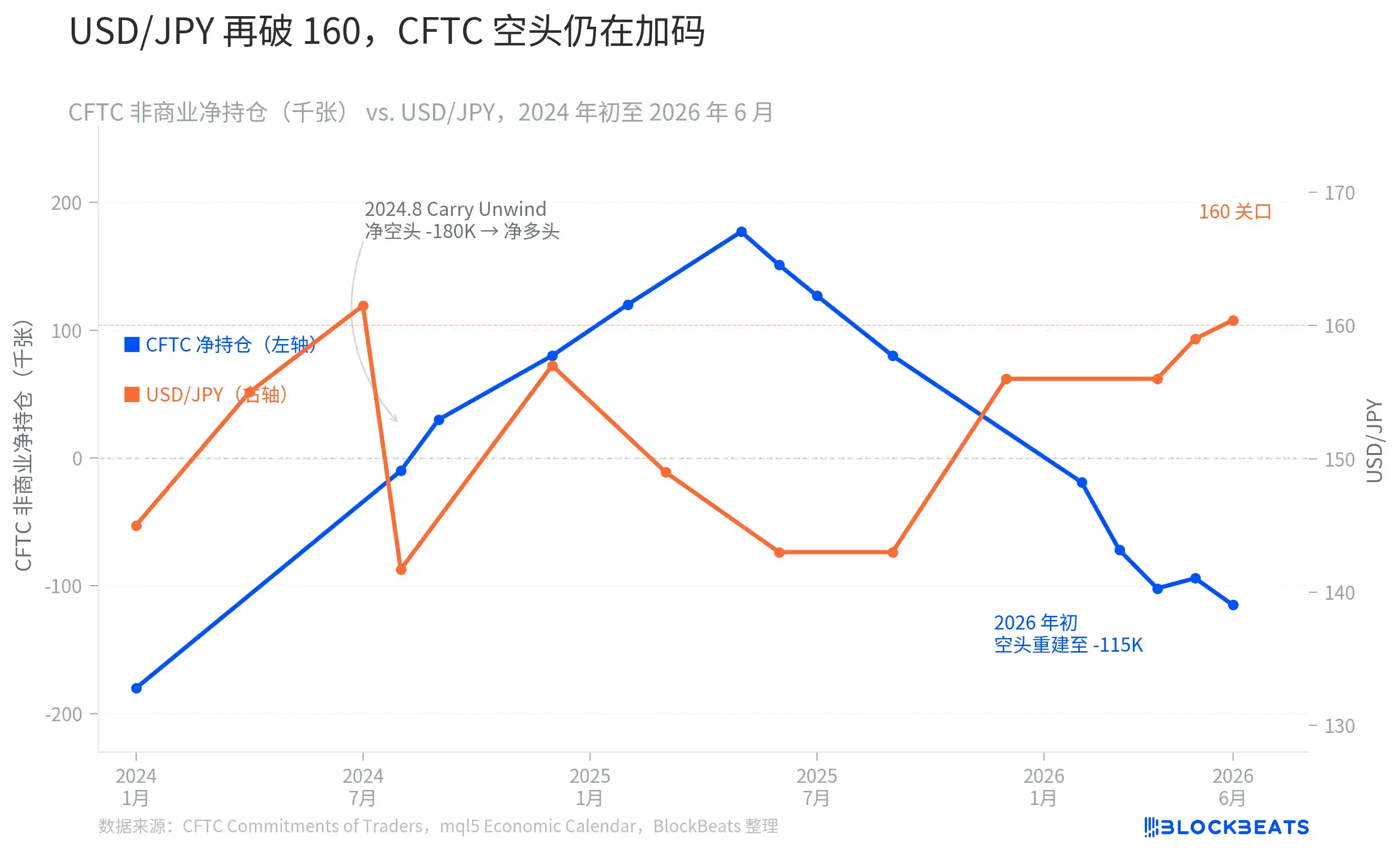
According to the CFTC report for the week ending May 26, the net short yen futures positions held by non-commercial accounts reached 114,667 contracts—112,993 long positions versus 227,660 short positions. This represented a further increase of 27,152 contracts in net short positions compared to the previous week.

The chart reveals a somewhat counterintuitive trend. In July 2024, when USD/JPY approached highs around 161, the CFTC net short was near the historical extreme zone of about -180,000 contracts. Subsequently, in early August, a surprise rate hike by the Bank of Japan (BOJ) combined with a much-weaker-than-expected US non-farm payrolls report forced a massive unwinding of yen shorts within weeks. The net short position shrank sharply from about -180,000 contracts, even reversing to a net long position exceeding +177,000 contracts by Q2 2025—a systemic carry trade squeeze indeed occurred during that period.

But the subsequent trajectory went completely against the 'squeeze narrative.' Starting from late 2025, yen net short positions began accumulating again, turning negative in February 2026 and expanding rapidly to -102,000 contracts by April. As of May 26, the net short position had reached -114,667 contracts. When USD/JPY returned to around 160, global speculative capital wasn't fleeing, but rather continuing to add to their positions.

This means that if the BOJ sends a more hawkish signal at its July meeting, or if US economic data unexpectedly weakens again, this batch of -114,667 net short positions will face passive unwinding pressure highly similar to that of August 2024. Japan's Ministry of Finance is also aware of this—from April 28 to May 27, the MOF used a record 11.7349 trillion yen to buy yen and sell foreign currency, attempting to suppress the shorts.

Largest Single-Round Intervention Fails to Hold 160

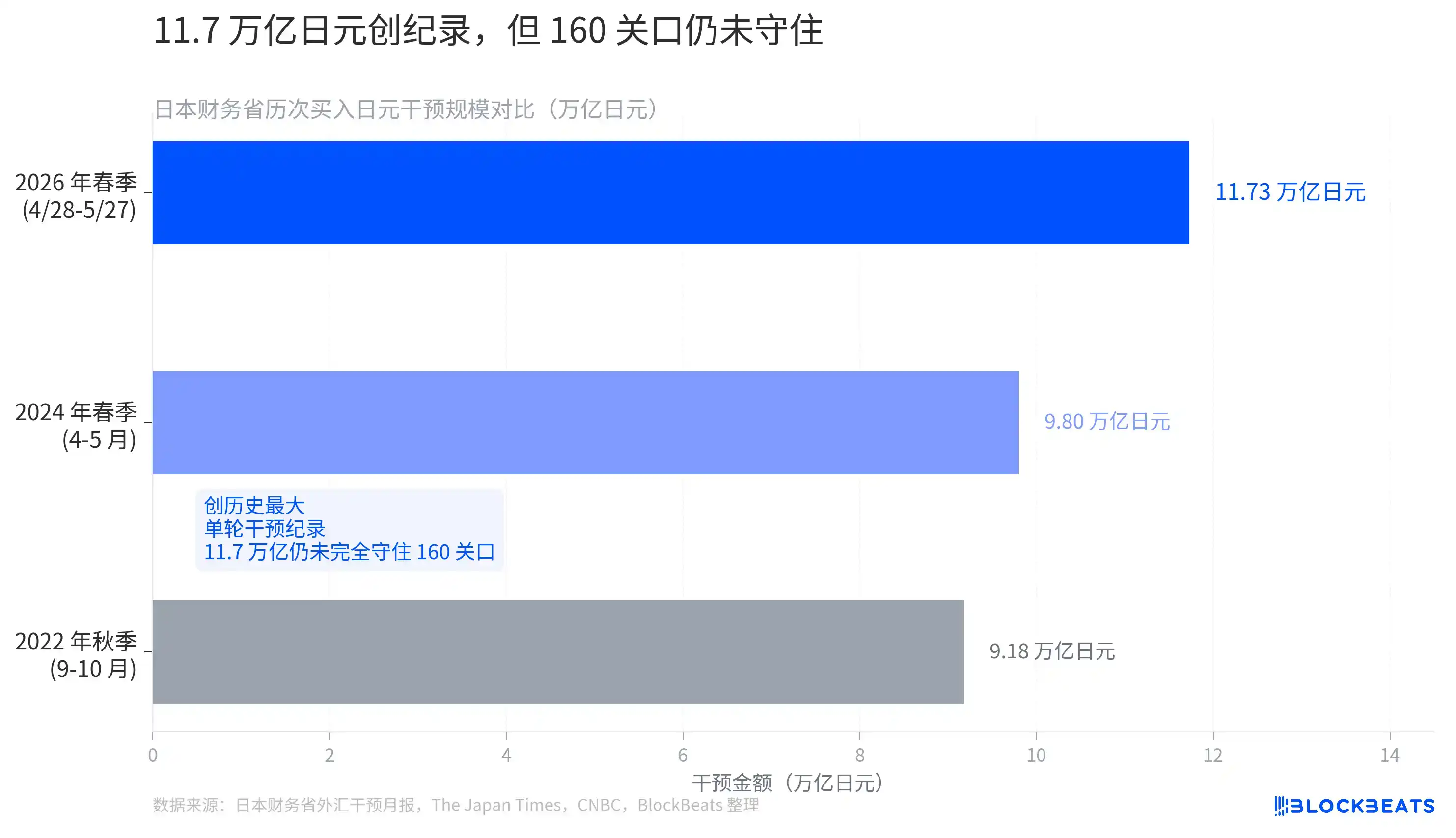
Japan's Ministry of Finance has a history of foreign exchange intervention dating back to 1998. In the autumn of 2022, when the yen fell near 152, the MOF conducted its first 'yen-buying' operation since 1998: spending 2.84 trillion yen in September and adding another 6.34 trillion yen in October, totaling about 9.18 trillion yen. That round briefly pushed USD/JPY down from 152 to around 127, but the effect lasted only a few months.

In the spring of 2024, as USD/JPY again approached and briefly broke through 160, the MOF intervened with about 9.80 trillion yen, which was the largest single-round operation since 2022 at that time, and also 'the first confirmed buying intervention since 2022.'

According to monthly intervention data released by Japan's Ministry of Finance on May 29, 2026, the operation scale from April 28 to May 27 was 11.7349 trillion yen (approximately 73.6 billion USD), making it the largest single-round intervention on record. It exceeded the total intervention amount for the entire year of 2022 and was nearly 2 trillion yen more than the spring 2024 intervention.

However, less than a week after the MOF disclosed these figures, USD/JPY still climbed back above the 160 level. The largest-ever intervention failed to completely hold this psychological barrier.

Foreign Funds Buying Japan Stocks Chase AI, Not Safe-Haven Flows from Carry Unwinding

If carry trades remain crowded, why is the Nikkei 225 still hitting new highs?

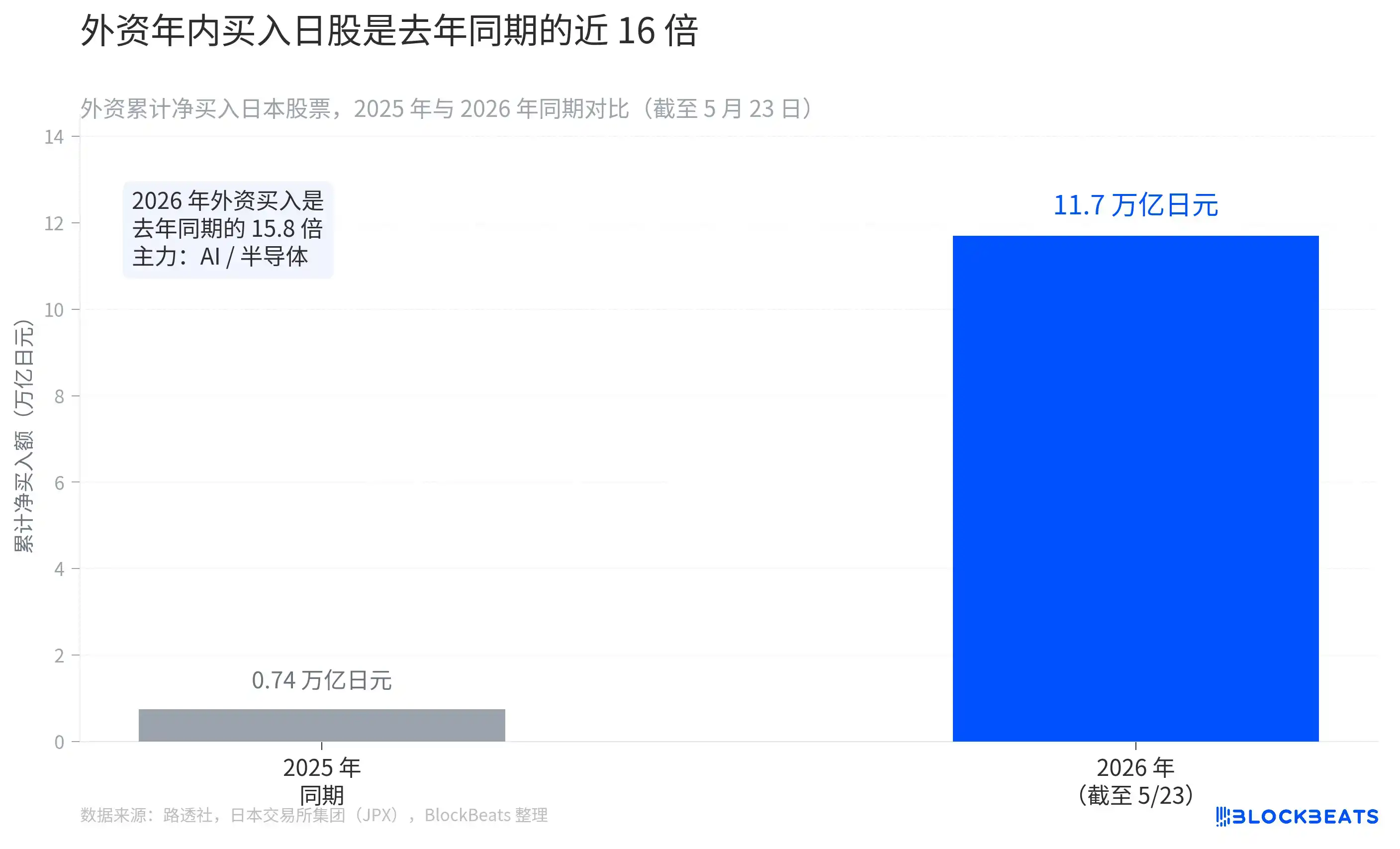
According to Reuters citing data from Japan Exchange Group (JPX), overseas investors had been net buyers of Japanese stocks for the 8th consecutive week as of the week ending May 23, with a weekly net purchase of 1.08 trillion yen. The cumulative net purchase amount for the year to date is close to 11.7 trillion yen.

During the same period in 2025, foreign investors' cumulative net purchase was only 742.1 billion yen. The 2026 figure is 15.8 times that amount.

The destination of these funds is highly concentrated. Among the top-performing individual stocks during the same period, AI investment platform SoftBank Group rose 17.62% for the week, while chip designer Socionext gained 12.26%. The Reuters report directly explained the buying impetus: Nvidia's earnings outlook boosted prospects for AI and semiconductor demand, with foreign capital chasing this theme via the Japanese market.

This logic is completely different from the 'carry unwind triggers selling' logic of August 2024. Back then, it was forced de-risking and indiscriminate selling, with capital exiting the Japanese market. The foreign net buying in 2026 is an active choice to enter the Japanese market to pursue the AI reflation trade. Their driving mechanisms differ, and their implications for the Nikkei index are also different.

Rate Hikes Not Suppressing Stocks, But This Relationship Is Becoming More Fragile

Another counterintuitive aspect of the Nikkei 225 is its continued rise against the backdrop of consecutive BOJ rate hikes.

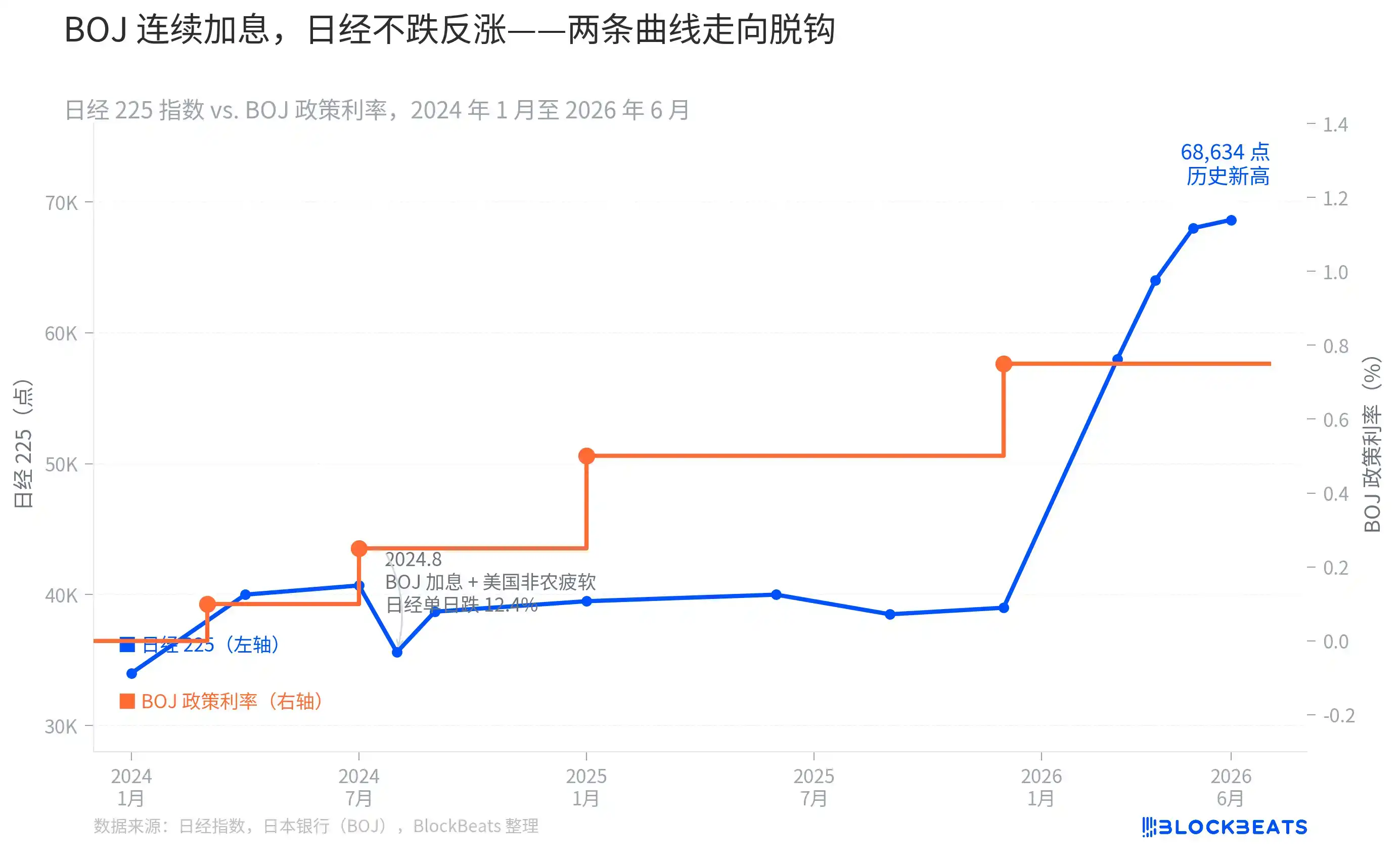
According to the Bank of Japan's policy decision announcements over the past two years, the rate hike path is as follows: March 2024 - ended negative interest rate policy, raising the policy rate from -0.1% to 0.1%; July 2024 - hiked again to 0.25%; January 2025 - hiked to 0.5%; December 2025 - hiked to 0.75%, the highest level since 1995. The April 2026 meeting maintained the rate at 0.75%, but passed by a 6-3 vote—three board members (Hajime Takata, Naoki Tamura, Junko Nakagawa) explicitly advocated for a hike to 1.0%.

The chart clearly shows that the correlation between rate hike events and Japanese stock movements has been completely different across stages. The July 2024 rate hike triggered a historic crash in the Nikkei 225, with a single-day drop of 12.4%—that was because the BOJ hike and weak US jobs data coincided, directly igniting the carry unwind. However, the two rate hikes in January and December 2025 were accompanied by the Nikkei 225 climbing from around 40,000 points all the way to the current new high of 68,634 points.

The reason behind this is not complicated: when the logic driving foreign buying is chasing the AI reflation trade, rather than relying on low yen interest rate funding costs, the BOJ's modest rate hikes have a quite limited impact on this portion of capital. Of course, this relationship is not immutable—if the BOJ indeed pushes the rate to 1.0% at its July meeting, while the US dollar weakens due to other factors, sharply increasing the funding cost for carry trades, the trajectories of these two curves may recouple at that point.

Putting the three charts together provides a relatively complete cognitive framework: yen short positions remain crowded, the MOF's historically largest intervention failed to hold 160, but the driver of the Japanese stock market's new highs is the AI-driven foreign capital inflow—all three statements can be true simultaneously, they are not mutually contradictory, and none alone can predict what happens next.

Связанные с этим вопросы

QWhat is the current status of yen carry trade positions according to CFTC data, and how does it compare to the situation before the 2024 August squeeze?

AAccording to the CFTC data as of May 26, speculative accounts hold a net short position of 114,667 contracts in yen futures. This indicates that carry trade positions are still crowded and have been increasing recently. This contrasts with the situation before the August 2024 squeeze, where the net short position was near -180,000 contracts, a historical extreme. While current levels are significant, they have not yet reached the peak seen before the 2024 unwind event.

QDespite Japan's largest-ever single round of FX intervention, why did the USD/JPY rate still break above 160?

AThe USD/JPY rate broke above 160 again shortly after Japan's Ministry of Finance disclosed its record 11.7349 trillion yen intervention conducted from April 28 to May 27. This suggests the intervention, while massive, was ultimately insufficient to completely defend the key 160 psychological level against the prevailing market forces driving yen weakness and dollar strength.

QWhat is the primary driver behind foreign investors' significant net buying of Japanese stocks in 2026, according to the article?

AThe primary driver is the pursuit of AI and semiconductor-related investment opportunities, fueled by a positive outlook for AI demand, as highlighted by companies like Nvidia. This is an active, thematic investment flow targeting specific sectors like AI platforms and chip designers, rather than a passive or避险 (risk-averse) flow related to the unwinding of yen carry trades.

QHow has the relationship between Bank of Japan (BOJ) interest rate hikes and the Nikkei 225 index performance changed over time?

AThe relationship has varied. The July 2024 rate hike, coinciding with weak US non-farm payroll data, triggered a massive 12.4% single-day Nikkei plunge due to a forced unwinding of carry trades. However, subsequent hikes in January and December 2025 occurred alongside a sustained rally in the Nikkei from around 40,000 to new highs above 68,000 points. This shift is attributed to the changing driver of equity inflows—from carry-trade dynamics to AI-focused investments—which are less sensitive to modest BOJ rate increases.

QWhat are the three key, seemingly contradictory facts presented in the article that form a complete picture of the current Japanese market?

AThe three key simultaneous facts are: 1) Yen short positions (carry trades) remain crowded and are still being added to. 2) Japan's historically largest foreign exchange intervention failed to decisively hold the USD/JPY rate below 160. 3) The Nikkei 225 is reaching new record highs, driven primarily by foreign capital chasing AI and reflation themes, not by避险 flows from carry trade unwinding.

Похожее

STRC Breaks Below $95: Why Does It Continue to Depeg? Is There Default Risk?

"STRC Falls Below $95: Why the Persistent Depegging and Is There Default Risk?" The article discusses the recent decline in the price of STRC, a perpetual preferred stock issued by Strategy (MSTR) designed to trade around a $100 par value. As of publication, STRC traded at $94.65, raising market concerns. STRC is described as a high-yield cash flow product, offering an 11.50% annual dividend paid monthly. Its "preferred" status grants it priority over common stock for dividends and in liquidation. Key reasons cited for the price depegging include: 1. **Bitcoin's Price Drop:** MSTR's assets are heavily tied to Bitcoin (BTC), which fell over 21% from its recent high, pressuring all Strategy-related products. 2. **Competitive Pressure:** Rival Strive Asset Management's similar product, SATA, offers daily dividends and has maintained its $100 par value with a ~13% yield. In response, Strategy has proposed changing STRC's dividend frequency from monthly to bi-weekly, pending shareholder vote. 3. **Technical Selling:** A break below $100 may have triggered algorithmic selling and stop-losses, exacerbating the decline. Regarding default risk, the analysis suggests it is currently low. Strategy founder Michael Saylor confirmed the June 2026 dividend rate remains at 11.50% with no cuts or suspensions. The company's massive reserve of 843,706 BTC provides a significant backstop for its obligations. Industry opinions are mixed. Some analysts view the BTC holdings as reliable support for dividends, while critics like Peter Schiff warn of potential dividend cuts leading to price crashes and lawsuits. Others highlight inflation risk and the company's ability to reduce dividends without a formal default. In summary, STRC's drop is attributed to BTC volatility, competition, and technical factors. While immediate default risk appears contained, the product faces challenges from market conditions and competitive dynamics.

marsbit1 ч. назад

STRC Breaks Below $95: Why Does It Continue to Depeg? Is There Default Risk?

marsbit1 ч. назад

AI Trading Cools, South Korean Stocks Plunge 1.8%, Spot Gold Rises 1%, Bitcoin Dives

A sell-off in AI-related stocks, triggered by Broadcom's disappointing earnings forecast, sent shockwaves through global markets. South Korea's KOSPI led Asia's decline, plunging 1.8% as the risks from concentrated chip stock gains and surging leveraged investments came to the fore. The tech-heavy Nasdaq 100 futures fell 0.5% following Broadcom's 14% after-hours plunge, which signaled a slower-than-expected transition to AI clients. This pullback extended Wall Street's weakness, halting the S&P 500's nine-day rally amid hawkish Fed signals and renewed Middle East tensions. South Korean authorities convened an emergency meeting, pledging "immediate measures" against market volatility and warning of record-high stock margin debt. The adjustment rippled across assets: Bitcoin fell to around $64,000, its lowest since February, while safe-haven gold rose 1% on bargain hunting. Oil prices dipped on Middle East ceasefire news. Market analysts noted the sell-off was driven by profit-taking after massive gains, particularly in chip stocks like Samsung and SK Hynix, which now dominate the KOSPI. Wall Street banks are divided on Korea's outlook, with Goldman Sachs raising its target while Citigroup and others warn of overvaluation and a potential bubble. Bridgewater's Ray Dalio noted that great technological shifts often create bubbles. Meanwhile, Fed officials' hints at potential future rate hikes added to the cautious mood ahead of key U.S. jobs data.

华尔街日报2 ч. назад

AI Trading Cools, South Korean Stocks Plunge 1.8%, Spot Gold Rises 1%, Bitcoin Dives

华尔街日报2 ч. назад

Торговля

Спот
Фьючерсы

Популярные статьи

Как купить S

Добро пожаловать на HTX.com! Мы сделали приобретение Sonic (S) простым и удобным. Следуйте нашему пошаговому руководству и отправляйтесь в свое крипто-путешествие.Шаг 1: Создайте аккаунт на HTXИспользуйте свой адрес электронной почты или номер телефона, чтобы зарегистрироваться и бесплатно создать аккаунт на HTX. Пройдите удобную регистрацию и откройте для себя весь функционал.Создать аккаунтШаг 2: Перейдите в Купить криптовалюту и выберите свой способ оплатыКредитная/Дебетовая Карта: Используйте свою карту Visa или Mastercard для мгновенной покупки Sonic (S).Баланс: Используйте средства с баланса вашего аккаунта HTX для простой торговли.Третьи Лица: Мы добавили популярные способы оплаты, такие как Google Pay и Apple Pay, для повышения удобства.P2P: Торгуйте напрямую с другими пользователями на HTX.Внебиржевая Торговля (OTC): Мы предлагаем индивидуальные услуги и конкурентоспособные обменные курсы для трейдеров.Шаг 3: Хранение Sonic (S)После приобретения вами Sonic (S) храните их в своем аккаунте на HTX. В качестве альтернативы вы можете отправить их куда-либо с помощью перевода в блокчейне или использовать для торговли с другими криптовалютами.Шаг 4: Торговля Sonic (S)С легкостью торгуйте Sonic (S) на спотовом рынке HTX. Просто зайдите в свой аккаунт, выберите торговую пару, совершайте сделки и следите за ними в режиме реального времени. Мы предлагаем удобный интерфейс как для начинающих, так и для опытных трейдеров.

1.4k просмотров всегоОпубликовано 2025.01.15Обновлено 2026.06.02

Как купить S

Sonic: Обновления под руководством Андре Кронье – новая звезда Layer-1 на фоне спада рынка

Он решает проблемы масштабируемости, совместимости между блокчейнами и стимулов для разработчиков с помощью технологических инноваций.

2.3k просмотров всегоОпубликовано 2025.04.09Обновлено 2025.04.09

Sonic: Обновления под руководством Андре Кронье – новая звезда Layer-1 на фоне спада рынка

HTX Learn: Пройдите обучение по "Sonic" и разделите 1000 USDT

HTX Learn — ваш проводник в мир перспективных проектов, и мы запускаем специальное мероприятие "Учитесь и Зарабатывайте", посвящённое этим проектам. Наше новое направление .

1.8k просмотров всегоОпубликовано 2025.04.10Обновлено 2025.04.10

HTX Learn: Пройдите обучение по "Sonic" и разделите 1000 USDT

Обсуждения

Добро пожаловать в Сообщество HTX. Здесь вы сможете быть в курсе последних новостей о развитии платформы и получить доступ к профессиональной аналитической информации о рынке. Мнения пользователей о цене на S (S) представлены ниже.

活动图片