Morgan Stanley Bitcoin ETF to Launch Tomorrow, Recommends Clients Allocate Up to 4% to Crypto Assets

marsbitОпубликовано 2026-04-08Обновлено 2026-04-08

Введение

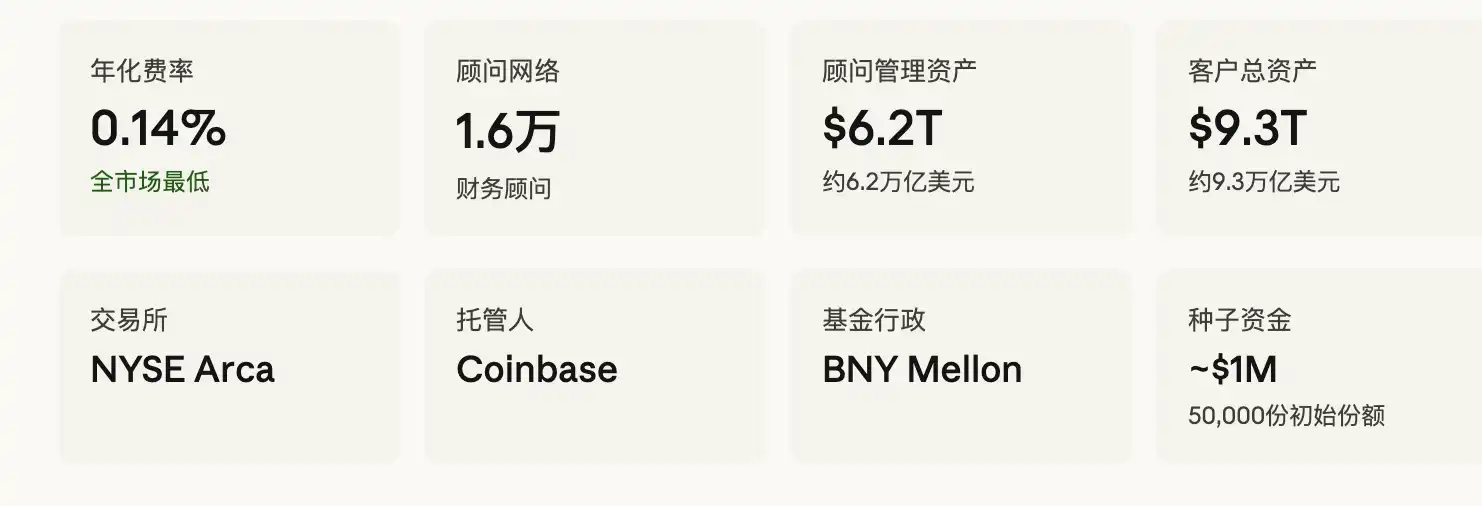
Morgan Stanley is set to launch its own spot Bitcoin ETF (ticker: MSBT) on NYSE Arca on April 8, making it the first major U.S. bank to directly issue such a product. With an annual management fee of 0.14%, it becomes the lowest-cost Bitcoin ETF on the market. The fund will hold Bitcoin directly and track the CoinDesk Bitcoin price index. The bank’s vast network of approximately 16,000 financial advisors, who manage around $6.2 trillion in client assets, can begin recommending the ETF immediately upon launch. Morgan Stanley’s Global Investment Committee has already advised clients to allocate up to 4% of their portfolios to crypto assets. Analysts suggest this distribution capability could unlock substantial institutional and advisory-driven capital into Bitcoin. Beyond Bitcoin, Morgan Stanley is building a broader crypto infrastructure, having also filed for Solana and staked Ethereum ETFs, applied for a national trust bank charter, and plans to offer direct crypto trading via E*Trade in 2026. The move is seen as a significant step in the institutional adoption of Bitcoin and a shift in traditional finance’s approach to cryptocurrency.

Author: Curry, Deep Tide TechFlow

Deep Tide Guide: The SEC has approved the registration statement for the Morgan Stanley Bitcoin Trust (ticker: MSBT), which will begin trading on NYSE Arca on April 8th, with an annual management fee of 0.14%, the lowest in the market.

Morgan Stanley thus becomes the first major U.S. bank to directly issue a Bitcoin spot ETF. Its approximately 16,000 financial advisors, managing $6.2 trillion in client assets, will be able to recommend the product to clients starting on the first day of trading.

The countdown to Morgan Stanley's Bitcoin spot ETF has officially begun.

According to a CoinDesk report on April 8th, the U.S. Securities and Exchange Commission (SEC) has declared the registration statement for the Morgan Stanley Bitcoin Trust (MSBT) effective. The bank submitted its final prospectus on the same day. Bloomberg ETF analyst Eric Balchunas confirmed on platform X that MSBT will begin trading on NYSE Arca on April 8th (Wednesday).

This comes just three months after Morgan Stanley initially filed the S-1 registration document in January of this year. The speed from application to listing far exceeded market expectations.

Lowest Fee in the Market, First Major Bank to Self-Issue

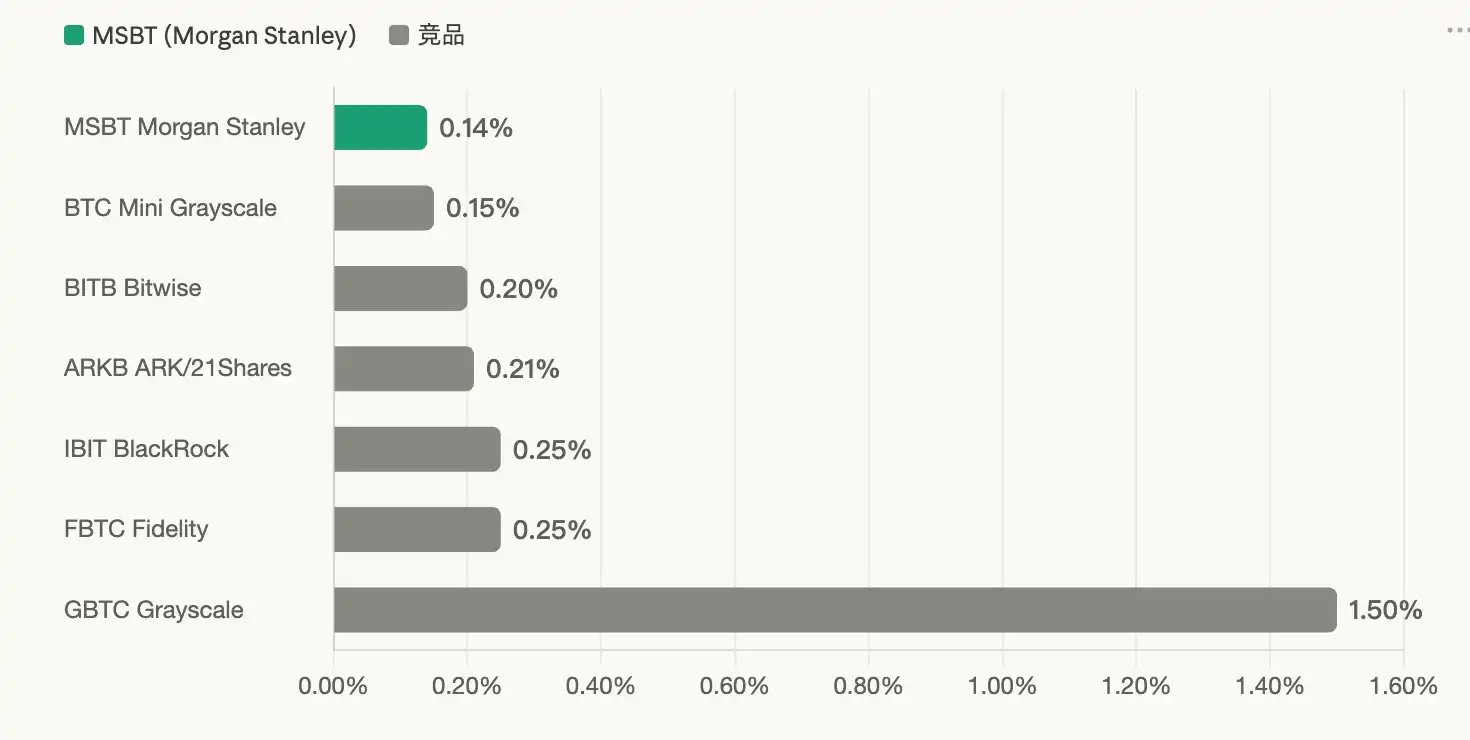
MSBT's annual management fee is set at 0.14%, which is 1 basis point lower than Grayscale's Bitcoin Mini Trust (0.15%) and 11 basis points lower than BlackRock's IBIT (0.25%), making it the product with the lowest fee among all U.S. Bitcoin spot ETFs.

Fee comparison of major competitors: Grayscale Bitcoin Mini Trust 0.15%, Bitwise BITB 0.20%, ARK/21Shares ARKB 0.21%, BlackRock IBIT and Fidelity FBTC both 0.25%, Grayscale's flagship product GBTC 1.5%.

The fee is one of the few core differentiating factors in the Bitcoin spot ETF market. All products directly hold Bitcoin and track the spot price, with highly homogeneous investment strategies. Cost differences become significant in large allocations and long-term holdings. For a $100,000 investment, MSBT saves approximately $110 in management fees compared to IBIT annually.

Historical data has proven the driving force of fees on fund flows: Grayscale's flagship product GBTC charges 1.5% and has seen its assets under management (AUM) shrink from about $29 billion to less than half since its conversion to an ETF in January 2024.

Regarding the MSBT product structure, the fund directly holds Bitcoin, tracking the CoinDesk Bitcoin Benchmark 4:00 PM New York Settlement Price, without using leverage, derivatives, or active trading strategies. Coinbase serves as the custodian and prime broker, BNY Mellon is responsible for cash custody and fund administration, and the initial seed capital is approximately $1 million, corresponding to 50,000 creation baskets.

More importantly, MSBT is the 12th product of its kind since the first batch of Bitcoin spot ETFs were listed in January 2024, and the first Bitcoin spot ETF directly issued and listed by a major U.S. bank. Previously, the issuers of listed products were all asset management companies or crypto-native institutions. Morgan Stanley's entry means that Wall Street banks are moving from "distributing others' products" to "making their own products."

The Distribution Network is the Real Weapon

The fee is just one card on Morgan Stanley's table; the real differentiator is the distribution network.

Morgan Stanley's approximately 16,000 financial advisors manage about $6.2 trillion in client assets (total client assets for the entire bank are about $9.3 trillion). MSBT will receive distribution support from this network starting on its first trading day. Bloomberg ETF analyst Balchunas referred to Morgan Stanley as a "captive audience" for the Bitcoin ETF market and pointed out that while Fidelity also has a partial advisor network, "Morgan Stanley is a whole other level."

Amy Oldenburg, the bank's Head of Digital Asset Strategy, previously revealed that currently about 80% of crypto ETF trading activity comes from self-directed investors, not advisor-managed accounts.

A self-owned product with the lowest fee in the market is expected to eliminate cost concerns advisors might have when recommending Bitcoin allocations, thereby unlocking the incremental space of the advisor channel, which has not yet been fully activated.

Morgan Stanley's Global Investment Committee had already recommended that clients allocate 0-4% of their investment portfolio to crypto assets. Phong Le, CEO of Strategy (formerly MicroStrategy), provided a more aggressive calculation on platform X: based on $6.2 trillion in client assets and a 2% allocation ratio, the potential capital scale is approximately $160 billion, nearly three times the current AUM of BlackRock's IBIT. He called MSBT the "Monster Bitcoin".

However, the actual allocation pace still holds uncertainty. Multiple steps are typically required between product availability and large-scale recommendation through the advisor channel, including compliance approval, investment policy adjustments, and client education.

More Than One ETF: Morgan Stanley's Full-Scale Crypto Layout

MSBT is not an isolated product. Morgan Stanley is systematically building crypto asset infrastructure.

The bank submitted applications for both Bitcoin and Solana spot ETFs in January of this year, followed by an application for a staking Ethereum ETF. In February, Morgan Stanley applied for a National Trust Bank charter (Morgan Stanley Digital Trust) to directly provide clients with digital asset custody, trading, and staking services.

On the retail side, the bank plans to open spot trading for Bitcoin, Ethereum, and Solana to retail investors through the E*Trade platform in the first half of 2026, partnering with Zero Hash. Jed Finn, Head of the Wealth Management Division, called direct crypto trading the "tip of the iceberg," hinting that more services such as custody, wallets, and tokenized assets will follow.

The logic of this multi-channel strategy is clear: institutional clients get MSBT allocations through advisors, self-directed investors trade cryptocurrencies directly through E*Trade, all completed within Morgan Stanley's ecosystem. CEO Ted Pick has already communicated with the U.S. Treasury regarding product development.

Reddit Community: 'Traditional Finance Has Surrendered'

The news sparked heated discussion in the Reddit crypto community. Several users interpreted Morgan Stanley's self-issuance of a Bitcoin ETF as a "surrender signal" from traditional finance towards Bitcoin, believing that the shift from resistance and观望 (wait-and-see) to active embrace by major Wall Street banks marks an irreversible institutionalization process for Bitcoin as an asset class.

Other users offered pragmatic views: the trading volume on the first day and the net inflows in the first month will be key indicators to test whether the distribution network can truly translate into actual allocations.

Связанные с этим вопросы

QWhat is the ticker symbol and management fee for Morgan Stanley's Bitcoin ETF?

AThe ticker symbol is MSBT, and it has an annual management fee of 0.14%, which is the lowest in the market.

QHow much client assets do Morgan Stanley's financial advisors manage, and what is the potential impact on the Bitcoin ETF market?

AMorgan Stanley's approximately 16,000 financial advisors manage about $6.2 trillion in client assets. The bank's global investment committee has recommended clients allocate 0-4% of their portfolio to crypto assets, potentially unlocking significant new capital into the Bitcoin ETF market.

QWhat makes Morgan Stanley's Bitcoin ETF (MSBT) unique compared to other existing Bitcoin ETFs?

AMSBT is the first Bitcoin spot ETF to be directly issued and listed by a major U.S. bank. Its key differentiators are its lowest-in-market fee (0.14%) and its immediate access to the bank's massive network of financial advisors and their clients.

QBesides the Bitcoin ETF, what other crypto-related products and services is Morgan Stanley developing?

AMorgan Stanley is building a full crypto infrastructure. This includes applications for a Solana spot ETF, a staking Ethereum ETF, a national trust bank charter (Morgan Stanley Digital Trust) for custody services, and plans to offer direct spot trading of Bitcoin, Ethereum, and Solana on its E*Trade platform for retail investors in 2026.

QWho are the key service providers (custodian, administrator) for the Morgan Stanley Bitcoin Trust (MSBT)?

ACoinbase serves as the custodian and prime broker for the MSBT, while BNY Mellon is responsible for cash custody and fund administration.

Похожее

Is the Sharp Decline Over? Let the Data Speak

**Has the Sharp Decline Ended? Let Data Speak** Bitcoin's recent significant drop has placed short sellers in a precarious position. Three concurrent pressures—sustained outflows from ETFs, miners offloading coins to exchanges, and short-term holders capitulating—pushed the price near $63k. The asset fell 13% this week and 21% this month, roughly halving from its all-time high. A critical data point is the extremely crowded short positioning, with a short-to-long ratio reaching 8:1, representing nearly $100 billion in short interest overhead. This creates conditions for a potential short squeeze if selling pressure merely pauses, similar to the event in November 2022 which triggered a 24% rally. The selling pressures are real: spot Bitcoin ETFs have seen a record $5.4 billion outflow over 20 days. Short-term holders moved 53k loss-held BTC to exchanges in a day, and miners sent 24k BTC to Binance, a six-month high. Capital is also rotating towards AI and tech stocks like SpaceX, with $400 billion invested in AI infrastructure recently. However, on-chain data shows accumulation by long-term holders, who added 200k BTC in a month, and institutions/miners have absorbed 1.24 million BTC since 2023. This indicates strong buying beneath the surface. Key levels to watch are the $67k-$70k zone (2021 high & 2024 breakout point). A swift recovery above it suggests a leverage washout; failure could test $60k-$55k. The direction also hinges on ETF flow reversal. Currently, the S&P 500 hits new highs driven by AI, while Bitcoin and DeFi (TVL down from $173b to $73.9b) lag. The most probable path is a grinding basing process between $60k-$58k with continued ETF outflows. A less likely but explosive scenario involves a sudden flow reversal, a surge above $70k triggering a short squeeze, and a rally back above $76k. The immediate trigger depends on when the relentless selling pauses. A final cautionary note questions Bitcoin's correlation: if the high-flying U.S. stock market corrects, will Bitcoin once again miss the rally but not the decline?

foresightnews_api17 мин. назад

Is the Sharp Decline Over? Let the Data Speak

foresightnews_api17 мин. назад

Single-Day Plunge of 30%, Arthur Hayes Suddenly Liquidates: Why Did ZEC Get Exploded by Security Issues?

On June 5th, Zcash founder Zooko Wilcox disclosed a critical soundness vulnerability in the project's latest Orchard privacy pool. This flaw, found in the elliptic curve multiplication constraints, could allow an attacker to create unlimited counterfeit ZEC within the shielded pool, with transactions appearing valid. The vulnerability was discovered in late May by security researcher Taylor Hornby, who utilized Anthropic's new Opus 4.8 AI model for a targeted audit. The Zcash ecosystem had already performed an emergency network upgrade to patch the issue. However, the detailed disclosure triggered severe market panic, causing ZEC's price to plummet over 30% in a single day. Notably, prominent investor Arthur Hayes announced he had sold his entire ZEC position following the news. The incident starkly challenges the "technological trust" narrative central to privacy coins. Despite years of top-tier cryptographic audits, the bug persisted until uncovered with advanced AI-assisted research. This highlights the growing gap between theoretical perfection and practical implementation in privacy technology. The event serves as a industry-wide warning: in an AI-driven security landscape, the assumption that "undiscovered equals safe" is obsolete. It underscores the urgent need for continuous, proactive security practices combining AI audits, formal verification, and rapid response mechanisms.

foresightnews_api1 ч. назад

Single-Day Plunge of 30%, Arthur Hayes Suddenly Liquidates: Why Did ZEC Get Exploded by Security Issues?

foresightnews_api1 ч. назад

Breaking the Curse of DeFi Cascading Liquidations, Vitalik Proposes a New Solution

**Vitalik Buterin Proposes New DeFi Design to Eliminate Forced Liquidations** Ethereum co-founder Vitalik Buterin has published a proposal for a new decentralized finance (DeFi) architecture aimed at removing the automatic liquidation mechanisms prevalent in current lending protocols. The core idea involves creating synthetic assets using options as building blocks, fundamentally avoiding the抵押借贷结构 that triggers forced sell-offs. The proposal responds to a recurring flaw in DeFi: during sharp market downturns, mass自动清算 of under-collateralized positions can exacerbate price declines, creating systemic selling pressure and market instability, as evidenced by recent crypto market volatility. Buterin's model would split an asset like 1 ETH into two option-like derivatives, P and N, pegged to a price index with a set strike price and expiration. At expiry, an oracle determines the settlement price to allocate the underlying ETH between P and N holders. This design eliminates the "cliff" of instant liquidation. Instead, a position's value would gradually drift from its target peg if not actively rebalanced by the user, transferring the rebalancing decision from the protocol to the user or automated tools. A key advantage is the reduced reliance on high-frequency, real-time oracle price feeds, which are vulnerable to manipulation and errors in current systems. The delayed settlement in the options model allows for more robust, fault-tolerant oracle designs. However, significant challenges remain for practical adoption. High transaction costs (slippage) from frequent rebalancing on automated market makers (AMMs) could erode user funds. The model may not be suitable for stablecoins requiring a strict 1:1 dollar peg, as it inherently allows for value drift. Success would depend on developing new liquidity provisioning models and deep markets for these synthetic assets. The proposal represents a fundamental rethinking of DeFi risk management, challenging the industry to explore alternatives to被动集中平仓 rather than merely optimizing existing liquidation processes. It remains a theoretical framework awaiting implementation and testing by development teams.

foresightnews_api1 ч. назад

Breaking the Curse of DeFi Cascading Liquidations, Vitalik Proposes a New Solution

foresightnews_api1 ч. назад

Bitcoin's Decline Marks the Transformation of Crypto

Title: The Decline of Bitcoin Marks the Transformation of Crypto While Bitcoin's price recently fell below $70,000, down approximately 45% from its peak, the broader crypto industry is not following it into decline. Instead, crypto is maturing and evolving beyond its dependence on Bitcoin's price movements. Two of Bitcoin's core functions are being usurped. First, AI has captured its role as the primary speculative asset. AI, with its tangible revenue, explosive demand, and massive capital inflows ($700-830 billion in 2024), is siphoning off the speculative "hot money" that once drove Bitcoin. It also contributes to a sustained high-interest-rate environment, further tightening liquidity for assets like Bitcoin. Second, dollar-pegged stablecoins like USDC and USDT have replaced Bitcoin as the crypto market's foundational currency and primary on/off-ramp. Most trading pairs and on-chain transactions are now settled in stablecoins, severing the historical link where all capital inflows had to pass through Bitcoin first. This decoupling allows projects to thrive based on their own fundamentals rather than Bitcoin's price. Examples include Hyperliquid, an on-chain derivatives exchange with annual revenues of $8-13 billion, and prediction market platform Polymarket, valued at $200 billion with $3.65 billion in annual fees. These projects are evaluated on traditional metrics like revenue and user growth. New opportunities are emerging, particularly around privacy. Privacy coins like Zcash (ZEC) are seeing surging demand, while infrastructure like NEAR enables private, cross-chain asset transfers without requiring users to hold a specific token—privacy becomes a universal service layer. In this new paradigm, stablecoins are the universal cash, various project tokens represent equity, and privacy-enabled cross-chain coordination layers (like NEAR) act as the critical infrastructure connecting a fragmented, multi-chain ecosystem. Bitcoin is now just one asset among many. The era where the entire crypto market moved in lockstep with Bitcoin is over. The industry's health should now be judged by project fundamentals—real revenue, active users, and tokenomics that capture value—and the development of the underlying infrastructure enabling a mature, dollar-denominated crypto economy.

foresightnews_api1 ч. назад

Bitcoin's Decline Marks the Transformation of Crypto

foresightnews_api1 ч. назад

Торговля

Спот
Фьючерсы

Популярные статьи

Как купить 4

Добро пожаловать на HTX.com! Мы сделали приобретение 4 (4) простым и удобным. Следуйте нашему пошаговому руководству и отправляйтесь в свое крипто-путешествие.Шаг 1: Создайте аккаунт на HTXИспользуйте свой адрес электронной почты или номер телефона, чтобы зарегистрироваться и бесплатно создать аккаунт на HTX. Пройдите удобную регистрацию и откройте для себя весь функционал.Создать аккаунтШаг 2: Перейдите в Купить криптовалюту и выберите свой способ оплатыКредитная/Дебетовая Карта: Используйте свою карту Visa или Mastercard для мгновенной покупки 4 (4).Баланс: Используйте средства с баланса вашего аккаунта HTX для простой торговли.Третьи Лица: Мы добавили популярные способы оплаты, такие как Google Pay и Apple Pay, для повышения удобства.P2P: Торгуйте напрямую с другими пользователями на HTX.Внебиржевая Торговля (OTC): Мы предлагаем индивидуальные услуги и конкурентоспособные обменные курсы для трейдеров.Шаг 3: Хранение 4 (4)После приобретения вами 4 (4) храните их в своем аккаунте на HTX. В качестве альтернативы вы можете отправить их куда-либо с помощью перевода в блокчейне или использовать для торговли с другими криптовалютами.Шаг 4: Торговля 4 (4)С легкостью торгуйте 4 (4) на спотовом рынке HTX. Просто зайдите в свой аккаунт, выберите торговую пару, совершайте сделки и следите за ними в режиме реального времени. Мы предлагаем удобный интерфейс как для начинающих, так и для опытных трейдеров.

645 просмотров всегоОпубликовано 2025.10.20Обновлено 2026.06.02

Как купить 4

Неделя обучения по популярным токенам 4: В 2025 году экосистема TRON переживает взрывной рост, TRON укрепляет позиции лидера по переводу стейблкоинов

В 2025 году экосистема TRON быстро развивается, уделяя особое внимание взаимодействию, безопасности и практическому внедрению.

2.1k просмотров всегоОпубликовано 2025.12.30Обновлено 2025.12.30

Неделя обучения по популярным токенам 4: В 2025 году экосистема TRON переживает взрывной рост, TRON укрепляет позиции лидера по переводу стейблкоинов

Обсуждения

Добро пожаловать в Сообщество HTX. Здесь вы сможете быть в курсе последних новостей о развитии платформы и получить доступ к профессиональной аналитической информации о рынке. Мнения пользователей о цене на 4 (4) представлены ниже.

活动图片