More Ethereum Locked: Bitmine Immersion Extends Its ETH Staking – Here’s How Much

bitcoinistОпубликовано 2026-01-15Обновлено 2026-01-15

Введение

Following a brief rebound in Ethereum's price, institutional staking activity is increasing, with significant amounts of ETH being locked. Bitmine Immersion, led by billionaire Tom Lee, has staked an additional 154,208 ETH worth $478.77 million within a 6-hour period, demonstrating strong conviction in Ethereum's long-term prospects. This brings the company's total staked ETH to 1.344 million, valued at approximately $4.17 billion. Separately, SharpLink Gaming has generated over 500 ETH in staking rewards last week, with cumulative rewards now reaching 11,157 ETH since its ETH treasury launch. Both companies are shifting from passive holding to active network participation, contributing to Ethereum's security and decentralization while earning yields. SharpLink also deployed $170 million in ETH on Linea, integrating native yield, restaking rewards, and direct incentives through institutional-grade infrastructure.

As the price of Ethereum slowly picks up pace following a brief rebound, a significant portion of the leading altcoin is currently being locked away in staking activity. Many institutions, such as Bitmine Immersion, have ventured into ETH staking, demonstrating the growing faith and interest in the investment method.

Bitmine’s Ethereum Staking Gets A Boost

In the burgeoning cryptocurrency market, Bitmine Immersion, a leading public company, continues to make decisive steps into the growing Ethereum ecosystem. Bitmine Immersion’s step into the ecosystem is evidenced by the company’s rising participation in ETH staking.

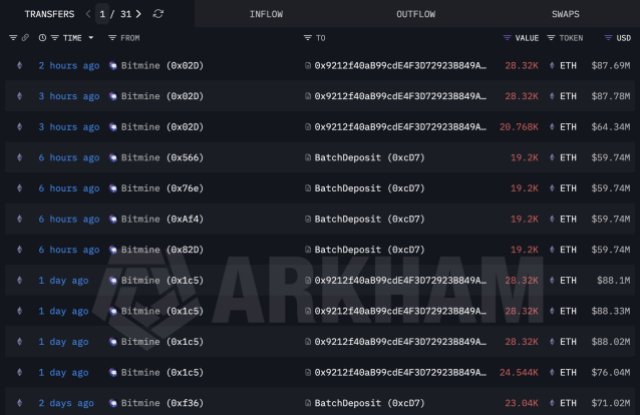
The public firm keeps extending its staking operations and reinforcing its commitment to on-chain yield generation following its latest move. This move was reported by Lookonchain, a popular on-chain data analytics platform, in a recent post on the X platform. Furthermore, the move coincides with staking’s continued development from a specialized tactic to a fundamental element of institutional cryptocurrency involvement, providing both recurrent benefits and a closer alignment with network security.

Source: Chart from Lookonchain on X

As seen in the report, the firm, led by industry leader and billionaire Tom Lee, has staked another 154,208 ETH valued at a staggering $478.77 million. Interestingly, the massive ETH staking was carried out within a 6-hour time frame, reflecting the firm’s robust conviction in the altcoin’s long-term prospects.

After the latest staking operation, the company has now staked a total of 1.344,224 ETH worth approximately $4.17 billion. By increasing its ETH stake, Bitmine Immersion is demonstrating its interest in Ethereum, from scaling upgrades to the ongoing expansion of DeFi and tokenized assets.

SharpLink Deepens Exposure With Expanded Staking Efforts

Another company making waves in the Ethereum staking is SharpLink Gaming, a move that was initiated alongside the launch of its ETH treasury since June 2. According to a report from the firm’s official page on X, they recently generated over 500 ETH in staking rewards last week.

SharpLink ETH staking rewards underscore its expanded participation in on-chain yield and increasing interest in the altcoin and its ecosystem. This growth highlights a larger trend as more businesses are moving from passive holding to active network participation, making Ethereum staking a key component of their business strategy.

With this additional ETH, SharpLink’s total cumulative staking rewards are now sitting at 11,157 ETH since it was launched. By dedicating more of its ETH holdings to validators, the firm is indirectly contributing to Ethereum’s security and decentralization while reaping the benefits of a constant flow of rewards.

Prior to the development, SharpLink deployed $170 million in ETH with a first-of-its-kind enhanced yield on Linea. Specifically, this move integrates native ETH yield, restaking rewards from Eigencloud, and direct incentives from Linea and Etherfi within an institutional-grade qualified custodian with the help of Anchorage. SharpLink has declared this the most productive way to hold ETH with institutional-grade infrastructure.

ETH trading at $3,340 on the 1D chart | Source: ETHUSDT on Tradingview.com

Связанные с этим вопросы

QHow much additional ETH did Bitmine Immersion stake in its recent move, and what is its total value?

ABitmine Immersion staked an additional 154,208 ETH, valued at approximately $478.77 million.

QWhat is the total amount of ETH that Bitmine Immersion has staked so far, and what is its estimated worth?

ABitmine Immersion has staked a total of 1,344,224 ETH, worth approximately $4.17 billion.

QWhich on-chain analytics platform reported Bitmine Immersion's latest ETH staking activity?

ALookonchain, a popular on-chain data analytics platform, reported Bitmine Immersion's latest ETH staking activity.

QHow much ETH in staking rewards did SharpLink Gaming generate last week?

ASharpLink Gaming generated over 500 ETH in staking rewards last week.

QWhat is the total cumulative staking rewards that SharpLink has earned since it launched its ETH treasury?

ASharpLink's total cumulative staking rewards are 11,157 ETH since its launch.

Похожее

Where Is the AI Infrastructure Industry Chain Stuck?

The AI infrastructure (AI Infra) industry chain is facing unprecedented systemic bottlenecks, despite the rapid emergence of applications like DeepSeek and Seedance 2.0. The surge in global computing demand has exposed critical constraints across multiple layers of the supply chain—from core manufacturing equipment and data center cabling to specialty materials and cleanroom facilities. Key challenges include four major "walls": - **Memory Wall**: High-bandwidth memory (HBM) and DRAM face structural shortages as AI inference demand outpaces training, with new capacity not expected until 2027. - **Bandwidth Wall**: Data transfer speeds lag behind computing power, causing multi-level bottlenecks in-chip, between chips, and across data centers. - **Compute Wall**: Advanced chip manufacturing, reliant on EUV lithography and monopolized by ASML, remains the fundamental constraint, with supply chain fragility affecting production. - **Power Wall**: While energy demand from data centers is rising, power supply is a solvable near-term challenge through diversified energy infrastructure. Expansion is further hindered by shortages in testing equipment, IC substrates (critical for GPUs and seeing price hikes over 30%), specialty materials like low-CTE glass fiber, and high-end cleanroom facilities. Connection technologies are evolving, with copper cables resurging for short-range links due to cost and latency advantages, while optical solutions dominate long-range scenarios. Innovations like hollow-core fiber and advanced PCB technologies (e.g., glass substrates, mSAP) are emerging to meet bandwidth needs. In summary, AI Infra bottlenecks are multidimensional, spanning compute, memory, bandwidth, power, and supply chain logistics. Advanced chip manufacturing remains the core constraint, while substrate, material, and equipment shortages present immediate challenges. The industry is moving toward hybrid copper-optical solutions and accelerated domestic supply chain development.

marsbit15 мин. назад

Where Is the AI Infrastructure Industry Chain Stuck?

marsbit15 мин. назад

Autonomy or Compatibility: The Choice Facing China's AI Ecosystem Behind the Delay of DeepSeek V4

DeepSeek V4's repeated delay in early 2026 has sparked global discussions on "de-CUDA-ization" in AI. The highly anticipated trillion-parameter open-source model is undergoing deep adaptation to Huawei’s Ascend chips using the CANN framework, representing China’s first systematic attempt to run a core AI model outside the CUDA ecosystem. This shift, however, comes with significant engineering challenges. While the model uses a MoE architecture to reduce computational load, it places extreme demands on memory bandwidth, chip interconnects, and system scheduling—areas where NVIDIA’s mature CUDA ecosystem currently excels. Migrating to Ascend introduces complexities in hardware topology, communication latency, and software optimization due to CANN’s relative immaturity compared to CUDA. The move highlights a broader strategic dilemma: short-term compatibility with CUDA offers practical benefits and faster adoption, as seen in CANN’s efforts to emulate CUDA interfaces. Yet, long-term over-reliance on compatibility risks inheriting CUDA’s limitations and stifling native innovation. If global AI shifts away from transformer-based architectures, strict compatibility could lead to technological obsolescence. Despite these challenges, DeepSeek V4’s eventual release could demonstrate the viability of a full domestic AI stack and accelerate CANN’s ecosystem growth. However, true technological independence will require building an original software-hardware paradigm beyond compatibility—a critical task for China’s AI ambitions in the next 3-5 years.

marsbit33 мин. назад

Autonomy or Compatibility: The Choice Facing China's AI Ecosystem Behind the Delay of DeepSeek V4

marsbit33 мин. назад

How Blockchain Fills the Identity, Payment, and Trust Gaps for AI Agents?

AI Agents are rapidly evolving into autonomous economic participants, but they face critical gaps in identity, payment, and trust infrastructure. They currently lack standardized ways to prove who they are, what they are authorized to do, and how they should be compensated across different environments. Blockchain technology is emerging as a solution to these challenges by providing a neutral coordination layer. Public ledgers offer auditable credentials, wallets enable portable identities, and stablecoins serve as a programmable settlement layer. A key bottleneck is the absence of a universal identity standard for non-human entities—akin to "Know Your Agent" (KYA)—which would allow Agents to operate with verifiable, cryptographically signed credentials. Without this, Agents remain fragmented and face barriers to interoperability. Additionally, as AI systems take on governance roles, there is a risk that centralized control over models could undermine decentralized governance in practice. Cryptographic guarantees on training data, prompts, and behavior logs are essential to ensure Agents act in users' interests. Stablecoins and crypto-native payment rails are becoming the default for Agent-to-Agent commerce, enabling seamless, low-cost transactions for AI-native services. These systems support permissionless, programmable payments without traditional merchant onboarding. Finally, as AI scales, human oversight becomes impractical. Trust must be built into system architecture through verifiable provenance, on-chain attestations, and decentralized identity systems. The future of Agent economies depends on cryptographically enforced accountability, allowing users to delegate tasks with clearly defined constraints and transparent operation logs.

marsbit1 ч. назад

How Blockchain Fills the Identity, Payment, and Trust Gaps for AI Agents?

marsbit1 ч. назад

Торговля

Спот
Фьючерсы

Популярные статьи

Manyu: восходящая мем-звезда на Ethereum, готовая открыть новую эру культуры Shiba

Manyu - это мемтокен на Ethereum, который приносит децентрализованную культурную и развлекательную ценность через вирусное влияние в соцсетях и вовлечённость сообщества.

1.9k просмотров всегоОпубликовано 2025.11.27Обновлено 2025.11.27

Manyu: восходящая мем-звезда на Ethereum, готовая открыть новую эру культуры Shiba

Обсуждения

Добро пожаловать в Сообщество HTX. Здесь вы сможете быть в курсе последних новостей о развитии платформы и получить доступ к профессиональной аналитической информации о рынке. Мнения пользователей о цене на ETH (ETH) представлены ниже.

活动图片