Mixed Signals for Ethereum: Technical Milestones and Rising Adoption Offset Market Pressure

bitcoinistОпубликовано 2026-01-06Обновлено 2026-01-06

Введение

Despite entering 2026 with mixed signals, Ethereum shows significant progress amid market pressure. The network is advancing technically with upgrades like PeerDAS and zkEVMs improving scalability and reducing validator burdens, while moving toward stronger security goals. Adoption is growing, with stablecoin transfers hitting $8 trillion in Q4 2025 and record activity in transactions and smart contract deployments. However, selling pressure persists, limiting price gains. Overall, Ethereum is in a phase of consolidation, balancing strong foundational growth against a cautious market.

The first week of the year has not been unkind to the market, with Ethereum (ETH) entering 2026 with a mixed narrative that reflects both progress and restraint. On one hand, the network is pushing through long-standing technical limits and seeing broader real-world usage.

On the other hand, market data indicate continued selling pressure, which has kept price action subdued. Together, these trends suggest Ethereum is less in decline than in transition, balancing structural growth against a cautious market environment.

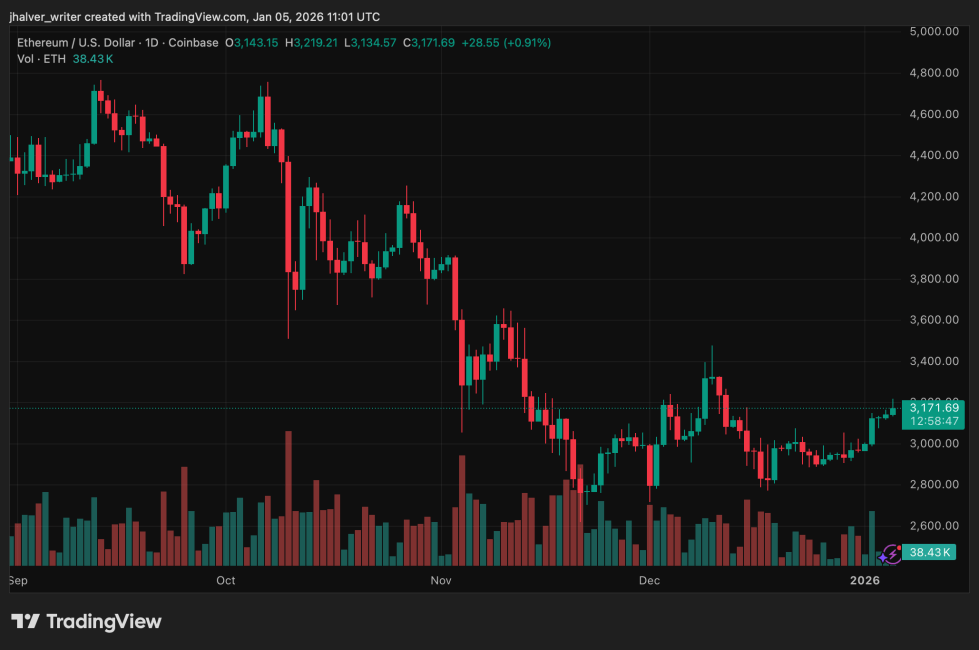
ETH's price trends slightly to the upside on the daily chart. Source: ETHUSD on Tradingview

Technical Progress and Network Upgrades

Recent comments from Ethereum co-founder Vitalik Buterin have drawn renewed attention to the progress on the blockchain trilemma, which is the challenge of balancing decentralization, security, and scalability.

According to Buterin, upgrades such as Peer Data Availability Sampling (PeerDAS) and zero-knowledge Ethereum Virtual Machines (zkEVMs) have moved this goal from theory into live conditions on the mainnet.

PeerDAS, introduced with the Fusaka upgrade in December, reduces the burden on validators by allowing them to verify data availability through sampling rather than processing full datasets. This improves scalability while maintaining accessibility to participation.

At the same time, zkEVMs have reached an early operational stage, with proof generation times falling sharply and verification costs dropping significantly. While still in alpha, these systems are expected to assume a larger validation role between 2027 and 2030, following further security enhancements.

Alongside performance gains, Ethereum’s roadmap is shifting toward protocol safety. The Ethereum Foundation has set a target of achieving 128-bit provable security by late 2026, indicating that recent speed and cost improvements are now being matched with increasingly stringent security goals.

Ethereum (ETH) Adoption Shifts Toward Utility

Beyond core protocol work, Ethereum’s usage metrics point to expanding adoption. Stablecoin transfer volume on the network exceeded $8 trillion in the fourth quarter of 2025, nearly doubling from earlier in the year.

Active addresses and daily transactions also reached record levels, reinforcing Ethereum’s role as a primary settlement layer for payments and tokenized assets.

Industry figures increasingly point to crypto-native neobanks as a key growth driver for 2026. These platforms combine self-custody, stablecoins, and yield products with familiar banking interfaces, lowering barriers for mainstream users.

Institutional participation in 2025, particularly through digital asset treasuries and staking-related structures, has helped lay the groundwork for this shift toward everyday financial use rather than short-term trading.

Market Pressure and Developer Momentum

Despite these developments, market flow data indicate that Ethereum remains under dominant selling pressure, reflecting a broader de-risking trend across cryptocurrency assets. This has limited upside and led to choppy price action, despite the emergence of positive narratives.

Similarly, developer activity tells a different story. An estimated 8.7 million smart contracts were deployed in the fourth quarter of 2025, the highest quarterly figure on record.

Taken together, Ethereum’s current signals point to consolidation rather than contraction. While market conditions continue to weigh on price, technical progress and rising adoption indicate the network is positioning itself for the next phase of growth once broader pressure eases.

Cover image from ChatGPT, ETHUSD chart from Tradingview

Похожее

OpenAI's 'Blueprint for the Future': Making AI Beneficial for Every Person on the Planet

A new transformative technology emerges every few generations. OpenAI draws a parallel with the advent of electricity in the 1920s, which initially brought convenience but ultimately enabled unprecedented progress in medicine, engineering, and living standards by empowering people to create new possibilities. AI is poised to recreate this phenomenon. Its true significance lies not in the technology itself, but in what people can achieve with it—from understanding a medical bill or starting a business to aiding scientific discovery. OpenAI believes AI should be universally accessible, allowing everyone to use it according to their own needs. This future, however, is not guaranteed. While transformative tech can centralize power, OpenAI's philosophy is that AI must serve humanity, augmenting human capabilities and broadly distributing its benefits. The company's first commitment is to build AI for human service, aiming to empower the many rather than concentrate power in a few. Safety, alignment with human intent, and oversight are paramount. OpenAI is optimistic about AI's potential to expand human welfare but remains clear-eyed about risks. The goal is to help people achieve more, not to replace them. Full automation is not the desired future; human judgment, values, and direction will become even more critical. OpenAI outlines three core goals: 1. Build automated AI researchers to accelerate and increasingly automate the research process itself, maintaining close human collaboration. The internal projection is that by March 2028, a significant portion of their research will be conducted by AI systems working alongside human researchers. 2. Accelerate economic development by advancing science, boosting productivity, and fostering growth, while ensuring the fruits are widely shared. 3. Provide a personal AGI for everyone on Earth, allowing individuals to benefit from this transformative technology in their own way. The company is entering its third phase, moving from foundational AGI research (Phase 1) to product deployment and learning from real-world use (Phase 2). The current challenge is making advanced AI abundant, affordable, safe, practical, and usable for all individuals and organizations. OpenAI concludes that a widely distributed power structure leads to a more resilient, adaptable, and free society. A positive AI future should not be controlled by a handful of entities but built, benefited from, and owned by many. If realized correctly, AI can become a cornerstone for enhancing global productivity, creativity, scientific advancement, and economic opportunity, fulfilling the mission to ensure AGI benefits all of humanity.

marsbit19 мин. назад

OpenAI's 'Blueprint for the Future': Making AI Beneficial for Every Person on the Planet

marsbit19 мин. назад

Arthur Hayes' New Article: AI Bubble Nears Bursting, Crypto Market Faces Short-Term Pressure

In a new essay, Arthur Hayes argues that the AI market bubble is approaching a rupture, which will place significant short-term pressure on crypto assets. He identifies rising oil prices, a trio of massive tech IPOs (SpaceX, Anthropic, OpenAI), and potential anti-AI political rhetoric from Trump as the three key catalysts for a correction. Hayes posits that the prolonged blockage of the Strait of Hormuz will drive energy prices higher, increasing operational costs for data centers and squeezing AI company profits. Simultaneously, the market may struggle to absorb the upcoming wave of multi-trillion dollar tech IPOs. Furthermore, with high inflation hurting his election chances, Trump could pivot to attacking the AI sector with proposals for heavy taxation and regulation to win over voters, spooking the market. Hayes notes that nearly all new dollar liquidity since 2022 has flowed into the AI sector, leaving little for Bitcoin, explaining its recent underperformance. He believes an AI stock crash would trigger a broad risk-off sentiment and credit contraction, dragging down crypto in the near term. Consequently, his fund, Maelstrom, has sold all AI-related stocks and non-core cryptocurrencies, retaining only Bitcoin and Ethereum while building positions in traditional energy stocks. He anticipates Bitcoin will bottom and resume its bull run only after the AI bubble pops and a new monetary easing cycle begins.

marsbit22 мин. назад

Arthur Hayes' New Article: AI Bubble Nears Bursting, Crypto Market Faces Short-Term Pressure

marsbit22 мин. назад

Торговля

Спот
Фьючерсы

Популярные статьи

Manyu: восходящая мем-звезда на Ethereum, готовая открыть новую эру культуры Shiba

Manyu - это мемтокен на Ethereum, который приносит децентрализованную культурную и развлекательную ценность через вирусное влияние в соцсетях и вовлечённость сообщества.

1.9k просмотров всегоОпубликовано 2025.11.27Обновлено 2025.11.27

Manyu: восходящая мем-звезда на Ethereum, готовая открыть новую эру культуры Shiba

Неделя обучения по популярным токенам 14: Glamsterdam — самое ожидаемое обновление Ethereum в 2026 году

Ordinals/Runes по-прежнему стимулируют доходы от комиссий за блоки и активность разработчиков, рассматриваются как отправная точка «нативной эмиссии активов» в сети.

1.5k просмотров всегоОпубликовано 2026.04.29Обновлено 2026.04.29

Неделя обучения по популярным токенам 14: Glamsterdam — самое ожидаемое обновление Ethereum в 2026 году

Обсуждения

Добро пожаловать в Сообщество HTX. Здесь вы сможете быть в курсе последних новостей о развитии платформы и получить доступ к профессиональной аналитической информации о рынке. Мнения пользователей о цене на ETH (ETH) представлены ниже.

活动图片