Memecoin Market Cap Plunges by $100 Billion in 2025, CoinGecko Report

RBK-cryptoОпубликовано 2025-12-26Обновлено 2025-12-26

Введение

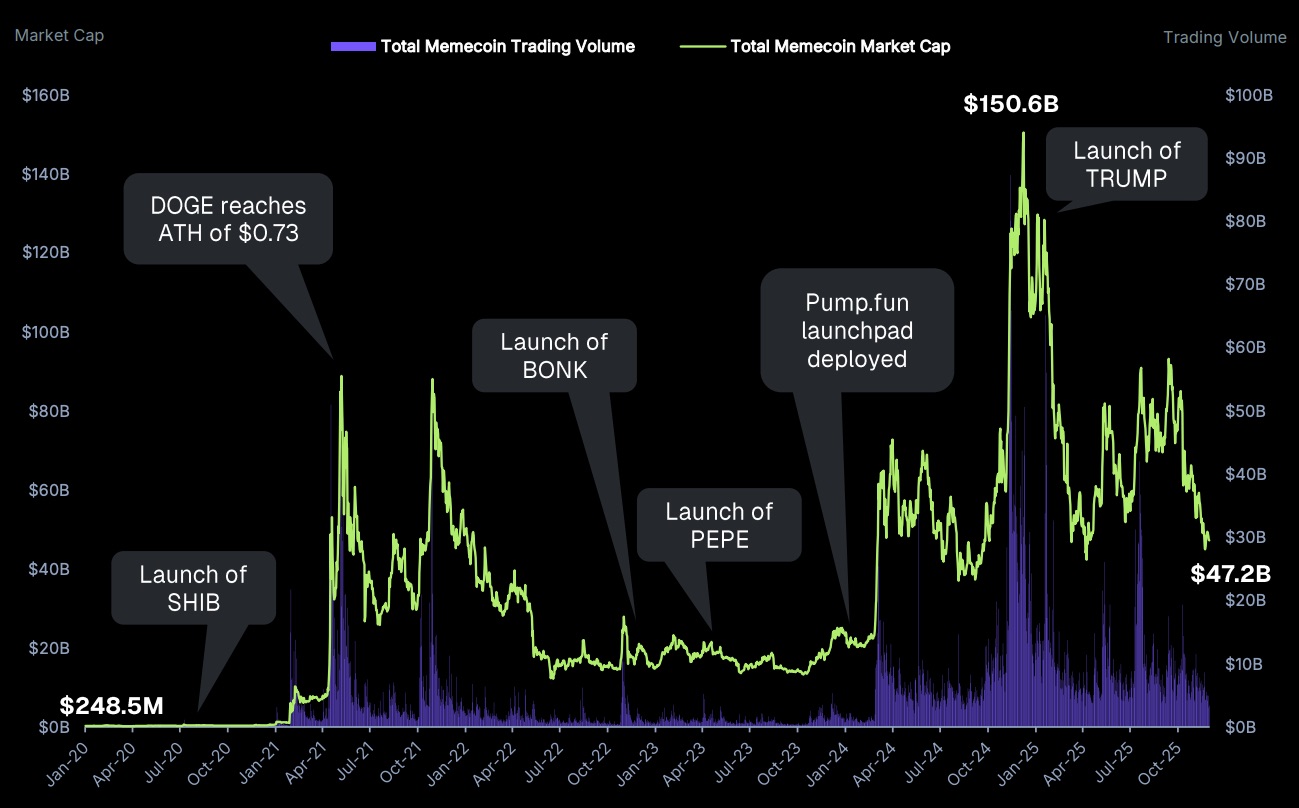
In 2025, the memecoin market capitalization plummeted by over $100 billion, according to a report by CoinGecko titled "2025 State of Memecoins." The decline began at the start of the year, coinciding with controversial token launches, including those of TRUMP, supported by Donald Trump's team, and LIBRA, which was promoted using the image of Argentine President Javier Milei without consent. The total market cap of memecoins had surged to a record $150 billion at the beginning of 2025, tripling the previous peak from the 2021 crypto bull run. This growth was fueled by platforms like Pump.fun, which facilitated the daily launch of thousands of new tokens. Dozens of these memecoins were even listed on major exchanges, including Binance and the typically cautious U.S.-based Coinbase. However, from the end of January and throughout the year, the sector's combined capitalization fell sharply, dropping to $47.2 billion by November. The report notes that despite the emergence of thousands of new tokens, the majority of the market's value remains concentrated in the "old guard" of memecoins: DOGE, SHIB, and PEPE. The report also highlights the "dark side" of the memecoin ecosystem, detailing prevalent fraudulent schemes such as "rug pulls" (sudden liquidity withdrawal), "sniping" (bot-driven instant token buys at launch), "bandling" (creating fake buy pressure), fake copies of popular tokens, and "honeypots" (tokens that become unsellable after purchase). The launch of the TRUMP to...

Since the launch of memecoins by Donald Trump's team, prices and trading volumes in meme tokens have been falling almost non-stop throughout the year.

Analysts from the popular cryptocurrency aggregator CoinGecko have released a report titled "2025 State of Memecoins" with an overview of the memecoin market. Among other things, the authors noted that the end of another "memecoin season" came at the beginning of 2025 and coincided with the controversial launches of TRUMP tokens with the support of the team of US President Donald Trump and LIBRA, whose advertising campaign creators attracted Argentine President Javier Milei.

Telegram channel "RBC-Crypto" — subscribe and stay up to date with the most important and relevant news about cryptocurrency.

Join the "RBC-Crypto" forum on Telegram to discuss news and trends in the crypto world.

Since the end of January and throughout the year, the total market capitalization of memecoins has fallen, and by November it amounted to $47.2 billion, according to the authors' calculations. The report's authors trace the entire history of memecoins, starting with the launch of Dogecoin in 2013, and note that despite the emergence of thousands of new tokens, the main share of capitalization is still concentrated among the "old-timers" — DOGE, SHIB, and PEPE.

The chart below shows historical trading volumes (indicated in purple), the total market capitalization of memecoins (green curve), and key events for the niche — the launch of the major memecoin SHIB, the historical price maximum of DOGE, the launch of the BONK memecoin, the launch of the PEPE memecoin, the launch of the Pump.fun platform, after which capitalization soars, and the launch of the TRUMP token, after which the market has been falling almost non-stop.

Trading volumes, total market capitalization, and key market events of the memecoin sector since 2020. Source: CoinGecko Research

In a separate section of the report, CoinGecko notes the "dark side" of memecoins. Among the most common fraudulent schemes, they name rug pulls (sudden withdrawal of liquidity), sniping (instant token buyout by bots at launch before further price growth), bandling (creating the illusion of demand with purchases from insider wallets), fake copies of popular tokens, and honeypots (the inability to sell a token after purchase).

Связанные с этим вопросы

QWhat was the peak market capitalization of memecoins in 2025, and how much did it fall by the end of the year according to the CoinGecko report?

AThe peak market capitalization of memecoins in 2025 was $150 billion. By November, it had fallen to $47.2 billion, representing a decline of over $100 billion.

QWhich platform was primarily responsible for the growth of the memecoin sector in 2025, and how did it contribute?

AThe platform Pump.fun was primarily responsible for the growth. It facilitated the daily launch of thousands of new tokens, fueling the memecoin boom.

QWhat two major events in early 2025, involving political figures, are cited as contradictory launches that marked the end of the 'memecoin season'?

AThe two events were the launch of TRUMP tokens supported by former U.S. President Donald Trump's team and the launch of LIBRA tokens, which involved the promotion of Argentine President Javier Milei in their advertising.

QDespite the launch of thousands of new tokens, which three 'old guard' memecoins continued to hold the majority of the sector's market capitalization?

AThe three 'old guard' memecoins that held the majority of the market capitalization were DOGE (Dogecoin), SHIB (Shiba Inu), and PEPE.

QWhat are some of the 'dark side' scams and fraudulent schemes mentioned in the CoinGecko report that are prevalent in the memecoin market?

AThe report mentions several scams including 'rug pulls' (sudden withdrawal of liquidity), 'sniping' (bots instantly buying tokens at launch), 'bandling' (creating fake buy pressure with insider wallets), fake copies of popular tokens, and 'honeypots' (tokens that become impossible to sell after purchase).

Похожее

After Marvell's 32% Surge, the Chinese Chip Family Behind It Emerges

The stock price of Marvell Technology surged 32.5% on June 2nd, driven by NVIDIA CEO Jensen Huang highlighting its custom ASICs and optical interconnects as core to AI data center architecture. This event brought attention to the Chinese semiconductor family behind Marvell: the Dai siblings. The story centers on three siblings, all UC Berkeley graduates, whose three-decade entrepreneurial journey aligns with major semiconductor industry shifts. In 1995, youngest sister Dai Wei Li co-founded Marvell with her husband Sehat Sutardja and his brother, focusing on storage controllers. Eldest brother Dai Wei Min founded EDA company Ultima, later sold to Cadence, and later founded VeriSilicon (芯原) in China, becoming a leading semiconductor IP provider. Second brother Dai Wei Jin co-founded EDA firm Silicon Perspective (sold to Cadence) and GPU IP company Vivante, later acquired by VeriSilicon. The combined "Dai-Sutardja" family network extends beyond Marvell. Their ventures and investments form a comprehensive ecosystem for the post-Moore's Law, chiplet era. Key holdings include: Dream Big Semiconductor (AI SuperNICs, acquired by Arm), Alphawave (high-speed SerDes IP, acquired by Qualcomm), and Silicon Box (a chiplet advanced packaging foundry). VeriSilicon itself thrives on the AI ASIC and IP boom in China. Collectively, the family's AI infrastructure-related portfolio is estimated at over $22 billion. Their strategy represents a distinct path: building critical components for open standards and key manufacturing capacity in the chiplet era, rather than pursuing standalone AI chip dominance. While this path may not create the next NVIDIA, it has enabled repeated successful exits and sustained influence within the global semiconductor industry.

marsbit47 мин. назад

After Marvell's 32% Surge, the Chinese Chip Family Behind It Emerges

marsbit47 мин. назад

Microsoft is Afraid of Being Marginalized by AI Giants

Microsoft, once the defining force of the PC era, now faces a familiar challenge in the AI age: the risk of being relegated to a profitable but invisible infrastructure provider. This anxiety was laid bare at Build 2026, where CEO Satya Nadella unveiled a major strategic pivot. The catalyst was a quiet April agreement that dissolved Microsoft's exclusive licensing and cloud-hosting deal with OpenAI, its once-vital partner. This erased Microsoft's key AI moat. With OpenAI and Anthropic defining AI applications and gaining enterprise traction—even within Microsoft's own ranks—Nadella had to answer: without exclusivity, what is Microsoft's role? The answer was a suite of seven in-house AI models, a developer-focused AI workstation (Surface RTX Spark Dev Box), and, most crucially, the Agent 365 platform for enterprise AI governance. The models, notably targeting Anthropic's strengths in coding and enterprise, signal a defensive move. However, the broader strategy is to make the models themselves less decisive. Financially, Microsoft's AI revenue is strong, driven largely by Azure running others' models. Yet its user-facing products like Copilot show weak penetration and engagement. Microsoft earns infrastructure money but lacks direct user mindshare. Nadella's core fear is being "hollowed out." As OpenAI and Anthropic prepare for IPOs and gain financial independence, they may build their own infrastructure, threatening Azure's lucrative AI revenue stream. Microsoft's window is to entrench itself deeper: not as the model creator, but as the indispensable platform for securely deploying, managing, and governing all AI models within the enterprise through Agent 365. Build 2026 revealed Microsoft's bet: in the AI era, the ultimate power lies not in any single model, but in the enterprise "operating system" that controls them. Nadella is determined to ensure Microsoft is the driver of this new era, not just a passenger.

marsbit1 ч. назад

Microsoft is Afraid of Being Marginalized by AI Giants

marsbit1 ч. назад

CPU, Quietly Returning to the Center of the AI Computing Power Stage

Over the past three years, AI computing power narratives have been dominated by GPUs. However, starting in 2026, this story began to shift. While training large models remains GPU-intensive, the rapid growth of inference and AI agent workloads, which require high levels of task orchestration, concurrency, and data flow management, has highlighted a renewed critical role for CPUs. These are tasks GPUs are not designed to handle. Intel's recent launch of the Xeon 6+ processor, built on its Intel 18A process and featuring up to 288 efficiency cores (E-cores), exemplifies this strategic pivot. It is positioned not as a mere companion to GPUs but as the essential "control plane" for AI infrastructure, optimized for high-density, energy-efficient, and high-throughput workloads characteristic of AI agents and inference. This "CPU resurgence" is not about CPUs outperforming GPUs in raw computation. It reflects a systemic bottleneck: as AI scales from training single models to deploying countless intelligent agents, the demand for coordination and data handling surges. Major cloud providers are also developing their own high-density ARM-based server CPUs for similar workloads. However, Intel's success with this strategy faces significant challenges. Competition includes NVIDIA's integrated CPU-GPU solutions, the expanding adoption of cloud vendors' in-house ARM CPUs, and the crucial market test of Intel's 18A manufacturing process against rivals like TSMC's N2. In conclusion, CPUs are indeed reclaiming a central, though redefined, role in AI compute—managing the complex orchestration that enables massive-scale AI deployment. While the trend is clear, which company will ultimately lead this CPU resurgence remains an open question to be decided in the data centers of 2027 and beyond.

marsbit1 ч. назад

CPU, Quietly Returning to the Center of the AI Computing Power Stage

marsbit1 ч. назад

Торговля

Спот
Фьючерсы

Популярные статьи

Как купить S

Добро пожаловать на HTX.com! Мы сделали приобретение Sonic (S) простым и удобным. Следуйте нашему пошаговому руководству и отправляйтесь в свое крипто-путешествие.Шаг 1: Создайте аккаунт на HTXИспользуйте свой адрес электронной почты или номер телефона, чтобы зарегистрироваться и бесплатно создать аккаунт на HTX. Пройдите удобную регистрацию и откройте для себя весь функционал.Создать аккаунтШаг 2: Перейдите в Купить криптовалюту и выберите свой способ оплатыКредитная/Дебетовая Карта: Используйте свою карту Visa или Mastercard для мгновенной покупки Sonic (S).Баланс: Используйте средства с баланса вашего аккаунта HTX для простой торговли.Третьи Лица: Мы добавили популярные способы оплаты, такие как Google Pay и Apple Pay, для повышения удобства.P2P: Торгуйте напрямую с другими пользователями на HTX.Внебиржевая Торговля (OTC): Мы предлагаем индивидуальные услуги и конкурентоспособные обменные курсы для трейдеров.Шаг 3: Хранение Sonic (S)После приобретения вами Sonic (S) храните их в своем аккаунте на HTX. В качестве альтернативы вы можете отправить их куда-либо с помощью перевода в блокчейне или использовать для торговли с другими криптовалютами.Шаг 4: Торговля Sonic (S)С легкостью торгуйте Sonic (S) на спотовом рынке HTX. Просто зайдите в свой аккаунт, выберите торговую пару, совершайте сделки и следите за ними в режиме реального времени. Мы предлагаем удобный интерфейс как для начинающих, так и для опытных трейдеров.

1.4k просмотров всегоОпубликовано 2025.01.15Обновлено 2026.06.02

Как купить S

Sonic: Обновления под руководством Андре Кронье – новая звезда Layer-1 на фоне спада рынка

Он решает проблемы масштабируемости, совместимости между блокчейнами и стимулов для разработчиков с помощью технологических инноваций.

2.3k просмотров всегоОпубликовано 2025.04.09Обновлено 2025.04.09

Sonic: Обновления под руководством Андре Кронье – новая звезда Layer-1 на фоне спада рынка

HTX Learn: Пройдите обучение по "Sonic" и разделите 1000 USDT

HTX Learn — ваш проводник в мир перспективных проектов, и мы запускаем специальное мероприятие "Учитесь и Зарабатывайте", посвящённое этим проектам. Наше новое направление .

1.8k просмотров всегоОпубликовано 2025.04.10Обновлено 2025.04.10

HTX Learn: Пройдите обучение по "Sonic" и разделите 1000 USDT

Обсуждения

Добро пожаловать в Сообщество HTX. Здесь вы сможете быть в курсе последних новостей о развитии платформы и получить доступ к профессиональной аналитической информации о рынке. Мнения пользователей о цене на S (S) представлены ниже.

活动图片