Mapping Ethereum’s macro sensitivity – Oil, liquidity & why ETH absorbs it all

ambcryptoОпубликовано 2026-03-16Обновлено 2026-03-16

Введение

The Ethereum market is undergoing a significant structural shift, with derivatives now dominating price discovery. Futures trading on major exchanges like Binance has grown to be over 12 times larger than spot trading. This surge in leveraged activity makes the market more fragile, as evidenced by recent liquidations totaling $135 million, which can trigger rapid price cascades. Concurrently, Ethereum is displaying heightened sensitivity to macroeconomic forces. Rising oil prices above $100 and tightening global liquidity are pressuring risk assets. Due to its critical role as $58.54 billion in collateral within DeFi protocols, ETH is deeply embedded in the financial infrastructure. This positions it as a key gauge for macro risk in the altcoin market, causing its price to react more to geopolitical shocks, energy volatility, and institutional hedging flows than purely crypto-native demand.

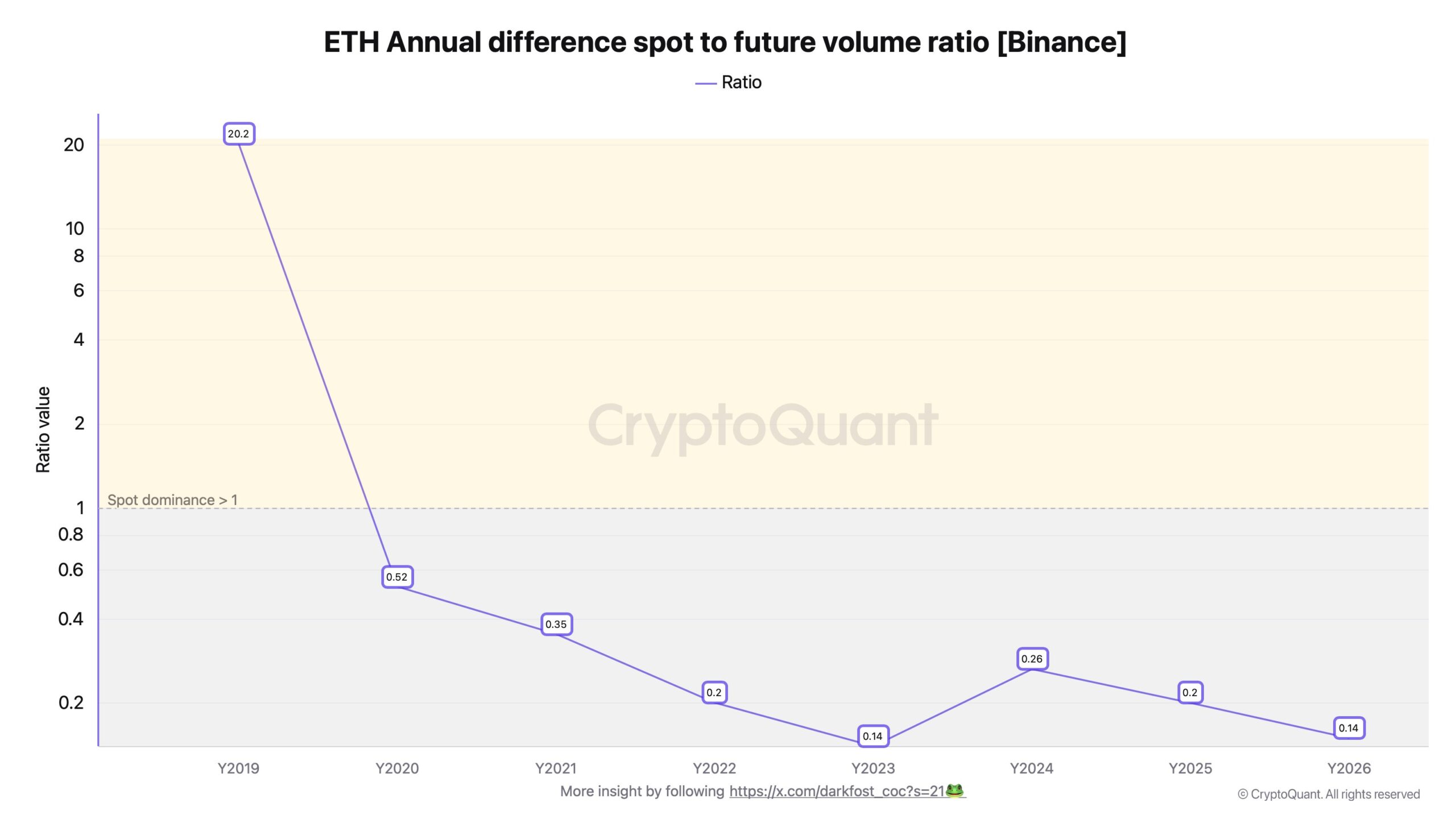
Ethereum’s market structure continued shifting toward derivatives dominance at the press time.

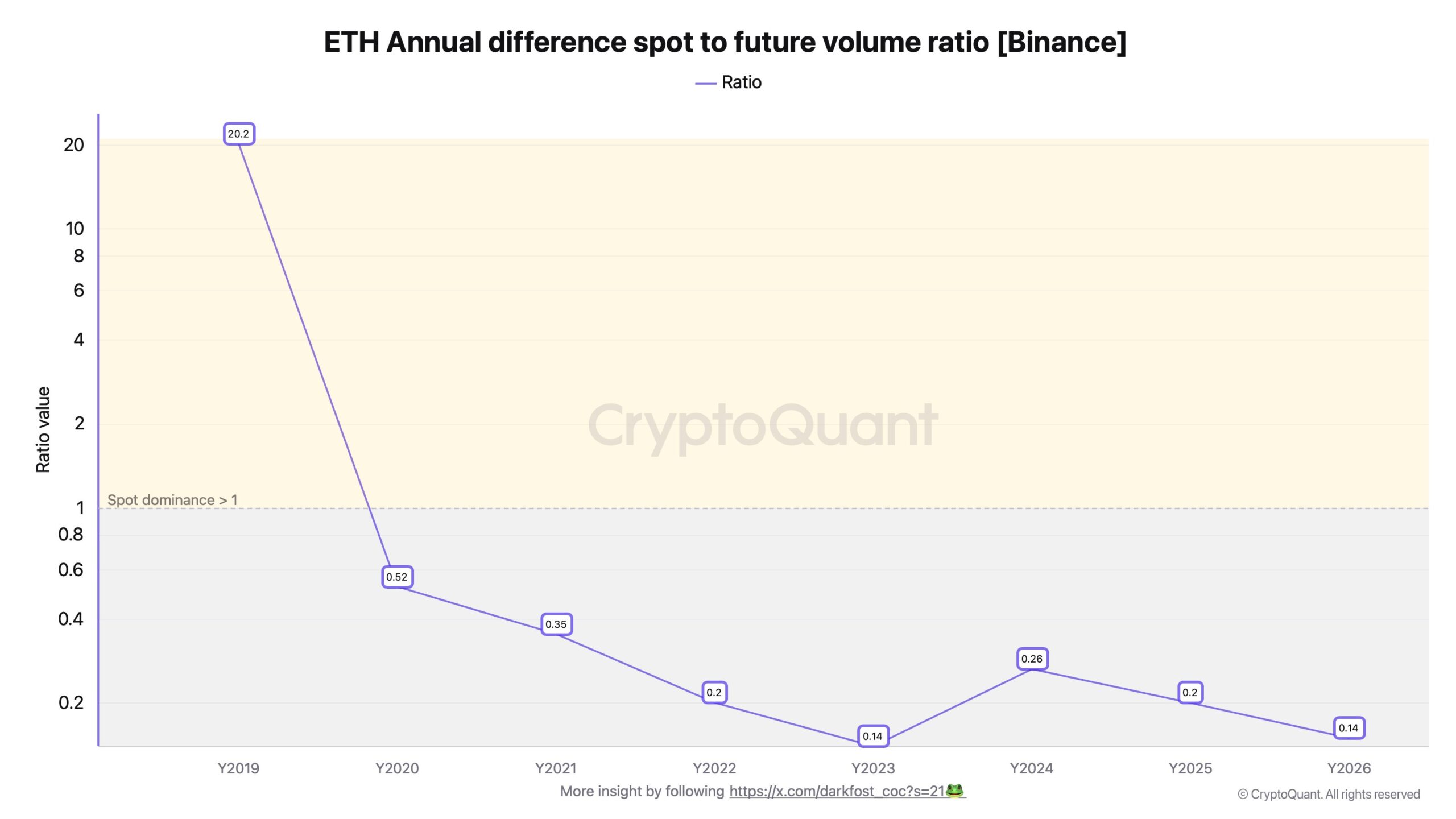
The Spot-to-Futures Volume Ratio on Binance collapsed from 20.2 in 2019 to 0.14 in 2026. This steep decline showed futures markets steadily absorbing price discovery.

As derivatives expand, futures volume exceeded spot activity by more than sixfold.

Source: Darkfost/ X

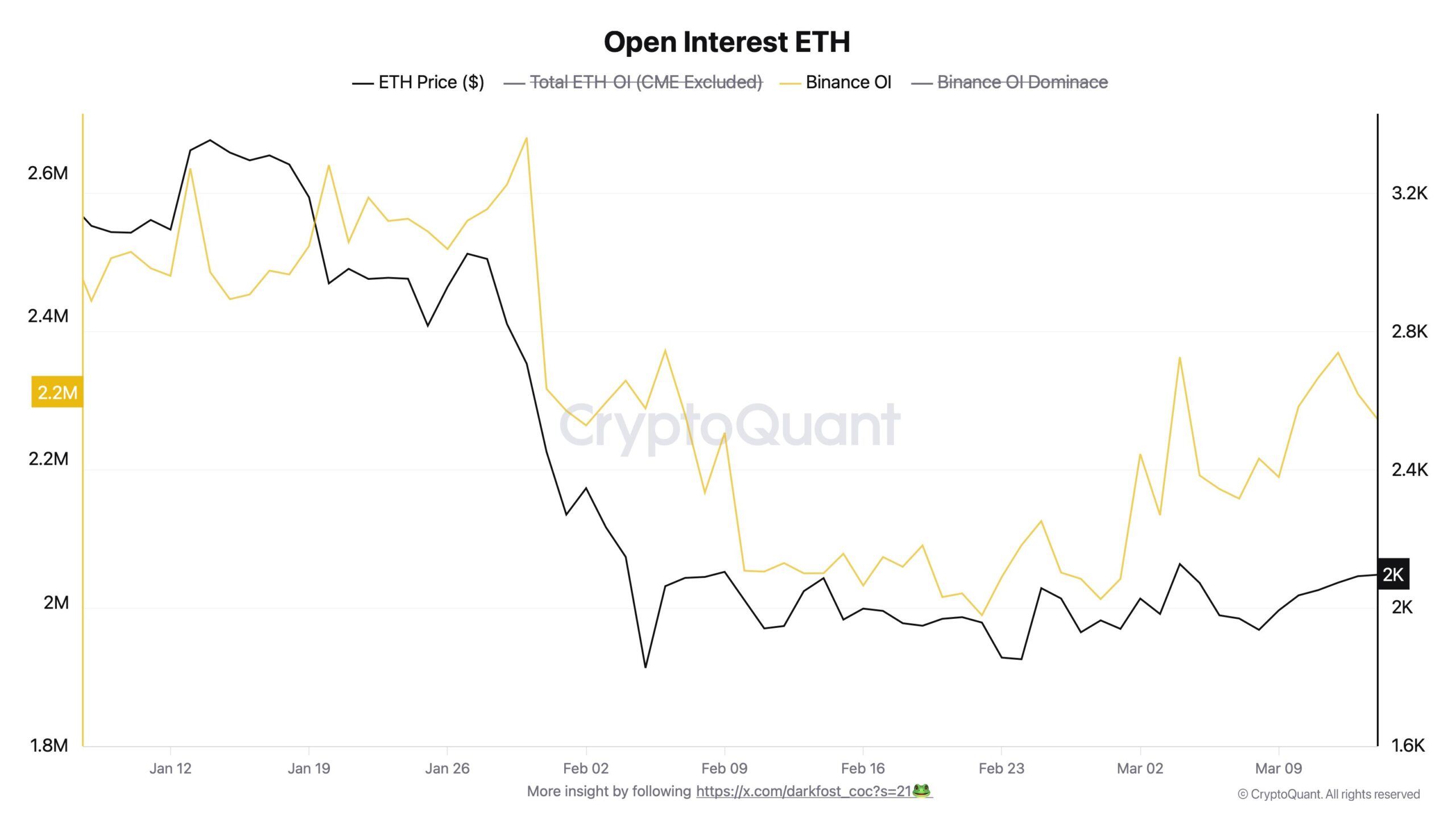
Meanwhile, positioning across leverage markets has adjusted sharply.

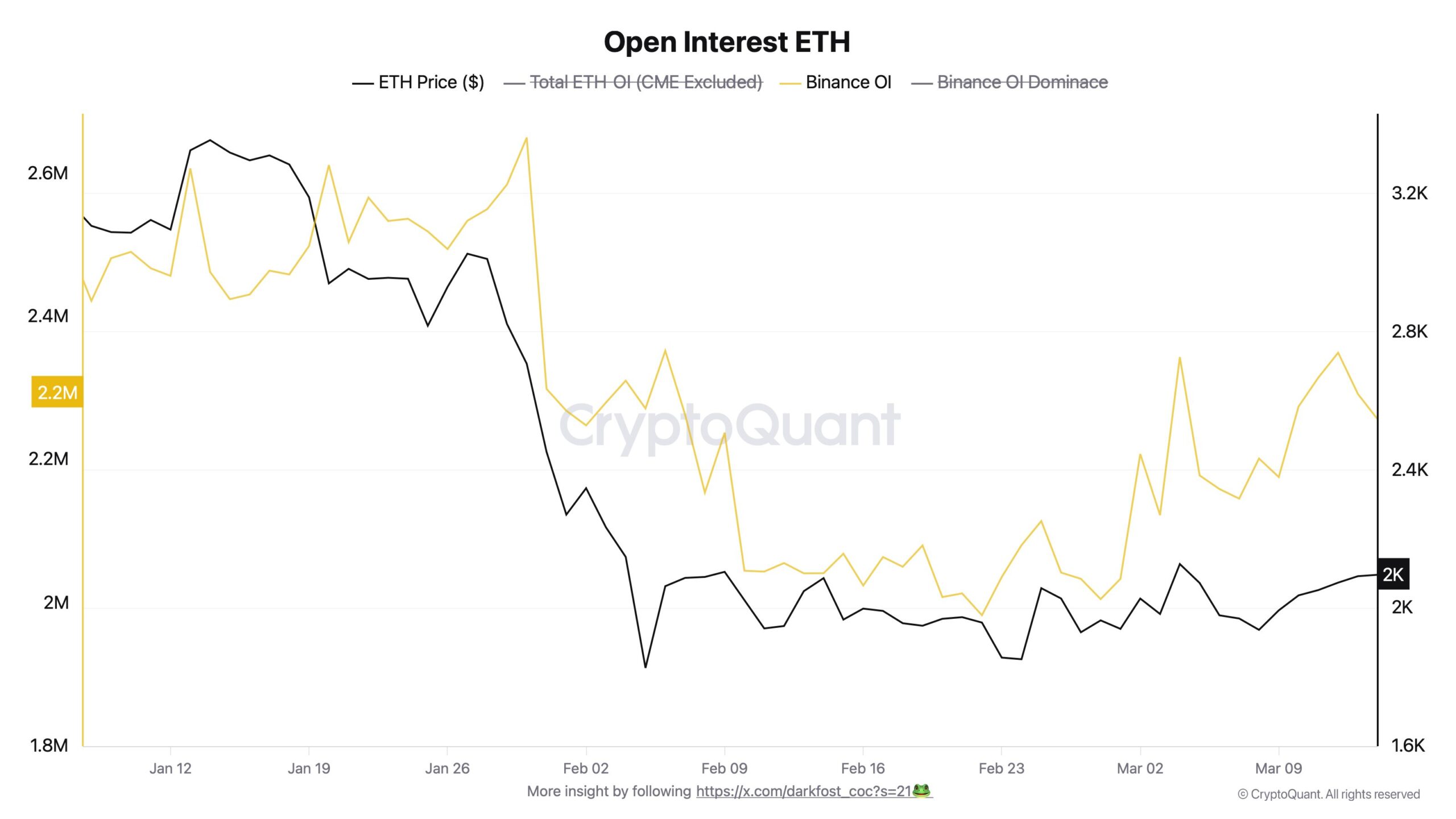
Since January, Binance Open Interest has dropped by roughly 400,000 ETH, equivalent to nearly $4 billion in leaving futures exposure. Yet futures activity remains elevated, signaling that traders rotate positions rather than abandoning leverage entirely.

Source: Darkfost/ X

Alongside this shift, macro pressure is intensifying.

Brent crude climbed above $100 as geopolitical tensions rose. Higher energy costs tighten liquidity conditions globally.

As liquidity compresses and yields rise, investors reduce exposure to risk assets. Within this environment, Ethereum [ETH] increasingly reacts to macro capital flows rather than purely crypto-native demand.

Derivatives now drive Ethereum price discovery

Ethereum’s price discovery is steadily shifting toward derivatives markets.

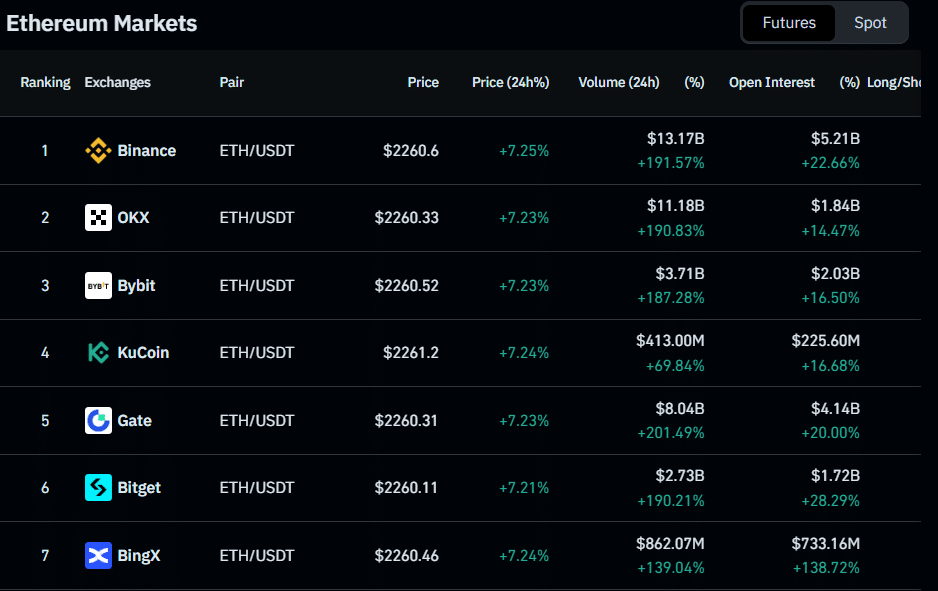
Aggregated Futures Volume reached over $57 billion in 24 hours, signaling where most trading activity now concentrates.

Meanwhile, Spot markets remain comparatively thin. On Binance, Futures Turnover hit $13.17 billion, while Spot Volume reached only $1.1 billion.

This imbalance places derivatives activity roughly 12.5 times larger than physical trading.

Source: CoinGlass

As liquidity concentrates in perpetual contracts, short-term positioning increasingly drives price action. Within this structure, leveraged exposure becomes fragile.

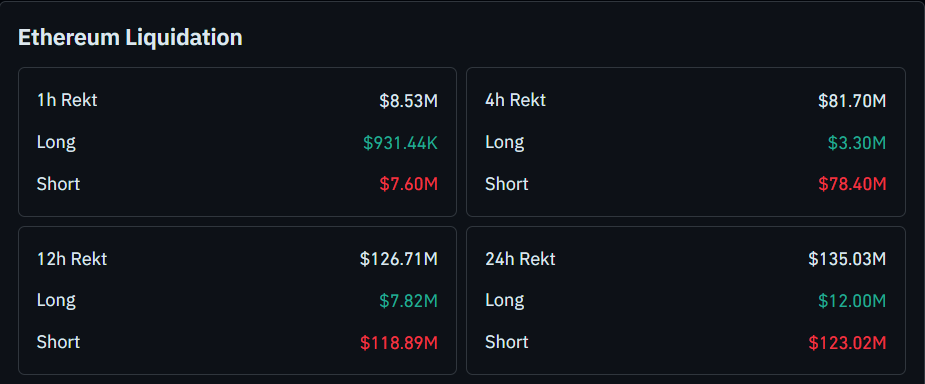
Recent liquidations totaled $135.03 million in 24 hours, triggering rapid cascades across derivatives markets.

Source: CoinGlass

As these liquidations unfold, volatility often accelerates. Ethereum, therefore, reacts more to leveraged positioning dynamics than steady spot accumulation.

Ethereum emerges as the altcoin market’s macro risk gauge

Oil markets are tightening as Brent crude pushes firmly above the $100 threshold. Such energy spikes often revive inflation concerns and pressure global liquidity conditions.

Meanwhile, the U.S. Dollar Index stabilizes near 100.39 while 10-year Treasury yields hover around 4.28%. These shifts gradually push investors toward defensive positioning across financial markets.

As liquidity tightens, risk assets typically absorb the pressure first.

Within this macro environment, Ethereum shows heightened sensitivity compared with most altcoins. ETH secures roughly $58.54 billion in collateral across DeFi protocols such as Aave and Lido.

This structural role keeps ETH deeply embedded in trading and lending infrastructure. As institutional desks hedge exposures through ETH markets, geopolitical shocks and energy volatility increasingly ripple into Ethereum’s price behavior.


Final Summary

  • Ethereum [ETH] derivatives markets now dominate price formation as futures volume exceeds spot activity by over sixfold, while leverage-driven liquidations increasingly amplify short-term volatility.
  • Ethereum is becoming a macro-sensitive altcoin as rising oil prices, tightening liquidity, and institutional hedging flows increasingly shape ETH market behavior.

Связанные с этим вопросы

QHow has the Spot-to-Futures Volume Ratio on Binance changed from 2019 to 2026, and what does this indicate?

AThe Spot-to-Futures Volume Ratio on Binance collapsed from 20.2 in 2019 to 0.14 in 2026, indicating that futures markets have steadily absorbed price discovery and now dominate trading activity.

QWhat is the current relationship between futures volume and spot activity for Ethereum trading?

AFutures volume now exceeds spot activity by more than sixfold, with derivatives activity being roughly 12.5 times larger than physical trading.

QHow much Binance Open Interest has left Ethereum futures markets since January, and what does this suggest about trader behavior?

ABinance Open Interest has dropped by roughly 400,000 ETH (nearly $4 billion) since January, suggesting that traders are rotating positions rather than abandoning leverage entirely.

QWhy is Ethereum increasingly reacting to macro capital flows according to the article?

AEthereum is increasingly reacting to macro capital flows due to tightening global liquidity conditions from rising oil prices and geopolitical tensions, which cause investors to reduce exposure to risk assets.

QWhat role does Ethereum's $58.54 billion in DeFi collateral play in its market behavior?

AEthereum's $58.54 billion in collateral across DeFi protocols like Aave and Lido embeds it deeply in trading and lending infrastructure, making it more sensitive to institutional hedging flows and macro shocks.

Похожее

Bitcoin's 'Rally Ends,' Officially Entering the Later Stage of a Bear Market?

Bitcoin prices declined 13% this week, reversing the recent rebound and signaling a likely transition into the later stages of a bear market. Key on-chain metrics deteriorated, with the short-term holder cost basis falling below the Realized Price—a pattern last seen in early 2022, characteristic of bear market maturity. The rally to ~$82k proved to be a bear market bounce, as evidenced by the 90-day realized profit/loss ratio failing to sustain above the bullish threshold of 2. Daily realized losses surged to $1.35B, including significant selling from long-term holders who accumulated near cycle tops, indicating ongoing supply redistribution. Price was rejected almost precisely at the aggregate US spot ETF cost basis of ~$83k, turning that level into resistance and leaving the average ETF investor underwater again. Spot market selling pressure intensified, with the 7-day volume delta turning significantly negative to its weakest level since February. While a major long liquidation event cleared over $400M in leverage, spot demand has not yet stepped in to absorb the resulting supply. Options markets continue pricing in higher future volatility (elevated volatility risk premium) and maintain a skew toward put options, reflecting persistent demand for downside protection, though not yet panic. Overall, market structure remains fragile. Sustained recovery likely requires a reclaim of the ETF cost basis, a shift back to positive spot demand, and a slowdown in realized loss-taking. Until then, the market risks further downside or extended consolidation within the broader bear trend.

Foresight News1 ч. назад

Bitcoin's 'Rally Ends,' Officially Entering the Later Stage of a Bear Market?

Foresight News1 ч. назад

How Risky is the "Death Spiral" of MSTR and STRC?

Summary: This article explores the perceived "death spiral" risk between MicroStrategy (MSTR), its Bitcoin holdings, and its perpetual preferred stock (STRC), drawing comparisons to the LUNA-UST collapse. While both systems feature price anchors, high yields for holders, and potential feedback loops, their core mechanisms differ fundamentally. The MSTR-STRC structure relies on continuous financing to sustain its high dividend payouts, primarily through stock ATM offerings. A negative feedback cycle could occur: falling MSTR stock price makes raising equity capital harder, increasing pressure to sell Bitcoin, which undermines STRC confidence and further depresses MSTR. However, unlike LUNA-UST's automated, direct linkage, the MSTR-STRC loop is weaker and has brakes: STRC dividends can be deferred or rates lowered, and STRC holders have a $100/share liquidation preference in bankruptcy, providing a price floor. The company's sustainability hinges on its ability to continue financing. Its current ~$900 million USD reserves cover only about 6.3 months of its ~$1.71 billion annual interest/dividend burden. The next six months are critical, aligning with both the potential bottom in Bitcoin's four-year cycle and the depletion timeline of its reserves. While a LUNA-style catastrophic collapse is deemed highly unlikely due to structural differences, the key question is whether MicroStrategy can navigate this period through healthy deleveraging to restart its capital engine.

Foresight News1 ч. назад

How Risky is the "Death Spiral" of MSTR and STRC?

Foresight News1 ч. назад

Торговля

Спот
Фьючерсы

Популярные статьи

Как купить S

Добро пожаловать на HTX.com! Мы сделали приобретение Sonic (S) простым и удобным. Следуйте нашему пошаговому руководству и отправляйтесь в свое крипто-путешествие.Шаг 1: Создайте аккаунт на HTXИспользуйте свой адрес электронной почты или номер телефона, чтобы зарегистрироваться и бесплатно создать аккаунт на HTX. Пройдите удобную регистрацию и откройте для себя весь функционал.Создать аккаунтШаг 2: Перейдите в Купить криптовалюту и выберите свой способ оплатыКредитная/Дебетовая Карта: Используйте свою карту Visa или Mastercard для мгновенной покупки Sonic (S).Баланс: Используйте средства с баланса вашего аккаунта HTX для простой торговли.Третьи Лица: Мы добавили популярные способы оплаты, такие как Google Pay и Apple Pay, для повышения удобства.P2P: Торгуйте напрямую с другими пользователями на HTX.Внебиржевая Торговля (OTC): Мы предлагаем индивидуальные услуги и конкурентоспособные обменные курсы для трейдеров.Шаг 3: Хранение Sonic (S)После приобретения вами Sonic (S) храните их в своем аккаунте на HTX. В качестве альтернативы вы можете отправить их куда-либо с помощью перевода в блокчейне или использовать для торговли с другими криптовалютами.Шаг 4: Торговля Sonic (S)С легкостью торгуйте Sonic (S) на спотовом рынке HTX. Просто зайдите в свой аккаунт, выберите торговую пару, совершайте сделки и следите за ними в режиме реального времени. Мы предлагаем удобный интерфейс как для начинающих, так и для опытных трейдеров.

1.4k просмотров всегоОпубликовано 2025.01.15Обновлено 2026.06.02

Как купить S

Sonic: Обновления под руководством Андре Кронье – новая звезда Layer-1 на фоне спада рынка

Он решает проблемы масштабируемости, совместимости между блокчейнами и стимулов для разработчиков с помощью технологических инноваций.

2.3k просмотров всегоОпубликовано 2025.04.09Обновлено 2025.04.09

Sonic: Обновления под руководством Андре Кронье – новая звезда Layer-1 на фоне спада рынка

HTX Learn: Пройдите обучение по "Sonic" и разделите 1000 USDT

HTX Learn — ваш проводник в мир перспективных проектов, и мы запускаем специальное мероприятие "Учитесь и Зарабатывайте", посвящённое этим проектам. Наше новое направление .

1.8k просмотров всегоОпубликовано 2025.04.10Обновлено 2025.04.10

HTX Learn: Пройдите обучение по "Sonic" и разделите 1000 USDT

Обсуждения

Добро пожаловать в Сообщество HTX. Здесь вы сможете быть в курсе последних новостей о развитии платформы и получить доступ к профессиональной аналитической информации о рынке. Мнения пользователей о цене на S (S) представлены ниже.

活动图片