Losing $19,000 Per Mined Coin, Bitcoin Mining Companies Collectively Flee to AI

marsbitОпубликовано 2026-03-29Обновлено 2026-03-29

Введение

Facing unsustainable losses of approximately $19,000 per Bitcoin mined due to rising costs and stagnant BTC prices, major public mining firms are pivoting aggressively toward AI infrastructure. According to a CoinShares report, these companies have signed over $70 billion in AI and high-performance computing contracts, with AI revenue projected to reach 70% of total income by 2026. To fund this transition, miners are taking on significant debt and selling Bitcoin holdings—over 15,000 BTC have been liquidated collectively. This shift is reducing Bitcoin’s network security, as hash rate has dropped from 1,160 EH/s to 920 EH/s. Market valuations now favor AI-exposed miners at 12.3x forward revenue, compared to 5.9x for pure-play miners. The industry’s future depends heavily on Bitcoin’s price: a recovery to $100,000 could slow the AI transition, while prices below $70,000 may accelerate the move away from mining.

Author: Shaurya Malwa

Compiled by: Deep Tide TechFlow

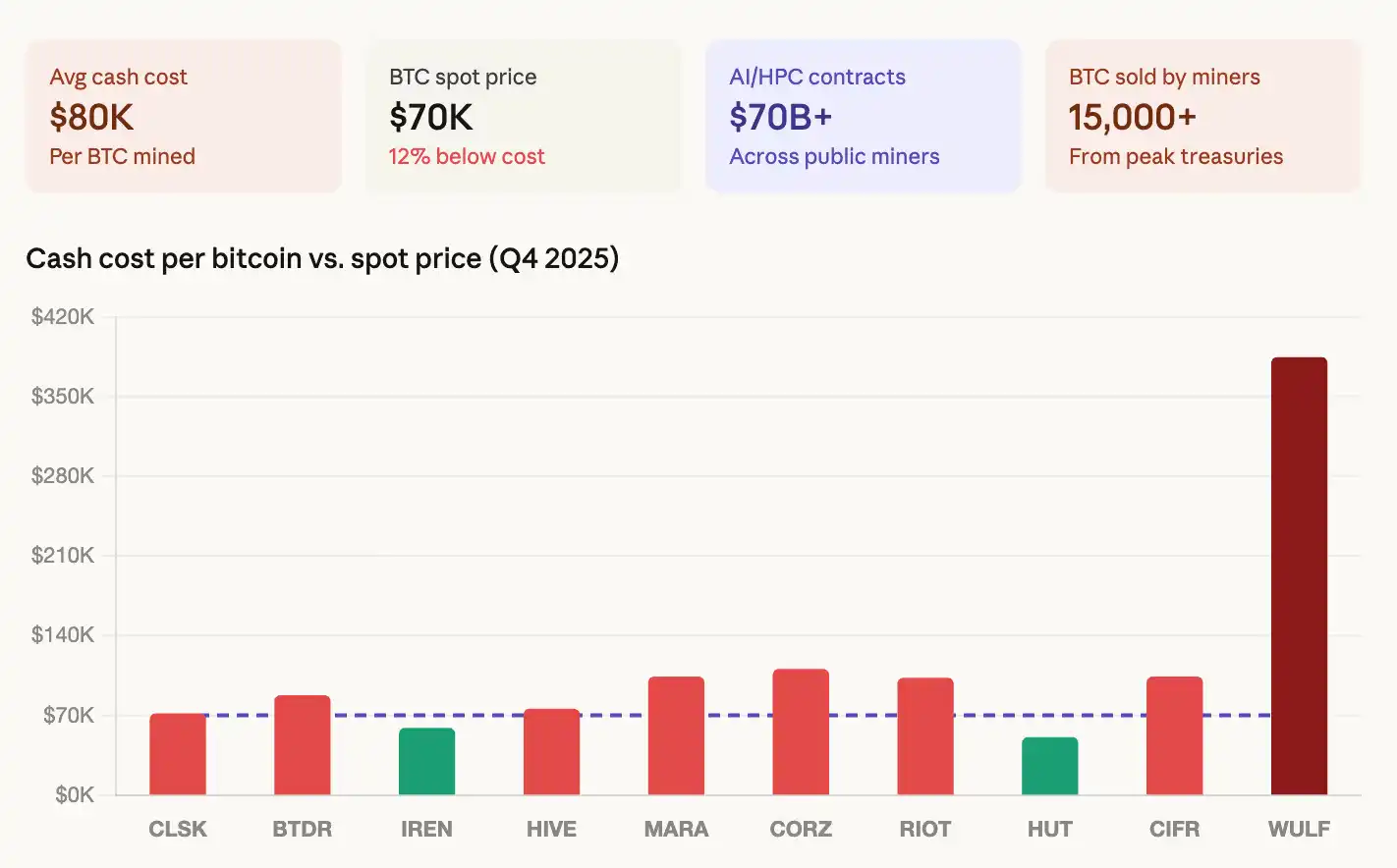
Deep Tide Guide: The latest mining report from CoinShares shows that the weighted average cost for listed mining companies to mine one Bitcoin has risen to about $80,000, while the current price of BTC is between $68,000 and $70,000—resulting in a loss of $19,000 per coin mined.

The industry is undergoing its most fundamental transformation since its inception: over $70 billion in AI/HPC contracts have been signed, listed mining companies have collectively sold over 15,000 BTC, and companies like IREN and TeraWulf have taken on tens of billions of dollars in debt. By the end of 2026, AI revenue may account for up to 70% of some mining companies' income. They are transitioning from Bitcoin miners to data center operators that happen to still mine. The core contradiction is: the companies selling Bitcoin to transition to AI are the same ones that secure the Bitcoin network. The hash rate has dropped from a peak of 1,160 EH/s to about 920 EH/s.

  • The Bitcoin mining industry is experiencing its most fundamental transformation since its inception, and the clearest signal is not the hash rate or difficulty adjustment, but the balance sheet.
  • CoinShares' Q1 2026 mining report released this week shows that the weighted average cash cost for listed mining companies to mine one Bitcoin in Q4 2025 rose to about $79,995.
  • Bitcoin has been trading in the $68,000–$70,000 range, and a CoinDesk report last week estimated a loss of about $19,000 per BTC mined.
  • This number is unsustainable, and the industry knows it. The response is a full-scale shift to AI infrastructure—which is reshaping the essence of these companies.

According to the CoinShares report, listed mining companies have collectively announced over $70 billion in AI and high-performance computing (HPC) contracts. CoreWeave's expanded agreement with Core Scientific is worth $10.2 billion over 12 years. TeraWulf has secured $12.8 billion in HPC contract revenue. Hut 8 signed a $7 billion, 15-year AI infrastructure lease at its River Bend campus. Cipher Digital signed a multi-billion dollar agreement with Google-backed Fluidstack.
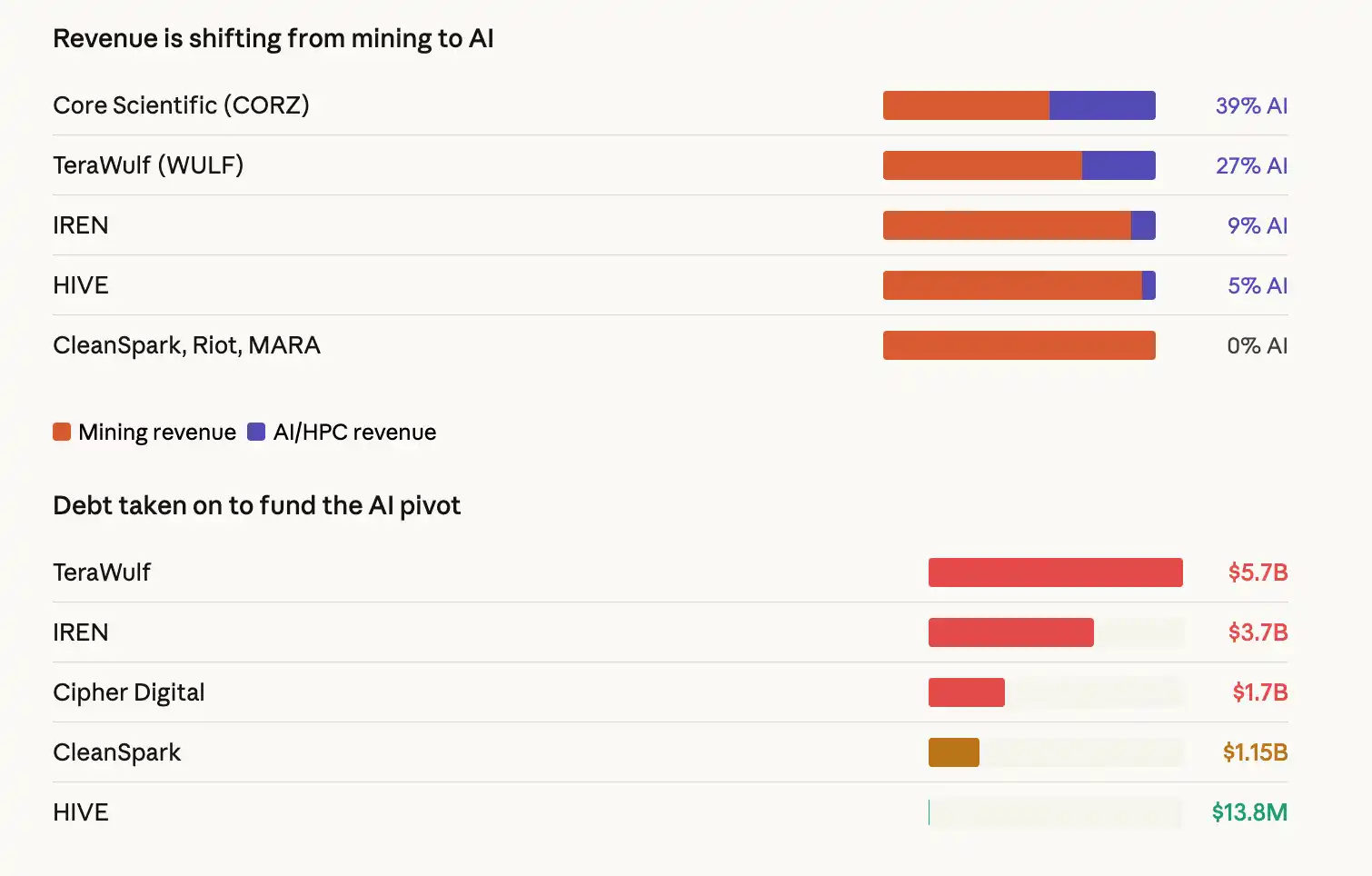
By the end of 2026, AI revenue could account for up to 70% of listed mining companies' income, compared to about 30% now. Core Scientific's AI hosting revenue already makes up 39% of its total revenue. TeraWulf is at 27%. IREN is currently at 9% but is rapidly expanding, with 200 megawatts of liquid-cooled GPU computing capacity under construction.

This means these mining companies are increasingly resembling data center operators that happen to still mine Bitcoin.

The economics explain why. CoinShares data shows that Bitcoin mining infrastructure costs about $700,000–$1 million per megawatt, while AI infrastructure costs about $8–$15 million per megawatt. The gap is significant, but AI offers structurally higher and more stable returns.

Hash price—a metric measuring miners' revenue per unit of computing power—fell to a post-halving all-time low in early March, around $28–$30/PH/day.

At this level, miners using mid-generation machines need electricity prices below $0.05/kWh to remain cash-flow positive. In contrast, AI infrastructure contracts promise profit margins exceeding 85%, with multi-year guaranteed revenue visibility.

Where Is the Money for the Transition Coming From?

The CoinShares report points out that there are two sources of funding for this transition, both clearly visible in the data.

First, debt. Leverage across the industry has qualitatively changed. IREN now carries $3.7 billion in convertible notes across five series. TeraWulf has total debt of $5.7 billion, consisting of convertible bonds and priority guaranteed notes from its computing power subsidiary.

Cipher Digital issued $1.7 billion in priority guaranteed notes in November, causing its quarterly interest expense to soar from $3.2 million in the first nine months to $33.4 million in Q4 alone. This is not a mining-level debt burden; it's an infrastructure-level bet—wagering that AI revenue will come fast enough to cover debt obligations.

Second, selling Bitcoin. Listed mining companies have collectively sold over 15,000 BTC from their peak holdings. Core Scientific sold about 1,900 BTC (worth $175 million) in January and plans to liquidate almost all remaining holdings in Q1 2026. Bitdeer zeroed out its holdings in February. Riot Platforms sold 1,818 BTC (worth $162 million) in December.

Even the largest listed holder, Marathon (holding 53,822 BTC), quietly expanded its policy in its March 10-K annual report, authorizing sales from its entire balance sheet reserves. Part of the reason is pressure from its $350 million Bitcoin-collateralized credit facility—as the price fell toward $68,000, the loan-to-value (LTV) ratio climbed to 87%.
Who Will Protect the Bitcoin Network?

The companies selling Bitcoin to fund AI are precisely those whose mining operations secure the Bitcoin network. This constitutes the core contradiction of this transition. When mining is unprofitable and AI is profitable, the rational economic decision is to shift capital away from mining. But if enough miners do this, the network's security budget shrinks.

Hash rate data already reflects this. The network hash rate peaked at about 1,160 EH/s in early October 2025 and has since declined to about 920 EH/s, with three consecutive negative difficulty adjustments—the first since July 2022.

Valuation Divergence

The market has already priced in this divergence. Mining companies with signed HPC contracts currently trade at 12.3 times their revenue for the next 12 months. Pure mining companies trade at only 5.9 times. The market is paying a premium of over twice for AI exposure, further reinforcing the incentive to transition.

The geographical landscape is also changing. The US, China, and Russia currently control about 68% of the global hash rate. In Q4 alone, the US increased its market share by about 2 percentage points. But emerging markets are also entering the fray—Paraguay and Ethiopia have entered the top ten global mining countries, driven by HIVE's 300-megawatt facility and Bitdeer's 40-megawatt facility, respectively.

Hash Rate Forecast

CoinShares predicts the network hash rate will reach 1.8 ZH/s by the end of 2026 and 2 ZH/s by the end of March 2027 (one month later than previous forecasts).

But this prediction assumes Bitcoin returns to $100,000 by year-end. If the price remains below $80,000, CoinShares forecasts the hash price will continue to fall, the hash rate will decline further, and more miners will exit. A sustained drop below $70,000 could trigger larger-scale capitulation—ironically, this would benefit survivors by lowering the difficulty.

New-generation hardware offers a potential way out. Bitmain's S23 series and Bitdeer's self-developed SEALMINER A3 both have energy efficiency below 10 joules/TH and are expected to ship in large volumes in the first half of 2026. These miners can roughly halve the energy cost per Bitcoin compared to current mainstream mid-generation models. But deploying them requires capital—and many miners are putting their money into AI.

The Bitcoin mining industry began this cycle as a group of companies protecting the network and hoarding Bitcoin. It is exiting this cycle as something else: a group of companies building AI data centers and selling Bitcoin to fund it.

Is this a temporary response to unfavorable economic conditions or a permanent structural shift? It depends on one variable: the price of Bitcoin. If it returns to $100,000, mining profits recover, and the AI transition slows. If it stays at $70,000 or lower, the transition accelerates, and the mining industry, which has been centered on mining for the past decade, will continue to disappear into something entirely different.

Original link: https://www.coindesk.com/markets/2026/03/27/bitcoin-miners-are-becoming-ai-companies-and-selling-their-btc-to-fund-the-transition


Связанные с этим вопросы

QAccording to the CoinShares report, what is the weighted average cash cost for public mining companies to mine one Bitcoin in Q4 2025?

AThe weighted average cash cost for public mining companies to mine one Bitcoin in Q4 2025 was approximately $79,995.

QWhat is the estimated loss per Bitcoin mined at the current price range of $68,000-$70,000?

AThe estimated loss per Bitcoin mined is approximately $19,000 at the current price range.

QWhat is the total value of AI and High-Performance Computing (HPC) contracts that listed mining companies have announced?

AListed mining companies have announced AI and HPC contracts with a cumulative value exceeding $70 billion.

QWhat are the two primary sources of funding for the mining industry's transition to AI infrastructure, as identified in the report?

AThe two primary sources of funding are taking on significant debt and selling their Bitcoin holdings.

QHow has the network's total hash rate changed since its peak in October 2025, and what is the implication of this change?

AThe network's total hash rate has dropped from a peak of approximately 1,160 EH/s to about 920 EH/s, indicating a contraction in the network's security budget as miners reallocate resources.

Похожее

Goldman Sachs Bows Down, Bitcoin Finally Breaks Through the Gates of Wall Street

Wall Street giants, including Goldman Sachs, Morgan Stanley, Charles Schwab, and the New York Stock Exchange, have reversed their long-standing opposition to Bitcoin and are now actively embracing it. After years of dismissing Bitcoin as a scam, a bubble, or a tool for illicit activities, these institutions are launching Bitcoin ETFs, enabling spot trading, and building dedicated crypto infrastructure. Goldman Sachs, which once called Bitcoin a "fraud tool," is now offering Bitcoin ETFs. Morgan Stanley, which internally banned the term "cryptocurrency," has launched its largest-ever ETF backed by Bitcoin. Charles Schwab has opened spot crypto trading for its retail clients, integrating Bitcoin alongside traditional assets. The NYSE is building robust infrastructure to support digital assets, signaling a long-term commitment. This dramatic shift is driven not by a change in ideology but by economic necessity. As Bitcoin repeatedly survived market crashes and grew into a multi-trillion-dollar asset class, ignoring it became too costly. Wall Street’s business model relies on capturing fees, and Bitcoin’s rise represented a massive wealth transfer occurring outside their ecosystem. The fear of missing out (FOMO) and client demand forced these institutions to capitulate. The article frames this as a historic surrender to Bitcoin’s mathematical inevitability. Unlike the trust-based traditional financial system, Bitcoin operates on decentralized, transparent, and unchangeable rules. Its scarcity and resilience make it a hedge against fiat currency devaluation and systemic risk. The narrative has flipped: not holding Bitcoin is now seen as the greater risk. The author concludes that Bitcoin has not been co-opted by Wall Street; instead, it has co-opted Wall Street, marking a fundamental shift in the global financial architecture.

marsbit47 мин. назад

Goldman Sachs Bows Down, Bitcoin Finally Breaks Through the Gates of Wall Street

marsbit47 мин. назад

Торговля

Спот
Фьючерсы

Популярные статьи

Тест по Bitcoin Биткоина

HTX Learn: Изучите Bitcoin halving и Заработаете Токены USDT

3.0k просмотров всегоОпубликовано 2024.04.16Обновлено 2024.04.16

Тест по Bitcoin  Биткоина

Что такое $BITCOIN

ЦИФРОВОЕ ЗОЛОТО ($BITCOIN): Комплексный анализ Введение в ЦИФРОВОЕ ЗОЛОТО ($BITCOIN) ЦИФРОВОЕ ЗОЛОТО ($BITCOIN) — это проект на основе блокчейна, работающий в сети Solana, который стремится объединить характеристики традиционных драгоценных металлов с инновациями децентрализованных технологий. Хотя он носит имя Биткойн, часто называемого “цифровым золотом” из-за его восприятия как средства хранения ценности, ЦИФРОВОЕ ЗОЛОТО является отдельным токеном, предназначенным для создания уникальной экосистемы в ландшафте Web3. Его цель — позиционировать себя как жизнеспособный альтернативный цифровой актив, хотя детали его применения и функциональности все еще развиваются. Что такое ЦИФРОВОЕ ЗОЛОТО ($BITCOIN)? ЦИФРОВОЕ ЗОЛОТО ($BITCOIN) — это токен криптовалюты, специально разработанный для использования в блокчейне Solana. В отличие от Биткойна, который выполняет широко признанную роль хранения ценности, этот токен, похоже, сосредоточен на более широких приложениях и характеристиках. Примечательные аспекты включают: Инфраструктура блокчейна: Токен построен на блокчейне Solana, известном своей способностью обрабатывать высокоскоростные и недорогие транзакции. Динамика предложения: ЦИФРОВОЕ ЗОЛОТО имеет максимальное предложение, ограниченное 100 квадриллионами токенов (100P $BITCOIN), хотя детали о его обращающемся предложении в настоящее время не раскрыты. Утилита: Хотя точные функциональные возможности не описаны, есть указания на то, что токен может быть использован для различных приложений, потенциально связанных с децентрализованными приложениями (dApps) или стратегиями токенизации активов. Кто создатель ЦИФРОВОГО ЗОЛОТА ($BITCOIN)? На данный момент личность создателей и команды разработчиков, стоящих за ЦИФРОВЫМ ЗОЛОТОМ ($BITCOIN), остается неизвестной. Эта ситуация типична для многих инновационных проектов в области блокчейна, особенно тех, которые связаны с децентрализованными финансами и феноменом мем-криптовалют. Хотя такая анонимность может способствовать культуре, ориентированной на сообщество, она усиливает опасения по поводу управления и ответственности. Кто инвесторы ЦИФРОВОГО ЗОЛОТА ($BITCOIN)? Доступная информация указывает на то, что у ЦИФРОВОГО ЗОЛОТА ($BITCOIN) нет известных институциональных спонсоров или значительных венчурных капиталовложений. Проект, похоже, функционирует по модели пирингового взаимодействия, сосредоточенной на поддержке и принятии сообществом, а не на традиционных путях финансирования. Его активность и ликвидность в основном сосредоточены на децентрализованных биржах (DEX), таких как PumpSwap, а не на устоявшихся централизованных торговых платформах, что еще больше подчеркивает его подход, ориентированный на grassroots. Как работает ЦИФРОВОЕ ЗОЛОТО ($BITCOIN) Операционные механизмы ЦИФРОВОГО ЗОЛОТА ($BITCOIN) можно подробно описать на основе его дизайна блокчейна и характеристик сети: Механизм консенсуса: Используя уникальный механизм доказательства истории (PoH) Solana в сочетании с моделью доказательства доли (PoS), проект обеспечивает эффективную валидацию транзакций, что способствует высокой производительности сети. Токеномика: Хотя конкретные дефляционные механизмы не были подробно описаны, большое максимальное предложение токенов подразумевает, что оно может быть предназначено для микротранзакций или нишевых случаев использования, которые еще предстоит определить. Интероперабельность: Существует потенциал для интеграции с более широкой экосистемой Solana, включая различные платформы децентрализованных финансов (DeFi). Однако детали относительно конкретных интеграций остаются неуточненными. Хронология ключевых событий Вот хронология, которая подчеркивает значимые вехи, касающиеся ЦИФРОВОГО ЗОЛОТА ($BITCOIN): 2023: Первоначальное развертывание токена происходит в блокчейне Solana, отмеченное его адресом контракта. 2024: ЦИФРОВОЕ ЗОЛОТО приобретает видимость, когда оно становится доступным для торговли на децентрализованных биржах, таких как PumpSwap, позволяя пользователям обменивать его на SOL. 2025: Проект наблюдает спорадическую торговую активность и потенциальный интерес к инициативам, возглавляемым сообществом, хотя на данный момент не зафиксировано никаких значительных партнерств или технических достижений. Критический анализ Сильные стороны Масштабируемость: Основная инфраструктура Solana поддерживает высокие объемы транзакций, что может повысить полезность $BITCOIN в различных сценариях транзакций. Доступность: Потенциально низкая цена торговли за токен может привлечь розничных инвесторов, способствуя более широкому участию благодаря возможностям дробного владения. Риски Отсутствие прозрачности: Отсутствие публично известных спонсоров, разработчиков или процесса аудита может вызвать скептицизм относительно устойчивости и надежности проекта. Волатильность рынка: Торговая активность сильно зависит от спекулятивного поведения, что может привести к значительной волатильности цен и неопределенности для инвесторов. Заключение ЦИФРОВОЕ ЗОЛОТО ($BITCOIN) является интригующим, но неоднозначным проектом в быстро развивающейся экосистеме Solana. Хотя он пытается использовать нарратив “цифрового золота”, его отход от установленной роли Биткойна как средства хранения ценности подчеркивает необходимость более четкого различения его предполагаемой утилиты и структуры управления. Будущее принятие и усвоение, вероятно, будут зависеть от решения текущей непрозрачности и более четкого определения его операционных и экономических стратегий. Примечание: Этот отчет охватывает синтезированную информацию, доступную на октябрь 2023 года, и с тех пор могут произойти события.

99 просмотров всегоОпубликовано 2025.05.13Обновлено 2025.05.13

Что такое $BITCOIN

Fractal Bitcoin: масштабирование Биткоина с помощью рекурсивной системы

Fractal Bitcoin — масштабное Layer-1-решнение, созданное на базе кода Биткоина, позволяющего достигать бесконечного масштабирования с помощью рекурсивного подхода.

2.2k просмотров всегоОпубликовано 2025.06.30Обновлено 2025.06.30

Fractal Bitcoin: масштабирование Биткоина с помощью рекурсивной системы

Обсуждения

Добро пожаловать в Сообщество HTX. Здесь вы сможете быть в курсе последних новостей о развитии платформы и получить доступ к профессиональной аналитической информации о рынке. Мнения пользователей о цене на BTC (BTC) представлены ниже.

活动图片