Longs Recede, Volatility Weakens, Bitcoin Locks in $60K-$70K Range

marsbitОпубликовано 2026-04-02Обновлено 2026-04-02

Введение

Bitcoin remains range-bound between $60,000 and $70,000, with early signs of accumulation in spot markets and a reset in derivatives positioning. Overhead supply remains a key structural issue, with approximately 8.4 million BTC held at a loss, concentrated between $80,000 and $126,000. Long-term holder realized losses have risen to around $200 million per day, indicating ongoing distribution. While Coinbase spot flows have turned slightly positive, demand remains tentative. Corporate treasury buying has narrowed significantly, with only one major player continuing consistent accumulation. Perpetual funding rates have reset to neutral, and implied volatility has softened across the term structure. Options skew shows renewed defensive positioning, and negative gamma below the spot price suggests vulnerability to amplified downside moves. The market lacks a clear catalyst and appears to be in a redistribution phase rather than a trending environment, requiring stronger demand or further supply absorption to break out.

Authored by: Glassnode

Compiled by: AididiaoJP, Foresight News

Bitcoin remains confined within the $60,000 to $70,000 range. The spot market shows early signs of absorption, while the derivatives market has completed a reset. Volatility has cooled, and positioning has become more balanced. However, the lack of a clear catalyst means the market lacks the confidence needed for a sustained breakout.

Summary

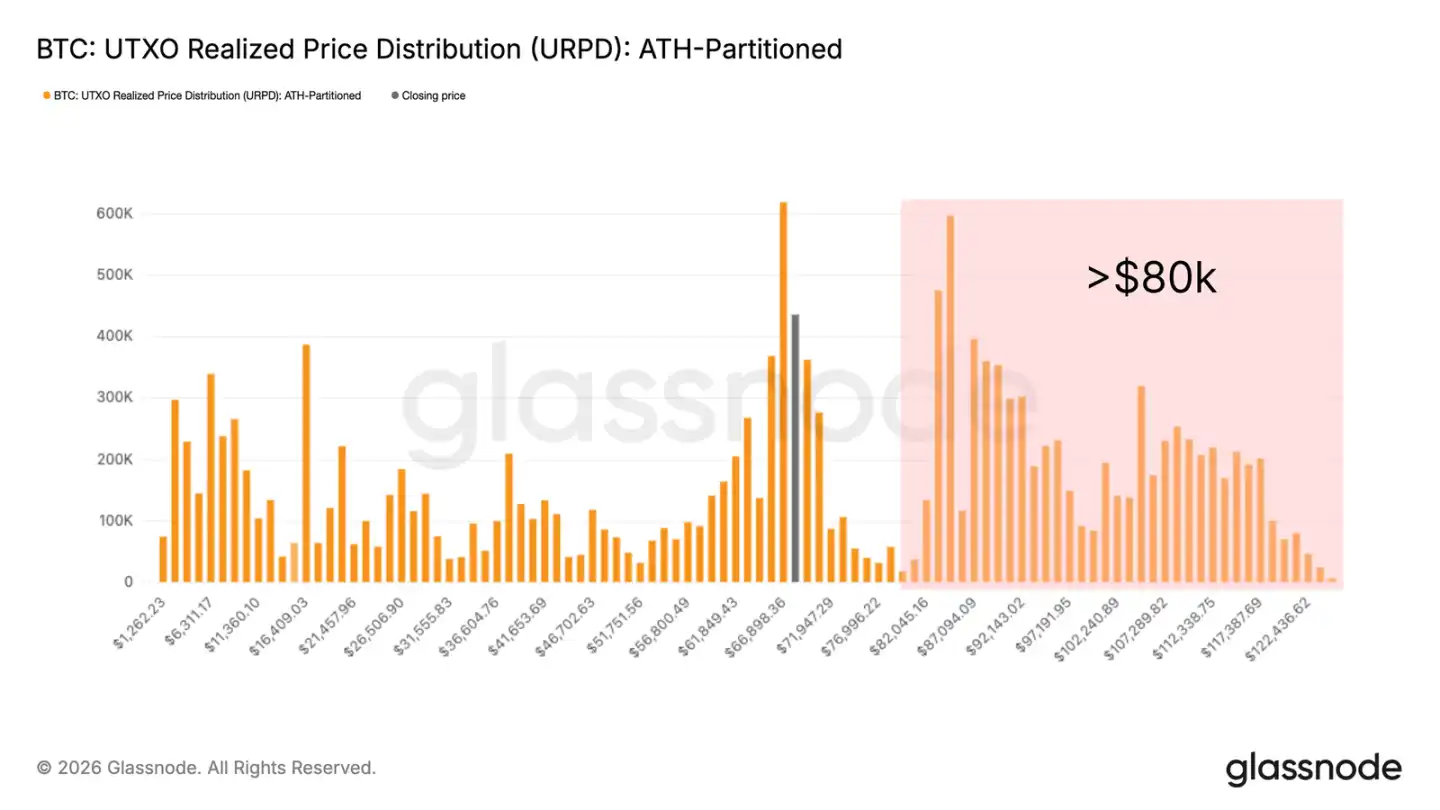
  • Bitcoin remains stuck in a wide range between $60,000 and $70,000. URPD data shows a dense cluster of supply overhead between $80,000 and $126,000. Digesting this supply overhang may require a deeper price discount or a longer period of redistribution.
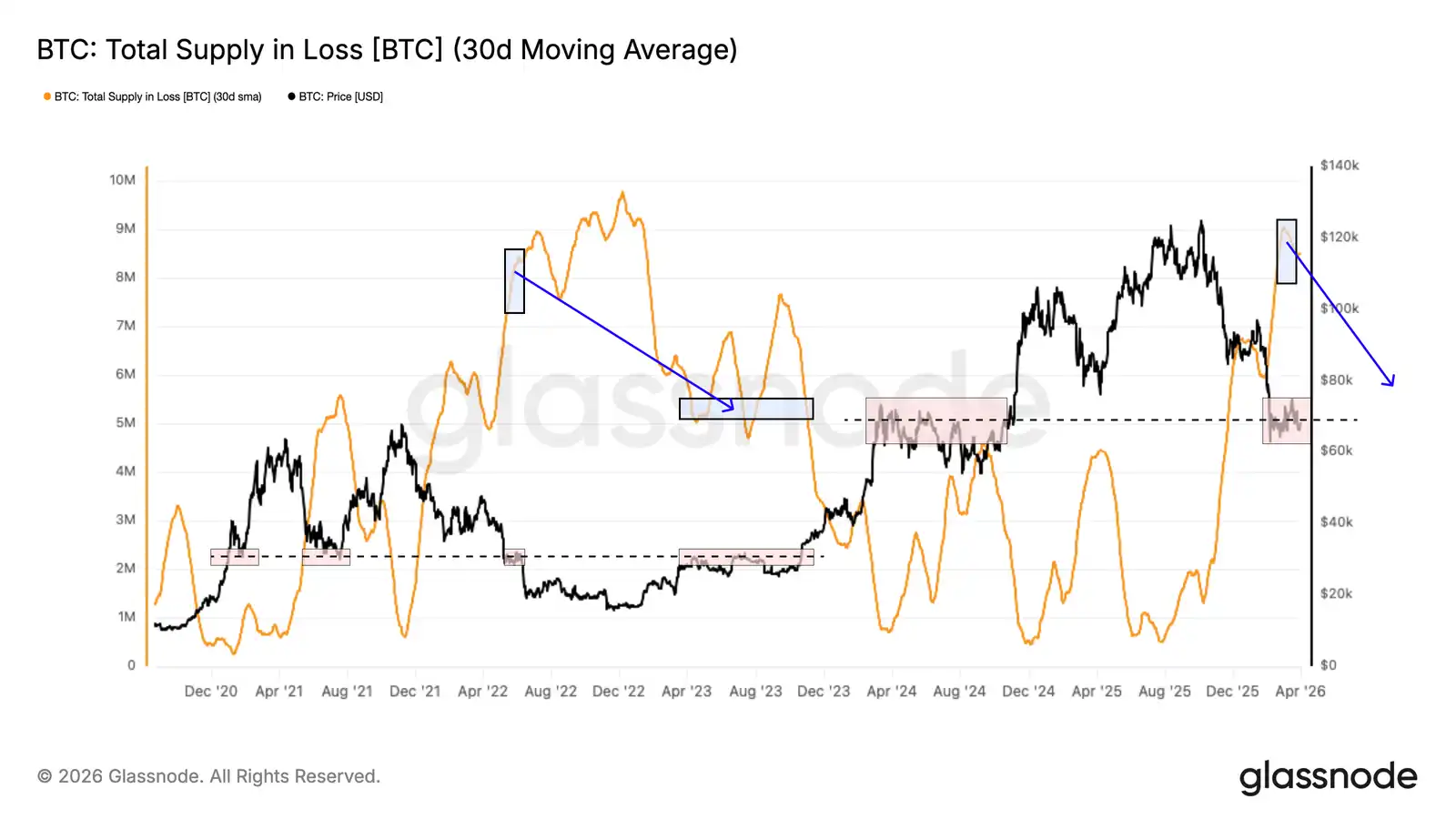
  • The total supply in loss is approaching 8.4 million BTC, resembling the market structure seen in Q2 2022. Back then, the market needed to redistribute approximately 3 million BTC to regain the cycle midline.
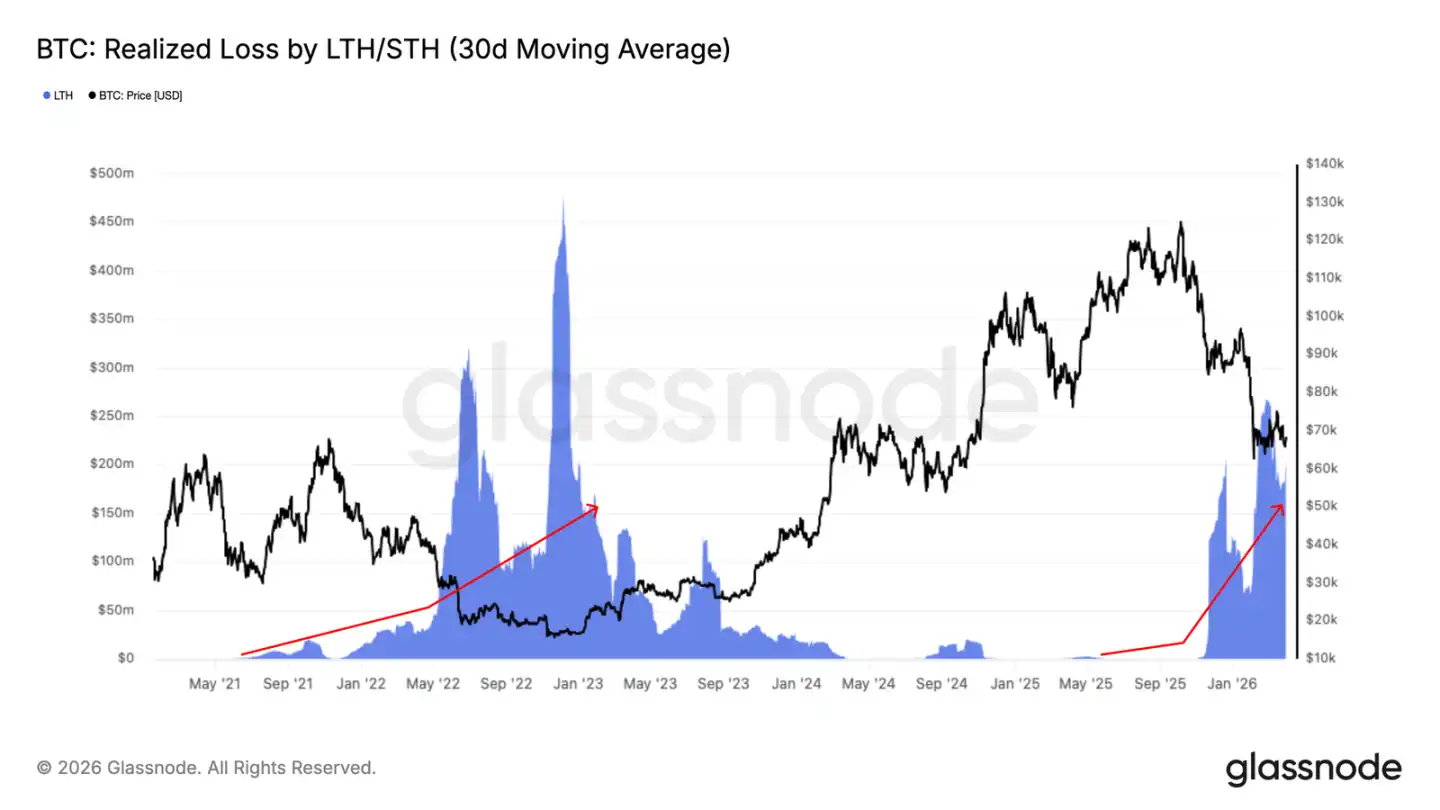
  • Long-Term Holder Realized Loss has been climbing since November 2025, now reaching levels around $200 million per day, confirming active capitulation. A cooling of this metric below $25 million per day would be a key threshold for market bottom formation.
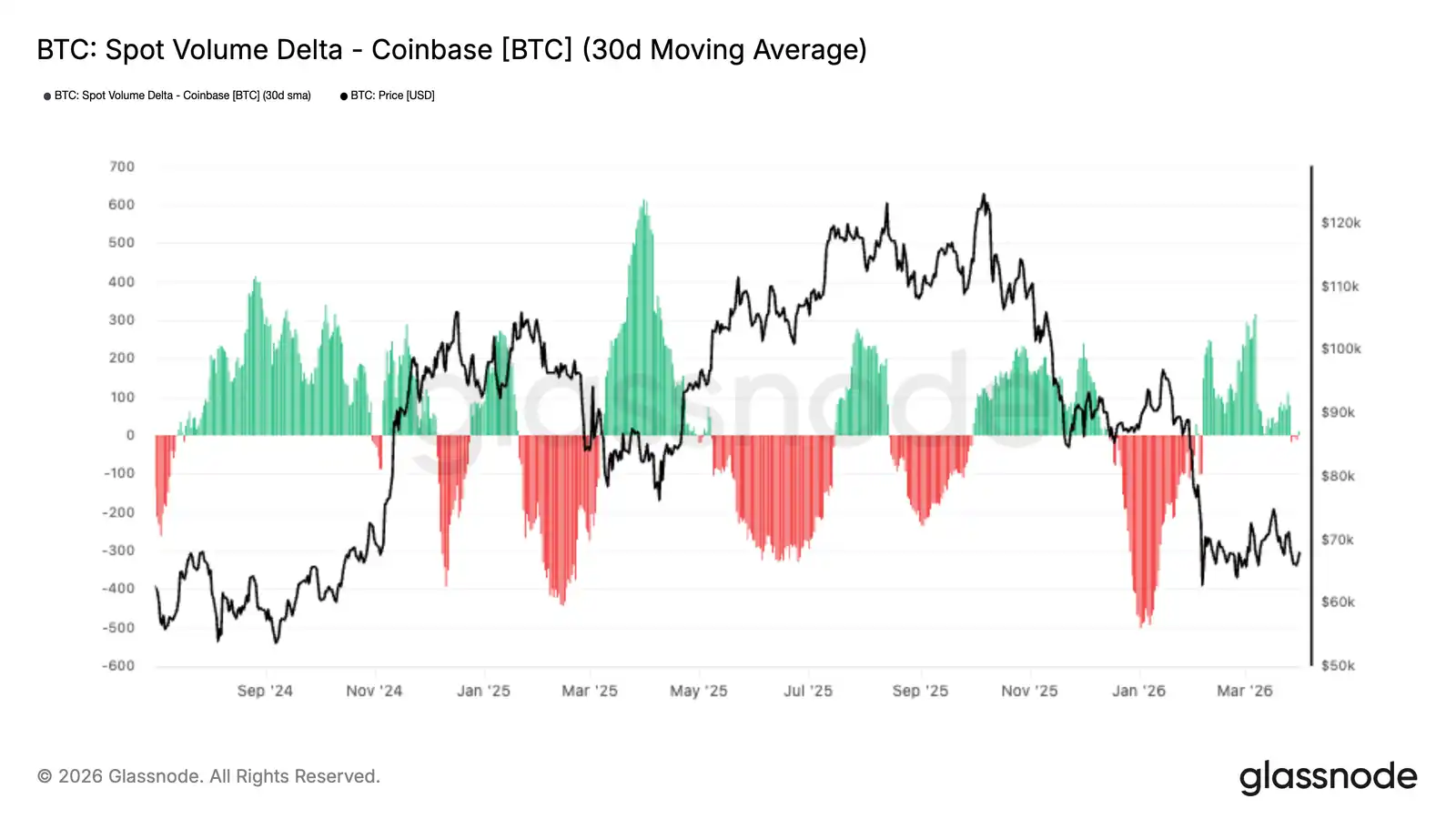
  • The Coinbase Spot Cumulative Volume Delta has turned to a slight positive, indicating spot buyers are beginning to absorb selling pressure. However, the current level of demand remains far below what is typically seen during the formation of durable lows.
  • Treasury flows have become more concentrated: Marathon has distributed ~15,000 BTC, while Strategy remains the only institution conducting large-scale, consistent buying.
  • Directional premium in the perpetual swap market has compressed to near-neutral levels, slightly below zero, reflecting a reset of long-biased leverage and cooling speculative enthusiasm.
  • Current perpetual positioning is far from momentum-driven; long exposure is being unwound, and short interest is re-emerging. This leaves the futures market more balanced overall, but also more cautious.
  • Implied Volatility continues to soften across the term structure, indicating the options market is pricing in a calmer near-term environment and reduced demand for volatility exposure.
  • Skew metrics are beginning to tilt downward again, signaling a return of protective positioning, though their levels remain well below those typically associated with strong hedging demand.
  • Gamma positioning has flipped back to being supportive of the market, reducing convexity effect on the downside and indicating stabilizing short-term dealer positioning following the recent negative gamma regime.

On-Chain Insights

The Scale of Unrealized Loss Supply

As price consolidates in the $60k-$70k range, this report will look beyond short-term price action to assess the structural forces shaping the current market. As noted in recent reports, one of the most persistent headwinds to momentum is the significant volume of supply acquired above $80k, which is now held at an unrealized loss.

This cohort has endured a bearish environment for over six months, facing a binary behavioral choice: either sell into any rally to minimize further losses, or capitulate psychologically as drawdowns deepen.

The URPD chart illustrates this clearly, showing a dense cluster of supply firmly overhead between $80k and $126k. Resolving this supply overhang will likely require either a significant price discount to attract new buyers, or a prolonged period where these coins are redistributed from loss-realizing holders to more conviction-driven new owners.
Supply in Loss

To quantify the overhead supply, we can use the 'Total Supply in Loss' metric. It counts the number of circulating bitcoins whose last move price was above the current spot price. Smoothed with a 30-day SMA to remove short-term noise, this metric currently sits around 8.4M BTC, meaning roughly 8M to 9M coins have been in loss persistently over the past month.

The scale of this value, coupled with spot trading near the current cycle's midline, suggests parallels to the market structure observed in Q2 2022. Historically, resolving supply overhangs of this magnitude has required a significant redistribution of coins from loss-holding sellers to new buyers entering at lower prices. The precedent of the 2022 bear market is instructive. Typically, the Total Supply in Loss compressed from above 8M BTC to around 5M BTC before the market decisively reclaimed the cycle midline. This implies roughly 3M coins changed hands before conditions normalized.
Tracking the Redistribution in Progress

After establishing the scale of loss supply needing redistribution, the next step is monitoring the pace of this process. The 'Long-Term Holder Realized Loss' metric measures the total value of losses realized by investors holding coins for over six months who are now selling below their cost basis. This metric directly captures the active redistribution of the aforementioned overhead supply.

Its 30-day moving average has been steadily rising since November 2025 and is now elevated at ~$200M per day. This confirms that Long-Term Holders are increasingly capitulating to the current market. While this wave of loss realization is a necessary and constructive part of the bear market clearing process, it alone is not a sufficient condition for a reversal. A significant cooling of this metric below $25M per day would represent a more convincing signal of seller exhaustion and has been a prerequisite for market basing historically, before sustainable bull markets commence.
Off-Chain Insights

Coinbase Spot Demand Returns

The spot market is showing tentative signs of stabilization. The 30-day moving average of the Coinbase Spot Volume Delta has turned to a slight positive in the latest readings. This follows an extended period of negative values throughout January and early February, reflecting sustained distribution pressure.

The recent shift suggests that as price stabilizes, buyers are beginning to absorb available supply and provide support. However, the magnitude of the positive delta remains modest, indicating current demand is tentative rather than conviction-driven.

Historically, more robust market recoveries require sustained positive spot flows, whereas fleeting bouts of buying often fail to produce follow-through. For now, the recent uptick is constructive, but a more durable recovery would likely require an expansion in buying pressure.
Treasury Flows Grow More Complex

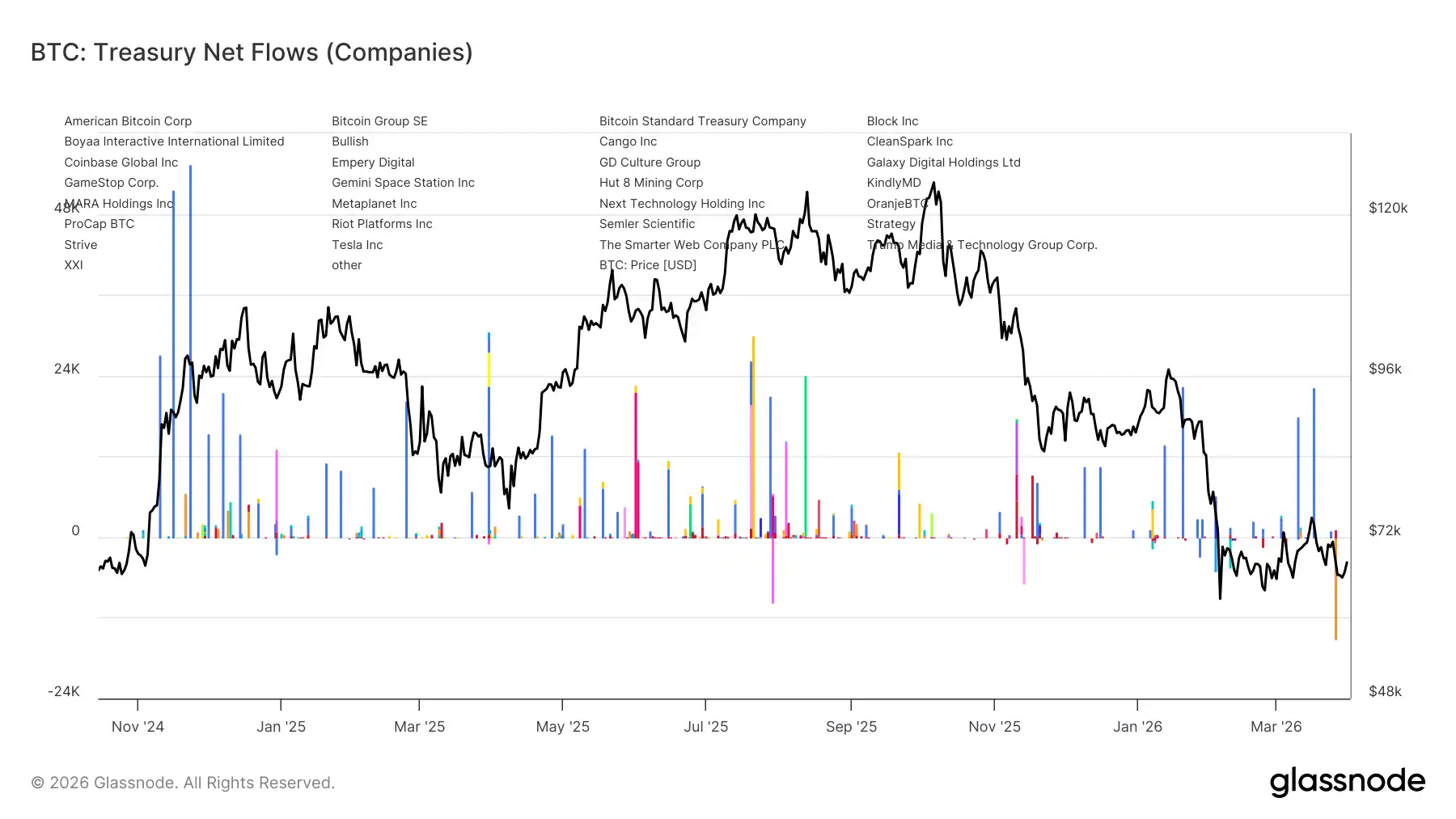
The broad base of treasury flows has weakened significantly in recent months. The latest data reveals a more uneven and selective pattern of activity. Earlier in the cycle, corporate accumulation was supported by a wider array of allocators. Recent flows, however, suggest buying support is becoming increasingly concentrated.

Most notably, Marathon has sold approximately 15,000 BTC, standing as one of the clearest examples of recent corporate treasuries reducing, not increasing, exposure. In contrast, Strategy appears to remain the only consistent structural buyer; the firm continues to make regular purchases even as participation from others becomes more sporadic.

This shift points to a significant change in market structure. Corporate demand is no longer a broad-based corporate accumulation trend and now appears narrower and more reliant on a single dominant player. The net result is that corporate buying, while still present, is on a less broad foundation and therefore a less reliable source of structural support compared to earlier cycle phases.
Perp Premium Reset

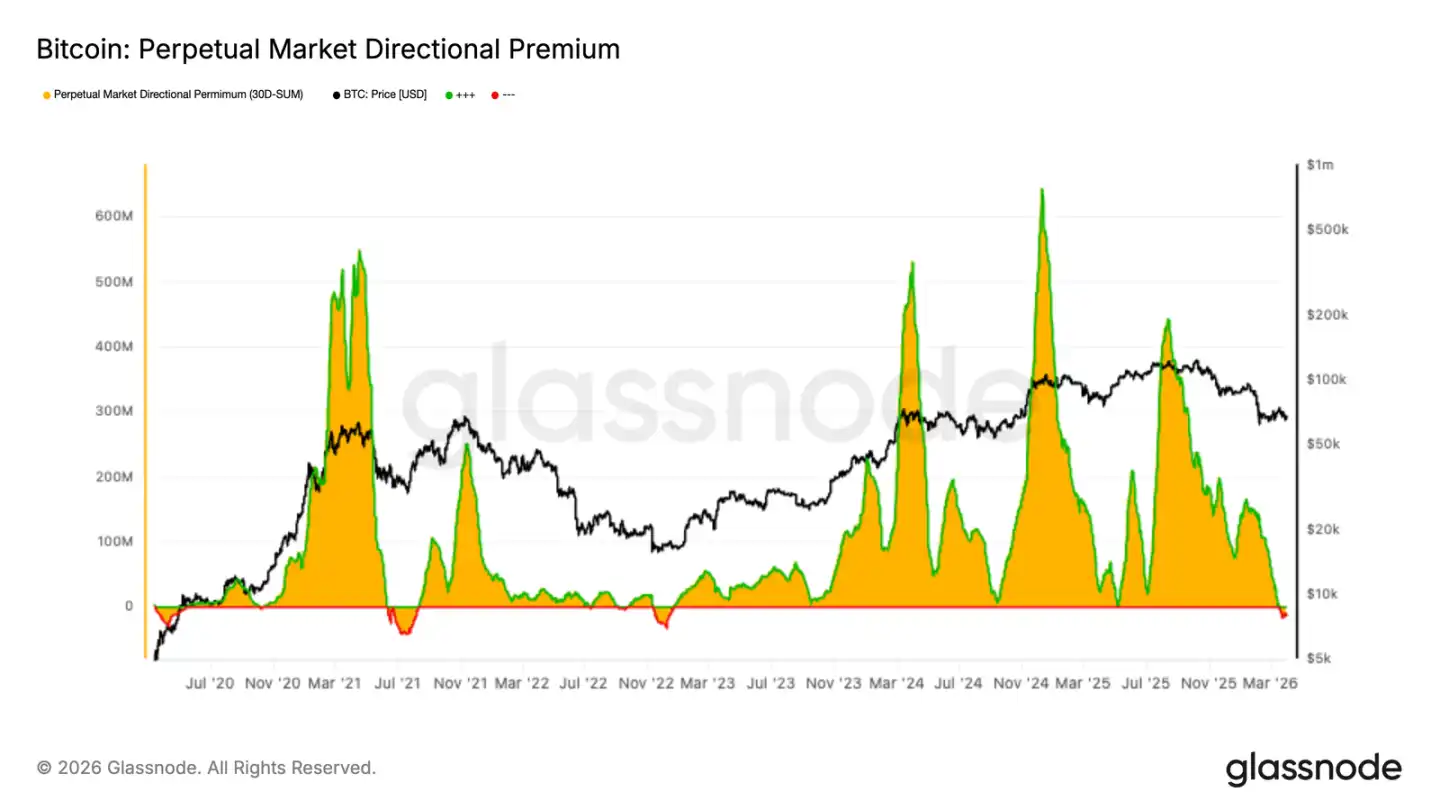
Directional premium in the perpetual swap market continues to compress, with the 30-day sum now near neutral and slightly negative. This marks a clear cooling from the long-biased conditions that previously supported the rally.

This shift suggests bullish speculative positions are being unwound, and short interest is beginning to re-emerge. The current structure does not reflect strong market conviction but points towards a more cautious and balanced perpetual market landscape.

Historically, resets in directional premium often accompany consolidation or trend exhaustion. This is because leverage is repriced following an extended move. In this sense, the recent decline in premium indicates speculative appetite has waned, leaving the perp market thoroughly reset with reduced leverage.
Volatility Expectations Are Lowering

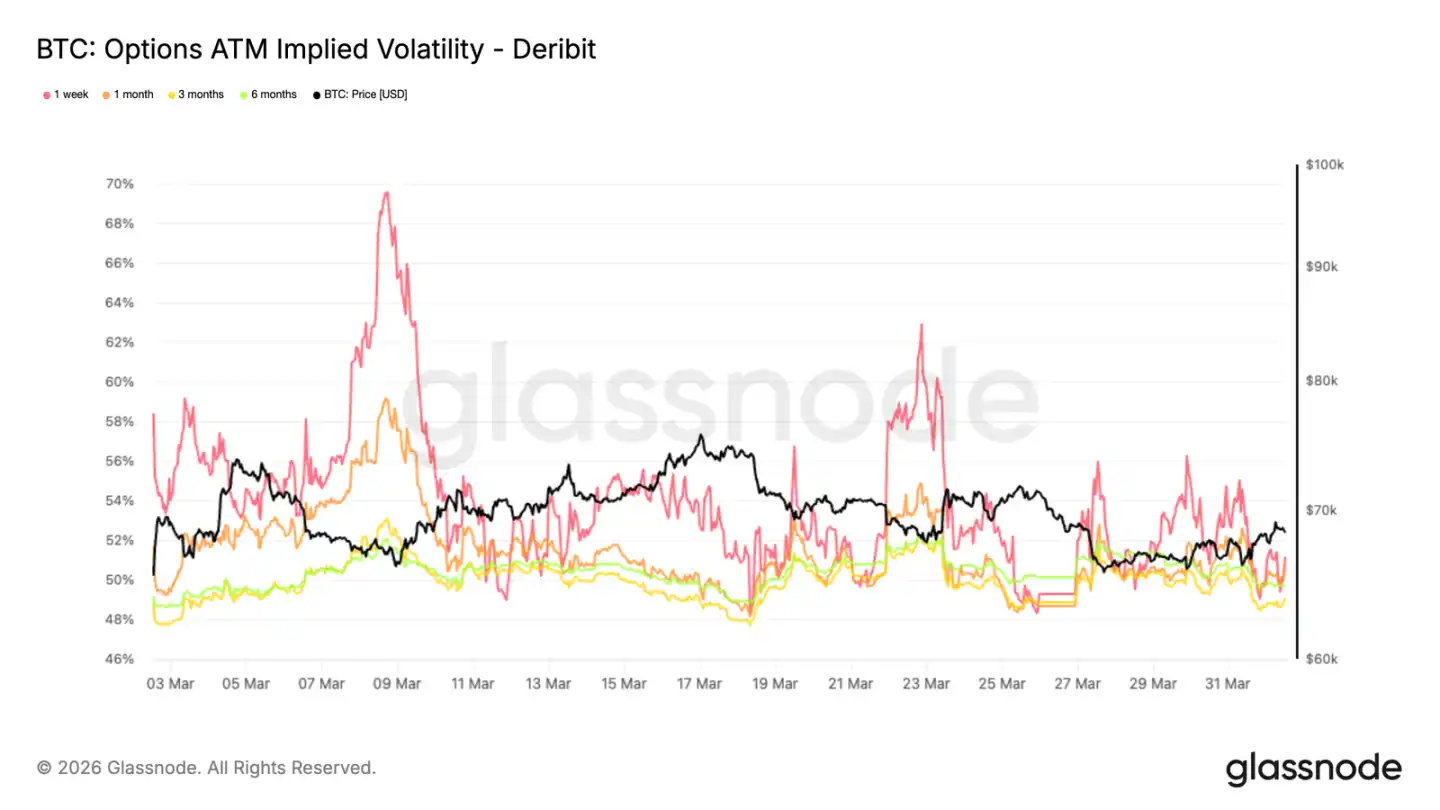
Following the reset in options market positioning, Implied Volatility is among the first places showing changes. Bitcoin's volatility term structure has shifted lower overall compared to last week, led by the front end. 1-week ATM Implied Volatility is now 51%, with the 3-month at 49%. Other tenors are packed tightly in between, with the 6-month at 49.8%, pointing to a significantly compressed term structure.

This reflects a market dialing down expectations for near-term large moves, despite ongoing macro uncertainty. Longer-dated vol is relatively better supported, suggesting uncertainty hasn't disappeared but is being pushed further out in time. In the near term, pricing is shifting towards a more convergent volatility regime as the market lacks immediate catalysts and demand for optionality has faded.
Downside Protection Begins Rebuilding

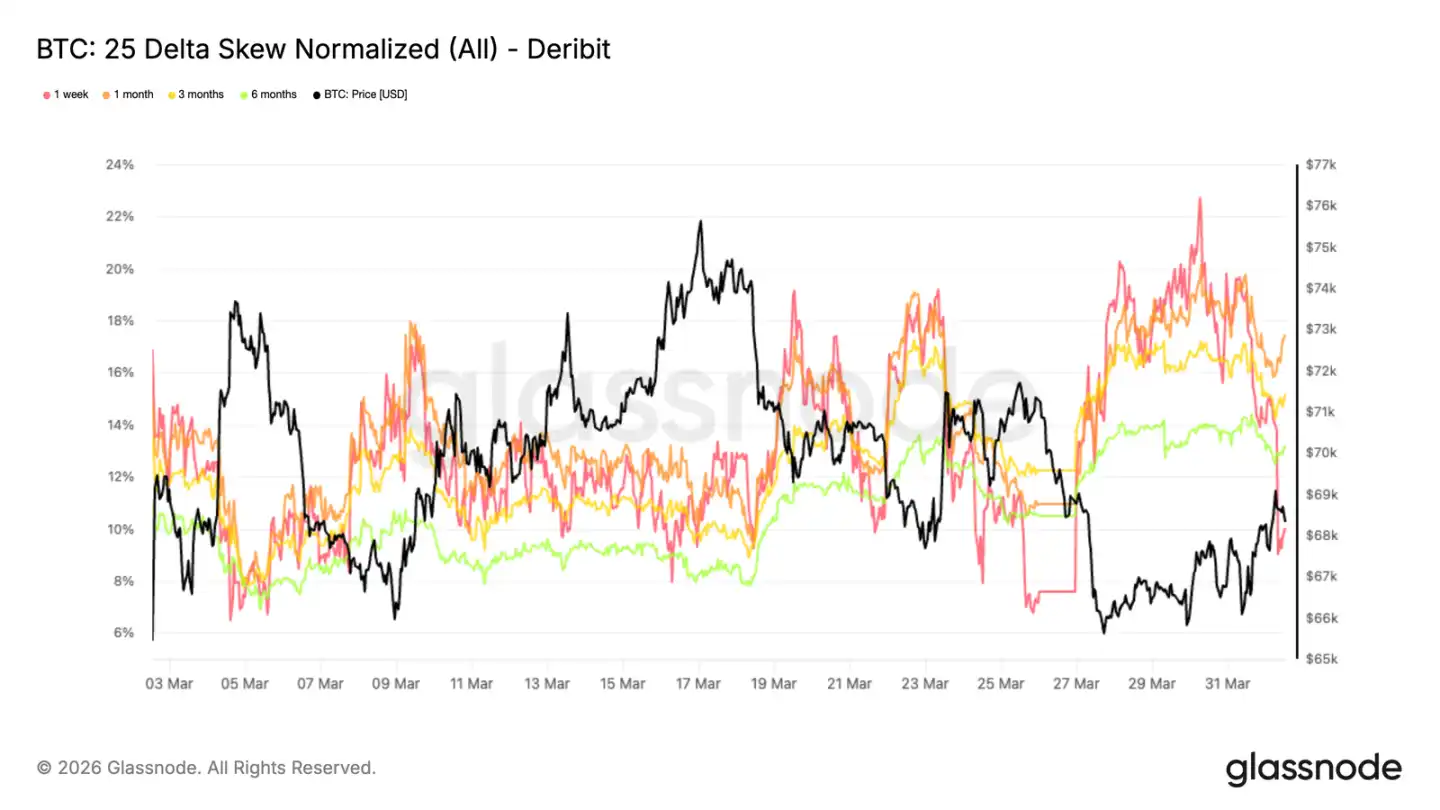
As volatility expectations soften, skew metrics reveal a shift in positioning towards more caution. The 25delta skew (calculated as put IV minus call IV) is higher, indicating the market prices more for downside protection. Last week, 1-week skew hit a monthly high of 22.7% before pulling back, reflecting its sensitivity to immediate price action. In contrast, longer-dated skew continues to trend higher and hold elevated: 1-month at 17.4%, 6-month at 13.2%.

This divergence across tenors is telling. While near-term price stabilization has slightly eased short-dated hedging demand, there remains strong buying of protective options in the medium term. The market isn't pricing aggressive moves, but the entire term structure consistently assigns more weight to downside risks. This points to a sustained defensive bias, not merely a transient reaction to short-term market gyrations.
Short-Term Gamma Below Market

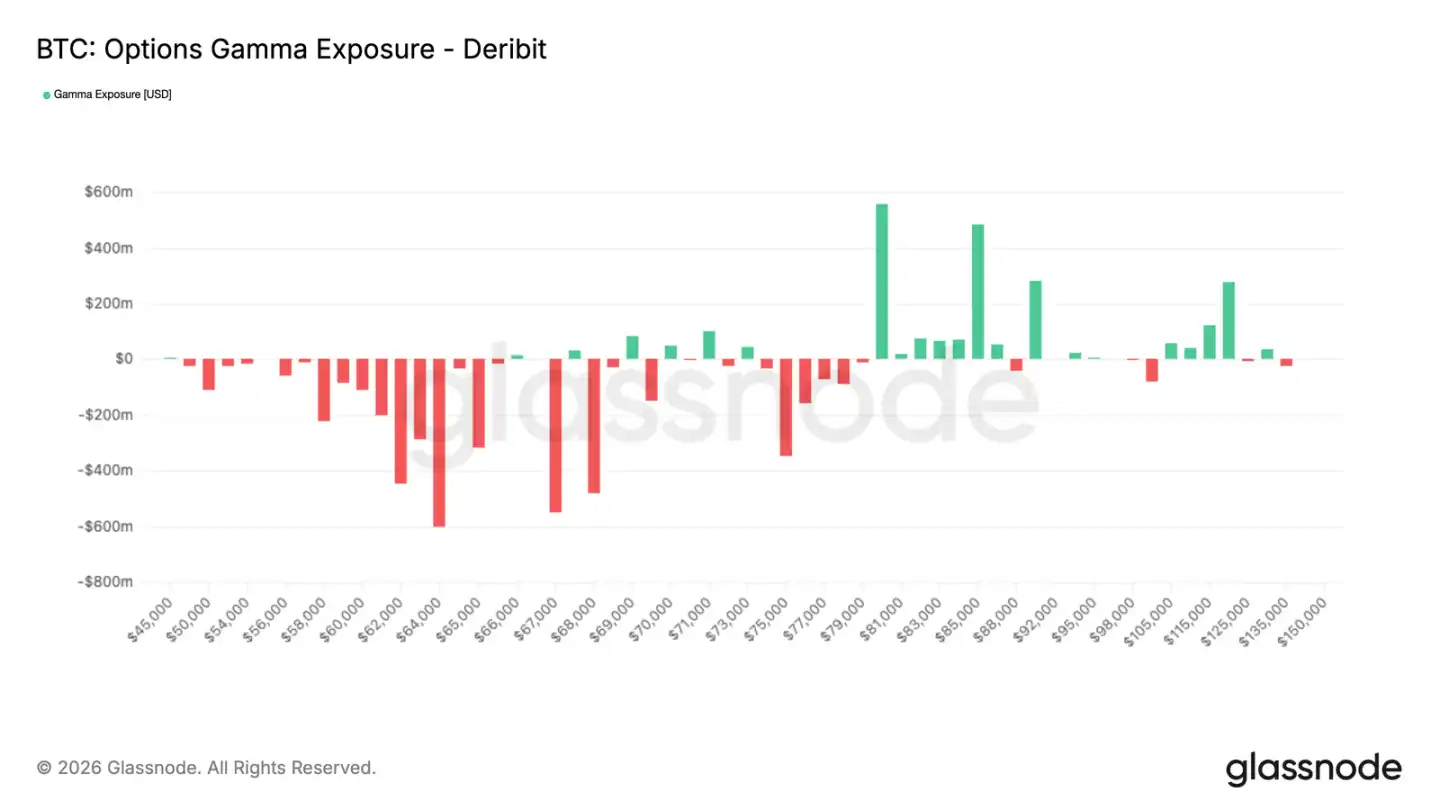
This more defensive positioning becomes more relevant when mapped to dealer gamma exposure. Negative gamma is now stacking up below current price levels, stretching from $68k down into the $50k's. This implies the market is buying puts below the spot price and does not expect the recent bounce to last much longer, forcing dealers to be the counterparty to these trades.

In this setup, dealers will be forced to sell into weakness, amplifying downward moves. With overall market structure appearing fragile post the March 27th expiry thinning liquidity, a move into this zone could exacerbate downside momentum through hedging flows. This could trigger accelerated selling, turning what might be a gradual move into a more violent repricing, potentially retesting the $60k level – the low of the February 5th sell-off.
Calm Realized Volatility Masks Fragility

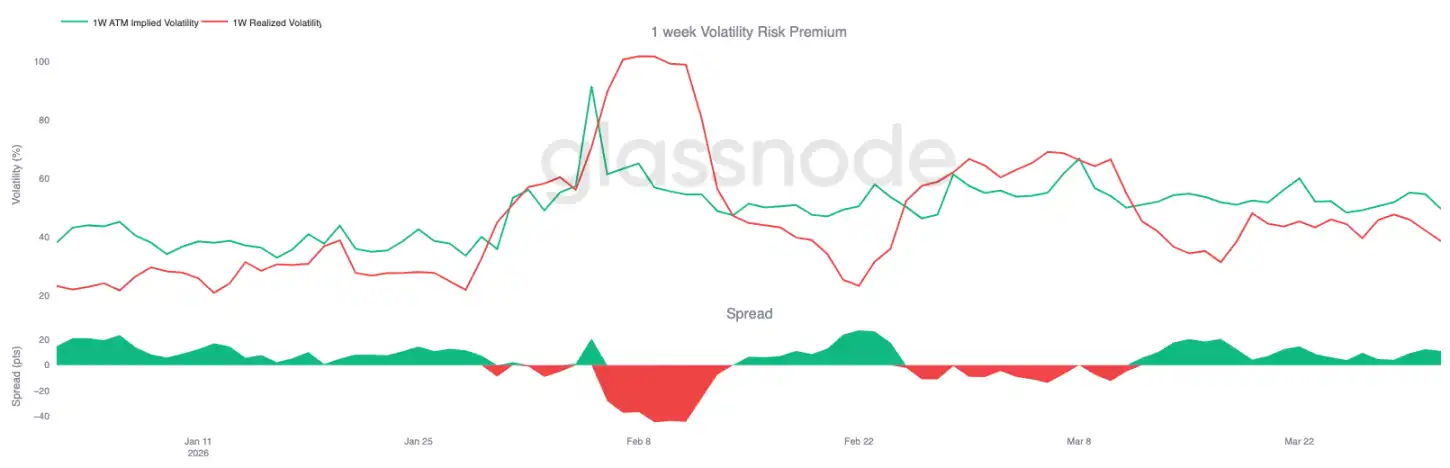
Compounding the fragility of the current setup is that Implied Volatility remains elevated above Realized Volatility. On the front end, 1-week Realized Vol is 38%, while 1-week Implied is 49%, a gap of 11 percentage points. This gap has persisted for over three weeks, indicating options are consistently priced for more movement than the market is actually experiencing.

At first glance, this reflects a seemingly stable market, as realized vol remains contained. However, the persistent premium suggests market participants are pricing risk despite a lack of actual price follow-through, pointing to an environment of low market confidence.

Combined with negative gamma, a market where vol is priced above realized is susceptible to having moves amplified by relatively modest selling pressure. This is because the market adjusts rapidly from a compressed pricing base, with limited positioning capacity to absorb flows.
Conclusion

Bitcoin remains locked in a wide $60k-$70k range. The market shows tentative signs of stabilization but lacks sufficient momentum for a decisive breakout in either direction. On-chain conditions still reflect a market in repair: supply in loss is elevated, and Long-Term Holder capitulation has not yet fully cooled. Meanwhile, spot demand is beginning to show improvement, suggesting sellers no longer have complete control.

Off-chain, the picture is similarly balanced. Corporate treasury demand has narrowed significantly, perpetual leverage has reset, implied volatility has softened, and dealer positioning stability has improved. Together, these signals point to an environment no longer under obvious stress but still searching for stronger conviction.

For now, Bitcoin appears to be in a phase of redistribution rather than trending clearly. Until spot demand expands more significantly and the overhead supply overhang begins to clear, range-bound trading is likely to remain the dominant characteristic.


Связанные с этим вопросы

QWhat is the current trading range for Bitcoin as described in the article?

ABitcoin is currently locked in a wide range between $60,000 and $70,000.

QWhat does the URPD data reveal about the supply overhead above the current price?

AThe URPD data shows a dense cluster of supply stacked in the range of $80,000 to $126,000, which represents a significant overhead resistance.

QWhat key on-chain metric indicates active capitulation by long-term holders, and what is its current level?

AThe Long-Term Holder Realized Loss metric indicates active capitulation, and its 30-day moving average has reached a high of approximately $200 million per day.

QHow has the Coinbase Spot Cumulative Volume Delta changed, and what does it signify?

AThe Coinbase Spot Cumulative Volume Delta 30-day moving average has turned to a slight positive value, indicating that spot buyers are beginning to absorb selling pressure, though the level of demand remains tentative.

QWhat is the current state of the perpetual futures market's directional bias according to the funding rate?

AThe directional premium in the perpetual futures market has compressed to near-neutral levels and is slightly negative, reflecting a reset of bullish leverage and cooling speculative enthusiasm, leading to a more balanced but cautious market.

Похожее

North Korean Hackers Loot $500 Million in a Single Month, Becoming the Top Threat to Crypto Security

North Korean hackers, particularly the notorious Lazarus Group and its subgroup TraderTraitor, have stolen over $500 million from cryptocurrency DeFi platforms in less than three weeks, bringing their total theft for the year to over $700 million. Recent major attacks on Drift Protocol and KelpDAO, resulting in losses of approximately $286 million and $290 million respectively, highlight a strategic shift: instead of targeting core smart contracts, attackers are now exploiting vulnerabilities in peripheral infrastructure. For instance, the KelpDAO attack involved compromising downstream RPC infrastructure used by LayerZero's decentralized validation network (DVN), allowing manipulation without breaching core cryptography. This sophisticated approach mirrors advanced corporate cyber-espionage. Additionally, North Korea has systematically infiltrated the global crypto workforce, with an estimated 100 operatives using fake identities to gain employment at blockchain companies, enabling long-term access to sensitive systems and facilitating large-scale thefts. According to Chainalysis, North Korean-linked hackers stole a record $2 billion in 2025, accounting for 60% of all global crypto theft that year. Their total historical crypto theft has reached $6.75 billion. Post-theft, they employ specialized money laundering methods, heavily relying on Chinese OTC brokers and cross-chain mixing services rather than standard decentralized exchanges. Security experts, while acknowledging the increased sophistication, emphasize that many attacks still exploit fundamental weaknesses like poor access controls and centralized operational risks. Strengthening private key management, limiting privileged access, and enhancing coordination among exchanges, analysts, and law enforcement immediately after an attack are critical to improving defense and fund recovery chances. The industry's challenge now extends beyond secure smart contracts to safeguarding operational security at the infrastructure level.

marsbit32 мин. назад

North Korean Hackers Loot $500 Million in a Single Month, Becoming the Top Threat to Crypto Security

marsbit32 мин. назад

Circle CEO's Seoul Visit: No Korean Won Stablecoin Issuance, But Met All Major Korean Banks

Circle CEO Jeremy Allaire's recent activities in Seoul indicate a strategic shift for the company, moving away from issuing a Korean won-backed stablecoin and instead focusing on embedding itself as a key infrastructure provider within Korea’s financial and crypto ecosystem. Despite Korea accounting for nearly 30% of global crypto trading volume—with a market characterized by high retail participation and altcoin dominance—Circle has chosen not to compete for the role of stablecoin issuer. Instead, Allaire met with major Korean banks (including Shinhan, KB, and Woori), financial groups, leading exchanges (Upbit, Bithumb, Coinone), and tech firms like Kakao. This approach reflects a broader industry transition: the core of stablecoin competition is shifting from issuance rights to systemic positioning. With Korean regulators still debating whether banks or tech companies should issue stablecoins, Circle is avoiding regulatory uncertainty by strengthening its role as a service and technology partner. The company is deepening integration with trading platforms, building connections, and promoting stablecoin infrastructure. This positions Circle to benefit regardless of which entity eventually issues a won stablecoin. Allaire also noted the potential for a Chinese yuan stablecoin in the next 3–5 years, underscoring a regional trend of stablecoins becoming more regulated and integrated with traditional finance. Ultimately, Circle’s strategy highlights that future influence in the stablecoin market will belong not necessarily to the issuers, but to the foundational infrastructure layers that enable cross-system transactions.

marsbit59 мин. назад

Circle CEO's Seoul Visit: No Korean Won Stablecoin Issuance, But Met All Major Korean Banks

marsbit59 мин. назад

SpaceX Ties Up with Cursor: A High-Stakes AI Gambit of 'Lock First, Acquire Later'

SpaceX has secured an option to acquire AI programming company Cursor for $60 billion, with an alternative clause requiring a $10 billion collaboration fee if the acquisition does not proceed. This structure is not merely a potential acquisition but a strategic move to control core access points in the AI era. The deal is designed as a flexible, dual-path arrangement, allowing SpaceX to either fully acquire Cursor or maintain a binding partnership through high-cost collaboration. This "option-style" approach minimizes immediate regulatory and integration risks while ensuring long-term alignment between the two companies. At its core, the transaction exchanges critical AI-era resources: SpaceX provides its Colossus supercomputing cluster—one of the world’s most powerful AI training infrastructures—while Cursor contributes its AI-native developer environment and strong product adoption. This synergy connects compute power, models, and application layers, forming a closed-loop AI capability stack. Cursor, founded in 2022, has achieved rapid growth with over $1 billion in annual revenue and widespread enterprise adoption. Its value lies in transforming software development through AI agents capable of coding, debugging, and system design—positioning it as a gateway to future software production. For SpaceX, this move is part of a broader strategy to evolve from a aerospace company into an AI infrastructure empire, integrating xAI, supercomputing, and chip manufacturing. Controlling Cursor fills a gap in its developer tooling layer, strengthening its AI narrative ahead of a potential IPO. The deal reflects a shift in AI competition from model superiority to ecosystem and entry-point control. With programming tools as a key battleground, securing developer loyalty becomes crucial for dominating the software production landscape. Risks include questions around Cursor’s valuation, technical integration challenges, and potential regulatory scrutiny. Nevertheless, the deal underscores a strategic bet: controlling both compute and software development access may redefine power dynamics in the AI-driven future.

marsbit1 ч. назад

SpaceX Ties Up with Cursor: A High-Stakes AI Gambit of 'Lock First, Acquire Later'

marsbit1 ч. назад

Торговля

Спот
Фьючерсы

Популярные статьи

Тест по Bitcoin Биткоина

HTX Learn: Изучите Bitcoin halving и Заработаете Токены USDT

3.0k просмотров всегоОпубликовано 2024.04.16Обновлено 2024.04.16

Тест по Bitcoin  Биткоина

Что такое $BITCOIN

ЦИФРОВОЕ ЗОЛОТО ($BITCOIN): Комплексный анализ Введение в ЦИФРОВОЕ ЗОЛОТО ($BITCOIN) ЦИФРОВОЕ ЗОЛОТО ($BITCOIN) — это проект на основе блокчейна, работающий в сети Solana, который стремится объединить характеристики традиционных драгоценных металлов с инновациями децентрализованных технологий. Хотя он носит имя Биткойн, часто называемого “цифровым золотом” из-за его восприятия как средства хранения ценности, ЦИФРОВОЕ ЗОЛОТО является отдельным токеном, предназначенным для создания уникальной экосистемы в ландшафте Web3. Его цель — позиционировать себя как жизнеспособный альтернативный цифровой актив, хотя детали его применения и функциональности все еще развиваются. Что такое ЦИФРОВОЕ ЗОЛОТО ($BITCOIN)? ЦИФРОВОЕ ЗОЛОТО ($BITCOIN) — это токен криптовалюты, специально разработанный для использования в блокчейне Solana. В отличие от Биткойна, который выполняет широко признанную роль хранения ценности, этот токен, похоже, сосредоточен на более широких приложениях и характеристиках. Примечательные аспекты включают: Инфраструктура блокчейна: Токен построен на блокчейне Solana, известном своей способностью обрабатывать высокоскоростные и недорогие транзакции. Динамика предложения: ЦИФРОВОЕ ЗОЛОТО имеет максимальное предложение, ограниченное 100 квадриллионами токенов (100P $BITCOIN), хотя детали о его обращающемся предложении в настоящее время не раскрыты. Утилита: Хотя точные функциональные возможности не описаны, есть указания на то, что токен может быть использован для различных приложений, потенциально связанных с децентрализованными приложениями (dApps) или стратегиями токенизации активов. Кто создатель ЦИФРОВОГО ЗОЛОТА ($BITCOIN)? На данный момент личность создателей и команды разработчиков, стоящих за ЦИФРОВЫМ ЗОЛОТОМ ($BITCOIN), остается неизвестной. Эта ситуация типична для многих инновационных проектов в области блокчейна, особенно тех, которые связаны с децентрализованными финансами и феноменом мем-криптовалют. Хотя такая анонимность может способствовать культуре, ориентированной на сообщество, она усиливает опасения по поводу управления и ответственности. Кто инвесторы ЦИФРОВОГО ЗОЛОТА ($BITCOIN)? Доступная информация указывает на то, что у ЦИФРОВОГО ЗОЛОТА ($BITCOIN) нет известных институциональных спонсоров или значительных венчурных капиталовложений. Проект, похоже, функционирует по модели пирингового взаимодействия, сосредоточенной на поддержке и принятии сообществом, а не на традиционных путях финансирования. Его активность и ликвидность в основном сосредоточены на децентрализованных биржах (DEX), таких как PumpSwap, а не на устоявшихся централизованных торговых платформах, что еще больше подчеркивает его подход, ориентированный на grassroots. Как работает ЦИФРОВОЕ ЗОЛОТО ($BITCOIN) Операционные механизмы ЦИФРОВОГО ЗОЛОТА ($BITCOIN) можно подробно описать на основе его дизайна блокчейна и характеристик сети: Механизм консенсуса: Используя уникальный механизм доказательства истории (PoH) Solana в сочетании с моделью доказательства доли (PoS), проект обеспечивает эффективную валидацию транзакций, что способствует высокой производительности сети. Токеномика: Хотя конкретные дефляционные механизмы не были подробно описаны, большое максимальное предложение токенов подразумевает, что оно может быть предназначено для микротранзакций или нишевых случаев использования, которые еще предстоит определить. Интероперабельность: Существует потенциал для интеграции с более широкой экосистемой Solana, включая различные платформы децентрализованных финансов (DeFi). Однако детали относительно конкретных интеграций остаются неуточненными. Хронология ключевых событий Вот хронология, которая подчеркивает значимые вехи, касающиеся ЦИФРОВОГО ЗОЛОТА ($BITCOIN): 2023: Первоначальное развертывание токена происходит в блокчейне Solana, отмеченное его адресом контракта. 2024: ЦИФРОВОЕ ЗОЛОТО приобретает видимость, когда оно становится доступным для торговли на децентрализованных биржах, таких как PumpSwap, позволяя пользователям обменивать его на SOL. 2025: Проект наблюдает спорадическую торговую активность и потенциальный интерес к инициативам, возглавляемым сообществом, хотя на данный момент не зафиксировано никаких значительных партнерств или технических достижений. Критический анализ Сильные стороны Масштабируемость: Основная инфраструктура Solana поддерживает высокие объемы транзакций, что может повысить полезность $BITCOIN в различных сценариях транзакций. Доступность: Потенциально низкая цена торговли за токен может привлечь розничных инвесторов, способствуя более широкому участию благодаря возможностям дробного владения. Риски Отсутствие прозрачности: Отсутствие публично известных спонсоров, разработчиков или процесса аудита может вызвать скептицизм относительно устойчивости и надежности проекта. Волатильность рынка: Торговая активность сильно зависит от спекулятивного поведения, что может привести к значительной волатильности цен и неопределенности для инвесторов. Заключение ЦИФРОВОЕ ЗОЛОТО ($BITCOIN) является интригующим, но неоднозначным проектом в быстро развивающейся экосистеме Solana. Хотя он пытается использовать нарратив “цифрового золота”, его отход от установленной роли Биткойна как средства хранения ценности подчеркивает необходимость более четкого различения его предполагаемой утилиты и структуры управления. Будущее принятие и усвоение, вероятно, будут зависеть от решения текущей непрозрачности и более четкого определения его операционных и экономических стратегий. Примечание: Этот отчет охватывает синтезированную информацию, доступную на октябрь 2023 года, и с тех пор могут произойти события.

99 просмотров всегоОпубликовано 2025.05.13Обновлено 2025.05.13

Что такое $BITCOIN

Fractal Bitcoin: масштабирование Биткоина с помощью рекурсивной системы

Fractal Bitcoin — масштабное Layer-1-решнение, созданное на базе кода Биткоина, позволяющего достигать бесконечного масштабирования с помощью рекурсивного подхода.

2.2k просмотров всегоОпубликовано 2025.06.30Обновлено 2025.06.30

Fractal Bitcoin: масштабирование Биткоина с помощью рекурсивной системы

Обсуждения

Добро пожаловать в Сообщество HTX. Здесь вы сможете быть в курсе последних новостей о развитии платформы и получить доступ к профессиональной аналитической информации о рынке. Мнения пользователей о цене на BTC (BTC) представлены ниже.

活动图片