The South Korean benchmark KOSPI index rose 3.6% on Thursday, marking a cumulative rebound of about 22% from the low on July 30, officially entering a technical bull market.
Samsung Electronics and SK Hynix were the core drivers of this rally, with both heavyweight chip stocks surging close to or over 5% in a single day.
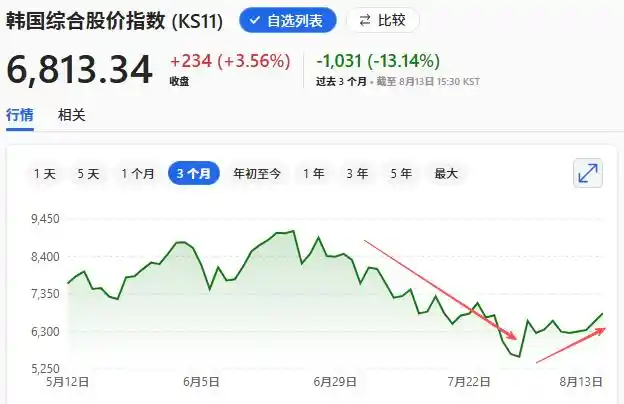
This rebound follows a period of extreme volatility. KOSPI plunged 22% in July alone, its worst monthly performance since the global financial crisis. Back then, forced liquidation of leveraged chip positions triggered chain-reaction trading halts, causing significant wealth losses for retail investors.
Behind this rally is a convergence of multiple positive factors: the latest earnings reports from global tech giants show persistently high AI capital expenditures, mild U.S. inflation data has eased market fears of further Fed rate hikes, regulators tightened rules on single-stock leveraged ETFs, and market expectations for upcoming shareholder return plans from Samsung and SK Hynix.
From Plunge to Bull: A Dramatic Reversal Within a Month
Just a month ago, the South Korean stock market was mired in a slump. KOSPI fell 22% in July alone, its worst monthly drop since the global financial crisis.
The trigger for the plunge was the forced liquidation of leveraged positions. Retail investors held large amounts of single-stock leveraged ETFs linked to chip stocks. When the tide turned, chain liquidations frequently caused intraday swings exceeding 5%, triggering exchange circuit breakers multiple times, wiping out billions of dollars in retail wealth in a short period.
Regulators stepped in quickly. Authorities tightened the minimum margin requirements for single-stock leveraged ETFs, significantly shrinking the daily trading volume of such products. Meanwhile, investors actively reduced leverage, and market volatility has fallen back to its lowest level since April.
Kang DaeKwun, CEO of Life Asset Management, said: "I believe the market became oversold during the liquidation of leveraged positions. As fund flows stabilize, the current rebound is a natural recovery."
AI Spending Remains Robust, Chip Demand Logic Intact
The fundamental support for this rally comes from the continued strength of AI demand.
The latest earnings reports from global tech giants show that investment in AI infrastructure has not slowed down, directly boosting expectations for demand for AI chips such as High Bandwidth Memory (HBM). Despite being driven mainly by retail investors, the South Korean stock market is still up over 60% year-to-date. However, even with this gain, KOSPI remains about 25% below its peak at the end of June.
Qian Zhang, an emerging markets equities specialist at Baillie Gifford, pointed out: "Due to the rise of AI agents and physical AI, memory demand has exploded, but we entered this phase with a fairly limited supply capability—the bottleneck is right here." "We are not saying the world will build data centers at this speed forever, but this is a real physical bottleneck, and there are only a few companies globally that can solve it."
Increased competitive threats from China had poured cold water on the strong momentum of memory stocks, but analysts believe the near-term demand outlook remains solid. The penetration of AI into more application scenarios and increased daily usage frequency continue to drive chip demand growth.
Shareholder Return Expectations Heat Up; Samsung, SK Hynix May Announce Trillion-Won Level Plans
Beyond the AI narrative, the upcoming shareholder return plans from the two chip giants have also become an important catalyst for recent market sentiment.
Samsung Electronics: During its Q2 earnings call, the company stated, "The board and management are actively discussing specific implementation plans, including special dividends, and the next phase of shareholder return policy." Its current three-year policy covering 2024-2026 expires this year.
According to calculations by DS Investment & Securities, Samsung Electronics' free cash flow (FCF) for this year is estimated at 263.2 trillion won. After deducting regular dividends, the additional return potential, corresponding to 50% of the cumulative three-year FCF, is about 131.8 trillion won.
KB Securities predicts that Samsung's annual shareholder return scale could be a minimum of 100 trillion won, up to a maximum of 200 trillion won—more than 10 times the current annual scale of 9.8 trillion won.
SK Hynix: The company has announced that it is "actively studying additional shareholder return plans, with specific details to be finalized and announced within Q3." Mirae Asset Securities expects SK Hynix's FCF to reach 180 trillion won this year, with net cash of 173 trillion won by year-end, estimating that funds available for returns amount to about 40 trillion won.
Daishin Securities believes that, if combining share buybacks for cancellation and special dividends, the return potential could reach up to 100 trillion won.
Mirae Asset Securities researcher Kim Young-gun noted that Samsung Electronics' "share price is down 39% from its peak; the current moment is a stage where the justification, yield, and perceived practical utility for advancing shareholder returns are all significantly enhanced."
He also stated that SK Hynix' "share price is down 51% from its peak, making it the optimal time for measures like buybacks, and the larger the return scale, the more the market will interpret it as the company's confidence in its future cash-generating ability."
Foreign Investor Sentiment Nuanced; Sustainability of Rally Uncertain
The moves of foreign investors warrant attention. Foreign investors were net buyers of Korean stocks on Thursday, but year-to-date, they remain net sellers, with cumulative withdrawals exceeding $100 billion—overheating and high valuations were the main reasons previously.
As this decline brought valuations down to more attractive levels, some overseas capital has begun to flow back.
However, whether the market can sustain its upward momentum remains uncertain. Kang DaeKwun said, "Until the AI narrative and US interest rates stabilize to some extent, it will be difficult for the market to maintain a continuous rise."
This article is from the WeChat public account "Wall Street News", author: Long Yue