Jack Dorsey's Company Is Laying Off 4,000 White-Collar Workers, Replaced by AI

Odaily星球日报Опубликовано 2026-02-27Обновлено 2026-02-27

Введение

Jack Dorsey's fintech company Block has announced a major workforce reduction, cutting nearly 40% of its employees—around 4,000 roles—to streamline operations and transition toward a flatter, AI-centric organizational structure. Despite reporting growing revenue and profitability, and even raising its 2026 profit guidance to $12.2 billion, Block is proactively restructuring to adapt to rapid AI-driven changes in productivity. Dorsey emphasized that AI tools are fundamentally reshaping how companies operate, enabling exponential growth without proportional increases in staff. This move reflects a broader trend among tech firms like Salesforce, Amazon, and ASML, which have also cut jobs during growth phases by leveraging AI for efficiency. Notably, Block’s stock surged 20% following the announcement, adding nearly $6 billion in market value—effectively valuing each eliminated role at about $1.5 million in created enterprise value. The layoffs primarily affect white-collar roles, as AI excels at tasks involving information processing—a core function of many knowledge-economy jobs. Affected employees will receive severance including 20 weeks' base pay, additional compensation per year served, a $5,000 transition bonus, and six months of continued health insurance. The situation underscores how AI is disrupting traditional employment faster than expected, shifting focus toward reskilling and adaptation in the automated economy.

Original | Odaily Planet Daily (@OdailyChina)

Author | Azuma (@azuma_eth)

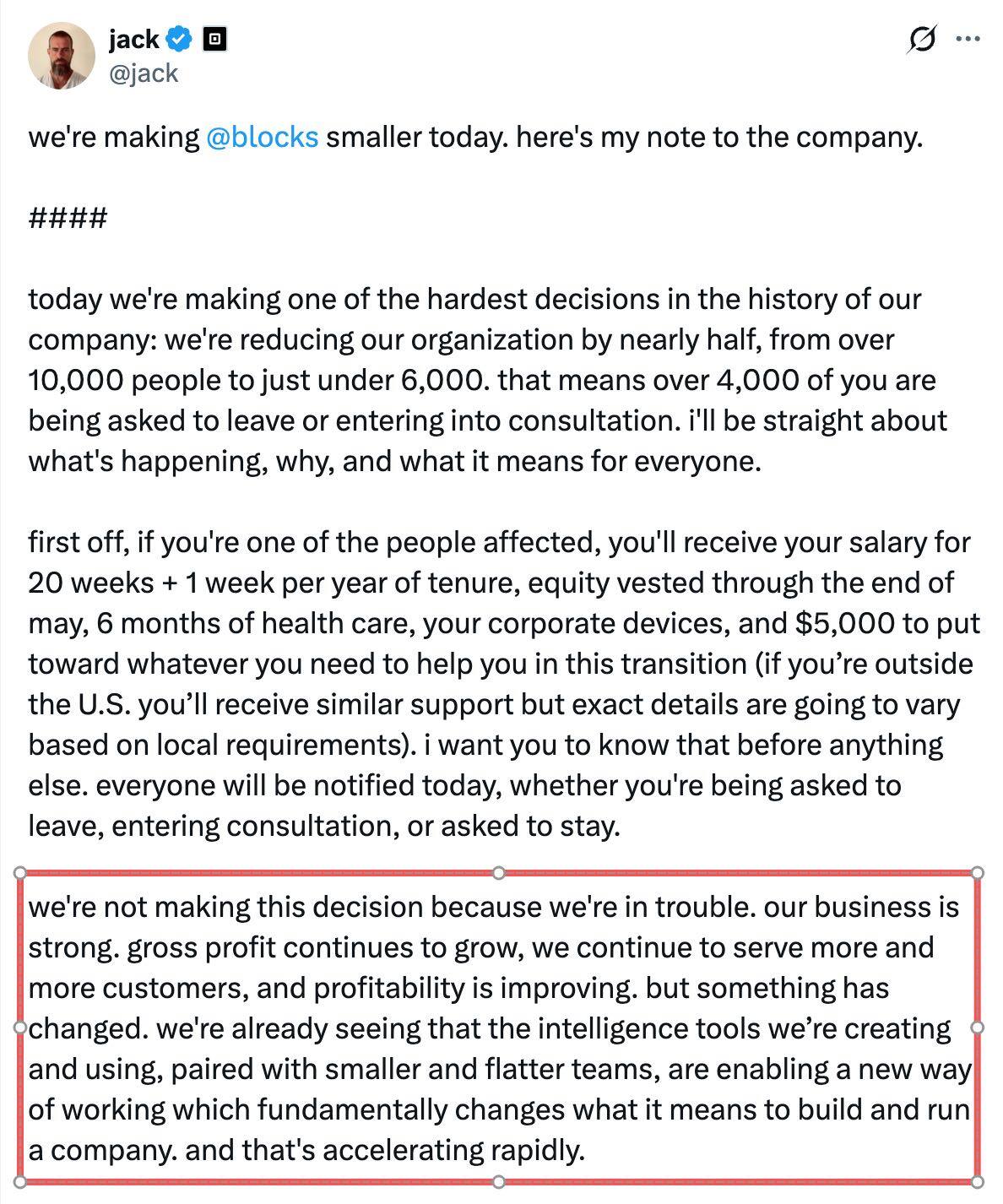
In the early hours of this morning Beijing time, financial technology company Block, led by Jack Dorsey (also the founder of Twitter), announced a large-scale layoff plan — nearly 4,000 positions will be cut, reducing the total number of employees from over 10,000 to less than 6,000, in order to promote a leaner, flatter, and AI-centric organizational structure.

Jack Dorsey himself is a fervent Bitcoin maximalist, believing that Bitcoin will ultimately become the native currency of the internet. Block's business is also deeply intertwined with Bitcoin. In addition to directly holding Bitcoin on its balance sheet and providing trading, wallet, and mining products and services, Block is also a long-term funder of Bitcoin core developers.

But this is not the focus of this article — the key point this article aims to emphasize is that, unlike other companies forced to lay off employees due to business contraction, Block is proactively choosing to cut nearly 40% of its positions during a period of growth in both business revenue and profit margins. Simultaneously with the layoffs, Block has further raised its 2026 gross profit guidance to $12.2 billion.

Jack Dorsey explained the reason for this decision in the announcement: "Something has changed. We have seen that the intelligent tools we are building and using, combined with smaller, flatter teams, are giving rise to a new way of working — this fundamentally changes the meaning of building and operating a company, and this change is accelerating rapidly... Rather than passively accepting the change and slowly laying off employees over the next few months or years, it is better to proactively adapt now."

The change mentioned by Jack Dorsey is not new — the rapid development of AI is iterating the traditional paradigm of productivity growth. In the past, enterprises mainly relied on linear growth in employee numbers to increase productivity and expand business scale; but now, with the help of rapidly evolving AI tools, enterprises can achieve exponential growth in productivity while maintaining or even reducing the number of employees.

Overseas influencer and product growth expert Aakash Gupta pointed out that Block is not the first company to make this decision: "Block is not an isolated case. ASML laid off 1,700 people last month while also announcing record order numbers; Salesforce laid off 5,000 people after AI began handling 50% of customer interactions; Amazon laid off 16,000 people in January last year and another 14,000 in October... All these companies were still in a growth trend when they made the decision to lay off employees. Jack Dorsey is just saying out loud what everyone has been tacitly acknowledging, that AI tools combined with smaller team size have completely changed the way a company is operated."

More notably, after Block announced its layoff plan, the capital market quickly gave its response — Block's stock price surged 20%, increasing its market value by nearly $6 billion on the spot. This means that for every position cut, about $1.5 million in enterprise value was created.

It has long been a social consensus that AI will disrupt the job market and eliminate some professions, but many people still underestimate the speed at which this change is arriving. In the past few weeks, we have witnessed the 'dimensionality reduction' impact of Anthropic on multiple industries such as SaaS; seen the 30 million reads of '2028 Global Intelligence Crisis' stirring public sentiment; and now we have Block proactively downsizing without concealing the reason.

Another counterintuitive reality is that while people once believed the threat of AI eliminating jobs would follow a gradual sequence 'from low-end to high-end,' the actual situation is that, due to the immaturity in the field of physical interaction, the first to be eliminated by AI are the white-collar jobs that the market once considered relatively mid-to-high-end. The reason is not complicated: the essence of white-collar work is to perform 'input → processing → output' of information based on specific industry standards, and this is precisely the area where AI large models excel.

In this round of layoffs at Block, affected employees will receive 20 weeks of salary plus an additional week's compensation for each year of service, as well as a $5,000 transition grant. Additionally, Block will continue to provide health insurance for employees for 6 months and allow them to keep their company equipment. The compensation conditions are quite good, but for these laid-off employees and the many positions already threatened by AI, it is time to think about how to avoid being eliminated in the AI era.

Связанные с этим вопросы

QWhat major announcement did Jack Dorsey's company Block make regarding its workforce?

ABlock announced a large-scale layoff plan, cutting nearly 4,000 jobs, which will reduce its total workforce from over 10,000 employees to fewer than 6,000.

QWhat was the stated reason for Block's decision to lay off such a significant portion of its employees despite being in a growth period?

AThe decision was driven by the rapid development of AI tools, which, combined with smaller, flatter teams, are creating a new way of working that fundamentally changes how a company is built and operated. Block chose to proactively adapt to this change rather than react slowly in the future.

QHow did the financial markets react to Block's announcement of the layoffs?

AThe market reacted positively; Block's stock price surged by 20%, increasing its market capitalization by nearly $6 billion, which equates to creating about $1.5 million in enterprise value for each job cut.

QAccording to the article, which sector of the workforce is AI currently impacting most significantly and why?

AAI is currently having the most significant impact on white-collar jobs. This is because the essence of white-collar work involves processing information (input → processing → output) according to specific industry standards, which is precisely the area where AI large language models excel.

QWhat compensation package was offered to the employees who were laid off from Block?

ALaid-off employees will receive 20 weeks of salary plus an additional week for each year of service, a $5,000 transition grant, 6 months of continued health insurance, and they are allowed to keep their company equipment.

Похожее

Has the 'Digital Gold' Narrative for BTC Failed?

**Title: Has the "Digital Gold" Narrative for Bitcoin Failed?** The article argues that Bitcoin's "digital gold" narrative remains valid despite a recent sharp price decline (from a peak near $126k in Oct 2025 to briefly under $61k in Feb 2026). It presents a long-term investment framework based on three core points: **1. Viewing Bitcoin as an Asset:** Bitcoin is presented as a superior potential store of value compared to gold. Key arguments are its absolute scarcity (21 million cap), superior portability, and transparent auditability via its public ledger. While acknowledging its current use in early, volatile stages (~3-4% global adoption), the author draws parallels to the early, disruptive phases of the internet and e-commerce. **2. Understanding the Recent Downturn:** The current ~50% correction is framed as a predictable, consensus-driven cycle following its post-halving peak (the 2024 halving preceded the Oct 2025 high). A crucial factor is a historic "changing of hands": the influx of new institutional buyers via ETFs allowed early, low-cost holders (miners, OG believers) to take profits. The author notes that while severe, Bitcoin's historical drawdowns (e.g., 93% in 2011, 77% in 2021-22) have been progressively smaller, suggesting maturing holder structure and decreasing volatility over time. **3. The Long-Term Perspective:** The long-term thesis hinges on Bitcoin capturing a portion of gold's market value. With Bitcoin's market cap at ~$1.4 trillion (at $70k) versus gold's ~$20 trillion, significant upside potential exists if the "digital gold" narrative is partially realized. However, the author strongly cautions that short-term risks remain, the bottom is unpredictable, and high volatility is inherent. The real risk is not Bitcoin failing but poor personal position management (over-leverage, wrong capital) and a lack of deep understanding, which can force investors out during severe downturns. The conclusion uses Amazon's 95% crash post-2000 dot-com bubble and subsequent 42x recovery as an analogy. The ultimate question is not if Bitcoin's price will rise, but if an investor's strategy and conviction can withstand the volatility to see the long-term play out. The recent divergence (gold up, Bitcoin down) is posed not as a narrative failure, but as potential evidence of this ongoing, painful transition from a speculative asset to a mainstream allocation.

marsbit2 ч. назад

Has the 'Digital Gold' Narrative for BTC Failed?

marsbit2 ч. назад

Has BTC's 'Digital Gold' Narrative Failed?

The article discusses Bitcoin's "digital gold" narrative, its recent price drop, and long-term outlook through the perspective of "Jason". It argues the narrative is not a failure but that Bitcoin represents a superior, new asset class due to its fixed supply (21 million), portability, and auditability. The piece compares its current ~3-4% global adoption rate to early internet/e-commerce, suggesting significant growth potential. Regarding the 2025-2026 price decline (from ~$126k to briefly under $61k), the author views it as a predictable, consensus-driven sell-off within Bitcoin's ~4-year cycle post-halving, exacerbated by a major "handover" from early, low-cost holders to new institutional buyers via ETFs. A key observation is that historical peak-to-trough drawdowns have lessened over time (e.g., 93% in 2011 to ~50% in 2026), indicating maturing volatility as holder structure changes. For the long term, the author uses a simple framework: Bitcoin's total market cap (~$1.4T at $70k) is only about 7% of gold's (~$20T). Even capturing 30-50% of gold's value would imply substantial upside. However, the article strongly cautions against viewing this as investment advice, emphasizing extreme volatility and the critical importance of risk management, position sizing, and deep fundamental understanding to survive severe drawdowns. It concludes by drawing a parallel to Amazon's 95% crash in 2000 and subsequent 42x recovery, stressing that the key is surviving market cycles to realize long-term potential.

链捕手3 ч. назад

Has BTC's 'Digital Gold' Narrative Failed?

链捕手3 ч. назад

From Code to Cognition: A Ten-Thousand-Word Guide to the Evolution of the Robot Brain

"From Code to Cognition: The Evolution of Robot Brains" The journey of robotic intelligence has shifted dramatically from manually coded systems to AI-driven brains. For decades, robots relied on layered software stacks—perception, state estimation, planning, control—each handcrafted. While predictable, they lacked adaptability. The 2010s saw deep learning revolutionize perception (e.g., object detection) and control (via reinforcement learning), but learned skills remained narrow. The arrival of Large Language Models (LLMs) marked a turning point. LLMs acted as high-level planners, interpreting natural language instructions and generating sequences of actions for traditional robotic systems to execute. However, true integration came with Visual-Language-Action (VLA) models, which fused vision, language, and motion prediction into a single network. Pioneered by models like RT-2 and open-source projects like OpenVLA, VLAs enable robots to reason and act directly from visual input and commands. The most advanced humanoid robots now employ a "dual-brain" architecture: a slow-thinking, large VLA (System 2) for reasoning and planning, and a fast-reacting, small network (System 1) for high-frequency motion control, sometimes with an even lower-level System 0 for balance. This split balances cognition with the physics of real-time movement. Computation is split between onboard hardware (e.g., NVIDIA Jetson) for safety-critical control loops and cloud/edge servers for non-critical tasks like learning and interfaces. A crucial driver is the open-source ecosystem—models like GR00T and OpenVLA allow startups to build upon pre-trained brains and fine-tune them with their own data, accelerating development. Despite progress, current systems struggle with recovery from errors, sample inefficiency, and long-horizon tasks. This has spurred the rise of **World Models**—neural networks that predict the consequences of actions. By simulating possible futures before acting (like NVIDIA Cosmos or Meta V-JEPA), robots can plan, recover, and generalize better. This represents the next frontier: shifting intelligence from learned reactions to an internal model of physics and cause-and-effect. The field is rapidly evolving. While not yet at its "ChatGPT moment," the convergence of cheaper hardware, scalable simulation, and world models points toward robots that are increasingly capable, adaptive, and useful. The question is shifting from "what can robots do?" to "what *should* they do?"

marsbit3 ч. назад

From Code to Cognition: A Ten-Thousand-Word Guide to the Evolution of the Robot Brain

marsbit3 ч. назад

AI Bubble Is Bursting

The AI Bubble is Bursting: A Necessary Purge on the Path to Ubiquitous Intelligence Market volatility has reignited debates about an AI bubble, with figures like Ray Dalio pointing to high valuations. However, this parallels the dot-com bubble, which, despite its crash, laid the physical infrastructure for today's internet era. The current AI investment frenzy, with tech giants planning trillions in infrastructure spending far outstripping current AI application revenues, appears similarly imbalanced. This 'bubble' is seen as an inevitable phase for a disruptive technology, paying the "innovation tax." Critically, AI inference costs have plummeted over 99.7% since 2023, making intelligence nearly free at the margin. This hasn't reduced spending but has instead unlocked massive new demand, as seen in enterprise AI cloud expenditure tripling. This follows the Jevons Paradox: efficiency gains lead to greater total consumption. The market is now entering a cleansing phase, weeding out speculative ventures lacking real moats. The deeper shift is a move from capital expenditure (CapEx) on hardware to value creation in operational expenditure (OpEx) through AI applications that solve real industry problems. While infrastructure valuations are high, rapid earnings growth from widespread AI adoption across sectors—from manufacturing and finance to law and healthcare—may digest these valuations over time. Ultimately, this creative destruction will leave behind robust infrastructure and optimized models, cheaply powering an AI-augmented future for all industries, much as the internet became indispensable after its own bubble burst. The core productive potential remains undiminished.

链捕手3 ч. назад

AI Bubble Is Bursting

链捕手3 ч. назад

Торговля

Спот
Фьючерсы

Популярные статьи

Неделя обучения по популярным токенам (2): 2026 может стать годом приложений реального времени, сектор AI продолжает оставаться в тренде

2025 год — год институциональных инвесторов, в будущем он будет доминировать в приложениях реального времени.

1.8k просмотров всегоОпубликовано 2025.12.16Обновлено 2025.12.16

Неделя обучения по популярным токенам (2): 2026 может стать годом приложений реального времени, сектор AI продолжает оставаться в тренде

Обсуждения

Добро пожаловать в Сообщество HTX. Здесь вы сможете быть в курсе последних новостей о развитии платформы и получить доступ к профессиональной аналитической информации о рынке. Мнения пользователей о цене на AI (AI) представлены ниже.

活动图片