Is RWA Entering the 'Equity Era'? The Backstory Behind Securitize, Ondo, and Coinbase's Simultaneous Moves

marsbitОпубликовано 2025-12-24Обновлено 2025-12-24

Введение

RWA is entering an "equity era," marked by a significant shift in focus from major players Securitize, Ondo, and Coinbase toward equity tokenization (Equity RWA). This synchronized move is not coincidental but is driven by clear regulatory direction. In December 2025, SEC Chairman Paul Atkins stated that the U.S. financial markets would migrate to blockchain within two years, a sentiment echoed by Nasdaq's plans for on-chain stock trading. Industry consensus is converging on an on-chain capital market future, with leaders from Maple Finance and Binance emphasizing RWA's potential to bridge blockchain with real-world assets. While private credit and U.S. Treasuries currently dominate RWA due to their regulatory clarity and stability, large institutions are now progressing toward equities. Each platform offers a distinct approach: Ondo provides tokenized stocks with liquidity directly backed by Nasdaq and NYSE-listed shares, targeting non-U.S. investors. Securitize is developing a fully compliant, native on-chain equity model where tokens represent direct shareholder rights. Coinbase is integrating stock trading into its platform, aiming to create a unified financial super-app for diverse assets. This collective pivot signals that on-chain equity is transitioning from an exploratory concept to a structurally significant component of the future financial system, representing a major milestone in RWA's evolution.

By: RWA Knowledge Circle

Edited by: RWA Knowledge Circle

Introduction

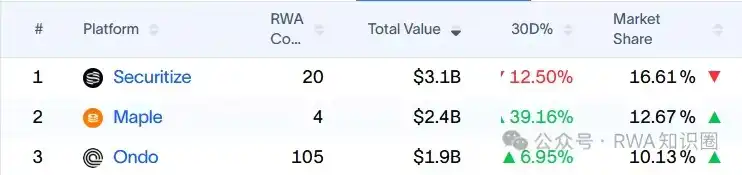
Recently, a noteworthy phenomenon has emerged in the RWA space. Securitize, ranked first in RWA market share, Ondo, ranked third, and leading digital asset exchange Coinbase have almost simultaneously focused their attention on the same thing—Equity RWA (tokenization of equity).

If this had happened a year or two ago, such "synchronization" would not have been common.

Securitize and Ondo both started with compliant financial asset RWA, with core products concentrated in U.S. Treasuries and cash-like assets; Coinbase has long been seen as an infrastructure platform for the crypto market, gradually expanding from exchanges and public chains to the application layer.

But recently, these three institutions have coincidentally begun to embrace on-chain stocks, which is clearly not a coincidence.

I. Not a Platform's "Whim," but Regulation Setting the Direction

Timing is crucial. On December 7, 2025, U.S. SEC Chairman Paul Atkins publicly stated:

In the next two years, the U.S. financial market will migrate entirely to the blockchain.

The SEC (U.S. Securities and Exchange Commission) is the core regulatory body for the U.S. capital market, responsible for securities issuance, exchange supervision, and market order. Public statements by the SEC Chairman often reflect not just personal views but the concentrated release of regulatory direction for the coming years.

Almost simultaneously, the Nasdaq exchange also clearly stated that it is advancing an on-chain trading solution for stocks.

These two signals, combined, make it clear: Equity on-chain is evolving from an "exploratory direction for Web3" to a recognized institutional migration path in traditional finance.

Against this backdrop, compliant RWA platforms like Securitize and Ondo, as well as platform infrastructure like Coinbase, entering equity tokenization is not radical innovation but a顺势而为 (going with the flow).

II. Industry Consensus Is Converging Toward an "On-Chain Capital Market"

Beyond regulation, internal industry judgments are also rapidly unifying.

On December 21, Sid Powell, co-founder and CEO of Maple Finance, the second-largest platform by RWA market share, stated:

In a few years, institutions will no longer distinguish between DeFi and TradFi; ultimately, all capital market activities will be completed on-chain.

Earlier, on October 8, Binance founder CZ also publicly expressed a similar judgment, believing that RWA is one of the most important directions for Web3 in the coming years because it truly enables systematic connection between blockchain and real-world assets.

From a market structure perspective, this consensus did not emerge out of thin air.

Currently, private credit and government bonds still dominate the RWA market, for practical reasons:

  • Not all real-world assets have high-frequency trading demand

  • Insufficient volatility limits on-chain liquidity

  • Regulatory recognition of RWA varies significantly across countries; whitelists, KYC, and permitted issuance are not yet unified

In contrast, the legal and regulatory paths for financial assets are highly mature, with clear ownership and transaction logic, making them more suitable for scaling first.

Thus, a clear trend is evident:

Larger institutions increasingly prefer to advance RWA along the mature path of Government Bonds → Stocks, rather than starting with assets from SMEs with complex equity structures.

III. Despite the Same Goal of "Stock RWA," the Three Offer Different Solutions

Interestingly, although the goal is the same, the implementation methods of the three institutions are completely different.

1. Ondo: Bringing the "Real Stock Market" On-Chain

Ondo Global Markets launched in September this year, offering over 100 types of on-chain tokenized stocks, allowing non-U.S. investors to participate in the U.S. stock market via blockchain settlement, 24/7.

Its biggest feature: Liquidity does not come from AMM pools but directly from Nasdaq and the NYSE.

In other words, Ondo's stock tokens are not "swapped on-chain with each other"; each token is 100% backed by real custodied shares, a model closer to the reserve mechanism of stablecoins. This results in almost no slippage for large trades. On compliance, Ondo has obtained FMA approval to offer tokenized U.S. stocks and ETFs in 30 European countries.

The data is also telling:

In the first week of December, the trading volume of Ondo stock tokens on the Bitget platform exceeded $88 million, capturing a 73% market share. Currently, Ondo Global Markets has reached a cumulative trading volume of $2 billion on Ethereum and BNB Chain, with a TVL exceeding $350 million.

On December 18, Ondo, together with LayerZero, launched Ondo Bridge, supporting 1:1 cross-chain transfer of 100+ stocks and ETFs across multiple chains.

2. Securitize: Native On-Chain Stocks, Leaning More Towards Institutional-Grade & Closed Structures

Securitize has chosen the path of highest complexity but also the most "institutionally native."

On December 17, Securitize announced plans to launch a native on-chain stock product in Q1 2026. Its core features are:

  • Real shares are issued directly on-chain

  • Simultaneously recorded in the issuer's official share register

  • Tokens represent full shareholder rights (dividends, voting, etc.)

More critically, Securitize itself is an SEC-registered transfer agent, ensuring token holders are legally direct shareholders, not indirect holders through an SPV or intermediary. However, it is important to note: This model does not equal "infinite fractionalization and free circulation."

In practice, whether circulation is open, whether whitelists are used, and whether transfer targets are restricted can still be fully controlled through compliant structures and company bylaws. This is why this model is more suitable for institutional-grade issuers, private placement structures, or directed equity arrangements.

3. Coinbase: Integrating Stocks into a "Financial Super App"

Coinbase's approach is more platform-oriented.

On December 18, Coinbase indicated it would introduce stock trading, prediction markets, and various other assets; on December 20, CEO Brian Armstrong announced: In-app stock trading is officially live. Currently, Coinbase supports:

  • 24/7 stock trading

  • Crypto assets and perpetual contracts

  • Prediction markets (in partnership with Kalshi)

  • Integration of decentralized exchange functions

And plans to launch Coinbase Tokenize, an RWA service for institutions, early next year. Its goal is very clear: One account to trade all assets; one interface to complete all financial operations.

IV. On-Chain Equity Is Becoming a Significant Long-Term Variable

Stocks are one of the core asset forms in the modern financial system, and on-chain equity is moving from fringe exploration to a main direction driven by both institutions and industry. Whether it's Ondo's market-driven path, Securitize's institutionally native path, or Coinbase's platform integration path, they are essentially answering the same question:

When capital markets migrate on-chain, in what form should stocks exist?

Understanding this change does not mean immediately participating, but it helps build a cognitive framework for the future financial structure.

As RWA gradually moves from "concept" to "infrastructure," equity tokenization is likely one of the most symbolic milestones.

Связанные с этим вопросы

QWhat recent trend in the US financial market is driving major RWA players like Securitize, Ondo, and Coinbase to focus on equity tokenization?

AThe recent statement by SEC Chairman Paul Atkins on December 7, 2025, indicating that the entire US financial market will migrate to blockchain within two years, along with Nasdaq's push for on-chain stock trading solutions, is driving this trend.

QHow does Ondo's approach to equity tokenization differ from traditional on-chain trading models?

AOndo's model does not rely on AMM pools for liquidity but directly sources it from Nasdaq and NYSE, with each token 100% backed by real custodied shares, minimizing slippage in large trades.

QWhat is the key legal distinction of Securitize's native on-chain equity model compared to other RWA platforms?

ASecuritize, as an SEC-registered transfer agent, ensures token holders are legally recognized as direct shareholders with full ownership rights (dividends, voting), with shares directly issued on-chain and recorded in the issuer's official cap table.

QWhat broader industry consensus is emerging regarding the future of capital markets and blockchain technology?

AIndustry leaders like Maple Finance's CEO Sid Powell and Binance's CZ believe that within a few years, institutions will not distinguish between DeFi and TradFi, as all capital market activities will migrate on-chain, with RWA being a key direction for systemic blockchain integration.

QHow is Coinbase integrating equity tokenization into its platform strategy?

ACoinbase is building a financial super-app by integrating 24/7 stock trading, crypto assets, perpetual contracts, prediction markets (via Kalshi), and decentralized exchange features, aiming to allow all financial operations in one account and interface, with plans for institutional RWA services like Coinbase Tokenize.

Похожее

Jensen Huang's CMU Speech: In the AI Era, Don't Just Watch, Build

Jensen Huang, CEO of NVIDIA and a first-generation immigrant, delivered the commencement address to Carnegie Mellon University's class of 2026. He shared his personal journey from a humble background to founding NVIDIA, emphasizing resilience, learning from failure, and the responsibility that comes with leadership. Huang framed the present moment as the dawn of the AI revolution, a shift he believes is more profound than previous computing waves. He described AI as fundamentally resetting computing—moving from human-written software to machines that understand, reason, and use tools. This will create a new industry for generating intelligence and transform every sector. While acknowledging AI's potential to automate tasks and displace some jobs, Huang distinguished between the *tasks* of a job and its core *purpose*. He argued AI will augment human capability, not replace humans. The real risk, he stated, is not AI itself, but people being left behind by those who effectively use AI. He presented AI as a generational opportunity for massive infrastructure investment—in chip factories, data centers, energy grids, and advanced manufacturing—that could re-industrialize nations like the U.S. and bridge the digital divide by making computing and intelligent tools accessible to all. Huang called for a balanced approach: advancing AI safely and responsibly, establishing prudent policies, ensuring broad access, and encouraging universal participation. He urged the graduates not to fear the future but to engage with optimism and ambition, reminding them of CMU's motto, "My heart is in the work." His core message was clear: this is their moment to actively build and shape the AI-powered future, not merely observe it.

marsbit23 мин. назад

Jensen Huang's CMU Speech: In the AI Era, Don't Just Watch, Build

marsbit23 мин. назад

The Era Has Arrived Where Human Writers Must Prove They Are Not Machines

The article describes an era where AI-generated content is flooding the market, forcing human authors to prove they are not machines. It begins with the example of dozens of AI-written, error-ridden biographies of Henry Kissinger appearing on Amazon within hours of his death, a pattern repeated for other deceased celebrities and even living experts who find fraudulent books under their names. This spam content has exploded, with monthly new book releases on platforms like Amazon reaching 300,000 by late 2025. The issue spans genres, from suspiciously high proportions of AI-written teen romance and self-help books to dangerous, AI-generated foraging guides containing lethal advice. The platforms' automated review systems, designed to catch plagiarism and banned words, are ill-equipped to detect AI-generated text that avoids these pitfalls while being nonsensical or fraudulent. The problem has infiltrated traditional publishing. A major publisher, Hachette, had to recall a bestselling horror novel after AI detection tools suggested 78% of its content was machine-generated. An acclaimed European philosophy book was later revealed to be entirely written by AI under a fake author persona. In response, authors are fighting back. At the 2026 London Book Fair, 10,000 writers published a blank book titled "Don't Steal This Book" containing only their signatures—using emptiness as a protest weapon in an age of AI overproduction. Initiatives like the "Human Author Certification" program have emerged, ironically placing the burden on humans to prove their work is not machine-made. The article warns of a vicious cycle: AI-generated low-quality books pollute the data used to train future AI models, leading to "model collapse" and an ever-worsening flood of digital waste, eroding trust in publishing and devaluing human creativity.

marsbit48 мин. назад

The Era Has Arrived Where Human Writers Must Prove They Are Not Machines

marsbit48 мин. назад

Торговля

Спот
Фьючерсы

Популярные статьи

Как купить S

Добро пожаловать на HTX.com! Мы сделали приобретение Sonic (S) простым и удобным. Следуйте нашему пошаговому руководству и отправляйтесь в свое крипто-путешествие.Шаг 1: Создайте аккаунт на HTXИспользуйте свой адрес электронной почты или номер телефона, чтобы зарегистрироваться и бесплатно создать аккаунт на HTX. Пройдите удобную регистрацию и откройте для себя весь функционал.Создать аккаунтШаг 2: Перейдите в Купить криптовалюту и выберите свой способ оплатыКредитная/Дебетовая Карта: Используйте свою карту Visa или Mastercard для мгновенной покупки Sonic (S).Баланс: Используйте средства с баланса вашего аккаунта HTX для простой торговли.Третьи Лица: Мы добавили популярные способы оплаты, такие как Google Pay и Apple Pay, для повышения удобства.P2P: Торгуйте напрямую с другими пользователями на HTX.Внебиржевая Торговля (OTC): Мы предлагаем индивидуальные услуги и конкурентоспособные обменные курсы для трейдеров.Шаг 3: Хранение Sonic (S)После приобретения вами Sonic (S) храните их в своем аккаунте на HTX. В качестве альтернативы вы можете отправить их куда-либо с помощью перевода в блокчейне или использовать для торговли с другими криптовалютами.Шаг 4: Торговля Sonic (S)С легкостью торгуйте Sonic (S) на спотовом рынке HTX. Просто зайдите в свой аккаунт, выберите торговую пару, совершайте сделки и следите за ними в режиме реального времени. Мы предлагаем удобный интерфейс как для начинающих, так и для опытных трейдеров.

1.3k просмотров всегоОпубликовано 2025.01.15Обновлено 2025.03.21

Как купить S

Sonic: Обновления под руководством Андре Кронье – новая звезда Layer-1 на фоне спада рынка

Он решает проблемы масштабируемости, совместимости между блокчейнами и стимулов для разработчиков с помощью технологических инноваций.

2.2k просмотров всегоОпубликовано 2025.04.09Обновлено 2025.04.09

Sonic: Обновления под руководством Андре Кронье – новая звезда Layer-1 на фоне спада рынка

HTX Learn: Пройдите обучение по "Sonic" и разделите 1000 USDT

HTX Learn — ваш проводник в мир перспективных проектов, и мы запускаем специальное мероприятие "Учитесь и Зарабатывайте", посвящённое этим проектам. Наше новое направление .

1.8k просмотров всегоОпубликовано 2025.04.10Обновлено 2025.04.10

HTX Learn: Пройдите обучение по "Sonic" и разделите 1000 USDT

Обсуждения

Добро пожаловать в Сообщество HTX. Здесь вы сможете быть в курсе последних новостей о развитии платформы и получить доступ к профессиональной аналитической информации о рынке. Мнения пользователей о цене на S (S) представлены ниже.

活动图片