Is It Time to End the Era of Perp DEXes Burning Cash for Growth?

marsbitОпубликовано 2026-08-12Обновлено 2026-08-12

Введение

The article questions whether the era of perpetual decentralized exchanges (Perp DEXes) relying heavily on token incentives for growth should end. It argues that while token incentives (points, airdrops, farming) are useful for bootstrapping liquidity and attracting users, they often attract short-term, incentive-driven behavior rather than genuine, long-term traders. The piece analyzes how platforms use future token value to acquire current trading volume and liquidity, but notes this creates data that is difficult to interpret. A key test comes after the Token Generation Event (TGE), when the removal of incentive expectations reveals whether user retention is based on product quality or continued subsidies. Data from platforms like Hyperliquid, Lighter, and edgeX shows varying success in converting airdrop attention into sustained trading relationships post-TGE. Post-TGE, the focus often shifts from distributing tokens to supporting the token's value through mechanisms like fee revenue buybacks and burns. However, this ties value redistribution to token holdings rather than direct trading contributions. Analysis of user behavior on platforms like Hyperliquid reveals that holding a platform's token, participating in its financial products, and engaging in perpetual trading are often distinct activities, indicating that broad token ownership does not equate to genuine trading demand. This creates a tension for platforms, which must manage both a trading market and a token m...

Author: Foresight News

The growth of Perp DEXes has largely benefited from token incentives.

Cold starts require incentives; traders, liquidity providers, and order flow channels create value for the market and deserve rewards. What's truly worth discussing is not "whether to incentivize," but rather in what form the incentives occur and whether the rewards truly correspond to the contributions.

Before TGE (Token Generation Event), platforms typically use future token expectations to attract current trading volume and liquidity through points, airdrops, and trading mining. Such mechanisms can quickly acquire users, but the fees users pay are real, while the rewards they receive still depend on future token allocation and market pricing. After TGE, fee revenue begins to be used for buybacks, burns, and staking rewards, gradually returning value to the ecosystem, but still primarily managed and distributed through the platform token.

The problem, therefore, is not the incentives themselves, but whether the incentives are overly reliant on future expectations. Traders generate trading demand and fee revenue; liquidity providers offer depth and execution; wallets, trading terminals, and communities bring sustained order flow. However, existing mechanisms tend to reward the ability to accumulate points and token holdings, rather than those who truly make the market function.

This is also a key issue discussed by Foresight Ventures during its investment in and incubation of PopDEX:Can a platform establish a more direct, more sustainable path for value to flow back, bringing rewards closer to real market contributions?

I. Early Growth and Demand Validation Under Token Incentives

1.Why Tokens Became the Default Tool

The cold start of a Perp DEX requires simultaneously attracting traders, liquidity, and distribution channels, while early-stage platforms usually lack stable revenue and can hardly bear high cash subsidies for long.

Tokens provide a more efficient coordination method: a platform can unify the contributions of traders, market makers, and early participants into future rights, trading future value for current trading volume, liquidity, and market attention.

dYdX represents a relatively complete early token incentive model. In its initial token supply, 25% was allocated to trading rewards, 7.5% to historical users, and 7.5% to liquidity rewards. Trading rewards were calculated based on fee contributions and open interest, while liquidity rewards considered quote uptime, two-sided depth, bid-ask spread, and number of markets covered. User acquisition, market maker subsidies, and early ownership distribution were thus integrated into the same token system.

Subsequent platforms have made various adjustments to this framework:

Hyperliquid combines Points, Referrals, and HLP to attract traders, expand order flow, and build protocol liquidity respectively;

Aster: adopts multi-season trading mining, maintaining continuous trading participation and user activity through successive point cycles and staged token distributions.

Lighter reduces trading barriers with zero fees and sets separate points for retail traders and market makers, distinguishing trading activity from liquidity quality;

These platforms do not rely solely on tokens, but tokens remain the core coordination tool in the cold-start system. Their advantage is not just "issuing rewards," but the ability to unify the contributions of different participants into future equity and defer most user acquisition and liquidity costs until TGE. Specific mechanisms vary, but the exchange relationship is largely consistent:The platform first uses future equity and upfront subsidies to exchange for current trading volume, liquidity, and market attention.

2.Points Attract Users Who Aren't Necessarily Long-Term Traders

Points airdrops not only change whether users join a platform, but also why they trade.

Normally, traders choosing a platform focus on liquidity, execution stability, fees, asset coverage, and risk management. After points airdrops are introduced, these criteria don't disappear, but users' decision-making weights change: besides the trading experience itself, users also calculate how many points they can earn per unit of trading cost, whether potential airdrops can cover fees and capital lock-up, and when rewards will materialize.

This doesn't mean users participating for points aren't professional traders. On the contrary, many professional traders also rationally assess point rewards. The issue is that when points become a significant variable in trading decisions, the volume a platform acquires no longer solely reflects product competitiveness but also includes users' pricing of future rewards.

Both types of trading behavior contribute volume, but their retention logic differs.

One type stems from sustained product demand: users stay because the platform's liquidity, execution, cost, and asset coverage meet their trading needs. The other type stems more from reward expectations: whether users continue trading depends on whether points still hold value, whether airdrops still have upside potential, and whether the input-output calculation still holds.
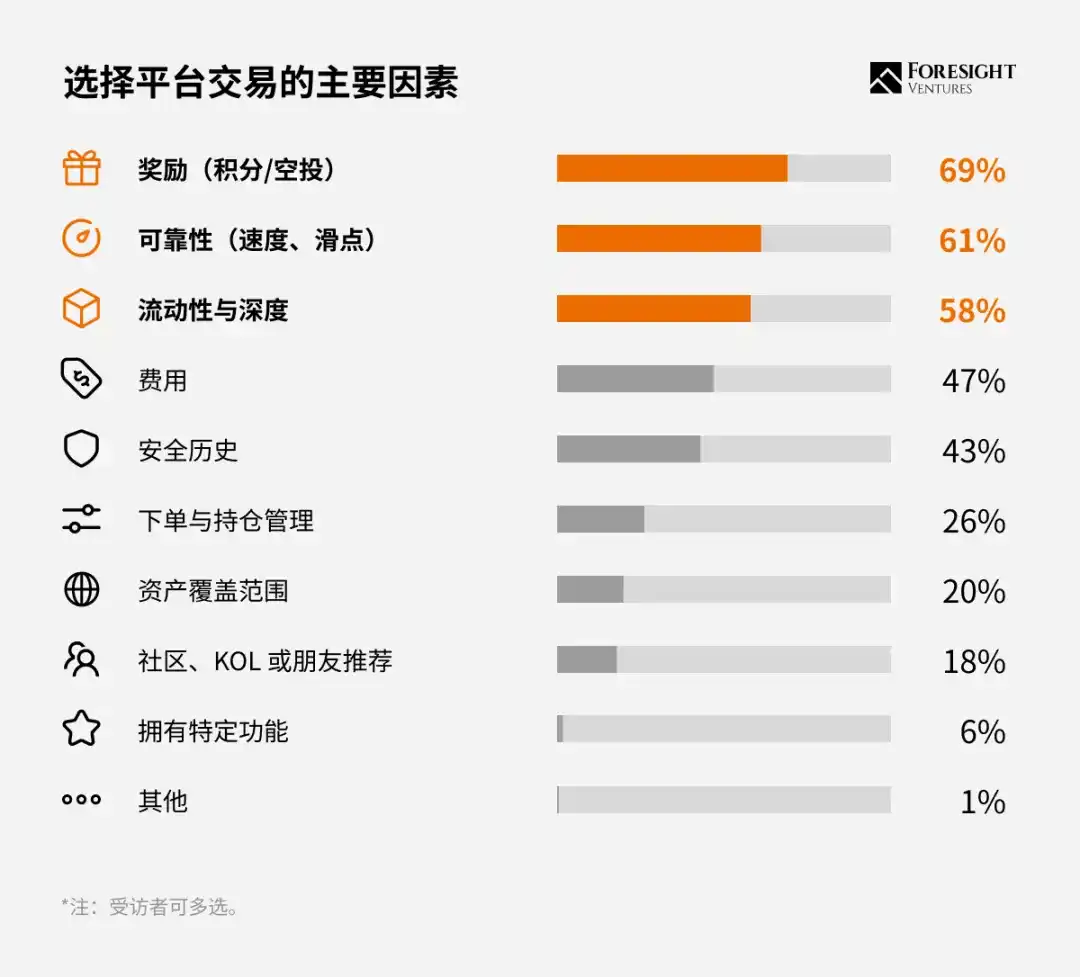
In a Perp DEX retail trader survey previously conducted by Foresight Ventures,69% of respondents listed points or airdrops as an important factor in choosing a trading platform, higher than reliability (61%), liquidity & depth (58%), and fees (47%).Points and airdrops are no longer just supplementary rewards outside the product; they are competing directly with reliability, liquidity, and fees, becoming a core variable in users' platform selection.

This changes the nature of the order flow a platform acquires. When users enter primarily based on reward expectations, the platform builds not a high-switching-cost relationship based on product habits, but a trading relationship requiring continuous subsidies.Rewards can lower the barrier for users to enter a platform, but they also lower the barrier for users to leave.

3.TGE is the First Stress Test for Trading Demand

During the points cycle, what a platform buys is not just trading volume, but also users' wait for future equity. As long as airdrops retain upside potential, users are willing to trade, pay fees, lock up capital, and accept a not-yet-fully-mature product experience.

But data from the points period is not pure. A trade might stem from real market demand or from airdrop expectations; a new user might generate long-term order flow or stop trading after completing tasks.

On the surface, they all count as growth.

When these different motivations are placed into the same token and points system, it becomes difficult for a platform to judge what it has ultimately gained. Therefore, post-TGE data shouldn't be viewed just in terms of rise or fall; three things are more important:

Whether trading volume remains after rewards are phased out or is maintained by a new round of incentives;

Whether market share increases, not just fluctuating with overall Perp DEX market trends;

Whether the platform has entered a phase of natural retention or is still in a new incentive cycle.

Platform

TGE Time

Avg Daily Volume 30 Days Pre-TGE

Avg Daily Volume 30 Days Post-TGE

Market Share Change

Hyperliquid

Nov 29, 2024

~$2.41B

~$5.08B

+18.6%

Lighter

Dec 30, 2025

~$6.64B

~$3.72B

−7.5%

edgeX

Mar 31, 2026

~$2.55B

~$1.70B

−2.9%

Note: This table only includes platforms for which consistent 30-day volume and market share data before and after TGE are available. Aster is not included in this comparison due to incomplete current public data.

What's truly important in this data is not which platform had higher volume after TGE, but which converted the attention brought by airdrops into a sustained trading relationship.

If there are still new rounds of points, mining, or subsidies after TGE, trading volume still contains incentive components and cannot be simply equated with demand crystallization. The real watershed is whether users are still willing to continue trading on the platform itself after the marginal appeal of reward expectations declines.

In other words, pre-TGE validates whether a platform can attract users; post-TGE validates whether a platform can make users stay. The former can be accomplished by incentives; the latter ultimately depends on product capabilities and value distribution mechanisms.

II. Value Begins to Flow Back, But Still Revolves Around the Platform Token

4.From Issuing Tokens to Supporting Tokens

After TGE, incentive mechanisms typically shift from "issuing tokens" to "supporting tokens." Platforms usually use fee revenue for buybacks, burns, staking rewards, and holding discounts. Value begins to flow back, but the distribution basis also shifts from trading contribution to token holdings.

This means traders first generate revenue through trading, then gain the qualification to share that revenue by purchasing or staking the platform token. Consequently, the platform needs to maintain two markets simultaneously: the trading market and the platform token market.

The two can reinforce each other, but are not always aligned. Professional traders may consistently contribute fees but be unwilling to take on additional platform token risk. Thus, what the platform gradually rewards is not just trading itself, but also users' capital commitment to the platform token.

This transition is implemented differently across platforms. What's truly worth comparing is not just whether buybacks occur, but how much revenue enters the token system, how tokens are handled after buyback, and who ultimately receives this value.

Platform

Fee Revenue Handling

Buyback Ratio

Post-Buyback Use

Primary Value Recipients

Hyperliquid

Fees go to the Assistance Fund and are used to buy HYPE

~99%

Purchased tokens are burned

HYPE holders benefit indirectly via supply contraction

Aster

Majority of platform fees used to buy back ASTER

99%

Handled per tokenomics mechanism

ASTER holders & ecosystem incentive participants

Lighter

Platform trading fee revenue used for programmatic LIT buybacks

~97%

Bought-back tokens permanently burned

LIT holders benefit indirectly via supply contraction

5.Platform Tokens Expand Participation, But Don't Equal Trading Demand

Platform tokens can expand ecosystem participation, but the address growth they bring may not translate synchronously into futures trading demand. To observe this divergence, we conducted a cross-analysis of Hyperliquid's HYPE holding addresses, wealth management user addresses, and futures trading user addresses.

The results show that among the union of the three user types, HYPE holders account for 89%, wealth management users 27%, and futures users only 20%; users participating in holding, wealth management, *and* futures trading make up only 5% of the total.

A further breakdown reveals:

Among futures users, 62% hold HYPE, but over 70% do not participate in wealth management;

Among HYPE holders, 86% have never engaged in futures trading;

Among wealth management users, 85% hold HYPE, but only 19% participate in futures trading.
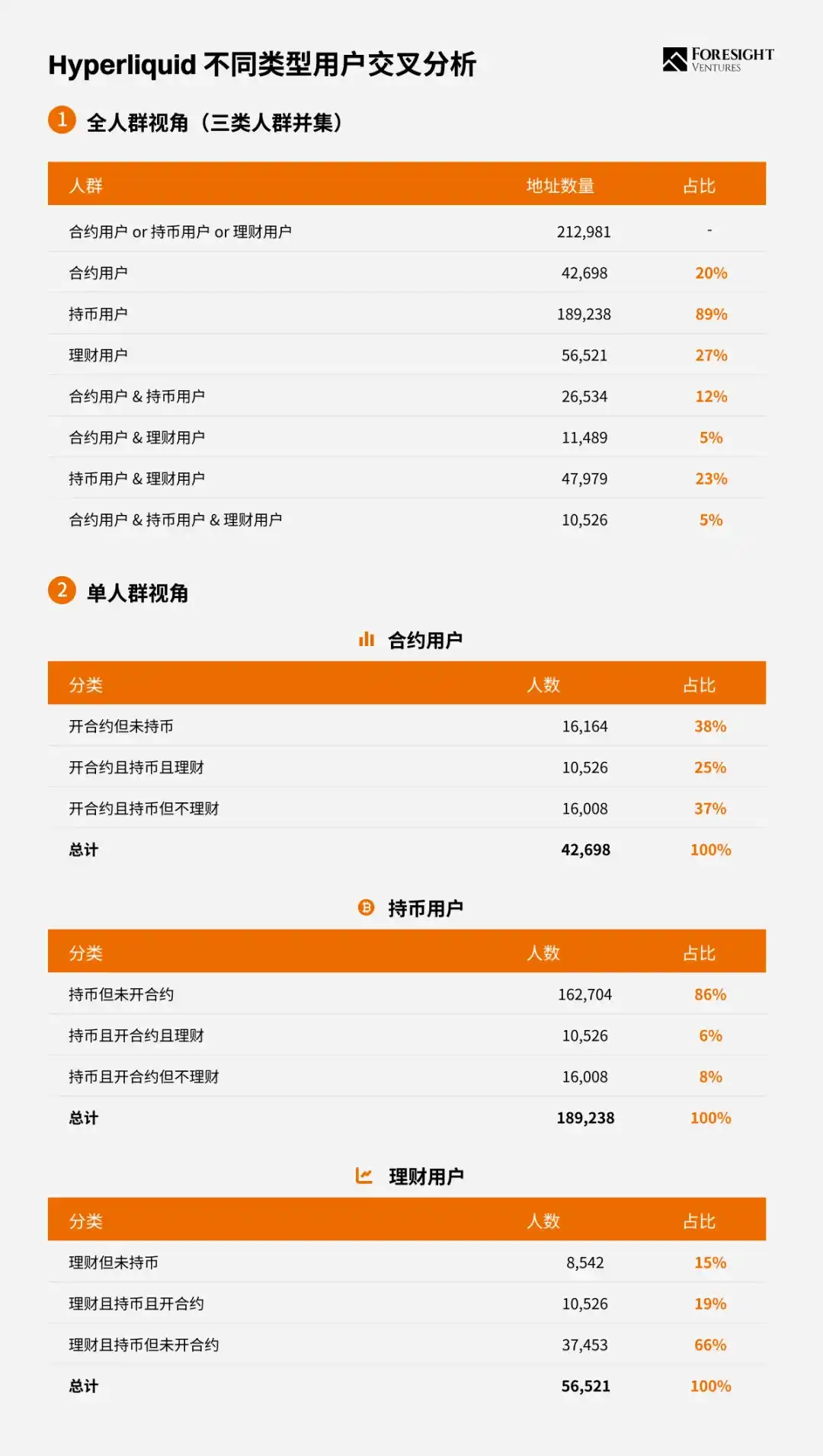
This data indicates that platform tokens can bring broader asset holding and ecosystem participation, but holding, wealth management, and trading do not correspond to the same demand. Holding may stem from asset allocation and price expectations, wealth management corresponds more to yield strategies, and only futures trading directly reflects trading demand and order flow.

When holding addresses, asset size, and wealth management users are all counted as ecosystem growth, capital participation can easily be misinterpreted as trading market growth. But for a Perp DEX, what truly determines market quality remains sustained trading, effective liquidity, and real fee revenue.

Platform tokens can expand ecosystem participation, but cannot substitute for trading demand itself.

6.One Platform, Two Sets of Growth Goals

When revenue distribution, fee discounts, and product privileges are all tied to the platform token, a Perp DEX essentially needs to operate two markets simultaneously: the trading market and the token market. This creates a fundamental tension:What does the platform prioritize serving—the trading product itself, or the value cycle built around the platform token?

These two sets of goals are not always synchronized. The trading market focuses on execution quality, liquidity, and cost, relying on long-term product capabilities; the token market focuses on demand, scarcity, and price expectations, relying on continuously creating reasons to hold the token.

The resulting risk is not just resource dispersion, but a shift in evaluation standards. Trading volume, fees, and user growth no longer solely measure the health of the trading product; they also begin to serve the purpose of supporting the token narrative. What a platform pursues may no longer just be more real trading, but more data that can strengthen token demand.

III. PopDEX: Another Answer for Incentive Mechanisms

From Foresight Ventures' investment perspective, what makes PopDEX noteworthy is not a simple discussion of whether a platform token exists, but that the team did not use token expectations as the starting point for growth, nor set holding status as a necessary prerequisite for trading rights. Compared to converging platform value into the platform token first and then redistributing it through the token, PopDEX starts more directly from real market contributions:Whoever creates value should receive that value back.

Based on this idea, PopDEX has established a100% Value Back System.

Here, 100% refers to the distributable value formed from trading fees, not returning each fee directly to the trader. Its core lies in: the distributable value formed from trading fees is no longer prioritized to support the platform token, but enters a backflow framework designed around real contributions.

Under this framework, PopDEX's value backflow will cover two types of participants: ecosystem contributors and real trading users. The former includes Referrals, Affiliates, trading activities, joint campaigns, and other ecosystem roles that continuously bring users, order flow, and market attention; the latter, based on real trading contributions, explores more direct, periodic, transparent, and verifiable ways for value to flow back.

As for the specific form in which this value will ultimately be distributed, PopDEX will gradually disclose details in subsequent product phases.

For PopDEX, this is not a negation of existing models, but a different attempt at incentive mechanisms: incentives are not only used to acquire growth but can also become the platform's way of continuously giving back to the ecosystem.

There is no standard answer for how incentive mechanisms should evolve, and the market will ultimately give its own judgment. But we believe that as the Perp DEX industry matures, its incentive mechanisms should not have only a single path; more answers are worth exploring.


Трендовые криптовалюты

Связанные с этим вопросы

QWhat is the main criticism of current Perp DEX token incentive models according to the article?

AThe main criticism is that current Perp DEX token incentive models over-rely on future expectations and rewards like points and airdrops. This often attracts users based on potential rewards rather than genuine product demand, creating a relationship that requires continuous subsidies. The incentive structure tends to reward points accumulation and token holding more than rewarding the true market contributors like traders, liquidity providers, and channels that bring sustainable order flow.

QWhat does the article identify as the key test for a Perp DEX's sustainability after its TGE (Token Generation Event)?

AThe key test after a TGE is whether trading volume and user engagement are retained after the initial reward expectations fade. It examines if the growth was based on genuine product demand or just incentive-seeking behavior. The article suggests that true sustainability is measured by whether users continue trading based on the platform's core product strengths—like liquidity, execution, and fees—rather than being dependent on new incentive cycles.

QAccording to the analysis of Hyperliquid user data, what is the relationship between holding the platform token (HYPE), participating in wealth management, and trading contracts?

AThe analysis shows a significant disconnect between holding the HYPE token, participating in wealth management products, and engaging in contract trading. While 89% of the analyzed addresses held HYPE, only 27% were wealth management users, and a mere 20% were contract traders. Crucially, only 5% of users participated in all three activities. This indicates that platform token holding drives broad ecosystem participation but does not directly translate into core trading demand.

QWhat fundamental tension does the article highlight for Perp DEX platforms after they issue a native token?

AThe article highlights a fundamental tension where a Perp DEX must manage two distinct markets simultaneously: the trading market and the platform token market. The goals for these markets can diverge. The trading market's health depends on product quality (execution, liquidity, costs), while the token market's value relies on creating demand and narratives for the token. This can lead to a conflict where platform metrics (like volume) may be prioritized more for supporting the token's price narrative than for reflecting genuine, sustainable trading activity.

QWhat is the core principle behind PopDEX's proposed '100% value backflow system'?

AThe core principle of PopDEX's '100% value backflow system' is that value should return directly and transparently to those who create it. Instead of channeling protocol revenue (like fees) first into mechanisms that support a platform token's price (e.g., buyback and burn), the system aims to allocate the distributable value from fees back to genuine market contributors. This includes ecosystem roles (like referrers, affiliates) that bring users and order flow, as well as real traders based on their transaction activity, aiming for a more sustainable and direct value distribution path.

Похожее

Предложение XRP Ledger по спонсируемым комиссиям может сделать XRP менее заметным для некоторых пользователей

Предлагаемая поправка к реестру XRP Ledger, известная как XLS-68, позволит спонсорам покрывать комиссии за транзакции и резервные требования для других пользователей. Это может позволить некоторым пользователям взаимодействовать с кошельками и приложениями, не владея напрямую XRP. Функция, включенная в пакет поправок xrpld v3.3.0, направлена на снижение трения при onboarding пользователей и абстракцию комиссий для улучшения пользовательского опыта (UX). Это не означает автоматического снижения спроса на XRP, но может сделать актив менее заметным в некоторых пользовательских сценариях. С одной стороны, новым пользователям больше не нужно будет самостоятельно приобретать XRP для совершения первых операций, что упрощает процесс. С другой — спонсорам (приложениям, кошелькам, биржам или бизнесам) по-прежнему потребуется XRP для покрытия комиссий и резервов сети. Упрощение UX может увеличить общую активность в сети, что потенциально компенсирует снижение прямой видимости токена. Наибольшую выгоду от этой функции могут получить корпоративные и потребительские продукты (например, банки, платежные системы, эмитенты стейблкоинов), которые смогут скрыть часть сложности блокчейна от конечных пользователей. Поправка пока является предложением и требует одобрения валидаторов XRPL. Её конечное влияние на экономику и видимость XRP будет зависеть от того, как именно разработчики внедрят эту функцию и будет ли она способствовать росту adoption сети.

bitcoinist3 мин. назад

Предложение XRP Ledger по спонсируемым комиссиям может сделать XRP менее заметным для некоторых пользователей

bitcoinist3 мин. назад

Сильный рост, умеренное повышение ставок, подконтрольные цены на нефть: рынок оценивает несуществующее совершенство

Рынки одновременно делают ставки на устойчивый рост, ограниченное повышение процентных ставок ФРС, управляемость шоков предложения на энергетическом рынке и снижение цен на нефть. Такой «идеальный» сценарий, казалось бы, благоприятен для рисковых активов, но оставляет крайне мало пространства для ошибок в политике, инфляции и геополитической ситуации. Как отмечает Deutsche Bank, сигналы с рынка противоречивы: акции США находятся на рекордных уровнях, а спреды кредитного риска — на минимумах, что отражает веру в устойчивость экономики. Однако рынок процентных ставок закладывает весьма умеренное ужесточение политики ФРС. Исторические данные показывают, что при текущем уровне инфляции Федрезерв в прошлом проводил более агрессивные циклы повышения ставок. Цены на нефть снизились с пиков, но это расходится с реальностью поставок: пролив Хормуз до сих пор не функционирует в полном объеме, а инфраструктура остается под угрозой. Рынок, судя по форвардным кривым, ожидает восстановления поставок, что повышает уязвимость. Ключевой риск заключается не в провале одного фактора, а в том, что несколько оптимистичных предположений не сбудутся одновременно. Если сильный рост будет подстегивать инфляционное давление или энергетические шоки сохранятся, текущая структура ценообразования на рисковые активы, процентные ставки и инфляционные ожидания может быть нарушена. Рынки практически не оставляют запаса на ошибку, и любое отклонение от идеального сценария может привести к их переоценке.

marsbit33 мин. назад

Сильный рост, умеренное повышение ставок, подконтрольные цены на нефть: рынок оценивает несуществующее совершенство

marsbit33 мин. назад

Только что взорвалась AAOI в оптической связи, а CoreWeave объявила заказ на 104 миллиарда долларов! Кто на самом деле получает выгоду на цепочке ИИ-инфраструктуры?

Выручка CoreWeave во втором квартале 2026 финансового года выросла примерно на 112% до 2,575 миллиарда долларов, а чистый убыток увеличился до 626 миллионов долларов. Несмотря на сохранение высоких темпов роста выручки, производственных мощностей и портфеля заказов, резкий рост операционных расходов привел к переходу операционной прибыли в отрицательную зону, а капитальные затраты значительно превысили операционный денежный поток, что вызвало рост долговой нагрузки и увеличение бремени процентных платежей. В будущем необходимо уделять пристальное внимание эффективности конверсии портфеля заказов, восстановлению нормы прибыли, а также внешнему финансированию и долговой нагрузке.

34 мин. назад

Только что взорвалась AAOI в оптической связи, а CoreWeave объявила заказ на 104 миллиарда долларов! Кто на самом деле получает выгоду на цепочке ИИ-инфраструктуры?

34 мин. назад

Является ли StonkBroker бесспорным вторым по значимости проектом на Robinhood Chain?

Заголовок: StonkBroker — действительно ли второй по значимости проект на Robinhood Chain? StonkBroker ($STONKBROKER) показал резкий рост за 14 дней, достигнув рыночной капитализации более $1 млрд, а его коллекция NFT превзошла по стоимости BAYC. Хотя многие считают его «вторым по силе» (№2) активом в экосистеме Robinhood Chain после $CASHCAT, устойчивость его фундаментальных показателей вызывает вопросы. Основные доходы проекта формируются за счёт комиссий за торговлю в NFT AMM (10% от операций конвертации NFT-токен) и платы за «активацию» NFT-Broker. Эта модель, основанная на взаимном росте цены NFT и токена, привлекла внимание и спекулянтов. Однако реальная продуктивная деятельность, такая как Launchpad для запуска новых проектов, ещё не началась. Скоро на Launchpad StonkBroker запустят мем-токен $CLOCKIN, что может повлиять на стоимость основного актива. Хотя проект демонстрирует сильное сообщество и потенциал, называть его однозначным «лидером №2» пока рано. Успех будет зависеть от способности создавать ценность для инвесторов и конкурировать на рынке, особенно в контексте общего развития экосистемы Robinhood Chain и будущих запусков. Инвесторам стоит оценивать риски, наблюдая за развитием производных проектов на его платформе.

marsbit45 мин. назад

Является ли StonkBroker бесспорным вторым по значимости проектом на Robinhood Chain?

marsbit45 мин. назад

Последняя миля стейблкоинов: MoneyGram подключает криптокошельки к 170+ странам через сеть наличных точек

Стейблкоины решают проблемы скорости и стоимости международных переводов, но не решают ключевую задачу: как конвертировать их в наличные деньги по всему миру. 11 августа компания MoneyGram, один из мировых лидеров в сфере денежных переводов, объявила о запуске своего сервиса конвертации криптовалют MoneyGram Ramps в сети Solana. Разработчики теперь могут через API подключить к своим приложениям сеть из почти 500 000 пунктов MoneyGram в более чем 170 странах. Пользователи могут обменять USDC на местную валюту или пополнить свой криптокошелек наличными. MoneyGram, основанная в 1940 году и ежегодно обрабатывающая транзакции на сумму свыше 2000 миллиардов долларов, с 2023 года ускорила трансформацию в финтех-платформу. Её услуги по конвертации уже работают в сети Stellar. Ключевая ценность Ramps — позволить любому криптокошельку или бирже, не строя собственную сеть и соблюдение нормативных требований, предлагать пользователям глобальный обмен между криптовалютой и наличными через проверенную физическую сеть MoneyGram. Выбор Solana обусловлен крайне низкой стоимостью и высокой скоростью транзакций в сети, что идеально подходит для небольших частых переводов. Интеграция с Solana Developer Platform упрощает доступ для разработчиков. Таким образом, MoneyGram, используя свою 85-летнюю историю и глобальную сеть, предоставляет стабильный, регулируемый мост между цифровыми долларами и реальной экономикой, решая «последнюю милю» проблемы внедрения стейблкоинов для повседневных переводов.

marsbit1 ч. назад

Последняя миля стейблкоинов: MoneyGram подключает криптокошельки к 170+ странам через сеть наличных точек

marsbit1 ч. назад

Торговля

Спот

Популярные статьи

Как купить ERA

Добро пожаловать на HTX.com! Мы сделали приобретение Caldera (ERA) простым и удобным. Следуйте нашему пошаговому руководству и отправляйтесь в свое крипто-путешествие.Шаг 1: Создайте аккаунт на HTXИспользуйте свой адрес электронной почты или номер телефона, чтобы зарегистрироваться и бесплатно создать аккаунт на HTX. Пройдите удобную регистрацию и откройте для себя весь функционал.Создать аккаунтШаг 2: Перейдите в Купить криптовалюту и выберите свой способ оплатыКредитная/Дебетовая Карта: Используйте свою карту Visa или Mastercard для мгновенной покупки Caldera (ERA).Баланс: Используйте средства с баланса вашего аккаунта HTX для простой торговли.Третьи Лица: Мы добавили популярные способы оплаты, такие как Google Pay и Apple Pay, для повышения удобства.P2P: Торгуйте напрямую с другими пользователями на HTX.Внебиржевая Торговля (OTC): Мы предлагаем индивидуальные услуги и конкурентоспособные обменные курсы для трейдеров.Шаг 3: Хранение Caldera (ERA)После приобретения вами Caldera (ERA) храните их в своем аккаунте на HTX. В качестве альтернативы вы можете отправить их куда-либо с помощью перевода в блокчейне или использовать для торговли с другими криптовалютами.Шаг 4: Торговля Caldera (ERA)С легкостью торгуйте Caldera (ERA) на спотовом рынке HTX. Просто зайдите в свой аккаунт, выберите торговую пару, совершайте сделки и следите за ними в режиме реального времени. Мы предлагаем удобный интерфейс как для начинающих, так и для опытных трейдеров.

951 просмотров всегоОпубликовано 2025.07.17Обновлено 2026.06.02

Как купить ERA

Обсуждения

Добро пожаловать в Сообщество HTX. Здесь вы сможете быть в курсе последних новостей о развитии платформы и получить доступ к профессиональной аналитической информации о рынке. Мнения пользователей о цене на ERA (ERA) представлены ниже.

活动图片