Is Bitcoin Price Witnessing A Relief Rally? What On-Chain Data Says

bitcoinistОпубликовано 2026-01-10Обновлено 2026-01-10

Введение

Bitcoin's price has shown a strong start to 2026, mostly staying above the key $90,000 level, sparking debate on whether this is a true bullish resurgence or a bear market relief rally. Analyst Maartunn points to on-chain data, noting that the bounce was supported by the ETF Realized Price at $85,000, where buyers defended their positions. The Coinbase Premium Gap also rose, indicating increased buying from U.S. investors, followed by strong ETF inflows—suggesting strategic rebalancing rather than emotional FOMO. However, BTC was rejected at the $94,000 resistance and remains below critical on-chain levels like the Short-Term Holder and Whale Realized Prices. Despite a 10% rise, the analyst concludes this is likely a relief rally within a bear trend. A sustained break above $94,000 is needed to confirm a bullish restart. Currently, BTC is trading around $90,360, down 1% in 24 hours.

The Bitcoin price looks to be off to a great start, having spent most of the new year above the psychological $90,000 mark. While the premier cryptocurrency has slowed down in recent days, there has been a display of significant bullish intent in the market so far in 2026.

Now, this latest show of optimism somewhat contradicts recent predictions that the Bitcoin price might be at the start of a bear market. This begs the question — could the bull run be nearing a restart, or is the price of BTC only witnessing a relief rally?

BTC’s Recent Bounce A Mere Bear Market Relief Rally — Analyst

In a January 9 post on the X platform, crypto analyst Maartunn shared interesting data points to answer the question of whether Bitcoin’s latest price bounce is meaningful or just a relief rally. The market pundit anchored their answer on both on-chain and technical price data.

Firstly, Maartunn acknowledged that the recent jump was only bound to happen, as the Bitcoin price found support around the ETF Realized Price at $85,000. This price level represents the average cost basis of BTC ETF investors, and as expected, the buyers defended their positions — leading to the price bounce.

This phenomenon is spotlighted by another on-chain metric, the Coinbase Premium Gap, which measures the difference between the Bitcoin price on Coinbase and global exchanges. According to Maartunn, the metric started to rise right after New Year’s Eve, signaling renewed buying activity from US-based investors.

Furthermore, the spot exchange-traded funds started seeing strong capital inflows days after this uptick in the Coinbase Premium Gap. “This looks more like strategic buying/portfolio rebalancing (new quarter, new year) than emotional FOMO,” Maartunn added.

Source: @JA_Maartun on X

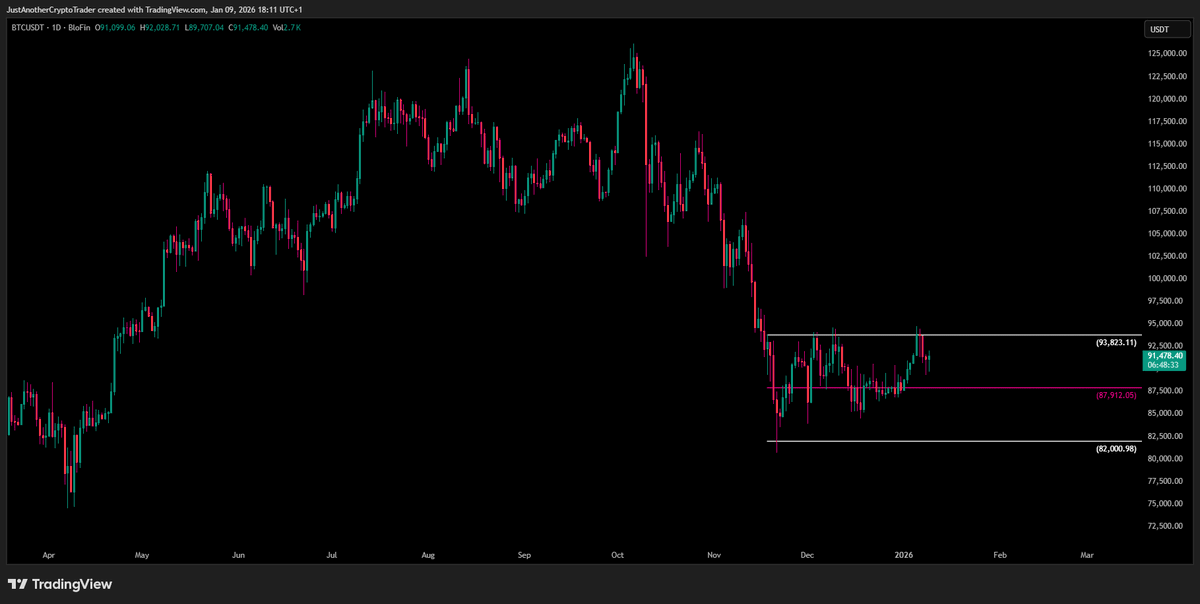
However, the crypto analyst noted that the rally only saw the Bitcoin Price climb to the range high at $94,000 before getting rejected. In essence, this suggests that the flagship cryptocurrency does not possess the bullish strength to breach that resistance.

Additionally, Maartunn mentioned that Bitcoin is still trading beneath crucial on-chain levels like the Short-Term Holder Realized Price and Whale Realized Price, both of which are acting as significant overhead resistance.

The on-chain analyst noted that the on-chain observations suggest that this recent bounce is merely a bear market relief rally, not a trend continuation — even though the price is up by about 10%. Only a clean break and sustained close above the $94,000 would indicate the Bitcoin price’s strong intent to rebuild a bullish structure, Martunn concluded.

Bitcoin Price At A Glance

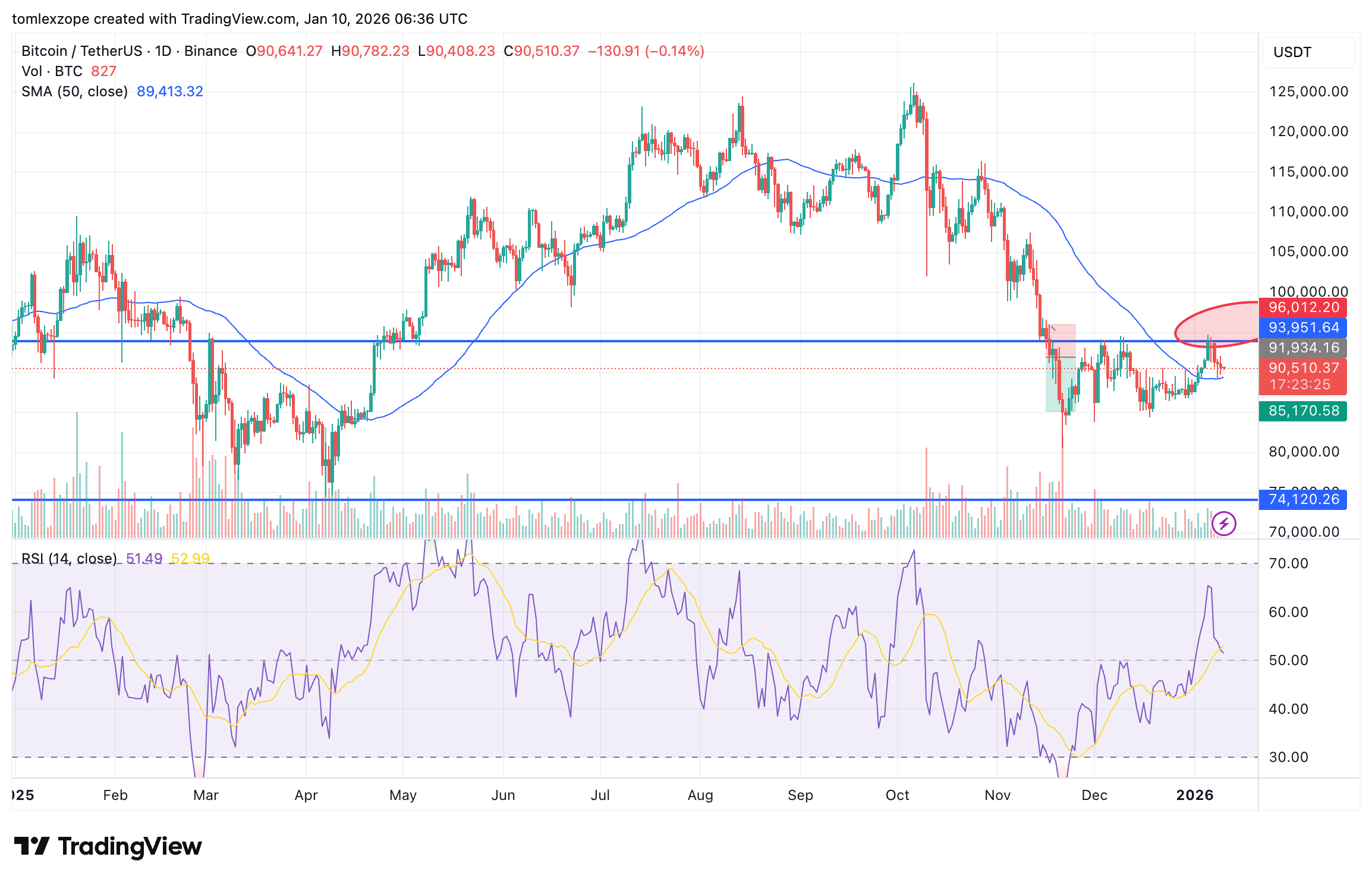
As of this writing, the price of BTC stands at $90,360, reflecting an almost 1% decline in the past 24 hours.

The price of BTC on the daily timeframe | Source: BTCUSDT chart on TradingView

Связанные с этим вопросы

QWhat on-chain metric signaled renewed buying activity from US-based investors after New Year's Eve?

AThe Coinbase Premium Gap, which measures the difference between the Bitcoin price on Coinbase and global exchanges.

QAccording to analyst Maartunn, what price level acted as a key support for Bitcoin, leading to the recent bounce?

AThe ETF Realized Price at $85,000, which represents the average cost basis of BTC ETF investors.

QWhat does the analyst conclude the recent Bitcoin price bounce represents, based on the on-chain data?

AHe concludes it is merely a bear market relief rally, not a trend continuation or the restart of a bull run.

QWhat critical resistance level did the Bitcoin price get rejected at during this rally?

AThe range high at $94,000.

QWhat two specific on-chain price levels is Bitcoin still trading beneath, which are acting as significant overhead resistance?

AThe Short-Term Holder Realized Price and the Whale Realized Price.

Похожее

The Value Distribution of Stablecoins

**Summary: The Value Distribution of Stablecoins** The article argues that stablecoins are evolving from mere trading tools into broader channels for dollar access. It divides the stablecoin ecosystem into four layers to analyze how value is distributed: 1. **Issuance Layer:** Mints stablecoins, holds reserve assets, and captures the spread between reserve yield and user costs (e.g., Tether, Circle). This layer currently earns the largest profit margin. 2. **Infrastructure Layer:** Connects stablecoins to the traditional financial system, handling fiat on/off-ramps, banking integration, compliance (KYC/AML), and asset management (e.g., Bridge, BVNK). This is the "unglamorous" but critical work, building the essential bridges between crypto and real-world finance. 3. **Acquiring/Distribution Layer:** Integrates stablecoins into merchant systems, manages payment flows, and provides enterprise financial software (e.g., Stripe, Coinbase). They act as the access point for businesses. 4. **Application Layer:** The end-users and businesses that ultimately use stablecoins for payments, settlements, or as a store of value. They benefit from convenience but have little pricing power. The core thesis is that while the issuance layer currently dominates profits, the often-overlooked **infrastructure layer holds significant long-term potential**. The real challenge and barrier to mass adoption is not the on-chain transfer of stablecoins (which is simple), but the complex "last mile" integration into existing business workflows, banking systems, and regulatory frameworks across different countries. Companies in this layer are currently in a "land grab" phase, investing heavily to build networks, secure bank partnerships, and establish compliance pathways. While their position is currently pressured by the profitable issuers above and distribution platforms below, the article suggests that if stablecoins become a default financial rail for businesses, the infrastructure providers who have done the hard work of integration will ultimately gain strong pricing power and become entrenched, essential players.

marsbit11 мин. назад

The Value Distribution of Stablecoins

marsbit11 мин. назад

The Value Distribution of Stablecoins

The Value Distribution of Stablecoins The article argues that stablecoins are evolving from a mere trading tool into a broad "dollar channel." It analyzes the industry's value chain through four layers: 1. **Issuance Layer (e.g., Tether, Circle):** The top layer that mints stablecoins, holds reserve assets, and captures the thickest interest rate spread. 2. **Infrastructure Layer (e.g., Bridge, BVNK):** Connects stablecoins to the traditional financial system, handling critical but complex "dirty work" like fiat on/off-ramps, banking integration, compliance (KYC/AML), and cross-border settlement. 3. **Acquiring/Distribution Layer (e.g., Stripe, Coinbase):** Embeds stablecoins into merchant systems, manages payment flows, and integrates with enterprise software. 4. **Application Layer:** End-users and businesses that ultimately use stablecoins for payments, settlement, or storing value. The author posits that while the issuance layer currently captures the most profit, the most overlooked and potentially critical layer is infrastructure. The core challenge for stablecoin adoption isn't the on-chain transfer (which is simple), but bridging the gap between blockchain and the real-world financial system. This involves solving practical problems for businesses: fiat conversion, reconciliation, tax handling, and user onboarding. Infrastructure companies are currently in a difficult "land-grab" phase—building networks, securing banking relationships, and achieving compliance country-by-country. They face pressure from both the profitable issuance layer above and distribution platforms below. However, the author suggests this layer is building a crucial moat. Once stablecoins become a default business rail, the infrastructure players who have done the hard work of integration may gain significant, durable value and pricing power.

链捕手14 мин. назад

The Value Distribution of Stablecoins

链捕手14 мин. назад

Why Is Nvidia Borrowing $20 Billion When It's Not Short of Cash?

Nvidia's recent announcement to issue at least $20 billion in senior notes, despite holding a strong cash position with over $48.6 billion in free cash flow last quarter, is not a sign of financial need. Instead, it represents a strategic move to leverage its high credit rating (recently upgraded to AA by S&P) to secure low-cost, long-term debt. This capital will support long-term AI infrastructure investments, data centers, R&D, supply chain prepayments, and strategic investments, while allowing the company to continue aggressive shareholder returns through stock buybacks and dividends. The decision reflects a mature capital management strategy: using debt to finance long-term growth assets is more efficient and less dilutive to shareholders than equity financing. It signals that Nvidia, like other tech giants (Alphabet, Meta, Amazon), is entering a new phase of heavy AI capital expenditure, shifting from a pure growth story to a story about capital allocation, credit strength, and long-term ecosystem positioning. The key question for investors is whether Nvidia can maintain its high cash flow generation and ensure that returns from these AI investments justify the cost of capital over the long term. The bond issuance amplifies its expansion capabilities but also ties its valuation more closely to the broader AI investment cycle's sustainability and profitability.

marsbit50 мин. назад

Why Is Nvidia Borrowing $20 Billion When It's Not Short of Cash?

marsbit50 мин. назад

How to Do Research Well: Deliberately Practice the Real Skills That Matter

No one truly teaches you how to do research. You're often given a desk, a pre-selected problem, and vague instructions to "create something new." Consequently, many people reverse-engineer the job based on visible outputs—papers, posts, announcements—learning only how to *appear* like a researcher rather than how to *become* one. True research capability is built from stacking small, trainable skills, nearly all of which can be developed through deliberate practice. **Pick Your Own Problem:** Most researchers absorb problems from advisors or trends, lacking the underlying reasoning. Choosing a problem you genuinely care about, as John Schulman advises, leads to original work. Develop "taste" like a muscle: predict experiment outcomes, guess paper results from methods, and track which findings remain important over time. **Upgrade Your Inputs:** Relying on shared reading lists (arXiv hot lists, filtered group chats) leads to unoriginal conclusions. Undervalued old literature often holds crucial insights (e.g., MoE, LSTM, backpropagation). Richard Sutton's "The Bitter Lesson" or Claude Shannon's 1952 talk on creative thinking are more predictive than lengthy modern surveys. Breadth matters as much as depth: draw from neuroscience, mechanism design, hardware knowledge, and honest statistics. Read papers directly, especially appendices and limitations sections. **Write Everything Down:** As Paul Graham noted, writing exposes flaws in seemingly mature ideas. Writing is the cheapest defense against self-deception. Following Feynman's principle, Darwin programmatically wrote down facts contradicting his theory to combat memory bias. Maintain a detailed log of hypotheses, setups, predictions, results, and updated understandings. Reviewing past logs fosters essential humility.

marsbit2 ч. назад

How to Do Research Well: Deliberately Practice the Real Skills That Matter

marsbit2 ч. назад

Торговля

Спот
Фьючерсы
活动图片