Investors Pull $414M From Crypto Funds As Inflation, MidEast War Jitters Mount

bitcoinistОпубликовано 2026-03-31Обновлено 2026-03-31

Введение

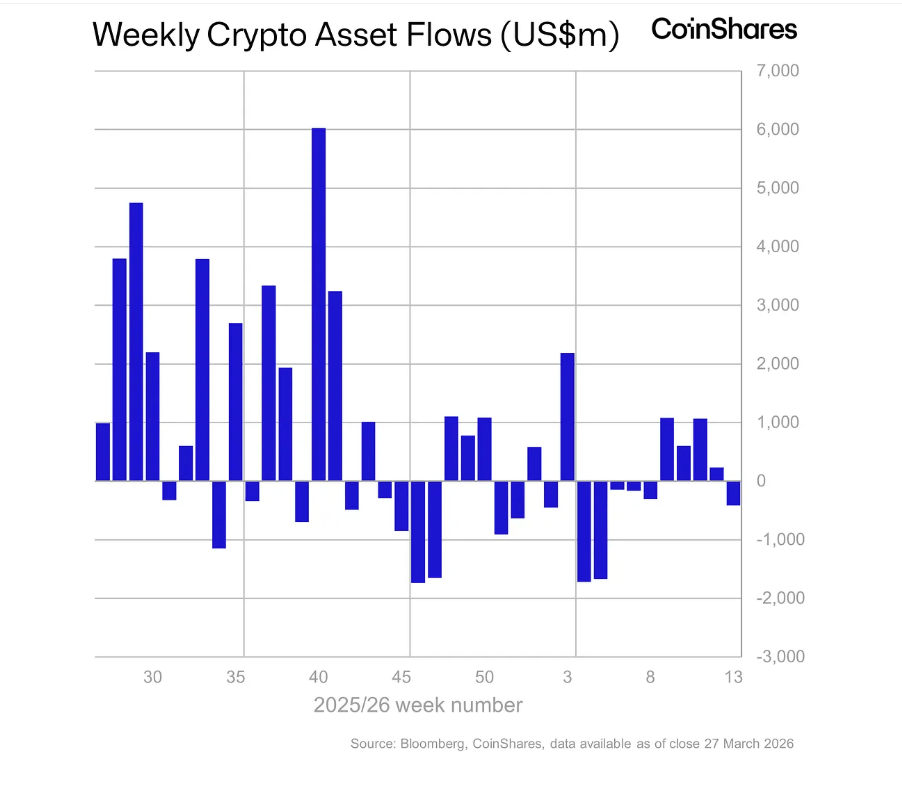
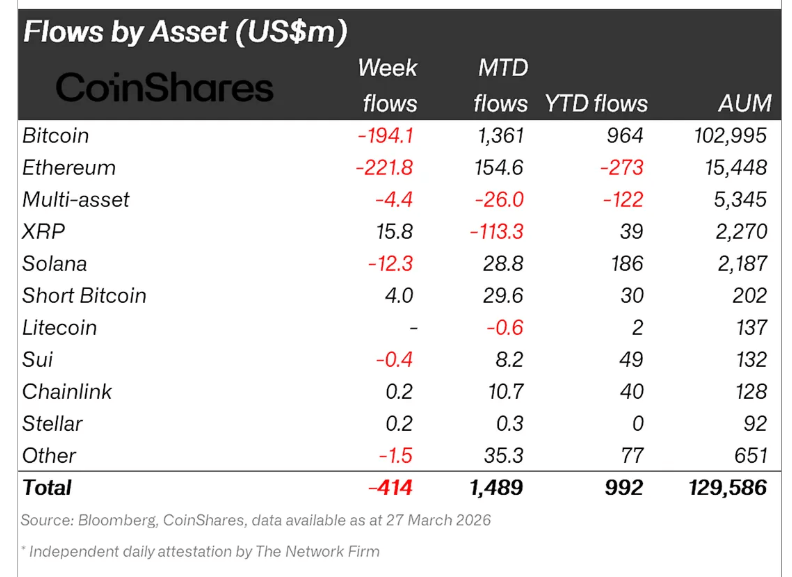
Investors withdrew $414 million from crypto funds last week, ending a five-week inflow streak. Spot Bitcoin ETFs saw $296 million in outflows, reversing earlier gains. Ether suffered the largest outflows at $222 million, pushing its year-to-date performance negative. Bitcoin remained positive for the year despite $194 million in outflows. XRP was an exception, attracting $16 million. The sell-off was driven by inflation concerns, shifting expectations for U.S. interest rate hikes, and rising Middle East tensions, causing a broad shift away from riskier assets. Total assets under management fell to near $130 billion, levels last seen in early February.

Spot Bitcoin ETFs snapped a four-week run of gains last week, posting $296 million in net outflows after pulling in more than $2.2 billion earlier in the month. The crypto reversal was swift — and it wasn’t limited to Bitcoin.

Ether Takes The Hardest Hit

Ether led all assets in outflows, shedding $222 million in a single week. That brought its year-to-date total into the red, with a net loss of $273 million — the worst performance among tracked assets.

Spot Ether ETFs also recorded $206 million in outflows for a second straight week, a sign that institutional demand for the second-largest cryptocurrency has been cooling steadily.

Bitcoin fared better in the long run. Despite $194 million leaving Bitcoin funds last week, the asset remains up $964 million in net inflows for the year.

A small group of investors even moved in the opposite direction — short-Bitcoin products drew $4 million in fresh capital, suggesting some are betting on more losses ahead.

Across the board, total assets under management in digital asset products dropped to close to $130 billion.

According to CoinShares head of research James Butterfill, that figure puts the market back at levels not seen since early February — broadly in line with where things stood in April 2025 during the first wave of US President Donald Trump’s tariffs.

Solana lost a little over $12 million over the same period. XRP was the exception. Reports from CoinShares show the token attracted close to $16 million in new capital, standing apart from the widespread exodus hitting nearly every other major asset.

What Spooked Investors

Three things rattled markets last week: inflation fears, shifting expectations around US interest rates, and rising tensions in the Middle East.

The most consequential of the three may be the rate outlook. Expectations heading into the June Federal Open Market Committee meeting moved away from potential cuts and toward possible hikes — a major shift that historically pushes investors away from riskier assets.

BTCUSD now trading at $67,744. Chart: TradingView

Digital assets tend to feel that pressure quickly. When borrowing costs look like they’re going up, money moves toward safer ground.

A Five-Week Streak Comes To An End

The $414 million in total outflows snapped what had been five consecutive weeks of inflows. Data from CoinShares shows the pullback reflected a broader shift toward risk-off behavior among investors, driven more by macroeconomic forces than anything specific to crypto markets.

Whether last week marks a turning point or a brief pause will likely depend on what signals come out of the Fed in the weeks ahead. For now, the money has moved — at least temporarily — to the sidelines.

Featured image from Getty Images, chart from TradingView

Связанные с этим вопросы

QWhat was the total amount of net outflows from crypto funds last week, ending a five-week streak?

AThe total net outflows from crypto funds last week were $414 million, which ended a five-week streak of inflows.

QWhich cryptocurrency asset suffered the largest outflows and what was the amount?

AEther (ETH) suffered the largest outflows, shedding $222 million in a single week.

QAccording to the article, what were the three main factors that spooked investors and rattled the markets?

AThe three main factors were inflation fears, shifting expectations around US interest rates, and rising tensions in the Middle East.

QWhat was the notable exception to the widespread outflows, and how much capital did it attract?

AXRP was the notable exception; it attracted close to $16 million in new capital.

QWhat does the shift in expectations for the June Federal Open Market Committee meeting indicate, and how does it typically affect investor behavior?

AExpectations shifted away from potential interest rate cuts and toward possible hikes. This shift historically pushes investors away from riskier assets, as higher borrowing costs make safer investments more attractive.

Похожее

Near Returns to the AI Stage: Transformation into a Public Chain Due to 'Payroll Difficulties,' Agent and Privacy Emerge as New Growth Narratives

NEAR Returns to AI Origins: From Payroll Struggles to Blockchain, Now Focusing on AI Agents and Privacy NEAR Protocol's journey began not with grand blockchain ambitions, but from a practical hurdle: its AI startup founders, including Transformer paper co-author Illia Polosukhin, couldn't efficiently pay international developers in 2017. This led them to pivot and build a high-performance, scalable blockchain. After years navigating various crypto narratives like sharding and cross-chain interoperability, NEAR is now leveraging its AI roots to re-enter the AI arena. A key driver is its "NEAR Intents" layer, which abstracts complex cross-chain transactions. Users simply state their goal (e.g., swap BTC for ETH), and a solver network finds the optimal route. This system has processed over $20B in cross-chain volume, generating significant fee revenue. A major growth area is private transactions via "Confidential Intents/Swaps," which hide trade details until settlement to protect against MEV and front-running. Remarkably, private swaps recently accounted for over 40% of NEAR's transaction volume, highlighting strong demand but also potential regulatory scrutiny. With its AI-founder pedigree, NEAR is positioning itself at the intersection of blockchain, AI agents, and privacy, aiming to become infrastructure for the emerging agent economy while navigating the challenges of its rapid adoption.

marsbit1 ч. назад

Near Returns to the AI Stage: Transformation into a Public Chain Due to 'Payroll Difficulties,' Agent and Privacy Emerge as New Growth Narratives

marsbit1 ч. назад

From Ethereum to AI's 'CROPS': What Exactly is This Set of 'Slow Variables' That Vitalik Repeatedly Emphasizes?

In recent discussions, Vitalik Buterin has frequently emphasized the concept of "CROPS," a framework defining core values for Ethereum's development. CROPS stands for Censorship Resistance, Capture Resistance, Open Source, Privacy, and Security. Initially outlined in the Ethereum Foundation's "EF Mandate," it represents a commitment to user sovereignty, ensuring that the network resists external control, remains open, protects privacy, and prioritizes security. The relevance of CROPS extends beyond Ethereum's foundational principles, becoming crucial in the context of AI integration. As AI agents begin handling wallet operations and automated transactions, the risk increases that users may cede control over their digital assets, privacy, and intentions to centralized AI service providers. A "CROPS AI" would therefore emphasize local execution where possible, privacy-preserving remote model calls (e.g., using zero-knowledge proofs), and transparent, verifiable processes to maintain user agency. Vitalik highlights a significant convergence between "CROPS Ethereum access layer" and "CROPS AI." Both address the same fundamental challenge: how users can access powerful services—be it blockchain data via RPCs or AI models—without exposing sensitive information or relinquishing ultimate control. This intersection points toward a future digital entry point that is more private, secure, and user-controlled. Ultimately, CROPS is not merely an abstract ideal but a practical guidepost. It steers development—from protocol resilience and wallet design to AI agent safety—towards a future where users retain self-sovereignty even as digital systems grow more complex and powerful. In an era of accelerating AI adoption, these "slow variables" of censorship resistance, openness, privacy, and security may define Ethereum's enduring value.

marsbit1 ч. назад

From Ethereum to AI's 'CROPS': What Exactly is This Set of 'Slow Variables' That Vitalik Repeatedly Emphasizes?

marsbit1 ч. назад

Silicon Valley 'Startup Guru' Steve Hoffman: Web3 + AI Could Be a Trap

Silicon Valley investor and "Godfather of Startups" Steve Hoffman warns that combining Web3 with AI is likely a trap, not a promising venture. In an interview, Hoffman argues that while AI is a foundational technology touching all industries, Web3 adds complexity, friction, and regulatory risk without solving mainstream consumer or business needs. He advises founders to focus on deep, specialized applications where startups can out-iterate giants, rather than on generic features easily replicated by large tech companies. Hoffman observes that Silicon Valley will lead foundational AI research, while China excels at rapid, large-scale application and commercialization, particularly in robotics. He stresses that AI-driven autonomous agents capable of collaborative, multi-step tasks are 2-4 years away, which will cause significant job displacement. The solution is not to slow AI but to redesign business models around human-AI collaboration and reform social systems like education and retraining. For startups, Hoffman recommends focusing on vertical, expertise-heavy domains to build defensibility. He sees major opportunities in AI fraud detection and cybersecurity. Key founder mindsets include systemic thinking over feature-focus, relentless customer centricity, building adaptive teams, and deeply understanding AI's capabilities and limits. Hoffman is also leading a non-profit initiative to establish university centers aimed at training future leaders in responsible, human-value-aligned AI innovation.

marsbit2 ч. назад

Silicon Valley 'Startup Guru' Steve Hoffman: Web3 + AI Could Be a Trap

marsbit2 ч. назад

Token Inefficient, Economy Tokenless

The article "Tokens Aren't Economical, Economics Aren't Tokenized" analyzes a pivotal shift in the AI industry from a technology-driven narrative to one dominated by capital efficiency. It highlights two concurrent trends: a severe capital shortage due to the exorbitant and recurring costs of compute (e.g., OpenAI's high burn rate) and a wave of corporate spin-offs where major tech companies are separating their AI units (like Kuaishou's Kling and Baidu's Kunlunxin). The core argument is that AI's "anti-internet" business model, where user growth increases costs rather than profits, has created a disconnect between high valuations and actual cash flow. Spin-offs address this by allowing AI assets to be valued independently. Within a parent company, they are seen as cost centers, but as standalone entities, they are priced based on their growth potential and scarcity in the primary market, leading to massive valuation premiums (e.g., Kling's estimated value tripling post-spin-off). The industry is at an inflection point, moving from "model worship" to "value realization." The competition is evolving from a pure compute (GPU) race to a broader focus on systemic efficiency and full-stack engineering (involving CPUs and orchestration) to achieve viable commercialization. The year 2026 is framed as a critical moment where the industry must definitively answer how to economically translate AI capability into tangible business value, reshaping the sector's future power structure.

marsbit2 ч. назад

Token Inefficient, Economy Tokenless

marsbit2 ч. назад

Торговля

Спот
Фьючерсы

Популярные статьи

Как купить WAR

Добро пожаловать на HTX.com! Мы сделали приобретение WAR (WAR) простым и удобным. Следуйте нашему пошаговому руководству и отправляйтесь в свое крипто-путешествие.Шаг 1: Создайте аккаунт на HTXИспользуйте свой адрес электронной почты или номер телефона, чтобы зарегистрироваться и бесплатно создать аккаунт на HTX. Пройдите удобную регистрацию и откройте для себя весь функционал.Создать аккаунтШаг 2: Перейдите в Купить криптовалюту и выберите свой способ оплатыКредитная/Дебетовая Карта: Используйте свою карту Visa или Mastercard для мгновенной покупки WAR (WAR).Баланс: Используйте средства с баланса вашего аккаунта HTX для простой торговли.Третьи Лица: Мы добавили популярные способы оплаты, такие как Google Pay и Apple Pay, для повышения удобства.P2P: Торгуйте напрямую с другими пользователями на HTX.Внебиржевая Торговля (OTC): Мы предлагаем индивидуальные услуги и конкурентоспособные обменные курсы для трейдеров.Шаг 3: Хранение WAR (WAR)После приобретения вами WAR (WAR) храните их в своем аккаунте на HTX. В качестве альтернативы вы можете отправить их куда-либо с помощью перевода в блокчейне или использовать для торговли с другими криптовалютами.Шаг 4: Торговля WAR (WAR)С легкостью торгуйте WAR (WAR) на спотовом рынке HTX. Просто зайдите в свой аккаунт, выберите торговую пару, совершайте сделки и следите за ними в режиме реального времени. Мы предлагаем удобный интерфейс как для начинающих, так и для опытных трейдеров.

373 просмотров всегоОпубликовано 2024.12.11Обновлено 2026.06.02

Как купить WAR

Обсуждения

Добро пожаловать в Сообщество HTX. Здесь вы сможете быть в курсе последних новостей о развитии платформы и получить доступ к профессиональной аналитической информации о рынке. Мнения пользователей о цене на WAR (WAR) представлены ниже.

活动图片