How GameStop’s Bitcoin ‘yield’ strategy could shape corporate BTC adoption

ambcryptoОпубликовано 2026-03-27Обновлено 2026-03-27

Введение

Corporate Bitcoin strategies are evolving from passive holding to active treasury management, with firms increasingly seeking to monetize their BTC holdings. Early adopters accumulated significant amounts as long-term reserves, but as exposure grew, companies began using structured tools to generate returns. GameStop exemplifies this shift, moving from holding 4,710 BTC as an inflation hedge to actively generating yield. The firm transferred most of its BTC to Coinbase Prime as collateral for a covered call program, earning premiums while maintaining economic exposure, despite incurring an accounting loss due to asset pledge. This active approach allows corporations to earn income, reduces liquid supply, and supports price stability. As institutional capital engages Bitcoin more dynamically, it tightens circulating supply and amplifies potential upside when demand increases, fundamentally reshaping BTC's role as a productive treasury asset.

Corporate behavior around Bitcoin [BTC] is shifting, as firms move from passive holding toward active treasury management.

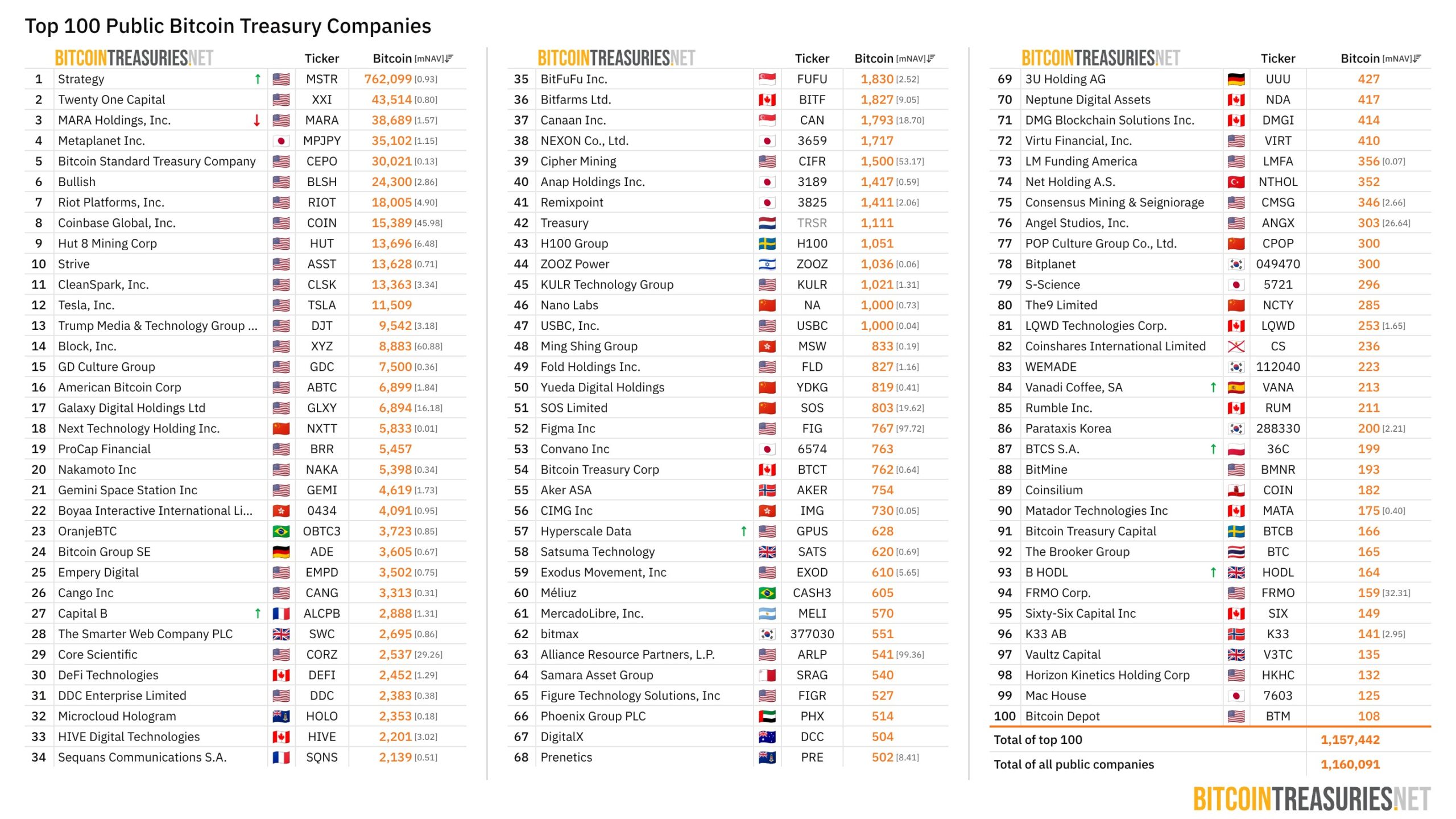
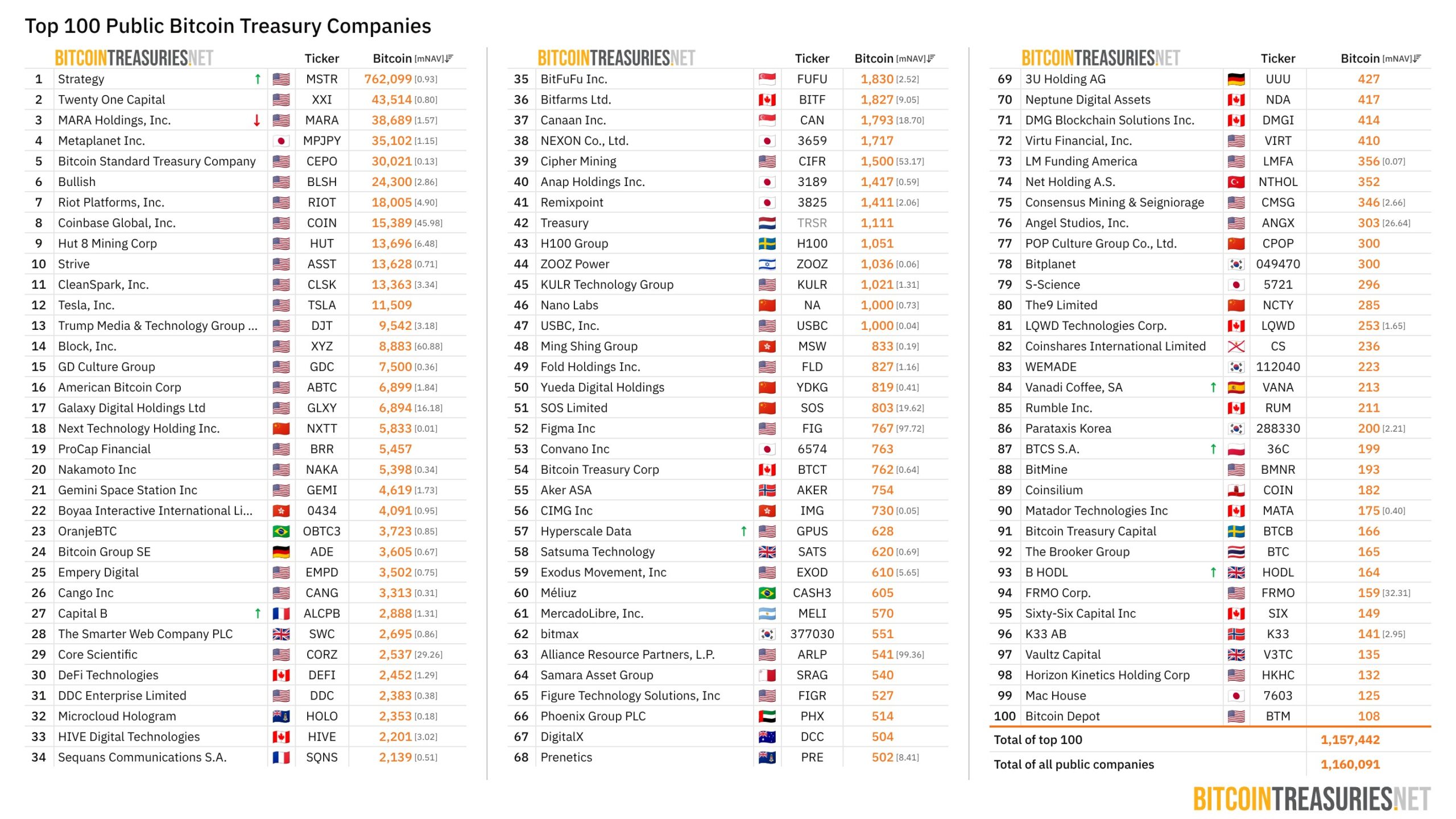
Early players such as Strategy accumulated 762,099 BTC, or 3.63% of supply, and used it as long-term reserve capital. Over time, public company holdings have surpassed 1.13 million BTC, demonstrating increased institutional commitment.

Source: Bitcoin Treasuries

As exposure grows, firms seek to monetize these holdings rather than leave them idle. They introduce structured tools such as ATM equity and yield-bearing preferred shares to generate returns. This shift happens as volatility creates opportunities to extract income while maintaining BTC exposure. Meanwhile, coins move into low-turnover custody, which tightens circulating supply.

This transition strengthens market structure, as institutional capital locks supply while actively engaging it, supporting price stability and amplifying upside when demand expands.

GameStop turns Bitcoin into a yield-generating asset

GameStop reshapes its Bitcoin strategy, moving from passive holding toward active yield generation as market conditions shift. In May 2025, it deployed about $500 million in cash reserves to acquire 4,710 BTC as an inflation hedge.

As the price later stalled within a range, holding alone offered limited returns, which pushed the firm to act. It then transferred 4,709 BTC to Coinbase Prime and pledged it as collateral. This enabled a covered call program with $105,000–$110,000 strikes, allowing GameStop to earn premiums while keeping downside exposure.

However, this structure involved trade-offs because Coinbase gained the right to use the pledged assets, resulting in asset derecognition and a $131.6 million loss. Nevertheless, a $368.3 million receivable protects economic exposure.

This shift signals a broader change, where corporations now use BTC actively, adding income layers while tightening supply and shaping market dynamics.

Bitcoin evolves into a treasury yield tool

Institutional activity around Bitcoin is shifting as firms move from passive holding toward active yield generation. GameStop’s pledge of 4,709 BTC reflects this shift, as corporations seek returns that go beyond price increases. This shift occurs as BTC trades in extended ranges, with idle holdings adding little value.

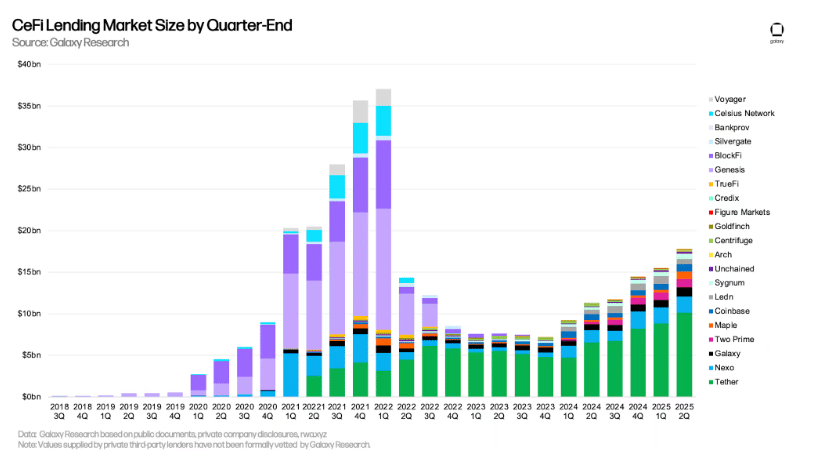
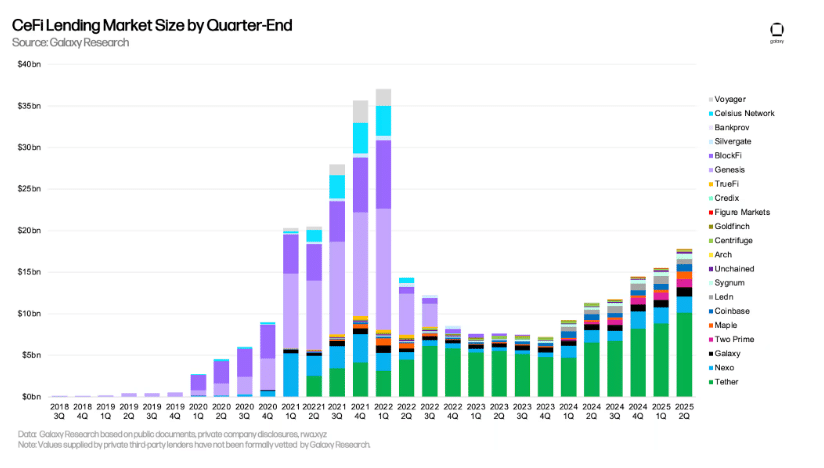
At the same time, capital flows into structured markets expand, with CeFi lending reaching about $25 billion.

Source: Galaxy Research

As this behavior spreads, BTC evolves into a productive asset, where active strategies tighten supply and amplify price moves once demand strengthens.


Final Summary

  • Bitcoin is shifting into an active treasury asset, as yield strategies tighten supply and support price stability during consolidation.
  • BTC yield adoption reduces liquid supply and boosts sensitivity to demand, strengthening the setup for sharper upside moves.

Связанные с этим вопросы

QWhat is the main shift in corporate behavior around Bitcoin as described in the article?

ACorporate behavior is shifting from passive holding of Bitcoin toward active treasury management and yield generation strategies.

QHow did GameStop change its Bitcoin strategy to generate yield?

AGameStop transferred 4,709 BTC to Coinbase Prime as collateral to enable a covered call program with strikes between $105,000 and $110,000, allowing it to earn premiums while maintaining downside exposure.

QWhat was the financial impact of GameStop's collateralization of its Bitcoin holdings?

AThe collateralization resulted in asset derecognition and a $131.6 million loss, but GameStop is protected by a $368.3 million receivable that maintains its economic exposure.

QHow does the adoption of active Bitcoin yield strategies affect the market structure?

AActive yield strategies tighten the circulating supply of Bitcoin, support price stability during consolidation, and amplify upside price movements when demand increases.

QWhat is the estimated size of the CeFi lending market mentioned in the article?

AThe CeFi lending market has reached about $25 billion, reflecting growing institutional capital flows into structured Bitcoin markets.

Похожее

The Right Way to Use Skills: 5 Reflections After Anthropic Publicly Shared Its Internal Methodology

A deep dive into Anthropic's internal methodology for building effective AI "Skills" reveals five key insights for maximizing their value. First, Skills should focus on capturing "Gotchas" and tacit organizational knowledge—like common pitfalls and undocumented rules—rather than restating general information the AI already knows. Second, think of Skills as a form of "Context Engineering"; they are best structured as folders, not monolithic documents. A core `SKILL.md` file should act as a navigational index, progressively pulling in detailed references, examples, and assets only as needed to avoid overwhelming the model's context window. Third, whenever possible, automate repetitive tasks with scripts. This preserves the model's reasoning capacity for judgment and analysis, while scripts reliably handle the execution, saving tokens and improving accuracy. Instructions within a Skill provide the "why" and the expert judgment, while scripts provide the concrete "how." Fourth, a Skill's description is critical and often misunderstood. It should not be a list of features but a routing rule that clearly signals *when* the Skill should be triggered based on user intent and common phrasing. Finally, as Skills scale from personal tools to team-wide assets, management is crucial. Anthropic advocates for a lightweight, organic approach: let new Skills spread organically within small groups first. Those that prove genuinely useful through adoption naturally graduate to a formal marketplace, ensuring the curated library contains only high-value, battle-tested tools.

marsbit2 мин. назад

The Right Way to Use Skills: 5 Reflections After Anthropic Publicly Shared Its Internal Methodology

marsbit2 мин. назад

Vying for the AI Payment Track: Traditional Card Networks Face Off Against Coinbase

As AI agents increasingly conduct commercial transactions, a battle for control over the underlying payment infrastructure is unfolding. The competition centers on two divergent and incompatible technical approaches for autonomous AI payments. One camp, led by traditional card networks Visa and Mastercard, relies on tokenized card credentials within the established banking rails. Visa's "Intelligent Commerce" and Mastercard's "Agent Pay" services extend their existing tokenization technology to authorized AI agents for consumer retail transactions, leveraging decades of fraud protection and dispute resolution systems. Their partners include major AI firms like Anthropic, OpenAI, and Microsoft. The opposing camp, spearheaded by Coinbase, advocates for an open internet protocol using stablecoins. Coinbase's x402 protocol utilizes the HTTP 402 status code to enable direct, machine-to-machine micropayments with USDC on-chain. This model eliminates card fees and is designed for high-frequency, low-value transactions between AI agents, such as paying for API calls or data streams, where traditional card costs are prohibitive. Currently, application scenarios are clearly divided. Mainstream consumer-facing AI shopping services (e.g., ChatGPT's "one-click checkout," Amazon's AI-assisted shopping) predominantly use card channels due to their mature consumer protections and merchant networks. Conversely, the stablecoin channel dominates machine-to-machine payments, as seen in Amazon Bedrock's core payment service using Base blockchain. Significantly, traditional card networks are not solely defending their turf; they are also investing in the stablecoin arena. Visa has rapidly expanded its stablecoin settlement volume and partnered with Coinbase on interoperability, while Mastercard moved to acquire stablecoin platform BVNK. This dual-strategy indicates their intent to become the fee-collecting gateway for all payment flows, regardless of the underlying rail. The short-term outlook is for coexistence: cards for personal retail, stablecoins for machine transactions. The long-term outcome hinges on whether AI-driven commerce will resemble traditional retail or evolve into a vast network of machine micropayments. Visa and Mastercard's hedging strategy suggests they are prepared for either future, while companies betting on a single channel face greater risk.

Foresight News4 мин. назад

Vying for the AI Payment Track: Traditional Card Networks Face Off Against Coinbase

Foresight News4 мин. назад

For the First Time, Pure Human Video Pretrained VLA for Dexterous Manipulation: Deployable with Minimal Fine-Tuning Data

For the first time, a purely human-video-pretrained Vision-Language-Action (VLA) model for dexterous manipulation requires only a small amount of data for fine-tuning to achieve successful real-world deployment. Achieving human-level dexterous manipulation remains a core challenge in robotics. While multi-fingered hands offer hardware potential, Visual-Language-Action (VLA) models lag behind due to the high cost of collecting diverse, high-quality robot data. A novel framework, VITRA, developed by Microsoft Research Asia and Tsinghua University, addresses this by automatically transforming massive, unlabeled real-world human activity videos into a structured V-L-A training dataset. Key innovations include precise 3D hand motion annotation from monocular video, atomic action segmentation based on hand-speed minima, and automated instruction generation using VLMs combined with 3D trajectory visualization. This process created a massive dataset of 1 million clips. Pretrained exclusively on this human video data, the VLA model (combining a VLM backbone with a Diffusion Transformer action expert) demonstrates strong zero-shot hand motion prediction in unseen environments. Crucially, it requires minimal fine-tuning (~1.2k demonstrations) on real robot data to achieve high-success-rate dexterous manipulation tasks like grasping, placing, pouring, and sweeping on hardware like the Realman robot with the XHAND1 dexterous hand. The model shows exceptional generalization to novel objects and environments. The research also observes promising scaling behavior, where performance improves with more pretraining data, paving the way for more generalized embodied intelligence.

marsbit14 мин. назад

For the First Time, Pure Human Video Pretrained VLA for Dexterous Manipulation: Deployable with Minimal Fine-Tuning Data

marsbit14 мин. назад

Торговля

Спот
Фьючерсы

Популярные статьи

Как купить S

Добро пожаловать на HTX.com! Мы сделали приобретение Sonic (S) простым и удобным. Следуйте нашему пошаговому руководству и отправляйтесь в свое крипто-путешествие.Шаг 1: Создайте аккаунт на HTXИспользуйте свой адрес электронной почты или номер телефона, чтобы зарегистрироваться и бесплатно создать аккаунт на HTX. Пройдите удобную регистрацию и откройте для себя весь функционал.Создать аккаунтШаг 2: Перейдите в Купить криптовалюту и выберите свой способ оплатыКредитная/Дебетовая Карта: Используйте свою карту Visa или Mastercard для мгновенной покупки Sonic (S).Баланс: Используйте средства с баланса вашего аккаунта HTX для простой торговли.Третьи Лица: Мы добавили популярные способы оплаты, такие как Google Pay и Apple Pay, для повышения удобства.P2P: Торгуйте напрямую с другими пользователями на HTX.Внебиржевая Торговля (OTC): Мы предлагаем индивидуальные услуги и конкурентоспособные обменные курсы для трейдеров.Шаг 3: Хранение Sonic (S)После приобретения вами Sonic (S) храните их в своем аккаунте на HTX. В качестве альтернативы вы можете отправить их куда-либо с помощью перевода в блокчейне или использовать для торговли с другими криптовалютами.Шаг 4: Торговля Sonic (S)С легкостью торгуйте Sonic (S) на спотовом рынке HTX. Просто зайдите в свой аккаунт, выберите торговую пару, совершайте сделки и следите за ними в режиме реального времени. Мы предлагаем удобный интерфейс как для начинающих, так и для опытных трейдеров.

1.4k просмотров всегоОпубликовано 2025.01.15Обновлено 2026.06.02

Как купить S

Sonic: Обновления под руководством Андре Кронье – новая звезда Layer-1 на фоне спада рынка

Он решает проблемы масштабируемости, совместимости между блокчейнами и стимулов для разработчиков с помощью технологических инноваций.

2.3k просмотров всегоОпубликовано 2025.04.09Обновлено 2025.04.09

Sonic: Обновления под руководством Андре Кронье – новая звезда Layer-1 на фоне спада рынка

HTX Learn: Пройдите обучение по "Sonic" и разделите 1000 USDT

HTX Learn — ваш проводник в мир перспективных проектов, и мы запускаем специальное мероприятие "Учитесь и Зарабатывайте", посвящённое этим проектам. Наше новое направление .

1.8k просмотров всегоОпубликовано 2025.04.10Обновлено 2025.04.10

HTX Learn: Пройдите обучение по "Sonic" и разделите 1000 USDT

Обсуждения

Добро пожаловать в Сообщество HTX. Здесь вы сможете быть в курсе последних новостей о развитии платформы и получить доступ к профессиональной аналитической информации о рынке. Мнения пользователей о цене на S (S) представлены ниже.

活动图片