Hoskinson Warns Cardano Could Lose Its ‘Science Coin’ Edge

bitcoinistОпубликовано 2026-05-21Обновлено 2026-05-21

Введение

Charles Hoskinson warns that Cardano risks losing its identity as the "science coin" if DReps fail to approve a key research funding proposal. He explains the ecosystem is in "treasury season" with a tougher funding environment, requesting $52 million this year versus $98 million last year, leading to cuts and layoffs. Hoskinson argues Cardano's research program is its "spine and backbone," responsible for its differentiation through work on proof-of-stake, extended UTXO, Plutus, and academic collaborations. He rejects calls to selectively fund parts of the research group, warning that treating researchers as commodities could lead to an irreplaceable talent drain to better-funded rivals. Hoskinson ties research funding to Cardano's long-term investment case, stating that without it, the project would lose a core value proposition. He ends with a direct appeal to DReps to vote for the proposal, calling it a necessary foundation for Cardano's future.

Charles Hoskinson has urged Cardano DReps to back a research funding proposal, warning that a failure to do so could damage one of the network’s core value propositions: its identity as a research-led blockchain.

Speaking in a May 21 livestream from England, Hoskinson said Cardano is in “treasury season” and facing a tougher funding environment than last year. According to him, the ecosystem is asking for about $52 million in funding this year, down from roughly $98 million last year, after cuts that have already affected engineers and community teams.

“Many people have had to make profound sacrifices,” Hoskinson said. “Good people have had to go. Engineers have been let go. Community teams liquidating familiar faces and new faces alike.”

But the proposal that drew his strongest concern was research. Hoskinson said he had seen a “disturbing trend” of some DReps voting against funding Cardano’s research group, despite what he described as its foundational role in the network’s development.

Hoskinson Defends Cardano’s Research Core

Hoskinson framed the debate as larger than a budget dispute. In his view, Cardano’s long-running research program is the “spine and backbone” of the ecosystem and a key reason the project has differentiated itself from other major blockchains.

“The spine and backbone of what makes Cardano Cardano has always been and will always be the fact that we’re the science coin,” he said. “We’re the research coin. Over the last 10 years, hundreds of millions of dollars has been spent, and countless hundreds of researchers have been involved in the production of the largest research group in the world for cryptocurrencies.”

He pointed to Cardano’s work on proof-of-stake research, extended UTXO, Plutus, sidechains and Bitcoin-related DeFi research as examples of the group’s output. He also argued that the network’s academic ties, spanning institutions such as Stanford, the University of Edinburgh, the University of Wyoming and others, are not easily replaceable.

Hoskinson said critics of the proposal have argued that research funding should be broken apart, allowing the ecosystem to “pick and choose” which areas or people to keep. He rejected that framing, saying it would force the ecosystem into decisions it is not equipped to make without damaging the research operation as a whole.

“So then I asked the DReps, which scientists would you like me to fire?” he said, before naming several researchers associated with Cardano’s technical development. “And if not people, perhaps institutions. Which institutions would you like to shut down? And because you’re so qualified, which research agendas do you so feel are unnecessary?”

Warning Over Talent Flight

A major part of Hoskinson’s argument was that Cardano’s researchers could be recruited by better-funded rival ecosystems if the project signals that their work is no longer valued. He said other blockchains with large treasuries would likely be interested in the same cryptographers, programming language experts and distributed systems researchers.

“If you treat these people like commodities, they will leave,” Hoskinson said. “They’ll leave to other ecosystems that have a lot more money and are willing to pay a lot more with better stability and certainty.”

He warned that the loss would not be easily reversible. Academic and technical talent, he argued, depends on long-term stability, and once researchers move on to other ecosystems, Cardano may not be able to bring them back. “We can’t recover this. It’s a one-way door. If you lose your best and brightest, we won’t get them back. We don’t get to say we’re sorry.”

Hoskinson also tied the issue to market perception. He asked what Cardano’s investment case would look like over the next three to five years if the ecosystem signaled it was no longer willing to support research. Without that layer, he suggested, Cardano would have to lean more heavily on metrics such as monthly active users, TVL or transaction volume.

The livestream ended as a direct appeal to DReps who have not yet voted and to those who have voted against the proposal. Hoskinson asked them to reconsider, saying research funding is not a discretionary line item but part of Cardano’s long-term competitive position.

“You can’t walk without a spine,” he said. “Please vote for science. Please vote for the research proposal for IOG. It’s a necessary foundational proposal, and we can’t afford to lose it.”

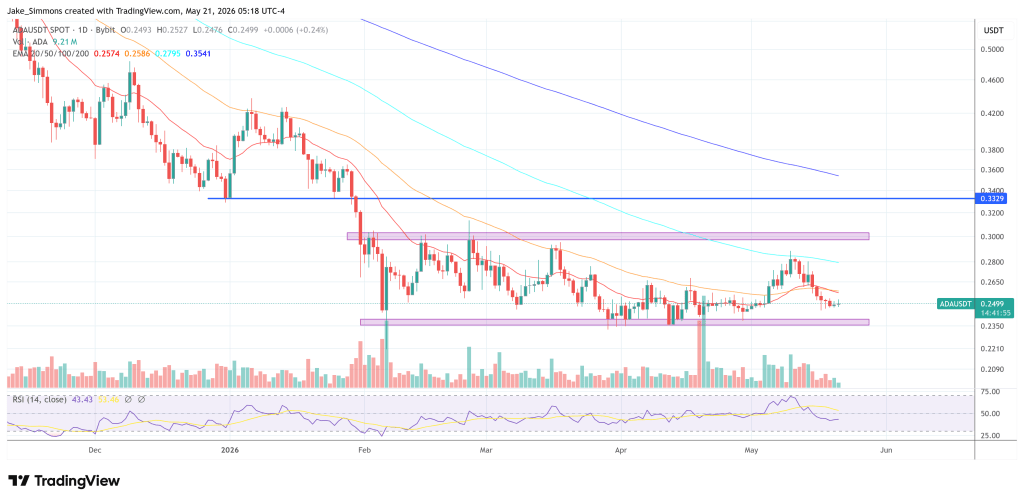
At press time, ADA traded at $0.2499.

ADA remains in sideways trend, 1-day chart | Source: ADAUSDT on TradingView.com

Связанные с этим вопросы

QAccording to Hoskinson, what is the core identity of Cardano that is at risk?

AAccording to Hoskinson, Cardano's core identity at risk is being the 'science coin' or the research-led blockchain, which he describes as the 'spine and backbone' of the ecosystem.

QWhat is the potential consequence if Cardano's DReps vote against the research funding proposal, as warned by Hoskinson?

AHoskinson warns that voting against the research funding could lead to a talent flight, where Cardano's researchers would leave for better-funded rival ecosystems. This loss would be irreversible and would damage Cardano's long-term competitive position and investment case.

QHow much funding is the Cardano ecosystem asking for this year, and how does it compare to last year?

AThe Cardano ecosystem is asking for about $52 million in funding this year, which is down from roughly $98 million last year.

QWhat examples does Hoskinson give to demonstrate the output of Cardano's research group?

AHoskinson points to Cardano's work on proof-of-stake research, extended UTXO, Plutus, sidechains, and Bitcoin-related DeFi research as examples of the research group's output.

QWhat does Hoskinson say critics of the research funding proposal have argued, and how does he respond?

AHoskinson says critics argue that research funding should be broken apart, allowing the ecosystem to 'pick and choose' which areas or people to fund. He rejects this, stating it would force the ecosystem into decisions it is not equipped to make and would damage the research operation as a whole, challenging critics to name which specific scientists or institutions they would cut.

Похожее

Who Funds the Agents?

**Summary: Who Funds AI Agents?** OpenAI recently shut down a feature allowing AI agents to shop for users, highlighting the challenge of creating a secure and regulated environment for agent-driven transactions. While payment infrastructure exists, a crucial governance layer—defining spending limits, fraud detection, tax handling, and return policies—is largely missing. The potential is enormous: AI agents already processed $73M across 176M transactions last year, with McKinsey forecasting this could grow to $3-5T in global consumer commerce by 2030. The core competition isn't just about processing payments, which can be very cheap (especially with crypto-based settlement), but about controlling the rules that govern agent spending. Key players like Stripe and Coinbase are racing to dominate this governance layer. Stripe's acquisition of wallet provider Privy allows it to set spending policies, identity checks, and human-in-the-loop approvals directly at the wallet level. Similarly, Coinbase's stack, including its x402 protocol and AgentKit, embeds governance rules. This vertical integration across settlement, wallet, and governance layers is becoming the dominant strategy. Control over the governance layer is where significant future value lies. If agents handle trillions in transactions, even a small fee for managing compliance, fraud prevention, and policy enforcement could generate billions in annual revenue. The companies that successfully integrate across the payment stack will capture value from idle agent balances, transaction fees, and governance services, positioning themselves as the foundational banks of the AI agent economy.

marsbit27 мин. назад

Who Funds the Agents?

marsbit27 мин. назад

A Nation Blocks Chips, a Giant Buys a Nuclear Power Plant: Why It's Time to Seriously Consider DeAI

**Title: Great Powers Blockade Chips, Giants Buy Nuclear Plants: Why It's Time to Seriously Consider DeAI** In May 2026, the US closed loopholes for Chinese firms to acquire advanced NVIDIA chips via overseas subsidiaries. That same month, Kenya halted a $1B geothermal data center project involving Microsoft, fearing its immense energy consumption. Meanwhile, Huawei announced mass production of its Ascend AI chip. These disparate events underscore a new reality: the competition for computing power ("compute") has escalated beyond the tech industry, becoming a geopolitical and infrastructural battleground. A new era of oligopoly is forming, with control over the AI stack—from GPU chips (NVIDIA) and cloud platforms (AWS, Azure, Google Cloud) to foundational models (OpenAI, Anthropic)—concentrating in a few Western "AI Octopus" corporations. This centralization creates systemic risks: pricing power and platform lock-in for users, infrastructure fragility, and a widening "compute divide" that threatens to marginalize nations without independent AI capacity. An "AI Iron Curtain" is deepening through export controls. In response, some nations like Saudi Arabia and the UAE are investing heavily to buy compute power, aiming to transition from oil to AI economies. The EU seeks to triple its compute capacity by 2030 to reduce dependency. However, the spending gap is vast, with four US tech giants alone planning ~$750B in AI capex for 2026. The race is increasingly constrained by energy, with AI tasks consuming up to 1000x more power than web searches, pushing firms to even acquire nuclear plants. This landscape is fueling interest in Decentralized AI (DeAI). It proposes a third way: using open protocols to coordinate a global network of idle GPUs, independent developers, and data centers, creating an AI infrastructure without a single controlling entity. Leveraging blockchain and cryptographic verification, DeAI aims to break market concentration, disperse energy demands, reduce geopolitical dependencies, and enhance transparency. While still nascent in performance and stability, DeAI's core promise is not immediate superiority but providing a crucial alternative architecture to resist monopoly, censorship, and centralized power. As specialized AI hardware costs fall and open-source models flourish, the window to build this foundation is open. The very existence of such competition serves as a vital check against the inevitable abuse of concentrated power.

marsbit1 ч. назад

A Nation Blocks Chips, a Giant Buys a Nuclear Power Plant: Why It's Time to Seriously Consider DeAI

marsbit1 ч. назад

Торговля

Спот
Фьючерсы

Популярные статьи

Как купить EDGE

Добро пожаловать на HTX.com! Мы сделали приобретение edgeX (EDGE) простым и удобным. Следуйте нашему пошаговому руководству и отправляйтесь в свое крипто-путешествие.Шаг 1: Создайте аккаунт на HTXИспользуйте свой адрес электронной почты или номер телефона, чтобы зарегистрироваться и бесплатно создать аккаунт на HTX. Пройдите удобную регистрацию и откройте для себя весь функционал.Создать аккаунтШаг 2: Перейдите в Купить криптовалюту и выберите свой способ оплатыКредитная/Дебетовая Карта: Используйте свою карту Visa или Mastercard для мгновенной покупки edgeX (EDGE).Баланс: Используйте средства с баланса вашего аккаунта HTX для простой торговли.Третьи Лица: Мы добавили популярные способы оплаты, такие как Google Pay и Apple Pay, для повышения удобства.P2P: Торгуйте напрямую с другими пользователями на HTX.Внебиржевая Торговля (OTC): Мы предлагаем индивидуальные услуги и конкурентоспособные обменные курсы для трейдеров.Шаг 3: Хранение edgeX (EDGE)После приобретения вами edgeX (EDGE) храните их в своем аккаунте на HTX. В качестве альтернативы вы можете отправить их куда-либо с помощью перевода в блокчейне или использовать для торговли с другими криптовалютами.Шаг 4: Торговля edgeX (EDGE)С легкостью торгуйте edgeX (EDGE) на спотовом рынке HTX. Просто зайдите в свой аккаунт, выберите торговую пару, совершайте сделки и следите за ними в режиме реального времени. Мы предлагаем удобный интерфейс как для начинающих, так и для опытных трейдеров.

573 просмотров всегоОпубликовано 2026.03.31Обновлено 2026.06.02

Как купить EDGE

Обсуждения

Добро пожаловать в Сообщество HTX. Здесь вы сможете быть в курсе последних новостей о развитии платформы и получить доступ к профессиональной аналитической информации о рынке. Мнения пользователей о цене на EDGE (EDGE) представлены ниже.

活动图片