Heat Rises for TermMax and Renaiss: How to Engage with These Two Projects Incubated by YZi Labs?

Odaily星球日报Опубликовано 2026-05-28Обновлено 2026-05-28

Введение

The article introduces TermMax and Renaiss, two projects recently gaining attention from the YZi Labs EASY Residency program incubator. It explains how users can potentially participate in them. TermMax is a DeFi protocol offering fixed-rate, fixed-term lending, functioning as a "lending AMM" to provide predictable interest rates. It has launched its V2 version, which improves capital efficiency and liquidity. Users can engage through its "Season 0" event on its V2 platform by connecting a wallet, daily check-ins, and completing tasks (deposit, trading, social) to earn points. Renaiss is a RWA infrastructure project focused on "collectible finance," specifically tokenizing real-world collectible trading cards (like Pokémon) onto the blockchain to enhance their liquidity and enable financial applications. Users can participate by visiting its official website, funding their account, and purchasing card packs (e.g., the OMEGA pack) with varying rarity tiers for a chance to obtain different card grades. Both projects represent specialized approaches within DeFi and RWA, aiming to offer users new avenues for fixed-income lending and investing in tokenized physical collectibles.

Original | Odaily Planet Daily (@OdailyChina)

Author | Asher (@Asher_ 0210)

Earlier this month, YZi Labs announced the 25 graduating projects from the third season of its flagship incubation program EASY Residency (For more details, read: EASY Residency Season 3 Graduation List Released, Which Sectors Has YZi Lab Focused On?). This round focused on directions such as restructuring on-chain financial markets, AI agents, tokenizing real-world assets, prediction markets, and privacy compliance.

Most projects are still in very early stages, with limited public information and relatively sparse community discussion. However, Odaily Planet Daily has observed that two projects in particular have seen a noticeable increase in heat recently: TermMax, which focuses on fixed-rate lending, and Renaiss, which revolves around the financialization of real-world collectible card assets.

Below, Odaily Planet Daily will examine TermMax and Renaiss from the perspectives of project positioning, product mechanisms, and potential engagement opportunities.

TermMax: A New DeFi Solution for Fixed-Rate Lending

Project Introduction

TermMax is a DeFi protocol focused on fixed-rate, fixed-term lending, which can be understood as a "Lending AMM." Compared to floating-rate lending protocols like Aave and Compound, TermMax emphasizes interest rate predictability—borrowers can lock in financing costs before opening a position, and lenders can also determine their yield at maturity in advance.

In terms of product mechanism, TermMax draws inspiration from the AMM concept of Uniswap V3 and tokenizes leverage and fixed-income exposure through Gearing Token and Fixed-rate Token. Users can complete fixed-rate lending, one-click Looping, Range Orders, and custom pricing curves within the platform. Operations such as lending, leveraging, and interest rate trading, which previously required repeated actions across multiple protocols, are now integrated into a single market.

Key Developments

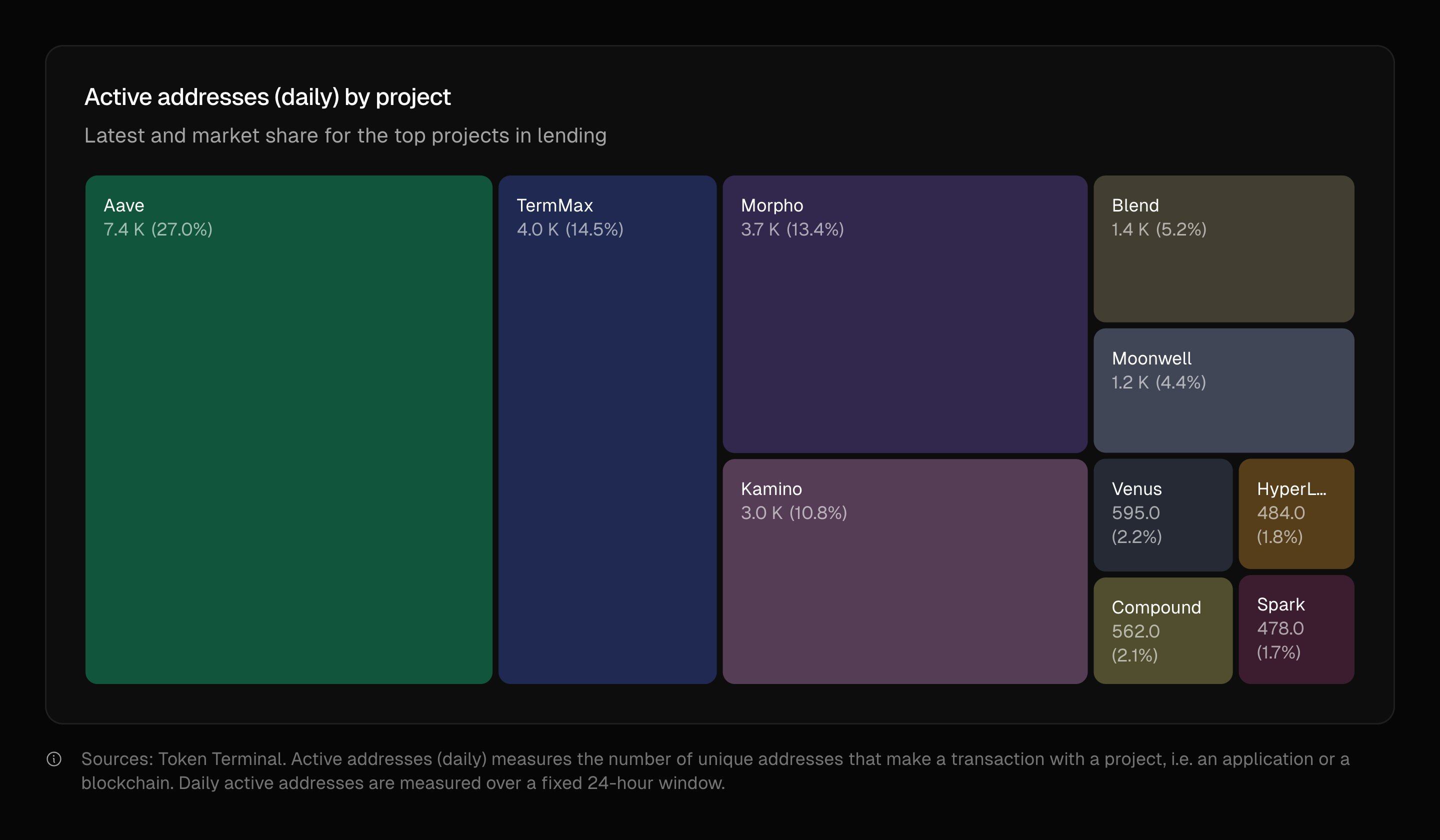
Since its mainnet launch in April 2025, TermMax's TVL recently surpassed $71 million. The project currently supports multiple networks including Ethereum, Arbitrum, BNB Chain, and is expanding to ecosystems like X Layer and Base. Previously, on March 25, 2026, TermMax ranked second on Token Terminal's daily active address leaderboard for DeFi lending protocols, second only to Aave.

Daily Active Address Leaderboard for DeFi Lending Protocols (March 25, 2026)

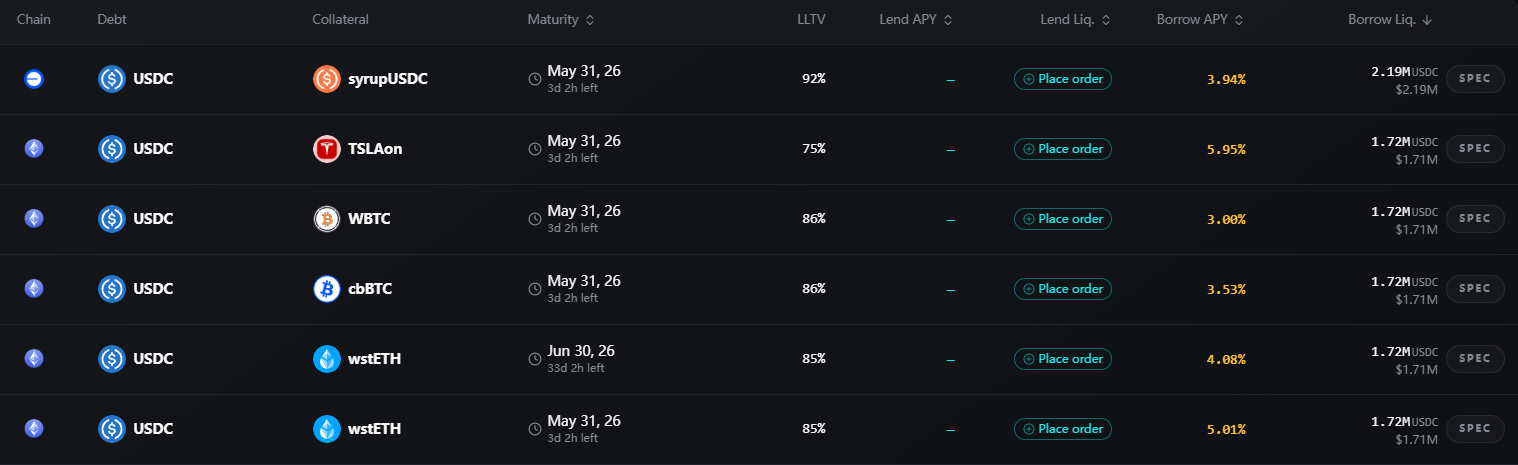
Furthermore, TermMax is integrating fixed-rate lending with RWA scenarios. In January 2026, TermMax launched a fixed-rate market on BNB Chain supporting Ondo tokenized stocks as collateral, allowing users to access funds without selling their tokenized stock assets. Additionally, TermMax launched a single-asset USD₮0 lending product on X Layer with a fixed APY of up to about 5.07%, and collaborated with Morpho to introduce one-click Rollover, enhancing the flexibility of fixed-term debt.

Last night, TermMax announced on platform X the launch of its V2 version. Compared to V1, the V2 version primarily restructures to address issues like liquidity fragmentation, low idle fund utilization, and insufficient order matching efficiency.

TermMax V2 Version Now Live

Specifically, V2 introduces Composable Base Yield, allowing Vaults to connect to ERC-4626 yield sources like Aave and Morpho, enabling idle funds that are not yet matched to generate base yield; Atomic Order allows the same liquidity to be listed in multiple markets simultaneously but can only be consumed once, thereby improving liquidity utilization; Order Aggregator automatically scans different order types to match users with better interest rate paths.

Additionally, V2 incorporates Smart Unwind and Alpha Zone. The former enhances the exit and fund recycling efficiency of debt positions, while the latter supports the more flexible creation of new markets. Overall, the focus of TermMax V2 is not on adding more complex features, but on making the fixed-rate lending market deeper in liquidity, more efficient in capital use, and simpler for users to operate.

Engagement Opportunities

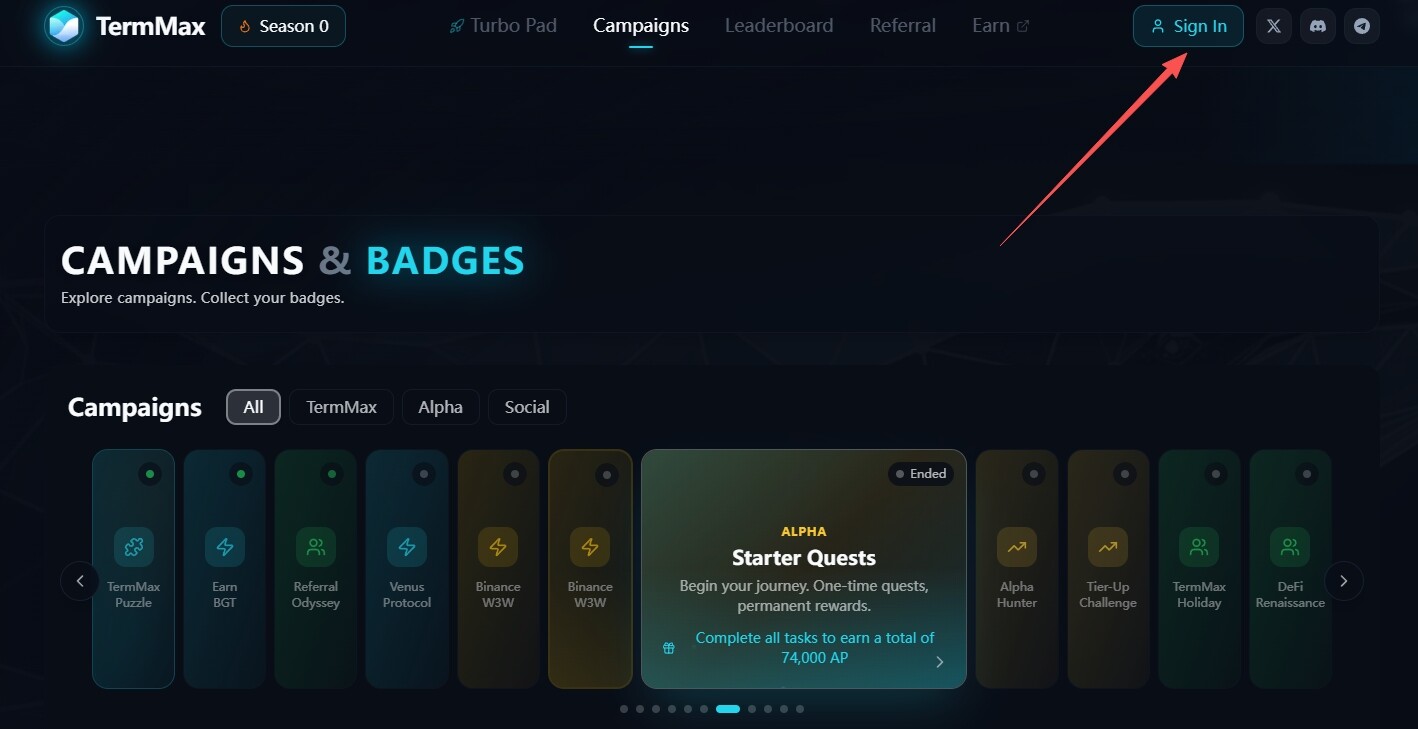
STEP 1. After entering the V2 version, click "Leaderboard" at the top to jump to the TermMax Season 0 event interface.

STEP 2. Click "Sign In" and connect your Web3 wallet to complete personal account login.

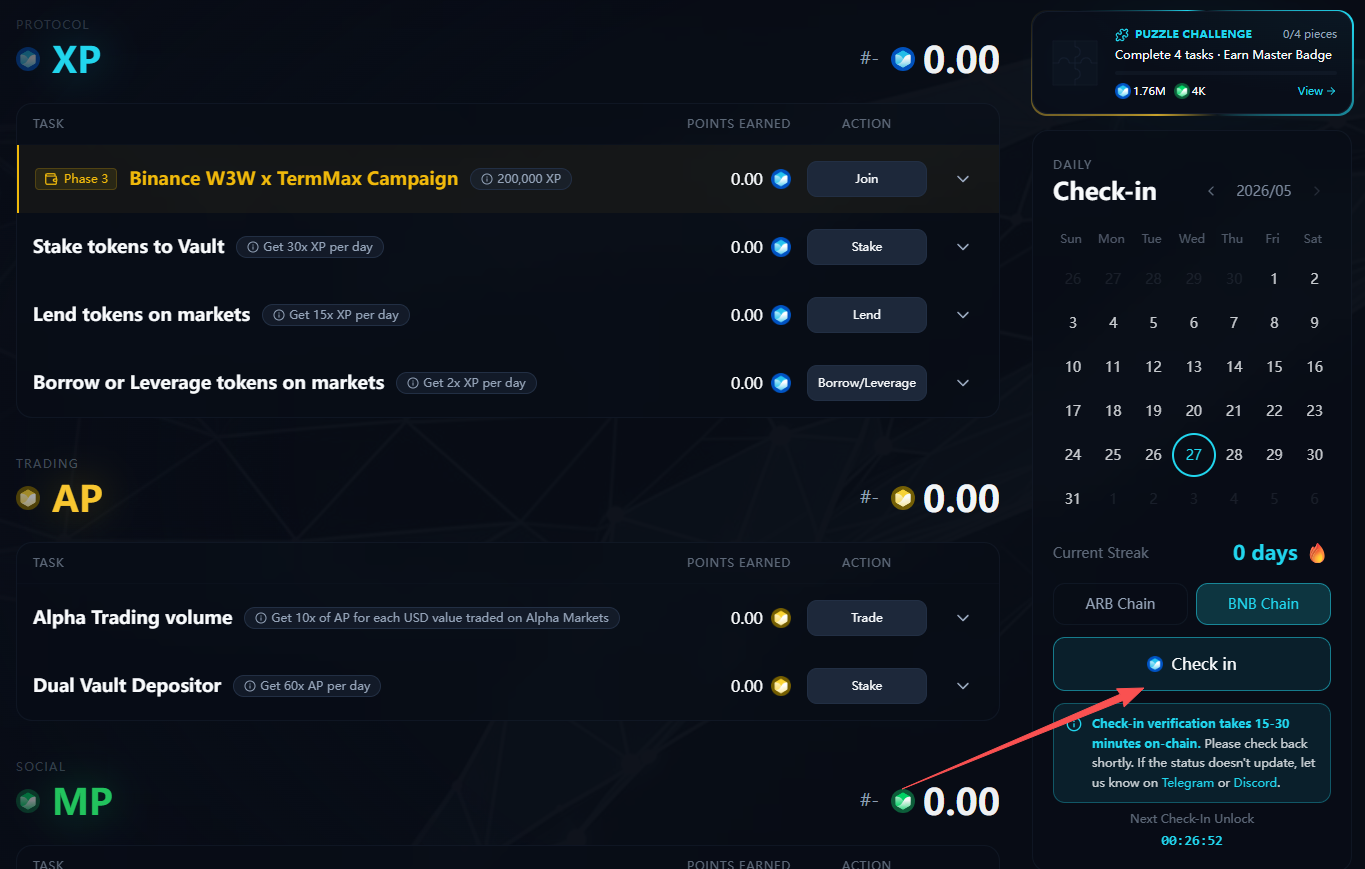
STEP 3. Complete daily check-ins (resets daily at 8 AM) to earn points.

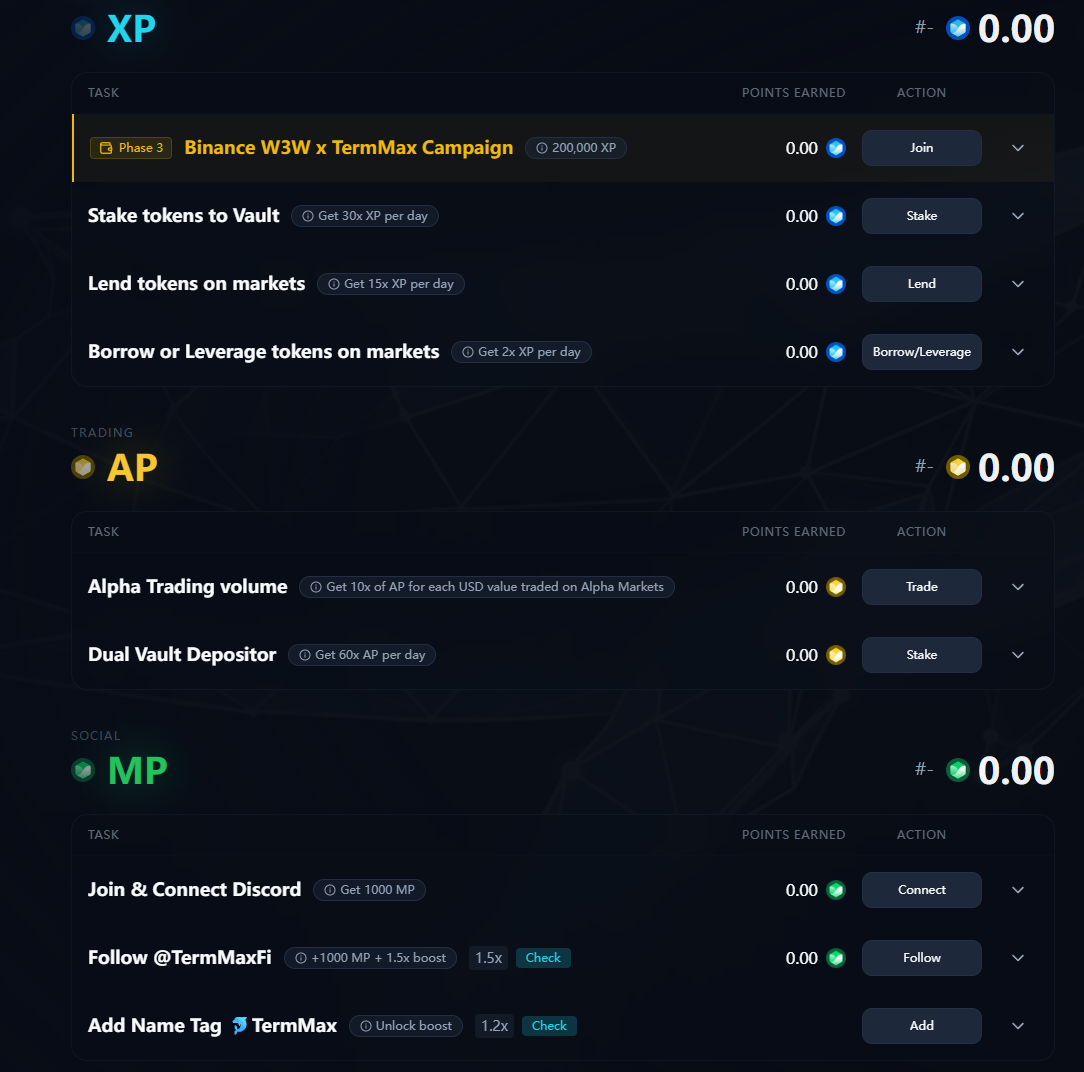
STEP 4. Points are divided into XP tasks (deposit-related), AP tasks (trade-related), and MP tasks (social-related). Complete the corresponding tasks according to the specified requirements to earn the respective point rewards.

Renaiss: Providing On-Chain Liquidity for Real-World Collectible Cards

Project Introduction

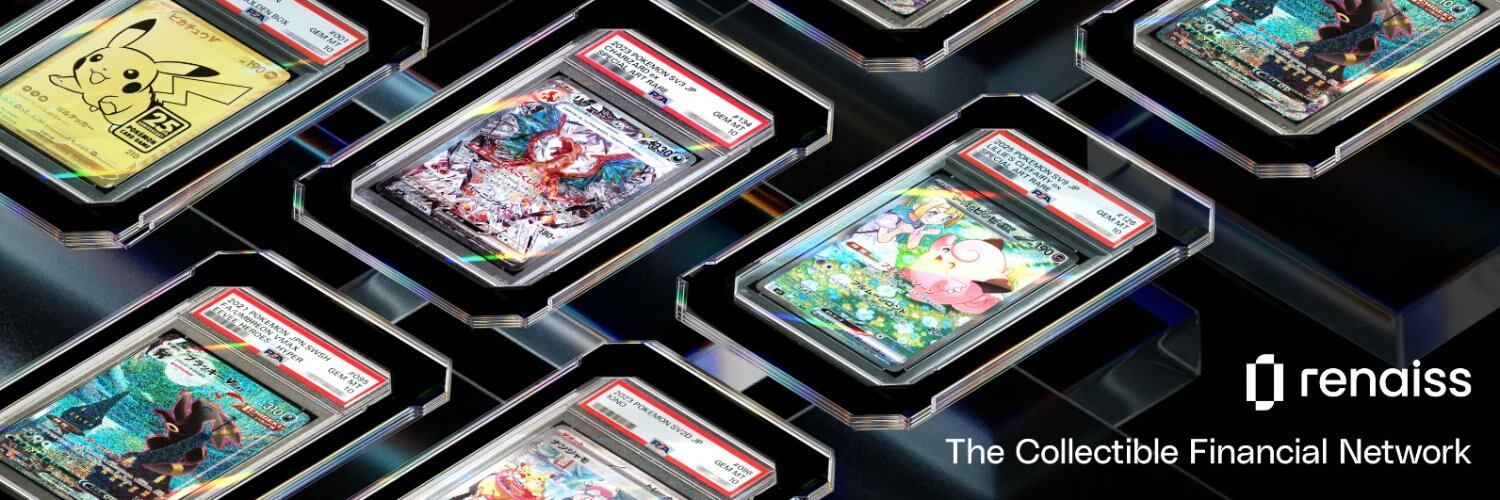
Renaiss is an RWA liquidity infrastructure project centered around real-world collectibles, focusing on collectible finance. Compared to common RWA categories like government bonds, stocks, and funds, Renaiss targets the more niche collectibles market, particularly real-world collectible assets such as trading cards and Pokémon cards. To date, Renaiss platform trading volume has exceeded $15 million.

Renaiss aims to address long-standing pain points in the real-world collectibles market, including high costs for physical custody and authenticity verification, opaque price data, fragmented trading liquidity, and difficulty in further financializing assets. The project uses on-chain ownership certificates, third-party custody, and data pricing systems to turn real-world cards and other collectibles into verifiable, tradable, and composable on-chain assets.

Renaiss enables more real-world collectibles to become verifiable, tradable, and usable in DeFi as on-chain assets. For example, once a high-value collectible card undergoes custody and on-chain mapping, it can not only be bought and sold but also has the potential to enter on-chain financial scenarios like staking and lending, ultimately becoming a protocol-layer project for real-world collectibles. This also distinguishes Renaiss from typical NFT projects. It does not reissue a batch of purely on-chain image assets but connects physically existing cards with established offline value and collector demand to the blockchain, allowing collectors to retain ownership of the physical asset while gaining higher liquidity on-chain.

Key Developments

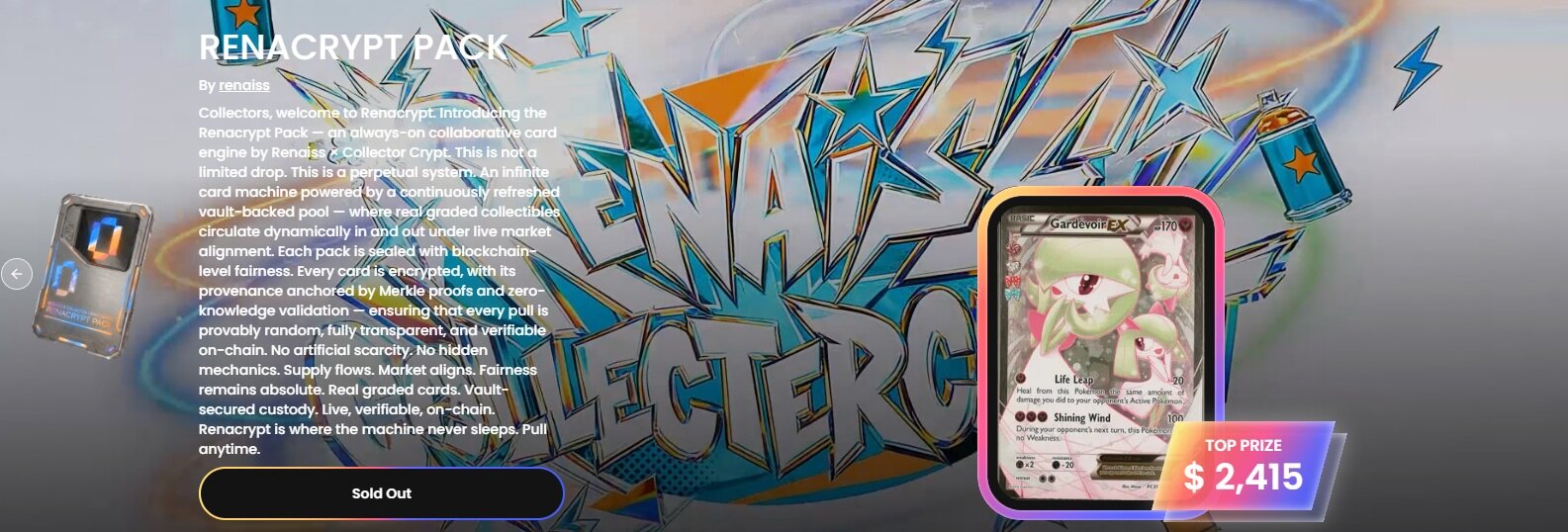
On May 22, announced the launch of the Magma Pack series card packs, with a total of 1,000 packs. The top cards have a maximum value of up to $2,900, and they sold out on the same day.

On May 26, announced the upcoming launch of the Eden Pack series card packs, themed around One Piece. The total number was not disclosed, but it includes over 100 top-grade cards.

Engagement Opportunities

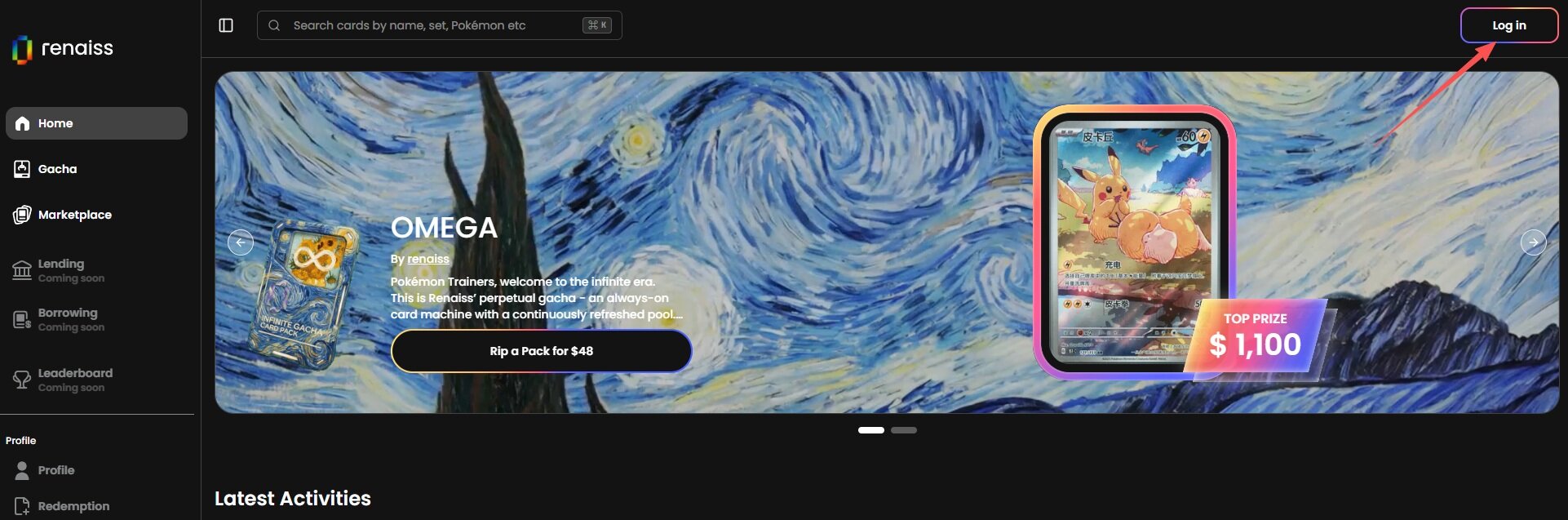
STEP 1. Go to the official website (link: https://www.renaiss.xyz/) and click "Log in" for personal account login.

STEP 2. Click the avatar in the top right corner to deposit funds.

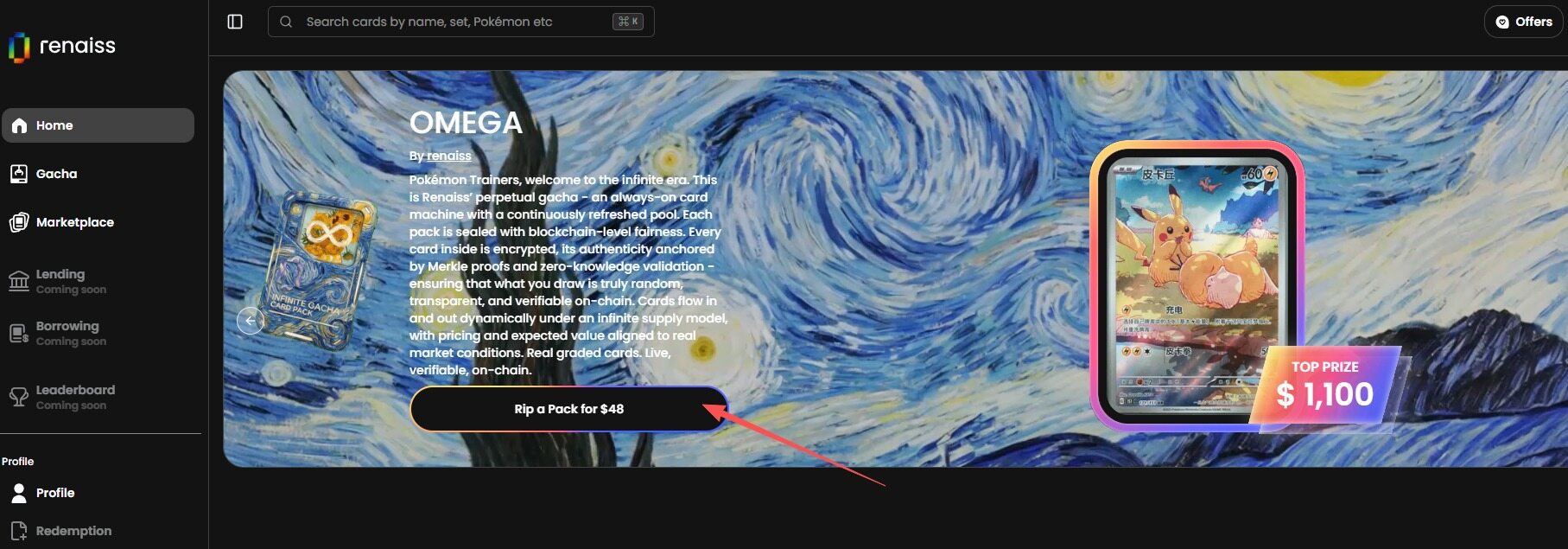
STEP 3. Click on the OMEGA card opening event on the homepage. Each card pack costs $48. There is a 90% chance of opening a C-grade card; a 7% chance for a B-grade card; a 2% chance for an A-grade card; and less than a 1% chance for an S-grade card.

Связанные с этим вопросы

QAccording to the article, what are the two projects incubated by YZi Labs that have seen a significant rise in popularity recently?

AAccording to the article, the two projects are TermMax, a fixed-rate lending protocol, and Renaiss, a platform for the financialization of real-world collectible card assets.

QWhat is the core problem TermMax V2 aims to solve, and what are the key new features introduced?

ATermMax V2 aims to address issues like fragmented liquidity, low utilization of idle funds, and inefficient order matching. Key new features include Composable Base Yield (integrating ERC-4626 yield sources like Aave), Atomic Order (allowing single liquidity to be listed across multiple markets), Order Aggregator (for better rate matching), Smart Unwind (for efficient position exit), and Alpha Zone (for flexible market creation).

QHow does Renaiss differentiate itself from typical NFT projects?

ARenaiss differentiates itself by not minting purely digital art assets. Instead, it focuses on bringing real-world collectible assets (like trading cards) with existing offline value and demand onto the blockchain through custody, verification, and on-chain representation. This allows owners to retain physical ownership while gaining enhanced on-chain liquidity and enabling potential DeFi use cases like staking or lending.

QWhat are the three types of points (and their corresponding tasks) users can earn in TermMax's Season 0 activity?

AIn TermMax's Season 0 activity, users can earn three types of points: XP points from deposit-related tasks, AP points from trading-related tasks, and MP points from social-related tasks.

QWhat specific feature did TermMax launch on BNB Chain in January 2026 to connect fixed-rate lending with the RWA sector?

AIn January 2026, TermMax launched a fixed-rate lending market on BNB Chain that supports Ondo tokenized stock as collateral, allowing users to borrow funds without selling their tokenized stock assets.

Похожее

Will OpenAI Swallow the Application Layer? a16z Says Real Opportunities Lie Outside General Models

As large language models (LLMs) from companies like OpenAI and Anthropic become more powerful, many fear they will dominate the AI application layer, leaving no room for startups. However, this article argues that the real opportunity lies not on the "Yellow Brick Road"—the high-profile, general-purpose tasks like code and text generation that model labs are directly pursuing—but in the "rest of Oz": complex, vertical-specific applications. On the Yellow Brick Road, model companies have inherent advantages: control over the model, better margins, pricing power, and strong distribution. Startups building generic, horizontal "co-pilot" tools for standard tasks are competing directly on this path and are vulnerable. True defensibility and value are found in specialized, vertical applications. These involve deep integration into messy, multi-step business workflows (e.g., sales, insurance, legal), handling legacy systems, data quality issues, compliance, and governance. The "scaffolding" around the model—the specialized tools, automations, workflows, and industry knowledge—becomes more critical than the raw model power itself. Vertical AI companies can build defensible moats through: * **Data & Learning Flywheels:** Capturing unwritten industry practices and specific customer feedback not found in public training data. * **Managing Model Complexity:** Routinely evaluating and routing queries across multiple models (including open-source) to optimize for performance and cost, and absorbing the migration burden of model upgrades for clients. * **Cost Optimization:** Using cheaper, fine-tuned models for specific sub-tasks instead of always calling the most expensive, general-purpose model. * **Governance & Compliance:** Providing the control plane for permissions, auditing, and ensuring compliance with industry-specific regulations (e.g., HIPAA, FINRA). Examples from sales (11x) and insurance (FurtherAI) illustrate that clients pay for systems that drive specific business outcomes (e.g., sales pipeline, policy underwriting), not for generic intelligence. These systems become the "operational memory" of a business, a layer that is hard to replace, even as the underlying LLMs commoditize and improve. To test if a startup is building in the "rest of Oz," it should pass checks like the **Tool & Steps Test** (requires complex, multi-step workflows), the **System Test** (owns the end-to-end workflow, not just a tool on top), and the **Hedge Fund / P&L Test** (measured by client business outcomes, not benchmark scores). Both model labs and vertical application companies will win. The next generation of enterprise software will be built in the specialized, complex, and high-value territory beyond the Yellow Brick Road.

marsbit6 мин. назад

Will OpenAI Swallow the Application Layer? a16z Says Real Opportunities Lie Outside General Models

marsbit6 мин. назад

'ASIC Giant' Marvell Sets Record Quarterly Revenue, Raises Guidance Again, CEO Says Data Center Business Is 'On Fire'

Marvell Technology, a leading player in custom AI chips and data center connectivity, reported record revenue for its fiscal Q1 2027, driven by explosive demand in its data center business. Revenue reached $2.418 billion, slightly surpassing expectations, though GAAP net income fell year-over-year due to acquisition-related costs. Crucially, data center revenue hit $1.83 billion, making up 76% of the total and growing 27% YoY. The company significantly raised its full-year and next-year guidance, citing "exceptionally strong AI-related orders." Revenue is now projected at ~$11.5 billion for FY2027 and ~$16.5 billion for FY2028. CEO Matt Murphy emphasized that growth in the data center segment is accelerating. The AI Interconnect business, now expected to grow over 70% annually, saw its forecast lifted again due to rising network demands in complex AI models. Additionally, Marvell's custom chip (XPU) business is on a steep growth path, with FY2028 revenue anticipated to double and a target of over $10 billion by FY2029. The company also expanded its strategic collaboration with NVIDIA, focusing on silicon photonics, system integration, and AI-RAN solutions. To secure supply for surging demand, Marvell plans about $1 billion in supplier prepayments this fiscal year, highlighting its long-term capacity planning. Despite the strong results, the stock dipped slightly in after-hours trading.

marsbit24 мин. назад

'ASIC Giant' Marvell Sets Record Quarterly Revenue, Raises Guidance Again, CEO Says Data Center Business Is 'On Fire'

marsbit24 мин. назад

Top Audit Expert Warns: All DeFi is Unsafe, Withdraw Now!

A leading DeFi security expert has issued a stark warning: all DeFi is now unsafe. Manuel Aráoz, founder of major security audit firm OpenZeppelin, stated on X that he is advising friends and family to withdraw funds from major protocols like Aave, MakerDAO, and Compound. The core reason for this drastic shift is the rise of AI. Aráoz argues that AI-powered coding agents can now identify and exploit smart contract vulnerabilities at an exponentially faster rate. This turns DeFi's transparency into a liability, providing a vast training dataset for attackers. The fundamental asymmetry of security—where defenders must patch every flaw, but attackers need only find one—is being catastrophically unbalanced by AI. Recent months provide chilling evidence. April saw massive exploits, including a $280 million loss at Drift Protocol and a $292 million theft from Kelp DAO. The trend continued into May with multiple high-value attacks on protocols like THORChain, Verus, Echo Protocol, and StakeDAO, demonstrating vulnerabilities across both on-chain code and off-chain management. AI acts as a force multiplier for hackers, enabling near-instantaneous vulnerability scanning, automated exploit script generation, and sophisticated social engineering. The recent development of ultra-powerful AI models like Anthropic's Mythos—so advanced its public release was delayed over security fears—signals even greater threats ahead. The article concludes that the risk-reward calculus for DeFi participants has fundamentally broken. With yields on many "blue-chip" protocols now in the single digits, users are essentially risking 100% of their principal for minimal returns, with no recourse in case of attack. In this environment, withdrawing funds may be the most rational risk management decision.

marsbit24 мин. назад

Top Audit Expert Warns: All DeFi is Unsafe, Withdraw Now!

marsbit24 мин. назад

Торговля

Спот
Фьючерсы
活动图片