Google's $85 Billion Secondary Offering Breaks Historical Record, Buffett Invests $10 Billion in AI Infrastructure

marsbitОпубликовано 2026-06-09Обновлено 2026-06-09

Введение

Alphabet (Google) has completed a record-breaking $847.5 billion equity offering, the largest in history. The funds are earmarked for AI infrastructure, with Alphabet's 2026 capital expenditure guidance raised to $180-190 billion. The complex financing structure included public offerings, convertible notes, and a $100 billion private placement to Warren Buffett's Berkshire Hathaway, seen as a major vote of confidence from value investors. Alphabet's move comes amid strong Q1 2026 results, with revenue hitting $110 billion and cloud backlog surpassing $460 billion. This offering signals the start of a massive AI funding supercycle. SpaceX is set for a $750 billion IPO, while AI giants Anthropic and OpenAI have also confidentially filed for public listings targeting trillion-dollar valuations. Analysts estimate total AI-related equity issuance in 2026 could reach $400 billion, dwarfing previous records. The flood of supply raises questions about market absorption, with historical data showing significant post-IPO pullbacks. Some advise investors seeking AI exposure to consider established players like Alphabet, which offers growth potential with comparatively lower risk than pure-play AI startups.

Author: Claude, Shenchao TechFlow

Shenchao TechFlow Insight: Alphabet priced $84.75 billion in equity financing on June 2nd, breaking Petrobras's 2010 record of $70 billion. The initial offering plan was $40 billion but expanded to $45 billion due to oversubscription; Berkshire Hathaway's $10 billion private placement anchored institutional confidence.

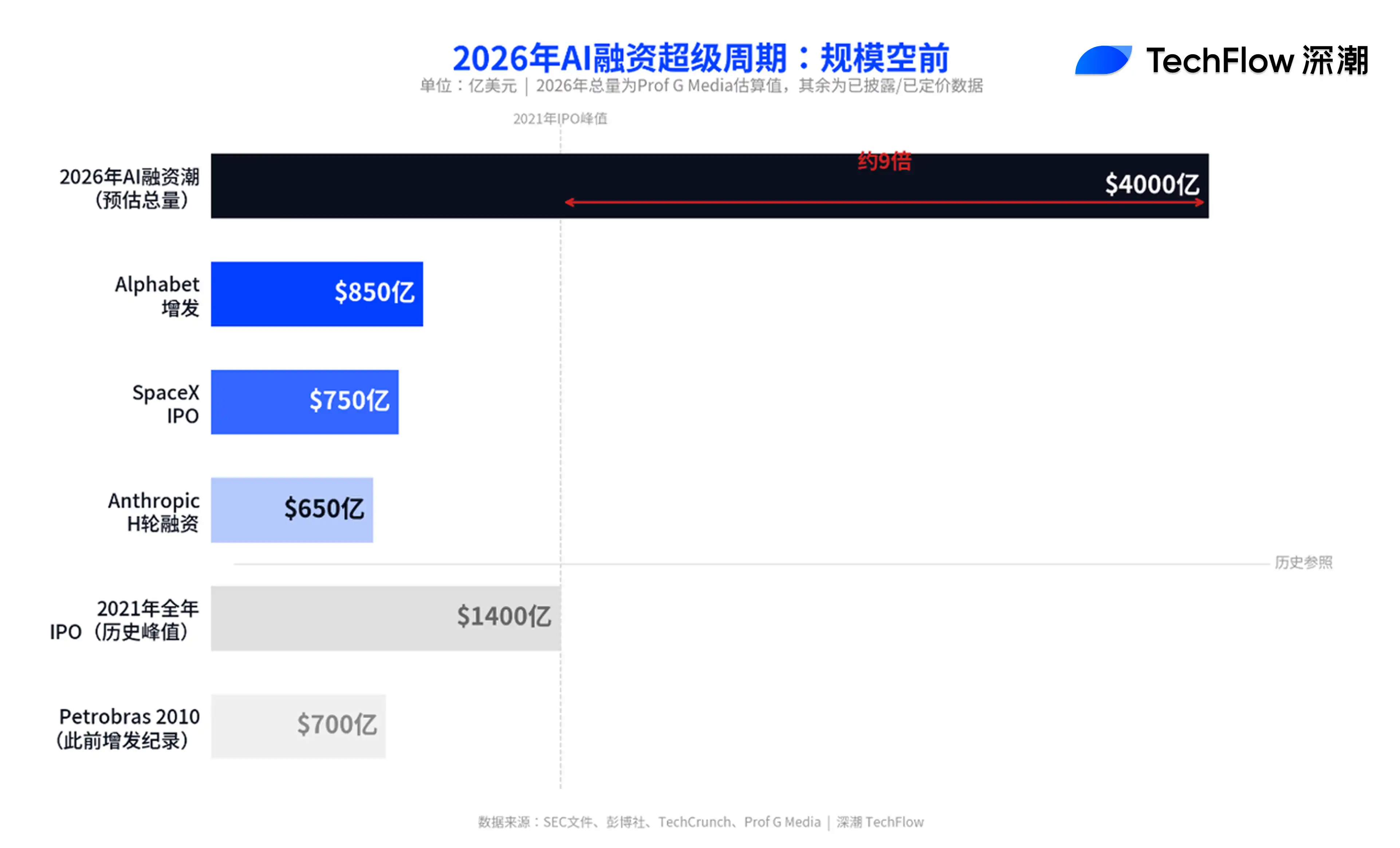
Meanwhile, SpaceX's $75 billion IPO is set to list on Nasdaq on June 12th, while Anthropic and OpenAI have both confidentially submitted S-1 filings. Total equity financing related to AI in 2026 could exceed $400 billion, nine times the size of last year's IPO market.

Alphabet has dropped a bombshell on the capital markets.

According to SEC filings and Bloomberg, Alphabet completed pricing for a total of $84.75 billion in equity financing on June 2nd, marking the largest single equity offering in history, surpassing the $70 billion record set by Petrobras in 2010 by over $14 billion. CEO Sundar Pichai posted on X platform that the initial offering was expanded from $40 billion to approximately $45 billion due to oversubscription. Following the announcement, Alphabet's stock price fell about 4%.
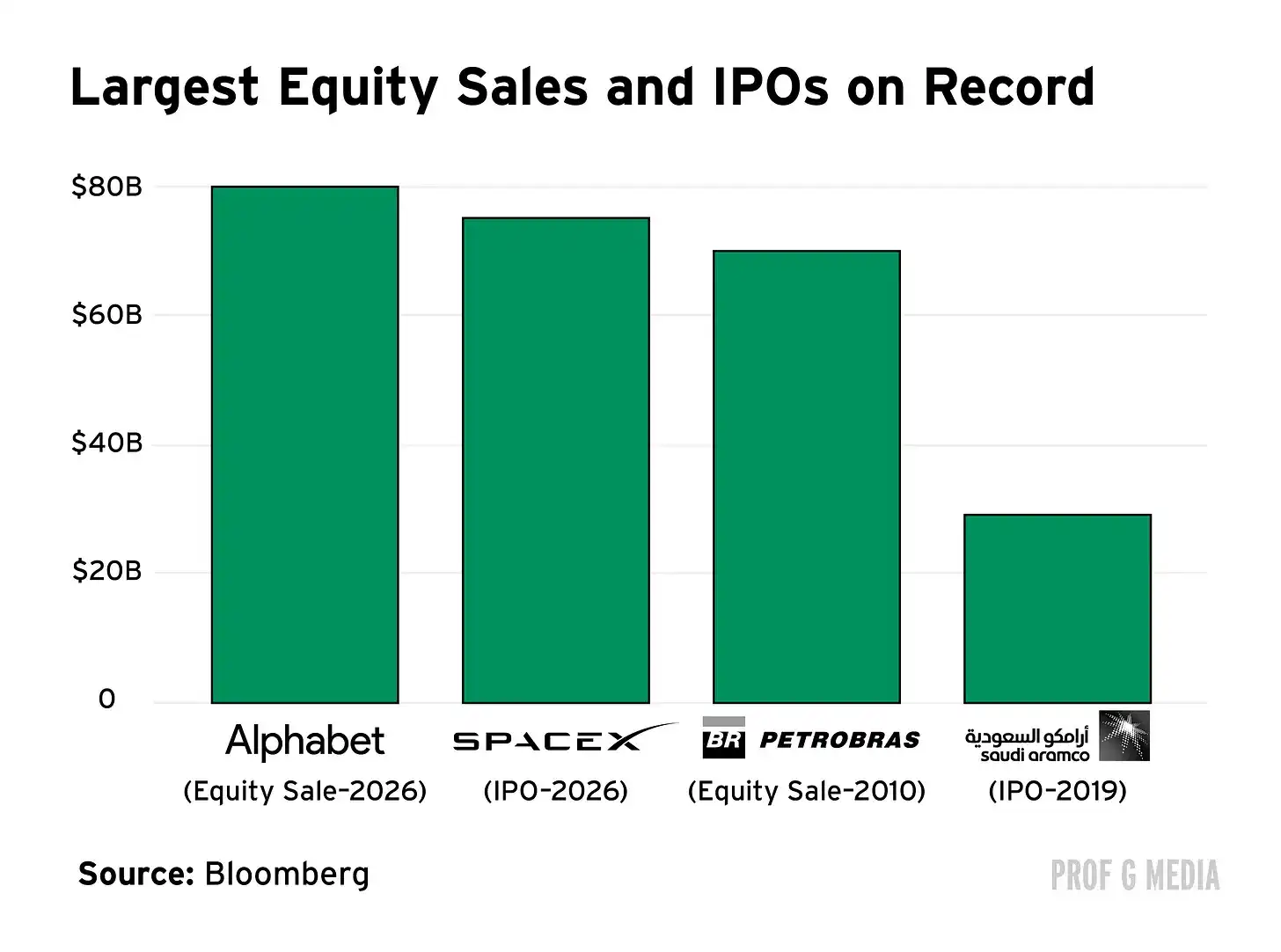
The destination of these funds is clear: AI infrastructure. Pichai defined it as "part of a multi-year investment strategy to seize the opportunities presented by AI." Alphabet's 2026 capital expenditure guidance has been raised to $180-$190 billion, nearly double the full-year 2025 figure of $91.4 billion.

How the $84.75 Billion Was Raised: A Four-Tier Structure Breakdown

This financing was not a simple secondary public offering but a composite structure pieced together from four components.

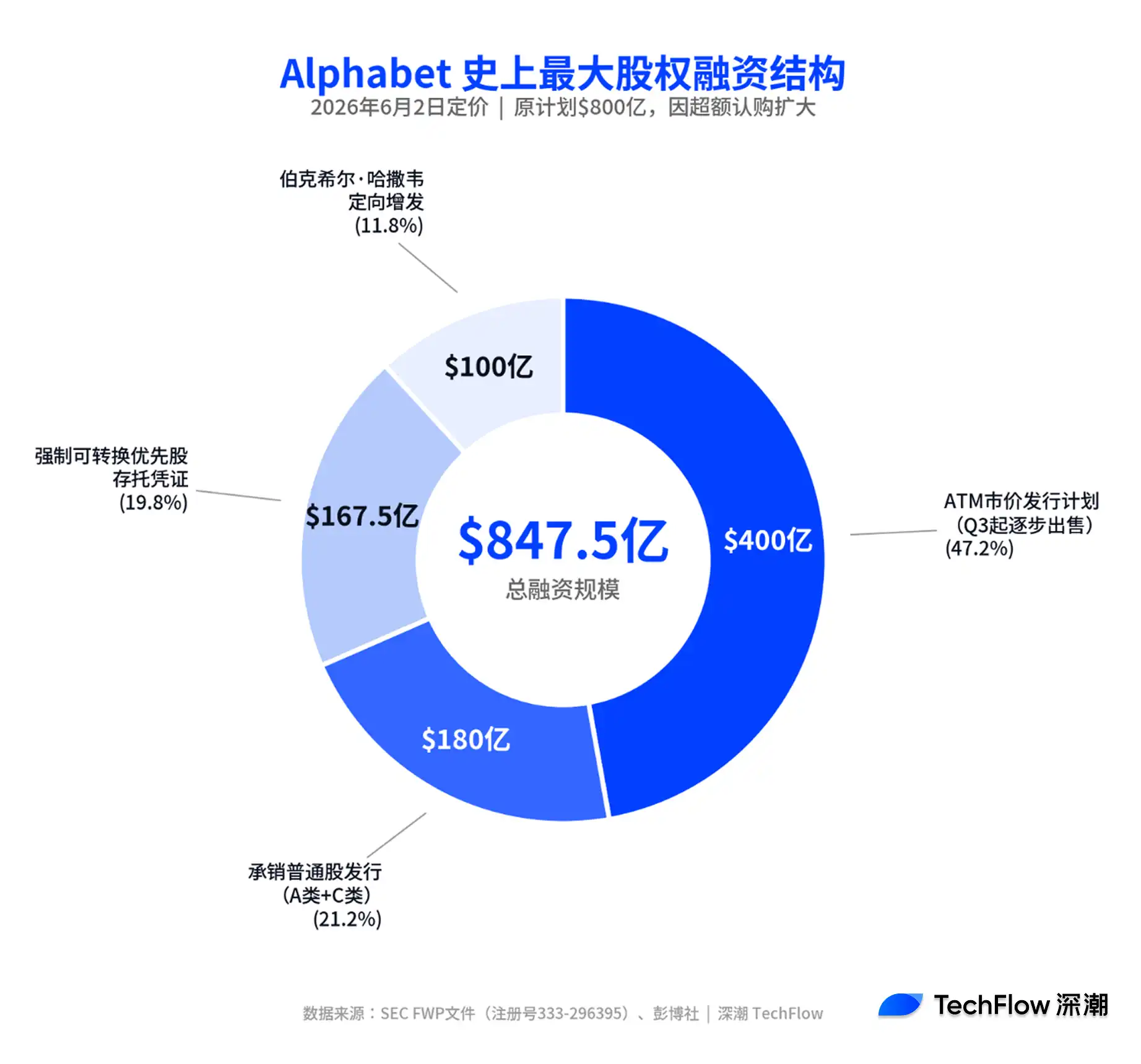
According to the FWP filing submitted to the SEC, the specific composition is: an underwritten offering of $18 billion in Class A common stock and Class C capital stock (expanded from the original plan of $15 billion); $16.75 billion in mandatory convertible preferred stock depositary receipts (expanded from the original plan of $15 billion), with a 6.25% fixed dividend rate; a $40 billion at-the-market offering program (ATM), which will gradually sell shares to the market starting in the third quarter; and a $10 billion private placement to Berkshire Hathaway.

The underwriting portion was priced at $355.20 per share for Class A shares and $351.80 per share for Class C shares. The common stock and depositary receipt offerings were settled on June 4th and June 5th, respectively.

Based on Alphabet's total market capitalization of approximately $4.2 trillion, this financing round represents less than 2% of its market value. According to Seeking Alpha analysis, considering the issuance structure and employee stock option tax obligations, the actual dilution effect may be lower than the nominal figure.
Buffett's $10 Billion Investment: Value Investors Cast a Vote of Confidence for AI Infrastructure

Berkshire Hathaway's $10 billion private placement was the most notable single transaction in this financing round.

According to SEC filings, Berkshire purchased equivalent amounts of Class A and Class C shares at approximately a 6.5% discount. This company, famous for value investing, has long been seen as conservative in the tech investment arena. But from heavily investing in Apple to now directly participating in AI infrastructure financing, Berkshire's move sends a signal: even the most cautious institutional capital now views AI infrastructure as an asset class worth betting on.

According to TechCrunch, Pichai specifically mentioned Berkshire's participation on X platform, emphasizing that its "long-term commitment to value investing" aligns with Alphabet's investment logic.

Google's Confidence: Q1 Revenue of $110 Billion, Cloud Backlog Exceeds $460 Billion

Alphabet's confidence in issuing an $85 billion financing check at this moment stems from solid data.

In the first quarter of 2026, Alphabet's total revenue reached $110 billion, a 22% year-over-year increase. Among this, Google Cloud revenue was $20 billion, a 63% increase, and contract backlog nearly doubled from the previous quarter to over $460 billion, with approximately 50% expected to be recognized as revenue within the next 24 months. Google Search and other business revenue grew 19% year-over-year to $60.4 billion, and Google paid subscription users reached 350 million. According to Prof G Media, Gemini's monthly active users are close to 900 million.

Pichai bluntly stated on the first-quarter earnings call: "We are constrained in the short term by compute supply." CFO Anat Ashkenazi added that capital expenditure in 2027 is expected to "increase significantly again." In other words, the $180-$190 billion annual capital expenditure is just the starting point.

Alphabet's President and Chief Investment Officer, Ruth Porat, played a key role in this financing round. Prof G Markets host Scott Galloway commented that Alphabet could have funded this investment entirely with cash from its own balance sheet, but Porat chose a smarter approach: financing with low-cost external capital while locking in investor allocations before Anthropic and OpenAI go public. "Every resource is finite, including investor appetite for AI infrastructure. Google just took $85 billion off the table," Galloway wrote.

The AI Financing Supercycle: SpaceX, Anthropic, OpenAI Queue Up for IPO

Alphabet's secondary offering is not an isolated event but the opening act of the 2026 AI capital markets supercycle.

SpaceX publicly filed its S-1 prospectus on May 20th, planning to issue 556.6 million shares at $135 per share, raising $75 billion, corresponding to a valuation of approximately $1.75 trillion. According to Bloomberg, the company is expected to price on June 11th and officially list on Nasdaq under the ticker "SPCX" on June 12th. The roadshow started on June 4th and has been oversubscribed. If completed, this will be the largest initial public offering in global IPO history.
Anthropic confidentially submitted a draft S-1 to the SEC on June 1st. Just prior, on May 28th, the company completed a $65 billion Series H funding round, with a post-money valuation of $965 billion, surpassing OpenAI's $852 billion to become the highest-valued AI company in Silicon Valley. According to multiple media reports, Anthropic's target IPO window is around October 2026, with exceeding a $1 trillion valuation on the first day seen as a baseline expectation.

OpenAI is also not far behind. According to CNBC's May 20th report, OpenAI is preparing to confidentially submit its IPO prospectus draft, with Goldman Sachs and Morgan Stanley acting as lead underwriters, targeting a valuation exceeding $1 trillion, with an IPO window between September and November 2026.

The Supply Shock of the $400 Billion Financing Wave: Can the Market Digest It?

Summing these numbers reveals a capital market financing scale in 2026 that is unprecedented.

According to Galloway's calculation, the largest year for IPO financing in history was 2021, with approximately $140 billion for the full year. The combined financing from just Google's secondary offering plus the IPOs of the three AI giants—SpaceX, Anthropic, and OpenAI—already far exceeds this record. If we add other AI-related listing projects like Cerebras and the entire 2026 financing pipeline, the total annual equity issuance could surpass $400 billion, approximately nine times the size of last year's IPO market.

Galloway presents a sobering historical statistic: the average maximum drawdown within one year of listing for the past 30 major IPOs was 55%. "The IPO moment is the peak of hype, the peak of demand. You are competing with every asset manager on the planet for the shares everyone wants," he wrote. "The smarter approach is often to wait for the hype to die down and find an entry point when fear is higher than greed."

For investors, Galloway offers a concise framework: Want AI exposure but unsure if Anthropic or OpenAI is worth their valuation? Buy Google. It's already one of the greatest businesses of all time, with a relatively reasonable valuation, offering upside with far less risk than pure-play AI companies. If AI ultimately disappoints, Alphabet won't disappear, but other companies might not be so lucky.


Трендовые криптовалюты

Связанные с этим вопросы

QWhat was the total size of Alphabet's record-breaking equity offering and how did it break the previous record?

AAlphabet completed an equity offering totaling $84.75 billion. This broke the previous record of $70 billion set by Petrobras (Brazil's state oil company) in 2010 by over $14 billion.

QWhat is the stated primary purpose of Alphabet's massive capital raise?

AThe stated primary purpose of the capital raise is for AI infrastructure investment. CEO Sundar Pichai defined it as 'part of a multi-year investment strategy to capture the opportunities presented by AI.'

QWho invested $10 billion in Alphabet's offering, and why is this significant?

ABerkshire Hathaway invested $10 billion in a private placement. This is significant as the company, known for its conservative value investing philosophy, is seen as giving a 'trust vote' to AI infrastructure as a legitimate asset class.

QWhich three major AI/tech companies are mentioned as preparing to go public in 2026, and what are their expected IPO valuations?

AThe three major companies are SpaceX (targeting a $1.75 trillion valuation), Anthropic (targeting a valuation exceeding $1 trillion), and OpenAI (also targeting a valuation exceeding $1 trillion).

QAccording to the article, what is a key risk or concern highlighted about the upcoming wave of large-scale AI-related public offerings?

AA key concern is the market's ability to absorb the massive supply of equity. Scott Galloway notes that the combined offering sizes could be 9x larger than last year's IPO market. He warns that IPOs often represent a peak in hype, and historically, major IPOs have seen an average maximum drawdown of 55% within their first year of trading.

Похожее

Биткойн-майнинг-фермы превращаются в AI-фабрики

Биткойн-майнинг превращается в инфраструктуру для ИИ. Компании, ранее занимавшиеся майнингом, такие как Crusoe и CoreWeave, перепрофилируют свои центры обработки данных с криптовалют на искусственный интеллект. Их главный актив — не оборудование, а уже готовый доступ к большим объемам электроэнергии, земле и разрешениям на подключение к сетям, что критически важно для создания дата-центров под ИИ. На фоне снижения доходности от майнинга биткойнов и высокого спроса со стороны ИИ-компаний этот переход стал экономически оправданным. Крупные майнинговые компании, включая TeraWulf, Cipher Mining и IREN, уже заключили долгосрочные контракты на сотни миллиардов долларов с такими гигантами, как Anthropic, AWS и Microsoft. Люди и капитал из криптоиндустрии также активно перемещаются в сферу ИИ. Основатель OpenSea создал агрегатор ИИ-моделей OpenRouter, а бывший сотрудник Coinbase основал платформу для медиа-моделей Fal.ai. Крипто-капитал финансирует ИИ-инфраструктуру, как в случае с Voltage Park Джеда Маккалеба, и поддерживает эксперименты, такие как распределенная сеть для обучения моделей Psyche от Nous Research. Хотя успех не гарантирован, криптоиндустрия передает ИИ три ключевых ресурса: энергомощности, инженерные кадры и капитал, накопленный в предыдущем цикле.

链捕手6 мин. назад

Биткойн-майнинг-фермы превращаются в AI-фабрики

链捕手6 мин. назад

Криптоплатежи за пептиды с серого рынка выросли на 700% за год — Подробности

Согласно недавнему отчёту, в США наблюдается резкий рост использования криптовалют, в основном биткойна и стейблкоинов, для покупки пептидов на сером рынке. Эти соединения, продаваемые как средства для омоложения, наращивания мышц и похудения, часто находятся в правовой серой зоне. Из-за ужесточения банковских ограничений многие поставщики, особенно в Китае, начали принимать криптовалюты. По данным Chainalysis, в первом квартале 2026 года продавцы пептидов получили $32 млн в криптовалюте, что на 700% больше, чем годом ранее. Аналитики TRM Labs также отмечают подобный тренд. Эксперты подчёркивают, что современные покупатели — это часто обычные потребители, привлечённые доступностью и низкой ценой, а не участники теневых рынков. Этот всплеск использования криптовалют для кросс-бордерных платежей происходит на фоне общего снижения розничного участия на крипторынке в начале 2026 года.

ambcrypto38 мин. назад

Криптоплатежи за пептиды с серого рынка выросли на 700% за год — Подробности

ambcrypto38 мин. назад

human.tech запускает Clean SDK для приватных Web3-приложений

Компания human.tech представила Clean SDK — набор инструментов для разработки приложений в Web3, в которых по умолчанию соблюдаются конфиденциальность и прозрачная подотчетность. Этот комплект, выпущенный одновременно с версией 5 Aztec, предоставляет разработчикам готовые компоненты для внедрения в их приложения проверки личности с нулевым разглашением (zero-knowledge), скрининга санкционных списков и приватных транзакций, без необходимости самостоятельно работать с конфиденциальными пользовательскими данными или создавать инфраструктуру для соответствия нормативным требованиям. Clean SDK решает ключевую проблему Web3, сочетая приватность с подотчетностью. С помощью zero-knowledge доказательств и программируемой верификации приложения могут подтверждать легитимность пользователей и прохождение средств проверки на санкции, не раскрывая при этом личную информацию. Таким образом, разработчикам больше не нужно выбирать между конфиденциальностью пользователей и регуляторными требованиями. Первый продукт на основе SDK — приложение Shield (мост между Ethereum и Aztec), которое было запущено одновременно с ним. Shield позволяет пользователям и автономным агентам переводить активы в Aztec, сохраняя анонимность, но при этом криптографически доказывая, что за каждой операцией стоит уникальный реальный человек, а средства проверены. Аудит Nethermind в мае 2026 года подтвердил надежность смарт-контрактов Shield. Как отметил сооснователь human.tech Шади Эль Дамати, «приватность без подотчетности ведет к злоупотреблениям, а подотчетность без приватности превращается в слежку. Clean SDK устраняет этот ложный выбор». Комплект предлагает три основных метода верификации: скрининг санкций (Proof of Innocence), подтверждение личности человека (Proof of Personhood, в том числе через Human Passport) и верификация личности с нулевым разглашением для операций с высокой стоимостью (Proof of Clean Hands). Данные хранятся в зашифрованном виде вне блокчейна, а проверки происходят как при входе, так и при выходе средств. В целом, Clean SDK, предназначенный в первую очередь для разработчиков в экосистеме Aztec, призван стимулировать создание разнообразных приватных финансовых приложений и сервисов, которые обеспечивают видимую подотчетность с помощью криптографических доказательств, не требуя от разработчиков создания сложной инфраструктуры с нуля. Этот запуск отражает растущий спрос на институциональные решения, которые прозрачно балансируют между приватностью и соответствием требованиям.

TheNewsCrypto45 мин. назад

human.tech запускает Clean SDK для приватных Web3-приложений

TheNewsCrypto45 мин. назад

Высвобождение ликвидности на $100 млн? Новая политика Pump.fun тестирует «5-минутную накачку»

21 июля платформа Pump.fun объявила о запуске режима BOOST, ставшего новой стандартной механикой запуска токенов. Его цель — решить проблему «мёртвой ликвидности». Когда токен переходит с bonding curve в ликвидный пул PumpSwap, около 20% средств навсегда блокируются в LP, становясь недоступными. По оценкам платформы, это приводит к ежегодным потерям ликвидности на сумму более $1 млрд. Механика BOOST меняет это: вместо блокировки, эти 20% средств (например, ~17.6 SOL для SOL-пар) используются в первые 5 минут после миграции токена для его скупки по методу TWAP (средневзвешенная цена по времени). Все выкупленные токены немедленно сжигаются. Это создаёт кратковременный искусственный покупательский спрос и одновременно сокращает предложение токена. Режим автоматически применяется для всех токенов, мигрирующих после 21 июля. Ранее выпущенные токены и токены, запущенные через Mayhem (AI Agent Lab), не участвуют. Цель BOOST — оживить торговлю в критические первые минуты после выпуска, чтобы удержать трейдеров и повысить общий объём торгов на платформе. Однако критики отмечают риски: после 5-минутного «фейерверка» токен может резко обрушиться при крупных продажах, а упрощённый старт может поощрить выпуск более низкокачественных мем-токенов.

marsbit52 мин. назад

Высвобождение ликвидности на $100 млн? Новая политика Pump.fun тестирует «5-минутную накачку»

marsbit52 мин. назад

Продажа блочного пространства умерла: публичные блокчейны должны найти новый способ существования

Статья "Продажа блок-пространства мертва: публичным блокчейнам нужно найти новый путь" утверждает, что традиционная бизнес-модель публичных блокчейнов, основанная на продаже пространства в блоках, больше не работает. Из 14 криптокомпаний, заработавших более $200 млн за два года, только Hyperliquid является блокчейном, чей месячный доход ($58 млн) в 100 раз превышает доход Arbitrum ($430 тыс.). Чтобы выжить, блокчейны должны превращаться в продуктовые студии, агрегаторы приложений или вертикальные SaaS-решения, отходя от роли нейтральной инфраструктуры. В статье также разбираются три ключевых события: 1. **Взлом Ostium**: Атака на LP-пулы протокола привела к потере более 40% TVL ($23,7 млн) из-за уязвимости в офф-чейн инфраструктуре, поставляющей цены. Это подчеркивает критическую важность контроля для протоколов, работающих с офф-чейн активами. 2. **Будущее опционов**: Чтобы достичь массового принятия, мощные возможности опционов должны быть абстрагированы от сложной терминологии и представлены через понятные продукты: структурированные продукты, vaultы для получения дохода, бинарные опционы и прогнозные рынки. 3. **На радаре**: Отмечаются тренды, такие как фиксированные займы (Yearn's Flex), смена стратегии Base после неудач с социальными токенами, запуск перпетуальных контрактов на индекс доллара (Plether) и фокус Starknet на приватности и защите от квантовых угроз.

marsbit1 ч. назад

Продажа блочного пространства умерла: публичные блокчейны должны найти новый способ существования

marsbit1 ч. назад

Торговля

Спот

Популярные статьи

Неделя обучения по популярным токенам (2): 2026 может стать годом приложений реального времени, сектор AI продолжает оставаться в тренде

2025 год — год институциональных инвесторов, в будущем он будет доминировать в приложениях реального времени.

1.9k просмотров всегоОпубликовано 2025.12.16Обновлено 2025.12.16

Неделя обучения по популярным токенам (2): 2026 может стать годом приложений реального времени, сектор AI продолжает оставаться в тренде

Обсуждения

Добро пожаловать в Сообщество HTX. Здесь вы сможете быть в курсе последних новостей о развитии платформы и получить доступ к профессиональной аналитической информации о рынке. Мнения пользователей о цене на AI (AI) представлены ниже.

活动图片