From OpenSea to OpenRouter: The Business Strategy of a Serial Entrepreneur in 'Aggregation'

比推Опубликовано 2026-03-13Обновлено 2026-03-13

Введение

From OpenSea to OpenRouter: The "Aggregation" Playbook of a Serial Entrepreneur Alex Atallah, co-founder of OpenSea (the largest NFT marketplace, once valued at $13 billion), left at the NFT market's height before its collapse. He has now founded OpenRouter, an AI model aggregation platform that unifies API access to over 500 models (including Claude, GPT, and DeepSeek) and charges a 5% fee on transactions. OpenRouter simplifies developer access by providing a single interface, avoiding the complexity of dealing with multiple providers, separate registrations, and API inconsistencies. Its growth has been rapid: monthly transaction volume surged from $800,000 in October 2024 to $8 million by May 2025, with annual processed value exceeding $100 million. The company, recently valued at $500 million after a $40 million funding round led by a16z, benefits from the AI boom and tools like OpenClaw, which uses OpenRouter as a default provider. Atallah’s strategy remains consistent: he doesn’t bet on which specific asset or model will succeed but instead positions himself as the essential intermediary in fragmented market—aggregating supply and capturing value through transaction fees. His approach highlights the power of building platforms that become critical infrastructure, regardless of which trend emerges next.

Author: David, Deep Tide TechFlow

Original Title: The Person Who Exited at the Peak of NFTs Is Now the Most Hidden Winner Behind OpenClaw


OpenClaw is trending, but the one quietly making money in this wave is a company you might not have heard of:

OpenRouter.

To use OpenClaw, you need to connect various AI models to get things done. Claude, GPT, DeepSeek—each has its own pricing and interfaces. What OpenRouter does is bundle these models together. You use them through OpenRouter, and it profits from the margin.

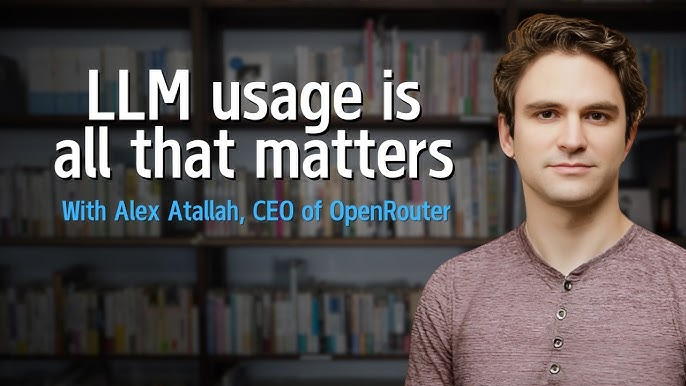
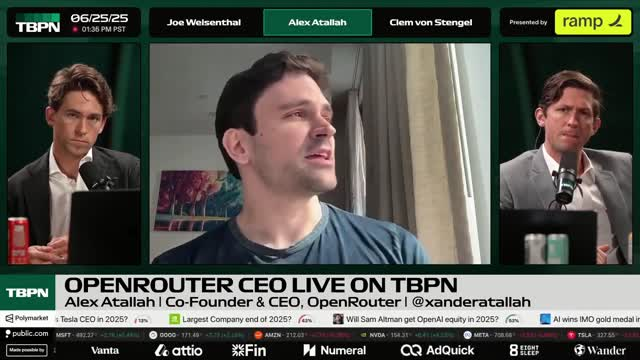
The person behind this business is Alex Atallah. His company just raised $40 million led by a16z, and it's now valued at $500 million.

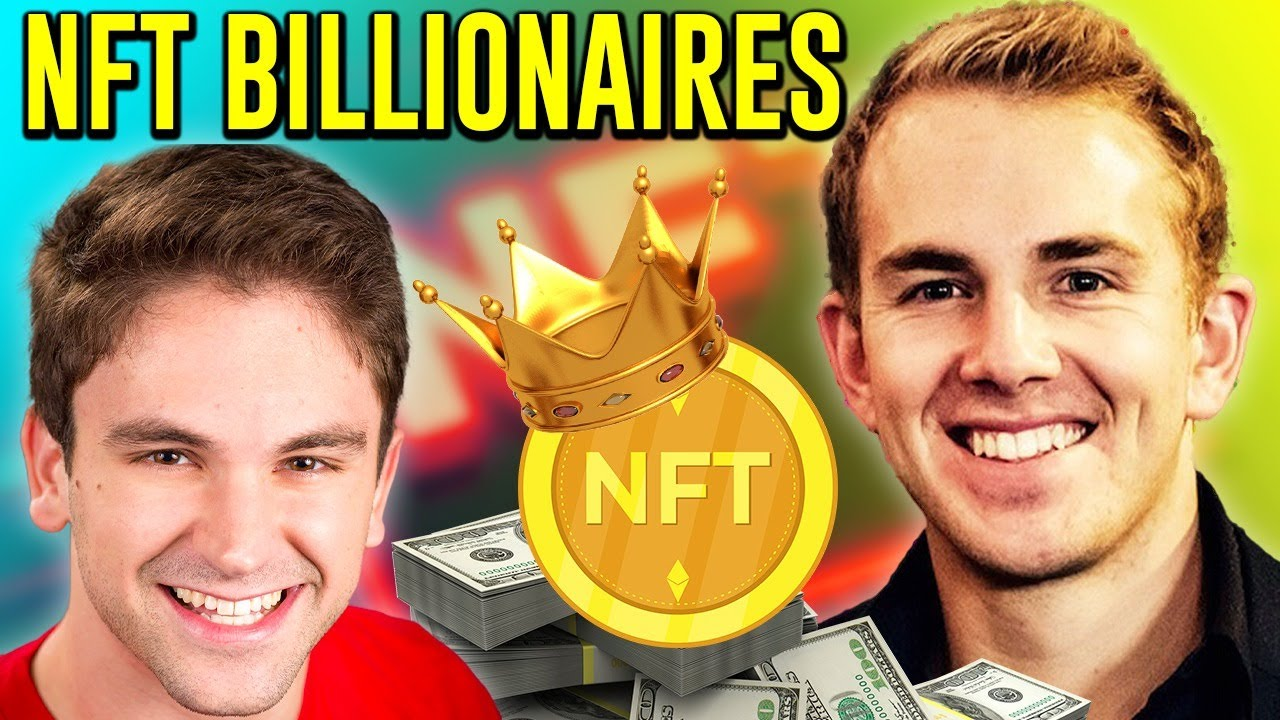
What you might not know is that his previous company was OpenSea, the world's largest NFT marketplace, which once reached a valuation of over $13 billion at its peak.

However, he chose to exit at the height of the NFT craze. A few months later, the NFT market crashed.

Now, he's making money again in the AI boom.

From Liquidity Aggregation to Large Model Aggregation

Alex Atallah, a Stanford computer science graduate.

In 2018, he co-founded OpenSea with Devin Finzer. The idea was simple: others mint NFTs, and they provide a platform for buying and selling, taking a 2.5% cut from each transaction.

OpenSea doesn't produce NFTs or speculate on them; it just provides shelves and aggregates liquidity.

When the NFT craze hit in 2021, breakout projects like Bored Ape Yacht Club became cultural phenomena. At its peak, OpenSea's monthly trading volume exceeded $5 billion. Forbes estimated that he and Finzer had a combined net worth of $2.2 billion.

In July 2022, he stepped down as CTO, saying he wanted to work on something new.

What happened next is well-known: NFTs crashed, the market entered a deep freeze, and OpenSea's business was in shambles. However, while the feast had its losers, Alex left before the music stopped.

In 2023, he started working on something called OpenRouter. In a nutshell:

It's an aggregation and routing platform for large models, putting hundreds of model APIs behind a single interface. Developers call them through OpenRouter, which takes a 5% fee.

You might ask, why not just go directly to OpenAI or Anthropic to call Claude or GPT?

Of course, you can.

But nowadays, no one uses just one model. You might use Claude for coding, Gemini for research, and delegate cost-effective tasks to DeepSeek. Each requires separate registration, top-ups, and has different interface formats...

Not to mention that many users who want to use Claude or GPT can't directly access their APIs from within China.

Thus, OpenRouter becomes the path of least resistance. One interface, over 500 models, unified format, automatic switching—one key to rule them all.

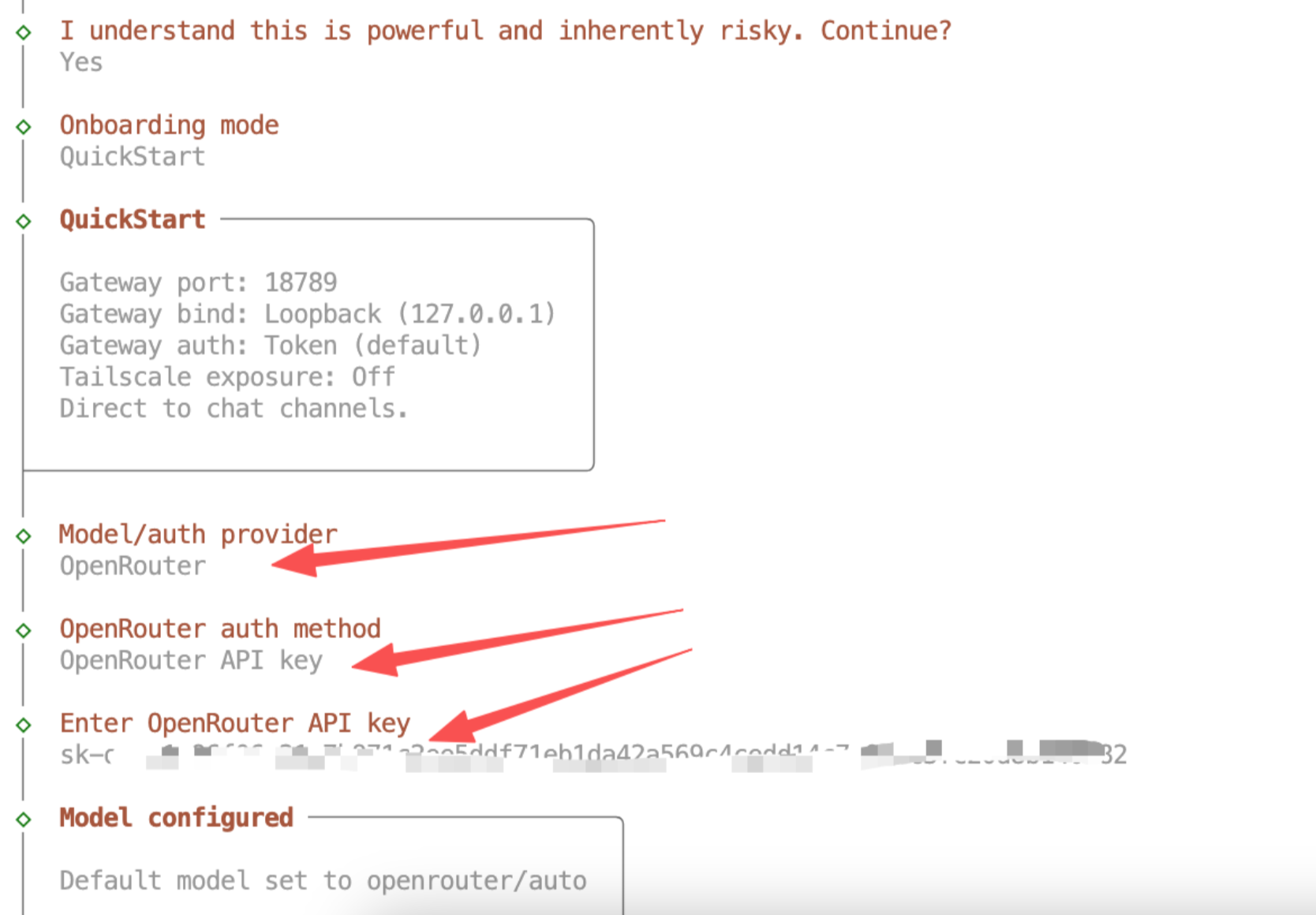
You might not have noticed while using OpenClaw, but the default provider (API provider) in the configuration file was OpenRouter.

Image source: Zhihu user Feng控炼丹师

When you call Claude or DeepSeek, the request goes to OpenRouter first, then is forwarded to the model provider. Even OpenClaw's documentation states:

If the system doesn't recognize your API key format, it defaults to OpenRouter.

How fast is this business growing?

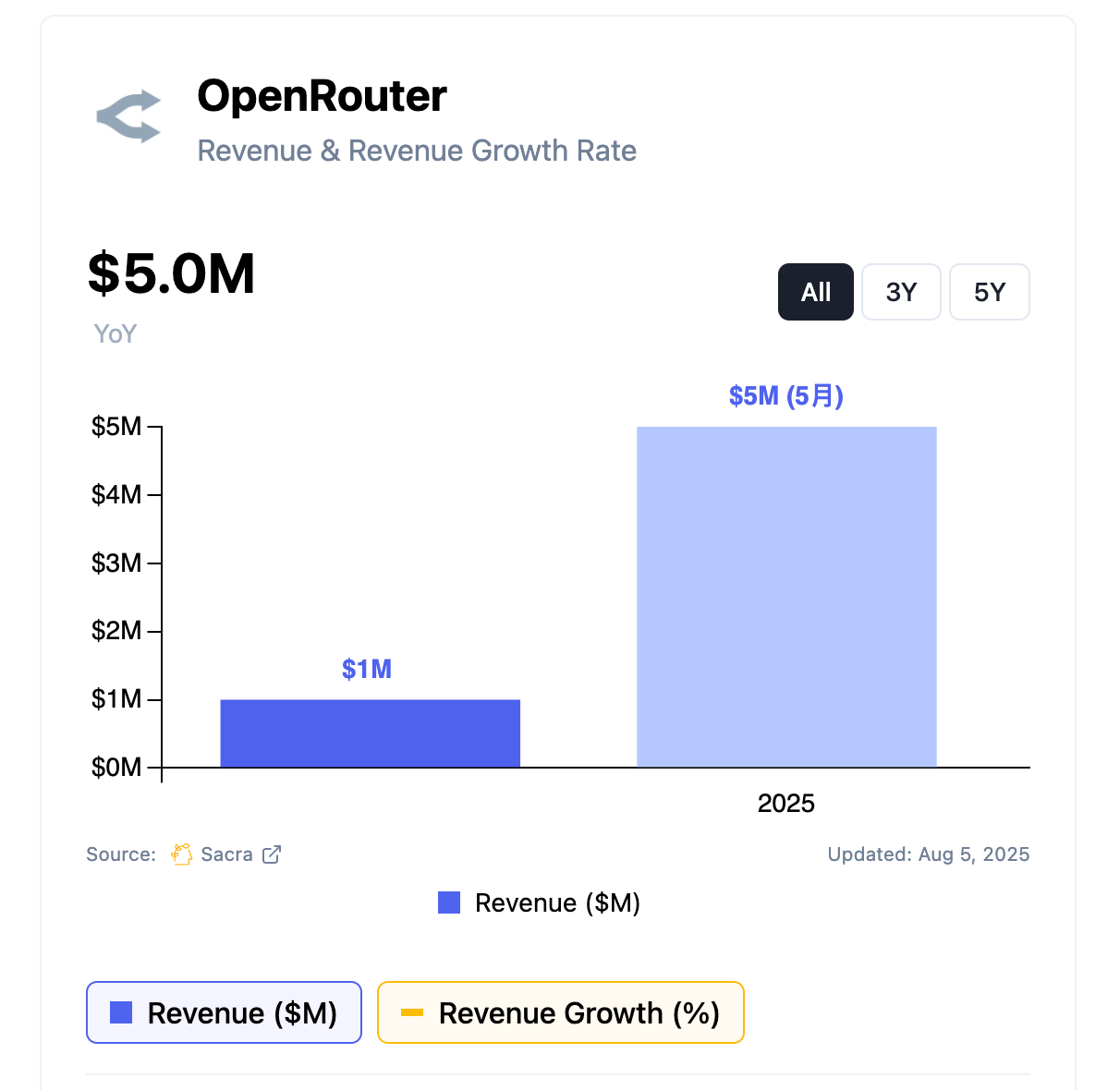
In October 2024, the amount of money flowing through OpenRouter monthly was $800,000. By May 2025, that number had grown to $8 million.

Seven months, tenfold growth.

Over a year, more than $100 million passed through his hands. He takes a 5% cut, netting $5 million, with a team of fewer than ten people.

Image source: sacra.com

a16z used his data to write an industry report titled "The State of AI: 100 Trillion Tokens"; Stripe customized a billing system specifically for him.

And with the explosion of OpenClaw this year, more developers and enthusiasts are pouring in, finding creative ways to burn tokens, inevitably needing to call various large models. This has completely fueled OpenRouter's business.

Moreover, a16z led an investment round in the company, valuing it at $500 million.

A seller of shovels has once again become a seller of shovels.

Different Hotspots, Same Model

If you look closely at Alex's two businesses, their structures are actually the same.

OpenSea's business was not minting NFTs but putting others' minted NFTs in one place. Buyers and sellers come to trade, and it takes a 2.5% cut. OpenRouter's business is not training models but putting others' trained models in one place. Developers come to call them, and it takes a 5% cut.

This approach seems to be his comfort zone. Whether it's NFTs or AI, the market structures share very similar characteristics:

The supply side is extremely fragmented, and demand-side buyers don't know where to find the supply. He stands in the middle as the shelf.

How fragmented were NFTs in 2021? Dozens of chains, hundreds of projects, tens of thousands of new collections every day. If you wanted to buy a Bored Ape, you couldn't check each project's website one by one. OpenSea aggregated them; you came to browse and buy, and sellers offered them to you.

How fragmented are large models in 2025? OpenAI, Anthropic, Google, Meta, DeepSeek, Mistral, 01.AI... Dozens of mainstream ones, plus hundreds from the open-source community.

Today, Claude might be best for coding; tomorrow, a new version of Gemini might be stronger for search; the day after, DeepSeek might halve its prices. Each switch requires changing the interface.

Atallah himself once said something that explains this logic very clearly:

"OpenSea brought very fragmented inventory together in one place. AI today looks very similar to that."

He doesn't need to know which NFT will rise or which model will win. He only needs to know one thing: the more fragmented the supply, the more valuable the middleman.

Moreover, the timing is interesting.

When he left in July 2022, OpenSea's valuation was still high. Although monthly NFT trading volume had fallen from its peak, no one thought it would crash. He said he wanted to "build something new from scratch." Half a year later, ChatGPT was released, and the era of large models began.

Did he see something, or was it just good luck?

I don't know. But one thing is certain:

When he registered OpenRouter in early 2023, AI large model routing products barely existed in the market. By the time everyone realized the need for a unified interface, he was already there.

Last time, he did the same thing in the NFT space. By the time everyone crowded in, he was already the largest platform.

Does It Matter If AI Is Hot?

In every wave of hype, most people ask: What will be hot?

In 2021, it was which NFT would rise; in 2024, which meme coin would 100x; in 2025, which AI application would break out; in 2026, what can be done with crayfish.

Atallah probably asks a different question. I think his thought process is: No matter what becomes hot, where will the money flow?

These two questions seem similar but are actually completely different bets.

Betting on "what will be hot," you need to guess right once. Bored Ape will rise, PEPE will 100x, some AI product will be the next ChatGPT. Guess right and get rich; guess wrong and go to zero. Most people experience the latter.

Betting on "where the money flows," you don't need to guess any single winner correctly. If NFTs rise, transactions happen on OpenSea, and he collects fees. The more fierce the AI model war, the more developers need a unified interface to switch between them, and the busier OpenRouter becomes.

Don't bet on who wins; bet that the battle will be long.

Looking back, those who make the most money in every cycle, in any industry, are usually platforms in this position.

Gold rushers come and go, but the water sellers keep collecting money.

But I think simply saying "selling water" or "selling shovels" isn't enough. Many shovel sellers have also failed. Atallah did something more specific right: he consistently positioned himself at the aggregation point.

Not just any tool can collect tolls. You need to be the one who consolidates fragmented supply. The more fragmented the supply and the higher the switching costs, the more pricing power the aggregation layer in the middle has.

This also explains why he entered both markets so early. Because aggregation businesses have one characteristic:

The first mover signs up the supply, making it hard for others to catch up.

So, Atallah's exceptional skill, I summarize in two sentences:

First, don't guess who will win; find the crossroads everyone must pass through. Second, build the road before others even realize they need a crossroads.

Exceptional People Never Choose the Table

Right now, I feel two voices are particularly loud.

One says AI Agents are toys; installing OpenClaw is useless except for burning tokens. The other says this is just another wave of AI hype, and no one will remember it in three months.

Both views might be right.

But for someone like Alex Atallah, it doesn't really matter.

Whether OpenClaw is useful or not, he's making money. If you think crayfish are boring and uninstall it today, the tokens you burned these two weeks have already passed through his hands.

Some think NFTs are dirty, a Ponzi scheme, a scam. He built a company valued at $13.3 billion on it. Some think AI Agents are a bubble, hype, with no business model. He built a company valued at $500 million on it...

Exceptional people probably don't need us to look down on the fields they're in.

He made money at the NFT table. He's making money again at the AI table. No one knows what the next table will be.

But I guess he'll still be at the door collecting tickets.


Twitter:https://twitter.com/BitpushNewsCN

Bitpush TG Discussion Group:https://t.me/BitPushCommunity

Bitpush TG Subscription: https://t.me/bitpush

Original article link:https://www.bitpush.news/articles/7619501

Связанные с этим вопросы

QWho is the founder of both OpenSea and OpenRouter, and what is his background?

AAlex Atallah, a Stanford computer science graduate, is the co-founder of OpenSea and the founder of OpenRouter.

QWhat is the core business model of OpenRouter, and how does it generate revenue?

AOpenRouter aggregates hundreds of AI models into a single API interface, allowing developers to access them uniformly. It charges a 5% fee on each API call made through its platform.

QHow did Alex Atallah's timing in leaving OpenSea and starting OpenRouter prove advantageous?

AHe left OpenSea at its peak in July 2022, just before the NFT market crashed, and started OpenRouter early in 2023, positioning it as a key aggregator before the AI model market became crowded.

QWhat key market condition does Alex Atallah's business strategy rely on for success?

AHis strategy relies on highly fragmented supply in a market, where both providers and users benefit from a centralized aggregator that reduces complexity and switching costs, giving the middle layer pricing power.

QWhat was OpenRouter's growth in transaction volume from October 2024 to May 2025?

AOpenRouter's monthly transaction volume grew from $800,000 in October 2024 to $8 million in May 2025, a tenfold increase in seven months.

Похожее

US Government Suddenly Halts Anthropic's Strongest Model, "Quasi-IPO Stock Price" Plunges 3.7% Overnight

U.S. Government Halts Anthropic's Top AI Models, 'Pre-IPO' Price Drops 3.7% On June 12, the U.S. government ordered Anthropic to shut down access to its two most powerful AI models, Claude Fable 5 and Claude Mythos 5, citing national security concerns. The directive, issued by the Department of Commerce, required Anthropic to block access for all foreign nationals, leading the company to disable the models globally for all users. Anthropic strongly opposed the move, arguing the government's basis was a "narrow jailbreak vulnerability" and warning that applying such a standard industry-wide would effectively halt all frontier model deployments. The news impacted Anthropic's implied valuation in speculative markets. The Anthropic perpetual contract on Hyperliquid fell approximately 3.7% to around $1,627, down from highs above $1,800 following the models' release. Unauthorized tokenized products linked to Anthropic on Solana also saw significant declines. The models, launched just days earlier on June 9, represented a major capability leap for Anthropic. Fable 5 was its first public release of a "Mythos"-tier model above its flagship Claude Opus. The shutdown creates an ironic situation for Anthropic, a company founded on "AI safety" principles, and adds uncertainty to its ongoing IPO preparations. The company is actively engaging with regulators to resolve what it calls a "misunderstanding" and restore service.

marsbit16 мин. назад

US Government Suddenly Halts Anthropic's Strongest Model, "Quasi-IPO Stock Price" Plunges 3.7% Overnight

marsbit16 мин. назад

SpaceX IPO Creates Trillion-Dollar Billionaire: Musk's Wealth Equals Half of Crypto Market

SpaceX's record-breaking IPO has propelled Elon Musk to become the first modern billionaire with a personal net worth exceeding $1 trillion, reaching $1.11 trillion according to Bloomberg. This staggering wealth surpasses the total market capitalization of all cryptocurrencies excluding Bitcoin and equals roughly half of the entire crypto market's value. The milestone highlights extreme wealth concentration and the significant devaluation of the altcoin market, whose total cap has nearly halved since late 2025 as capital flows into large tech stocks. SpaceX's Nasdaq debut saw its valuation hit $2.2 trillion, with shares soaring from a $135 offer price to close at $161. Its first-day trading volume of $85 billion set a new global IPO record. Musk owns 42% of the company. Despite his wealth dwarfing the altcoin sector, Musk maintains deep ties to digital assets. He personally holds Bitcoin, Ethereum, and Dogecoin, while his companies, SpaceX and Tesla, collectively hold over 30,000 Bitcoin, ranking among the top corporate BTC holders globally. His acquisition and integration of financial data tools into X (formerly Twitter) further connect his ecosystem to the markets. Ultimately, Musk's trillion-dollar status underscores the immense wealth controlled by tech founders, though this fortune remains largely tied to volatile stock prices rather than liquid assets.

Foresight News24 мин. назад

SpaceX IPO Creates Trillion-Dollar Billionaire: Musk's Wealth Equals Half of Crypto Market

Foresight News24 мин. назад

Hardcore First Look | Ocean Embodied Intelligence Company 'Shihang Intelligence' Secures Record-Breaking 1 Billion in Funding, Zhu Xiaohu, Temasek Place Bets

Breaking News | Ocean Embodied Intelligence company "Shihang Intelligent" secures a record-breaking 1 billion RMB (approximately 10 billion yuan) in Series A financing, with investment from Zhu Xiaohu and Temasek. Author: Qiu Xiaofen | Editor: Yuan Silai Ocean Embodied Intelligence company "Shihang Intelligent" has completed its Series A funding round, raising over 1 billion RMB. This marks the largest single funding round in the global marine robotics field to date. Investors include upstream momentum funds from chip companies "Moore Thread" and "Kunlunxin," Singapore's state-owned investment platform Vertex Growth, and listed company Dyneo, among others. Existing investors like GSR Ventures (whose founder Zhu Xiaohu has invested for the fifth time), Vertex Ventures China, Hua Ying Capital, and Long Capital also significantly increased their investments. Founder and CEO Chen Xiaobo, a 1989-born alumnus of Harbin Engineering University, is a long-time expert in underwater robotics. He received the National Defense Science and Technology Progress Award at age 28 (the youngest recipient) and led the development of China's first commercial underwater cleaning robot. The funds will be used for core technology R&D, global market expansion, and building the industry chain ecosystem to scale the application of marine robots in complex underwater scenarios. The ocean is considered one of the most challenging environments for robotics due to low light, high turbidity, complex currents, limited communication, high pressure, and corrosion. "Shihang Intelligent" focuses on developing core underlying technologies for marine robots, covering six key systems: power, control, sensing, navigation, sealing, and deployment. Its robots are capable of operating at depths from 0 to 10,000 meters with full degrees of freedom, performing complex maneuvers, autonomous navigation, and multi-robot collaboration. Applications include ship cleaning, underwater security, offshore wind power, marine ranching, and seabed inspection. The company's order value for the first half of 2026 alone has exceeded 1 billion RMB. Its "Orca Robot" is used by major shipping companies and has performed maintenance on over a thousand large vessels. In April of this year, the company launched its ocean embodied large model "Cangqiong CEORION." Unlike traditional remote-controlled or pre-programmed robots, this model integrates environmental perception, task understanding, and action generation into a single end-to-end architecture. Trained on millions of hours of commercial operation data and simulation data, it covers 12 major underwater operation scenarios. In simulations, it achieved over 90% task success rate and over 70% zero-shot adaptation capability to unseen environments. A built-in physics reasoning module reduces collision risk by 80%, enabling autonomous operation even with weak or no communication. Recently, "Shihang Intelligent" was selected as a core technology partner for Singapore's Maritime and Port Authority national hull inspection and cleaning program. These advancements indicate marine robotics is moving from pilot projects to scaled applications, with real-world operations generating valuable data to continuously improve robot capabilities. CEO Chen Xiaobo stated the company will continue investing in core marine robotics technology, the embodied intelligence model, and global application scenarios to expand into more high-risk, high-difficulty, and high-value underwater operations.

marsbit50 мин. назад

Hardcore First Look | Ocean Embodied Intelligence Company 'Shihang Intelligence' Secures Record-Breaking 1 Billion in Funding, Zhu Xiaohu, Temasek Place Bets

marsbit50 мин. назад

Three Months, 35 Billion Yuan: Investors Rush to Grab the OpenAI of the Physical World

Investors flock to a physical AI startup as the race for the "OpenAI of the physical world" heats up. Ji Jia Shi Jie (GigaWorld), a company dedicated to developing Artificial General Intelligence (AGI) for the physical world, has raised 3.5 billion RMB (approximately $490 million) in just three months, according to a report from investment media outlet Touzijie. The latest B2 funding round of 1 billion RMB attracted a wide range of top-tier investors, including sovereign wealth funds, industrial capital, and financial institutions. This brings the total funding for the young company, now valued over 10 billion RMB, to 3.5 billion RMB across three recent rounds. The company is led by Huang Guan, a post-90s Tsinghua University PhD with extensive experience in AI, autonomous driving, and entrepreneurship. Its core innovation is a "dual-pyramid" system comprising a five-layer data pyramid (from internet videos to real-world robot data) and a three-layer algorithm pyramid focused on world simulation, action alignment, and reinforcement learning. This system underpins its key models: the "World Action Model" (e.g., GigaBrain series for robot control) and the "World Generation Model" (e.g., GigaWorld series for simulating and understanding the physical world). Its models have reportedly achieved top rankings in global robotics benchmarks. Ji Jia Shi Jie argues that while current digital AGI excels in information processing, the next frontier is physical AGI—systems that can understand and interact with the real world. The company believes the field is approaching its "GPT-3 moment," a key inflection point in capability scaling. To achieve this, the company is pursuing a dual-market strategy. For the consumer (C) market, it launched the "SeeLight" brand and its S1 general-purpose humanoid robot, which has secured initial orders for deployment in real homes. For the business (B) market, it focuses on industrial automation with its Maker series robots, having signed agreements for large-scale deployment in factories, and its DriveDreamer world model for autonomous driving, which is already in use with over 30 automakers and tech companies. The report concludes that by bridging the gap between digital intelligence and physical action, Ji Jia Shi Jie aims to unlock a new wave of productivity, ultimately bringing physical AGI into everyday life.

marsbit1 ч. назад

Three Months, 35 Billion Yuan: Investors Rush to Grab the OpenAI of the Physical World

marsbit1 ч. назад

What's the Connection Between Pinduoduo's Huang Zheng and Blockchain?

This text explores the unexpected connection between Pinduoduo founder Colin Huang and blockchain, as suggested in his article *Turning Capitalism Upside Down*. Huang argues Pinduoduo's core business is about managing "uncertainty." He posits that wealth flows to the rich because they absorb life's uncertainties (e.g., illness, job loss) that devastate the poor, who pay a premium for certainty through insurance or stable prices. Pinduoduo's model attempts a "reverse insurance": by aggregating consumer demand via group-buying and flash sales, it creates a large, predictable order for manufacturers. This certainty allows factories to remove risk premiums, passing savings back as lower prices, thus partially reversing the wealth flow. The key obstacle, Huang notes, is that an individual's buying intent is an unreliable promise. He then asks if blockchain is the natural solution for this "reverse insurance." The text elaborates that blockchain, through smart contracts with binding deposits, could transform casual intent into a costly-to-break, enforceable commitment. This replaces interpersonal trust with coded rules, making promises credible, pricable, and resistant to fraud. Finally, the author draws a parallel to Bitcoin, framing two paths to creating certainty: the "Pinduoduo path" of aggregating decentralized will into scale, and the "Bitcoin path" of locking rules into immutable code. Both sacrifice something—personal freedom or system flexibility—to manufacture trust and predictability.

链捕手2 ч. назад

What's the Connection Between Pinduoduo's Huang Zheng and Blockchain?

链捕手2 ч. назад

Торговля

Спот
Фьючерсы
活动图片