From Ban Threats To Bank Licenses: Russia’s New Crypto Play

bitcoinistОпубликовано 2026-03-07Обновлено 2026-03-07

Введение

The Bank of Russia has proposed allowing banks and brokerage firms to obtain licenses to operate cryptocurrency exchanges through a simplified notification process based on existing licenses. Central Bank Governor Elvira Nabiullina stated that this move aims to leverage the banking sector’s experience in anti-money laundering and fraud prevention to protect digital asset market clients. Under the proposal, crypto and stablecoins would be classified as "currency valuables"—permissible for ownership and trading but restricted as a domestic payment method. Banks would face a temporary risk cap of 1% of their capital when dealing with crypto. Qualified investors may trade without limits, while non-qualified investors are restricted to purchasing up to 300,000 rubles annually per intermediary. This regulatory shift reflects Russia’s gradual move from hostility toward crypto to tightly managed acceptance, with the goal of bringing activity onshore, enforcing taxation, and sidelining unlicensed foreign platforms. The central bank aims to finalize the legal framework by mid-2026.

The Bank of Russia has proposed letting banks and brokerage firms obtain licenses to operate crypto exchanges.

A New Crypto Play

A report published by Interfax on March 5 states that The Central Bank of Russia (CBR) Governor Elvira Nabiullina has proposed to allow banks and brokers to obtain crypto exchange licenses via a notification process, as based on their current licenses. This statement was made at the annual meeting of lending institutions with the Central Bank.

According to Nabiullina, the proposal aims to leverage the banking sector’s infrastructure for fighting money laundering and countering the financing of terrorism and fraud in order to better protect digital assets market clients. In what appears to be a conciliatory move between regulators and digital asset’s traders, Nabiullina directly addresses some of the main concerns typically raised by TradFi when arguing against crypto assets:

We hope that your extensive banking experience in AML/CFT [anti-money laundering and countering the financing of terrorism], as well as your experience in countering fraud, will help protect your clients in the crypto market once it is legalized.

The Crypto Proposal

The exchange permissions being notification‐based means that institutions could bolt cryptocurrency services onto existing financial licenses instead of going through a separate, standalone approval process.

Under the draft rules, crypto and stablecoins would be treated as “currency valuables”: Russians could own and trade them but using them as a domestic means of payment would remain restricted.

Regarding the risk level, Naibullina remain cautious. She clarified that there would be a temporary threshold for banks’ involvement in the asset class:

However, we would still like to limit the level of risk a bank takes in this area to one percent of capital. Let’s start by seeing how banks operate within the one percent cap, and then see whether we need to move forward.

According to the Interfax report, qualified investors may acquire crypto assets without restrictions, while non-qualified investors are limited to purchasing up to 300,000 rubles per year through a single intermediary. The proposal effectively turns banks into the primary regulated gateways for digital asset trading.

Russia’s Back-And-Forth

Since 2020, Russia has recognized digital assets as property but banned them as a means of payment. Russia flirted with a full ban in 2022 and then shifted to “regulate, don’t ban.” By 2024–2025, Russia allowed limited cross‐border use, legalized mining, and opened the market only to banks and “super qualified” investors, keeping retail, P2P, and foreign platforms in a gray zone.

A Change In The Tide

Russia has slowly but surely moved from hostility to tightly managed acceptance: the new push to license banks and brokers as cryptocurrency intermediaries is about pulling activity onshore, taxing it, preserving capital controls, and sidelining unlicensed foreign exchanges rather than outlawing crypto itself.

The central bank is pushing to finish the broader legal framework by mid‐2026, after which penalties for unlicensed intermediaries and offshore platforms that do not localize in Russia are expected to kick in.
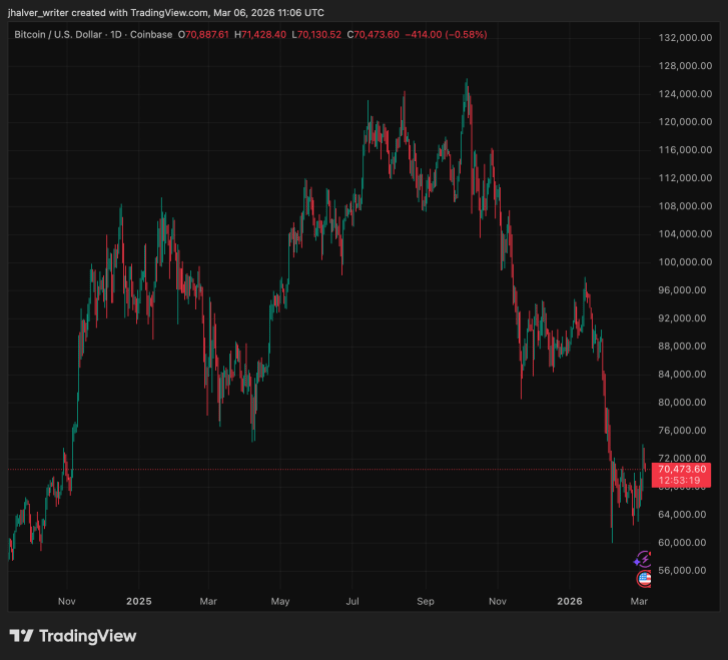
BTC's price trends to the downside on the daily chart. Source: BTCUSD on Tradingview

Cover image from ChatGPT, BTCUSD chart from Tradingview

Связанные с этим вопросы

QWhat is the Bank of Russia's new proposal regarding cryptocurrency exchanges?

AThe Bank of Russia has proposed allowing banks and brokerage firms to obtain licenses to operate crypto exchanges through a notification process based on their existing licenses.

QWhat is the primary reason given by Governor Elvira Nabiullina for this new crypto proposal?

AThe proposal aims to leverage the banking sector's infrastructure for anti-money laundering (AML) and countering the financing of terrorism and fraud (CFT) to better protect clients in the digital assets market.

QHow would crypto assets be treated under the draft rules, and what key restriction remains?

ACrypto and stablecoins would be treated as 'currency valuables,' meaning Russians can own and trade them, but using them as a domestic means of payment would remain restricted.

QWhat risk limitation does the Central Bank propose for banks involved in crypto assets?

AThe Central Bank proposes to limit the level of risk a bank takes in this area to one percent of its capital as a temporary measure.

QHow has Russia's overall stance on cryptocurrency evolved from 2020 to the present, according to the article?

ARussia has evolved from recognizing digital assets as property but banning them as payment in 2020, to flirting with a full ban in 2022, and then shifting to a 'regulate, don't ban' approach. By 2024-2025, it allowed limited cross-border use, legalized mining, and is now opening the market to banks and qualified investors to pull activity onshore and tax it.

Похожее

380,000 Apps Exposed, 2,000+ Apps Leaked Secrets: AI Programming Turns 'Intranet' into Public Internet

Israeli cybersecurity firm RedAccess uncovered a severe data exposure trend linked to "vibe coding" or AI-powered software development tools. Their research found approximately 38,000 publicly accessible web applications built with platforms like Lovable, Base44, Netlify, and Replit. Of these, an estimated 2,000 apps exposed sensitive corporate and personal data, including medical records, financial information, internal strategic documents, and customer chat logs. In some cases, access even granted administrative privileges. The core issue stems from default privacy settings that make applications public by default, combined with a lack of built-in security controls (like authentication) in the AI-generated code. This allows employees without security expertise—"citizen developers"—to easily create and deploy applications that bypass standard corporate security reviews. The exposed apps, often indexed by search engines, are trivially discoverable. While some platform providers (Replit, Lovable, Wix/Base44) argue that security configuration is the user's responsibility and question the validity of some findings, security researchers confirm the widespread reality of such exposures. This pattern, also noted in prior studies, highlights a critical security gap as AI democratizes app creation, potentially leading to massive, unintentional data leaks.

marsbit31 мин. назад

380,000 Apps Exposed, 2,000+ Apps Leaked Secrets: AI Programming Turns 'Intranet' into Public Internet

marsbit31 мин. назад

Attracting Global Capital, Asia's New 'Super Cycle' Is Unfolding

Investors are turning to Asia as the next frontier for global equity growth, with a new "super cycle" unfolding across the region. Driven by the AI revolution, Asian markets, particularly South Korea, have seen significant rallies. According to Morgan Stanley analysis, the underlying drivers of Asia's industrial cycle are shifting from traditional sectors like real estate and manufacturing to massive investments in AI infrastructure, energy security and transition, and supply chain resilience. Fixed asset investment in Asia is projected to grow from around $11 trillion in 2025 to $16 trillion by 2030, with a 7% annual growth rate from 2026-2030. The AI wave is a primary catalyst, driving immense capital expenditure for chips, servers, data centers, and power systems. Asia is central to this hardware supply chain. In China, AI investment is focused on building a full-system domestic capability, with the local AI chip market potentially reaching $86 billion by 2030. Beyond AI, China's export story is expanding from EVs and batteries to robotics. The country already captures about half of new global industrial robot demand and over 90% of humanoid robot shipments. This growth phase mirrors the early stages of China's EV export boom. Simultaneously, energy security investments, spurred by AI's massive power needs, are rising, with China benefiting from its leadership in solar, batteries, and EVs. Regional defense spending is also increasing structurally, supporting demand for advanced manufacturing. The main beneficiaries are China, South Korea, and Japan, positioned in core supply chain areas. However, risks remain, including potential overcapacity, profit margin pressures from competition, persistent technological restrictions, geopolitical friction, and workforce displacement due to AI-driven automation. Market volatility is also expected to increase as investor expectations diverge on the realization of these capital investment and export themes.

marsbit32 мин. назад

Attracting Global Capital, Asia's New 'Super Cycle' Is Unfolding

marsbit32 мин. назад

Funding Weekly Report | 14 Public Funding Events, Kalshi Completes $10B New Funding Round at $220B Valuation Led by Coatue Management

Weekly Funding Roundup: 14 Deals and $10.49B+ in Total Funding, Led by Kalshi's $1B Round Last week (5.4-5.10) saw 14 notable funding events in the global blockchain ecosystem, raising over $10.49 billion in total. Key highlights include Kalshi, a prediction market platform, securing a $1 billion round led by Coatue Management, reaching a $22 billion valuation. The platform now boasts ~2 million MAUs and $178B in annualized trading volume. In DeFi, regulated on-chain reinsurer OnRe raised $5 million in Series A funding, and Bitcoin-backed credit protocol Saturn Credit completed a $2 million seed round. For Infrastructure & Tools, OpenTrade raised $17 million to expand its stablecoin yield infrastructure, and RWA platform Balcony secured $12.7 million to deploy its property settlement service in the US. Centralized Finance saw one deal: AI-driven trading platform Stockcoin.ai completed a seed round led by Amber Group. In the prediction market sector alongside Kalshi, AI-powered platform Elastics raised $2 million. Other notable deals include SC Ventures' strategic investment in crypto market maker GSR and Centrifuge securing a "seven-figure" investment from Coinbase to become a core RWA partner for Base. On the investor side, Haun Ventures raised a new $1 billion fund targeting crypto and AI, and Multi Investment raised ~$616 million to focus on blockchain and Web3 investments.

marsbit1 ч. назад

Funding Weekly Report | 14 Public Funding Events, Kalshi Completes $10B New Funding Round at $220B Valuation Led by Coatue Management

marsbit1 ч. назад

Торговля

Спот
Фьючерсы

Популярные статьи

Как купить BAN

Добро пожаловать на HTX.com! Мы сделали приобретение Comedian (BAN) простым и удобным. Следуйте нашему пошаговому руководству и отправляйтесь в свое крипто-путешествие.Шаг 1: Создайте аккаунт на HTXИспользуйте свой адрес электронной почты или номер телефона, чтобы зарегистрироваться и бесплатно создать аккаунт на HTX. Пройдите удобную регистрацию и откройте для себя весь функционал.Создать аккаунтШаг 2: Перейдите в Купить криптовалюту и выберите свой способ оплатыКредитная/Дебетовая Карта: Используйте свою карту Visa или Mastercard для мгновенной покупки Comedian (BAN).Баланс: Используйте средства с баланса вашего аккаунта HTX для простой торговли.Третьи Лица: Мы добавили популярные способы оплаты, такие как Google Pay и Apple Pay, для повышения удобства.P2P: Торгуйте напрямую с другими пользователями на HTX.Внебиржевая Торговля (OTC): Мы предлагаем индивидуальные услуги и конкурентоспособные обменные курсы для трейдеров.Шаг 3: Хранение Comedian (BAN)После приобретения вами Comedian (BAN) храните их в своем аккаунте на HTX. В качестве альтернативы вы можете отправить их куда-либо с помощью перевода в блокчейне или использовать для торговли с другими криптовалютами.Шаг 4: Торговля Comedian (BAN)С легкостью торгуйте Comedian (BAN) на спотовом рынке HTX. Просто зайдите в свой аккаунт, выберите торговую пару, совершайте сделки и следите за ними в режиме реального времени. Мы предлагаем удобный интерфейс как для начинающих, так и для опытных трейдеров.

643 просмотров всегоОпубликовано 2024.10.27Обновлено 2025.03.21

Как купить BAN

Обсуждения

Добро пожаловать в Сообщество HTX. Здесь вы сможете быть в курсе последних новостей о развитии платформы и получить доступ к профессиональной аналитической информации о рынке. Мнения пользователей о цене на BAN (BAN) представлены ниже.

活动图片