From Ban Threats To Bank Licenses: Russia’s New Crypto Play

bitcoinistОпубликовано 2026-03-07Обновлено 2026-03-07

Введение

The Bank of Russia has proposed allowing banks and brokerage firms to obtain licenses to operate cryptocurrency exchanges through a simplified notification process based on existing licenses. Central Bank Governor Elvira Nabiullina stated that this move aims to leverage the banking sector’s experience in anti-money laundering and fraud prevention to protect digital asset market clients. Under the proposal, crypto and stablecoins would be classified as "currency valuables"—permissible for ownership and trading but restricted as a domestic payment method. Banks would face a temporary risk cap of 1% of their capital when dealing with crypto. Qualified investors may trade without limits, while non-qualified investors are restricted to purchasing up to 300,000 rubles annually per intermediary. This regulatory shift reflects Russia’s gradual move from hostility toward crypto to tightly managed acceptance, with the goal of bringing activity onshore, enforcing taxation, and sidelining unlicensed foreign platforms. The central bank aims to finalize the legal framework by mid-2026.

The Bank of Russia has proposed letting banks and brokerage firms obtain licenses to operate crypto exchanges.

A New Crypto Play

A report published by Interfax on March 5 states that The Central Bank of Russia (CBR) Governor Elvira Nabiullina has proposed to allow banks and brokers to obtain crypto exchange licenses via a notification process, as based on their current licenses. This statement was made at the annual meeting of lending institutions with the Central Bank.

According to Nabiullina, the proposal aims to leverage the banking sector’s infrastructure for fighting money laundering and countering the financing of terrorism and fraud in order to better protect digital assets market clients. In what appears to be a conciliatory move between regulators and digital asset’s traders, Nabiullina directly addresses some of the main concerns typically raised by TradFi when arguing against crypto assets:

We hope that your extensive banking experience in AML/CFT [anti-money laundering and countering the financing of terrorism], as well as your experience in countering fraud, will help protect your clients in the crypto market once it is legalized.

The Crypto Proposal

The exchange permissions being notification‐based means that institutions could bolt cryptocurrency services onto existing financial licenses instead of going through a separate, standalone approval process.

Under the draft rules, crypto and stablecoins would be treated as “currency valuables”: Russians could own and trade them but using them as a domestic means of payment would remain restricted.

Regarding the risk level, Naibullina remain cautious. She clarified that there would be a temporary threshold for banks’ involvement in the asset class:

However, we would still like to limit the level of risk a bank takes in this area to one percent of capital. Let’s start by seeing how banks operate within the one percent cap, and then see whether we need to move forward.

According to the Interfax report, qualified investors may acquire crypto assets without restrictions, while non-qualified investors are limited to purchasing up to 300,000 rubles per year through a single intermediary. The proposal effectively turns banks into the primary regulated gateways for digital asset trading.

Russia’s Back-And-Forth

Since 2020, Russia has recognized digital assets as property but banned them as a means of payment. Russia flirted with a full ban in 2022 and then shifted to “regulate, don’t ban.” By 2024–2025, Russia allowed limited cross‐border use, legalized mining, and opened the market only to banks and “super qualified” investors, keeping retail, P2P, and foreign platforms in a gray zone.

A Change In The Tide

Russia has slowly but surely moved from hostility to tightly managed acceptance: the new push to license banks and brokers as cryptocurrency intermediaries is about pulling activity onshore, taxing it, preserving capital controls, and sidelining unlicensed foreign exchanges rather than outlawing crypto itself.

The central bank is pushing to finish the broader legal framework by mid‐2026, after which penalties for unlicensed intermediaries and offshore platforms that do not localize in Russia are expected to kick in.

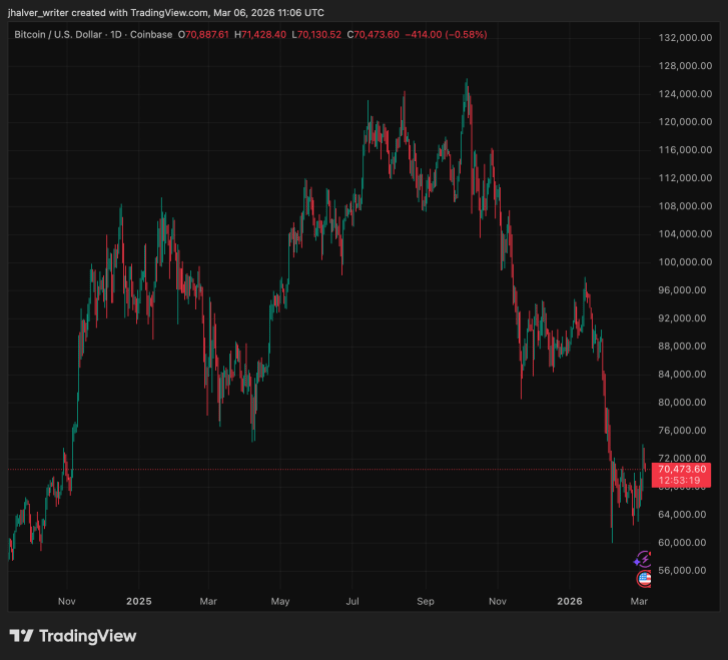
BTC's price trends to the downside on the daily chart. Source: BTCUSD on Tradingview

Cover image from ChatGPT, BTCUSD chart from Tradingview

Связанные с этим вопросы

QWhat is the Bank of Russia's new proposal regarding cryptocurrency exchanges?

AThe Bank of Russia has proposed allowing banks and brokerage firms to obtain licenses to operate crypto exchanges through a notification process based on their existing licenses.

QWhat is the primary reason given by Governor Elvira Nabiullina for this new crypto proposal?

AThe proposal aims to leverage the banking sector's infrastructure for anti-money laundering (AML) and countering the financing of terrorism and fraud (CFT) to better protect clients in the digital assets market.

QHow would crypto assets be treated under the draft rules, and what key restriction remains?

ACrypto and stablecoins would be treated as 'currency valuables,' meaning Russians can own and trade them, but using them as a domestic means of payment would remain restricted.

QWhat risk limitation does the Central Bank propose for banks involved in crypto assets?

AThe Central Bank proposes to limit the level of risk a bank takes in this area to one percent of its capital as a temporary measure.

QHow has Russia's overall stance on cryptocurrency evolved from 2020 to the present, according to the article?

ARussia has evolved from recognizing digital assets as property but banning them as payment in 2020, to flirting with a full ban in 2022, and then shifting to a 'regulate, don't ban' approach. By 2024-2025, it allowed limited cross-border use, legalized mining, and is now opening the market to banks and qualified investors to pull activity onshore and tax it.

Похожее

What's the Connection Between Pinduoduo's Huang Zheng and Blockchain?

This text explores the unexpected connection between Pinduoduo founder Colin Huang and blockchain, as suggested in his article *Turning Capitalism Upside Down*. Huang argues Pinduoduo's core business is about managing "uncertainty." He posits that wealth flows to the rich because they absorb life's uncertainties (e.g., illness, job loss) that devastate the poor, who pay a premium for certainty through insurance or stable prices. Pinduoduo's model attempts a "reverse insurance": by aggregating consumer demand via group-buying and flash sales, it creates a large, predictable order for manufacturers. This certainty allows factories to remove risk premiums, passing savings back as lower prices, thus partially reversing the wealth flow. The key obstacle, Huang notes, is that an individual's buying intent is an unreliable promise. He then asks if blockchain is the natural solution for this "reverse insurance." The text elaborates that blockchain, through smart contracts with binding deposits, could transform casual intent into a costly-to-break, enforceable commitment. This replaces interpersonal trust with coded rules, making promises credible, pricable, and resistant to fraud. Finally, the author draws a parallel to Bitcoin, framing two paths to creating certainty: the "Pinduoduo path" of aggregating decentralized will into scale, and the "Bitcoin path" of locking rules into immutable code. Both sacrifice something—personal freedom or system flexibility—to manufacture trust and predictability.

链捕手39 мин. назад

What's the Connection Between Pinduoduo's Huang Zheng and Blockchain?

链捕手39 мин. назад

The Storage Magnate Who Conquered a Trillion-Dollar Kingdom, Yet Ultimately Could Not Become the Richest

**Summary:** "The Memory Magnate Who Built a Trillion-Dollar Empire, Yet Never Became the Richest" explores the journey of Zhu Yiming, founder of GigaDevice (603986) and co-founder of the soon-to-IPO ChangXin Memory Technologies (CXMT). The article positions GigaDevice, a fabless chip designer now valued at ~¥340 billion, as a prequel to the massive IDM (Integrated Device Manufacturer) venture, CXMT. Starting in 2005 with minimal capital, Zhu strategically "picked up the pieces" by focusing on niche markets like NOR Flash and microcontrollers (MCUs), areas major players were exiting. This allowed GigaDevice to grow into a diversified semiconductor company, maintaining robust profitability even during industry downturns by controlling costs. However, the piece argues that in the highly cyclical and capital-intensive memory chip industry, the fabless model has limits. True resilience and scale require the ability for "counter-cyclical expansion" – investing heavily during downturns – a tactic only possible for IDMs like Samsung or SK Hynix. This insight led Zhu to partner with the Hefei city government in 2016 to establish CXMT, an IDM focused on DRAM. Zhu's symbolic moves, like forfeiting salary and diluting his equity, were crucial in securing the massive state and bank funding needed. CXMT's equipment base is now valued even higher than that of BYD's vast auto manufacturing empire. Despite the potential for CXMT to reach a market cap of ¥1-2 trillion upon its IPO, Zhu's indirect stake in both companies is estimated below 3%, placing his personal wealth far below that of China's top billionaires. The article concludes that his strategic vision built a trillion-yuan memory landscape, but the capital structure necessary to achieve it precluded a personal fortune of similar scale.

marsbit46 мин. назад

The Storage Magnate Who Conquered a Trillion-Dollar Kingdom, Yet Ultimately Could Not Become the Richest

marsbit46 мин. назад

XRP Ledger Daily Fees Drop Below $400 As Network Activity Question Returns

The XRP Ledger is drawing attention as daily network fees have fallen below $400. While low fees align with XRPL's design for affordable transactions and are often seen as a strength, the metric can also serve as an indicator of network demand and paid transaction volume. This data point of around $3,100 in weekly fee burn highlights the stark contrast with higher-fee chains like Ethereum and Bitcoin. The development fuels an ongoing debate. Proponents view low fees as a sign of efficiency and accessibility, while critics may question if the network is generating sufficient high-value activity relative to its market cap and payments-focused narrative. The article cautions against overstating the finding, noting a single low-fee day does not signify network failure. It instead adds context to discussions about XRPL's usage, especially alongside Ripple's broader initiatives in stablecoins (RLUSD), AI payments, and enterprise infrastructure. The report recommends monitoring for a fee rebound, checking transaction counts for a fuller picture, and confirming the trend via native explorers like Bithomp. It frames the story within a larger market shift where on-chain data, protocol updates, and infrastructure developments are becoming crucial alongside price action. The editorial stance is to present the verified data, explain its significance for assessing network activity, and avoid hype, positioning it as part of the daily crypto conversation.

bitcoinist5 ч. назад

XRP Ledger Daily Fees Drop Below $400 As Network Activity Question Returns

bitcoinist5 ч. назад

Торговля

Спот
Фьючерсы

Популярные статьи

Как купить BAN

Добро пожаловать на HTX.com! Мы сделали приобретение Comedian (BAN) простым и удобным. Следуйте нашему пошаговому руководству и отправляйтесь в свое крипто-путешествие.Шаг 1: Создайте аккаунт на HTXИспользуйте свой адрес электронной почты или номер телефона, чтобы зарегистрироваться и бесплатно создать аккаунт на HTX. Пройдите удобную регистрацию и откройте для себя весь функционал.Создать аккаунтШаг 2: Перейдите в Купить криптовалюту и выберите свой способ оплатыКредитная/Дебетовая Карта: Используйте свою карту Visa или Mastercard для мгновенной покупки Comedian (BAN).Баланс: Используйте средства с баланса вашего аккаунта HTX для простой торговли.Третьи Лица: Мы добавили популярные способы оплаты, такие как Google Pay и Apple Pay, для повышения удобства.P2P: Торгуйте напрямую с другими пользователями на HTX.Внебиржевая Торговля (OTC): Мы предлагаем индивидуальные услуги и конкурентоспособные обменные курсы для трейдеров.Шаг 3: Хранение Comedian (BAN)После приобретения вами Comedian (BAN) храните их в своем аккаунте на HTX. В качестве альтернативы вы можете отправить их куда-либо с помощью перевода в блокчейне или использовать для торговли с другими криптовалютами.Шаг 4: Торговля Comedian (BAN)С легкостью торгуйте Comedian (BAN) на спотовом рынке HTX. Просто зайдите в свой аккаунт, выберите торговую пару, совершайте сделки и следите за ними в режиме реального времени. Мы предлагаем удобный интерфейс как для начинающих, так и для опытных трейдеров.

757 просмотров всегоОпубликовано 2024.10.27Обновлено 2026.06.02

Как купить BAN

Обсуждения

Добро пожаловать в Сообщество HTX. Здесь вы сможете быть в курсе последних новостей о развитии платформы и получить доступ к профессиональной аналитической информации о рынке. Мнения пользователей о цене на BAN (BAN) представлены ниже.

活动图片