Franklin Templeton brings ETFs on-chain as Ethereum hosts over $13B in tokenized assets

ambcryptoОпубликовано 2026-03-25Обновлено 2026-03-25

Введение

Franklin Templeton is launching two ETFs that can be traded directly through crypto wallets 24/7, marking a shift in how traditional financial products are accessed. One fund tracks the S&P 500, while the other focuses on short-term U.S. Treasuries. Both will be issued on Ethereum, enabling peer-to-peer trading without relying on traditional brokers or market hours. The move aligns with the growing tokenized real-world asset market on Ethereum, which has reached approximately $13.6 billion in value, with U.S. Treasury products making up the majority at $11.8 billion. The firm is collaborating with Ondo Finance to support the tokenized distribution of the funds.

Franklin Templeton is launching two exchange-traded funds that can be traded directly through crypto wallets around the clock. It marks a shift in how traditional financial products are accessed and settled.

The move brings equity and bond exposure onto blockchain rails, at a time when tokenized assets on Ethereum alone are approaching $13.6 billion.

The asset manager said the funds — one tracking the S&P 500 and another focused on short-term U.S. Treasuries — will be issued on Ethereum and available for trading 24/7.

Investors will be able to buy, sell, and hold shares using self-custody wallets, removing the need for traditional brokerage accounts and standard market hours.

Franklin Templeton is also working with Ondo Finance to support the tokenized distribution of the funds.

According to Bloomberg, the collaboration will allow the ETFs to trade in crypto wallets continuously, bypassing the brokerage infrastructure that has traditionally defined ETF access.

Franklin Templeton launches ETFs that trade directly in crypto wallets

The two ETFs are designed as fully on-chain products, allowing peer-to-peer trading without relying on centralized intermediaries.

While access through traditional brokers will still be supported, the core functionality shifts toward wallet-based ownership and transfer.

Franklin Templeton said the funds will operate under a hybrid structure, allowing shares to be created or redeemed in both fiat currency and stablecoins. This model is intended to bridge conventional financial systems with blockchain-based settlement.

The firm has already expanded its digital asset footprint in recent years. This includes the launch of an on-chain money market fund and is now extending that approach to broader asset classes.

How the funds work without brokers or market hours

Unlike traditional ETFs, which are limited by exchange trading hours and settlement timelines, the new funds are designed to function continuously. Transactions can occur at any time, with ownership recorded directly on-chain.

This setup reduces reliance on intermediaries and shortens settlement cycles, while giving investors direct control over their holdings through self-custody wallets.

The funds will also be compatible with platforms that support on-chain settlement, allowing participation from both crypto-native users and traditional investors.

Tokenized assets on Ethereum near $13.6B as Treasuries dominate growth

Franklin Templeton’s move comes as tokenized real-world assets continue to expand on Ethereum.

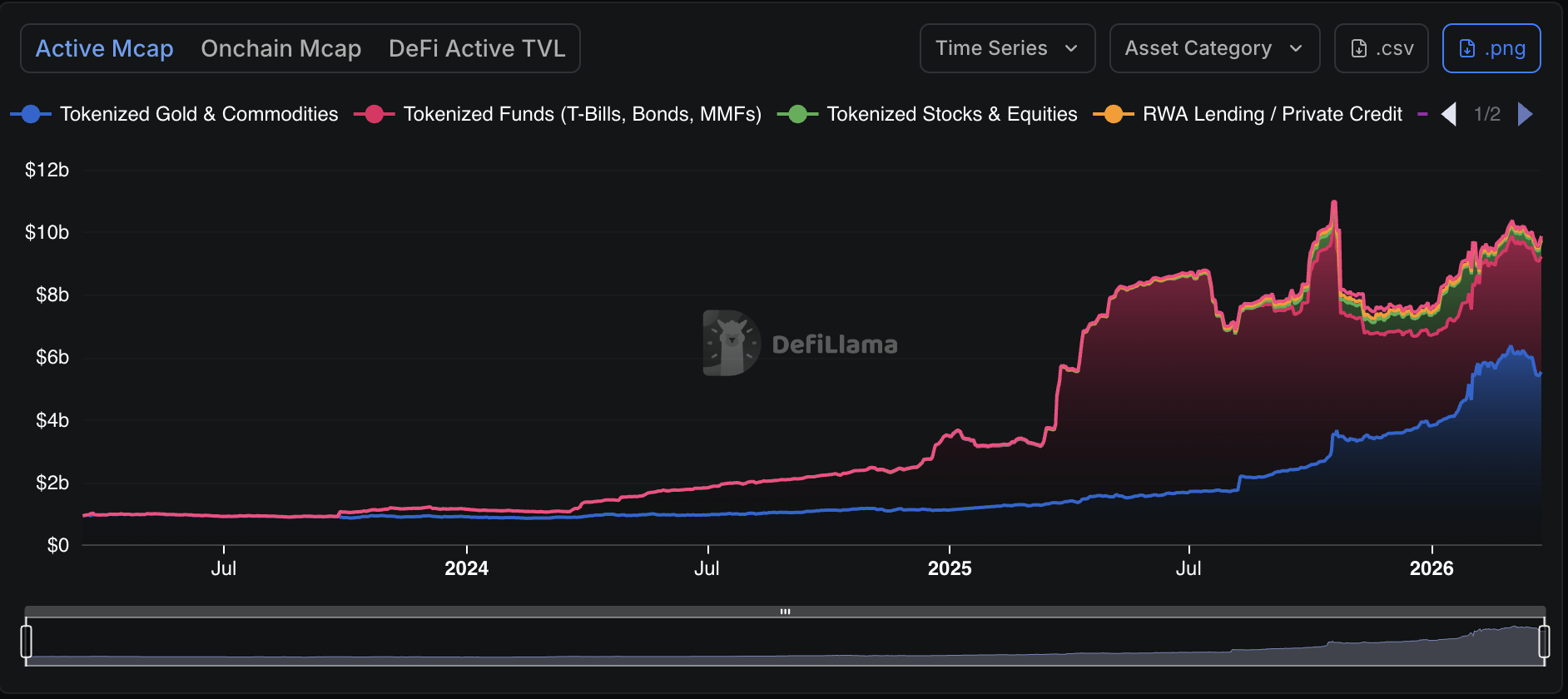
Data shows total on-chain RWA market capitalization on the network has reached approximately $13.6 billion. Also, around $9.86 billion is actively circulating across 36 issuers.

Source: DefiLlama

Within that market, tokenized U.S. Treasury products account for roughly $11.8 billion, making them the largest segment.

This aligns closely with Franklin Templeton’s decision to include a Treasury-focused ETF, suggesting the firm is targeting an already established demand base.

Growth has accelerated since 2024, with tokenized funds and credit products driving most of the expansion. The trend points to increasing institutional participation, as asset managers test blockchain-based distribution and settlement models.

The ETFs are expected to launch in the coming weeks, pending regulatory clearance.


Final Summary

  • Franklin Templeton’s ETFs shift trading from broker-led systems to wallet-based, 24/7 access on Ethereum.
  • The launch aligns with a $13.6B tokenized asset market where Treasuries already dominate demand.

Связанные с этим вопросы

QWhat is Franklin Templeton launching and on which blockchain?

AFranklin Templeton is launching two exchange-traded funds (ETFs) that can be traded directly through crypto wallets, and they are being issued on the Ethereum blockchain.

QHow do these new ETFs differ from traditional ETFs in terms of trading and settlement?

AUnlike traditional ETFs limited by exchange hours and settlement timelines, these new funds can be traded 24/7 with transactions settled directly on-chain, reducing reliance on intermediaries and allowing peer-to-peer trading.

QWhat is the total value of tokenized real-world assets on Ethereum mentioned in the article?

AThe total on-chain real-world asset market capitalization on Ethereum has reached approximately $13.6 billion.

QWhich type of tokenized asset dominates the current on-chain market, and what is its approximate value?

ATokenized U.S. Treasury products dominate the market, accounting for roughly $11.8 billion of the total tokenized assets on Ethereum.

QWho is Franklin Templeton collaborating with to support the tokenized distribution of these funds?

AFranklin Templeton is working with Ondo Finance to support the tokenized distribution of the funds.

Похожее

Uncovering the Truth About Agent Commerce, Payments, and Infrastructure

Decoding Agent Commerce, Payments, and Infrastructure: The Reality Over the past year, I've been building infrastructure for the Agent economy, engaging with major players like Stripe, Visa, Coinbase, Google, and dozens of startups. A clear conclusion emerges: true, large-scale demand does not yet exist. Startups face structural challenges. Data points illustrate this gap. Stripe's Agent commerce platform has over 1,000 merchants but only single-digit transacting agents. Visa's Agent payment token requires 9-month KYC and a $250M revenue threshold, accessible only to giants like Amazon. On-chain analysis reveals actual daily Agent transaction volume is around $17k, half of which are test transactions. The article analyzes four potential markets: **1. Agent-to-Merchant (A2M):** Current AI shopping UX is often inferior to traditional e-commerce for visual, comparison-heavy purchases (clothing, electronics). Chat interfaces are a step back. Real merchant interest is defensive "Agent Engine Optimization," fearing future obsolescence, not current demand. Potential exists in high-frequency, low-decision purchases (e.g., food delivery) or simplifying terrible UX (complex checkouts, non-native shoppers), but these require massive consumer distribution channels dominated by giants like DoorDash and Amazon. **2. Agent-to-API (A2A):** Developers already have subscriptions and billing for core APIs (compute, data). The argument for micro-payments via crypto for sub-dollar API calls is addressed by pre-paid balances today. The deeper issue is supplier resistance; major SaaS firms rely on enterprise contracts, not fractional cent pricing. Opportunity lies in the long tail of niche services, but this is a smaller market catering to developers, a historically low-paying group. **3. Agent-to-Agent (A2A):** This remains a theoretical long-term vision with near-zero current transaction volume. It involves unique challenges: discovery, trust, negotiation, dispute resolution. When it materializes, it will require a fundamentally new settlement infrastructure for high-speed, variable-value, multi-party transactions. It's a real long-term bet, but not the current market. **4. Agent-to-Finance (A2F):** This is the only category with existing, paying demand. Integrating AI into financial workflows (trading, portfolio management) is a natural evolution and enables new capabilities like autonomous rebalancing. However, competition favors incumbents with regulatory licenses, compliance infrastructure, and existing client relationships. **The Real Issue:** Why is infrastructure still being built? Incumbents can afford long-term bets, and payment companies see every problem as a nail for their payment hammer. However, payment is just one piece. The core challenge is *coordination*—orchestrating work between Agents and humans, verifying outcomes, and settling results. Payment is part of settlement, which is part of coordination. Companies that solve the coordination problem will subsume payments, not the other way around. Startups lack the infinite runway of giants and must find today's real market, which, after a year of exploration, lies outside these four categories—in an area with real, growing, and underserved activity.

marsbit5 ч. назад

Uncovering the Truth About Agent Commerce, Payments, and Infrastructure

marsbit5 ч. назад

Торговля

Спот
Фьючерсы

Популярные статьи

Manyu: восходящая мем-звезда на Ethereum, готовая открыть новую эру культуры Shiba

Manyu - это мемтокен на Ethereum, который приносит децентрализованную культурную и развлекательную ценность через вирусное влияние в соцсетях и вовлечённость сообщества.

1.9k просмотров всегоОпубликовано 2025.11.27Обновлено 2025.11.27

Manyu: восходящая мем-звезда на Ethereum, готовая открыть новую эру культуры Shiba

Неделя обучения по популярным токенам 14: Glamsterdam — самое ожидаемое обновление Ethereum в 2026 году

Ordinals/Runes по-прежнему стимулируют доходы от комиссий за блоки и активность разработчиков, рассматриваются как отправная точка «нативной эмиссии активов» в сети.

1.5k просмотров всегоОпубликовано 2026.04.29Обновлено 2026.04.29

Неделя обучения по популярным токенам 14: Glamsterdam — самое ожидаемое обновление Ethereum в 2026 году

Обсуждения

Добро пожаловать в Сообщество HTX. Здесь вы сможете быть в курсе последних новостей о развитии платформы и получить доступ к профессиональной аналитической информации о рынке. Мнения пользователей о цене на ETH (ETH) представлены ниже.

活动图片