First Primary Battle: How Is the Crypto Industry Heavily Betting on the Continuation of Trump's Agenda?

比推Опубликовано 2026-03-04Обновлено 2026-03-04

Введение

The 2026 US midterm primary season begins, with crypto industry super PACs like Fairshake deploying over $288 million to influence key races in Texas, North Carolina, and Arkansas. Their goal is to elect pro-crypto candidates and secure a "pro-crypto Congress" to pass the stalled CLARITY Act, which aims to clarify SEC/CFTC regulatory roles and allow institutional crypto adoption. In Texas, PACs are targeting anti-crypto Democrat Al Green while supporting opponents like Christian Menefee. Similar efforts are underway in North Carolina to unseat incumbents seen as obstacles. The industry is heavily aligned with Trump’s pro-crypto agenda, following his signing of the GENIUS Act for stablecoins in 2025. With the CLARITY Act stuck in the Senate due to partisan disputes and election-year politics, crypto groups are spending heavily in primaries to ensure legislative support. The outcome could determine whether Trump’s crypto policies, like Bitcoin reserves and DeFi deregulation, move forward or face further delays.

Author: Sanqing, Foresight News

Original Title: U.S. Midterm Elections Kick Off, Crypto Industry Heavily Backs Trump's Pro-Crypto Agenda


March 3 (Eastern Time) marked the official start of the 2026 U.S. midterm election primary season. Voters in Texas, North Carolina, and Arkansas were the first to cast their votes, deciding the nominees for several congressional Senate and House seats. This early battle, seen as a bellwether for the continuation of the "Trump era," not only impacts the power dynamics in Congress but also directly relates to the long-awaited process of regulatory clarity for the crypto industry.

The crypto industry's involvement this time is earlier and heavier than in the 2024 cycle. Fairshake and its affiliated super political action committees (PACs, including Protect Progress, Defend American Jobs, etc.) started the year with nearly $200 million in cash on hand, with total industry contributions exceeding $288 million. Their goal is to secure a "pro-crypto Congress," push through remaining legislation like the "CLARITY Act" (Digital Asset Market Clarity Act), and avoid permanent setbacks due to election-year delays.

Three-State Primaries: Crypto PACs' Precise "Sniping" and "Escort"

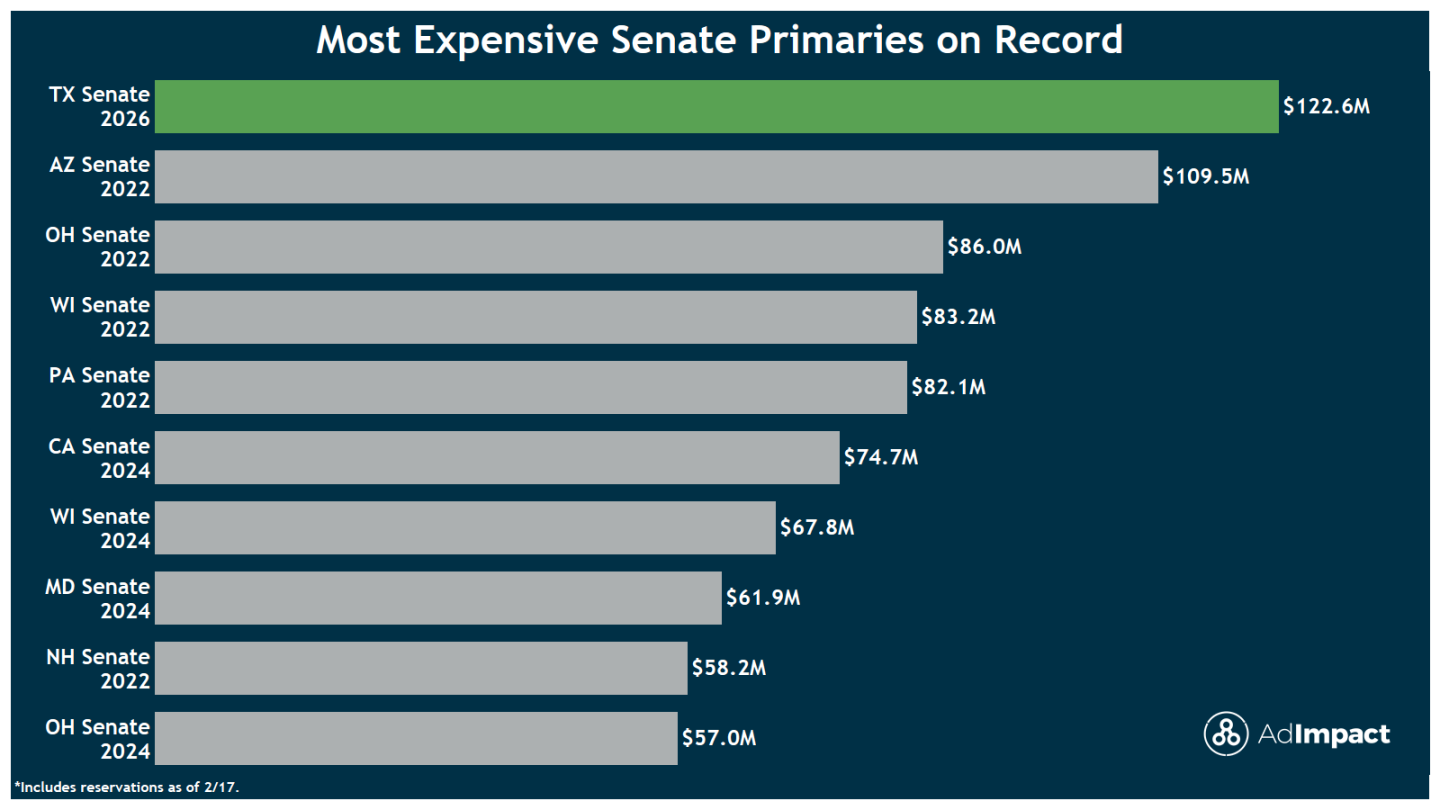
According to data from political ad tracking platform AdImpact, ad spending related to the Texas Senate primary alone has exceeded $122 million, making it the most expensive Senate primary in history.

Image Source: AdImpact Blogs | Data as of February 27

The crypto industry's political strategy has become highly sophisticated: adhering to the principle of "pro-crypto in, anti-crypto out," no longer blindly aligning with a single party.

Texas has become one of the crypto industry's most significant battlegrounds. Protect Progress has announced a $1.5 million ad buy to publicly oppose Democratic Representative Al Green.

Green previously voted against the "GENIUS Act" signed by Trump and has consistently obstructed the "CLARITY Act," earning a "strongly anti-crypto" rating from Stand With Crypto. His opponent, Christian Menefee, is rated "strongly pro-crypto."

Crypto PACs like Web3 Forward have also funneled indirect support worth millions of dollars to Democratic Senate candidate Jasmine Crockett through media ads and other means.

Crockett previously voted for the "GENIUS Act" and FIT21 (a precursor to the "CLARITY Act") but explicitly opposed the final version of the "CLARITY Act."

North Carolina is also seeing intense action. Crypto funds have injected $500,000 to support Republican challenger Laurie Buckhout in her bid to unseat Democratic incumbent Representative Don Davis (NC-01 district). Davis narrowly defeated Buckhout in 2024; with the district now leaning more Republican after redistricting, the crypto industry hopes to capitalize on this opportunity for a change.

Meanwhile, Democratic incumbent Representative Valerie Foushee in the NC-04 district primary is facing an intra-party challenge from progressive candidate Nida Allam. Foushee accepted crypto-related donations in 2022, but the primary focus this year has shifted to data center and AI issues. The crypto industry clearly hopes to use this opportunity to further ensure key positions, like those on the House Financial Services Committee, are held by more steadfast allies.

While Arkansas hasn't seen massive single investments, as one of the Senate seat races, its primary outcome will affect the Republican Party's slim majority in the Senate—a core variable in the "CLARITY Act" being stalled there.

Trump Term Effect: From "Candidate Promise" to "Presidential Push"

At the start of his second term, Trump designated crypto as a national strategic priority. He publicly declared his intention to make the U.S. the "global crypto capital" and directly called out Wall Street banks on social media, stating they "must make a good deal with the crypto industry," otherwise the "CLARITY Act" would go to China.

White House Crypto Policy Advisor Patrick Witt更是直言, regulatory clarity would unlock "trillions of dollars" in institutional funds waiting on the sidelines.

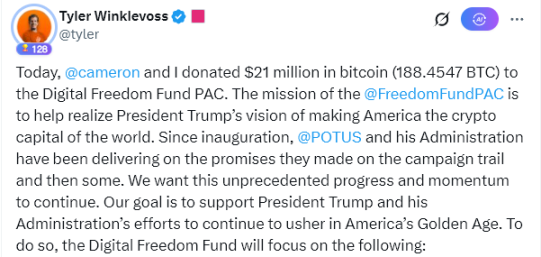
Because of this, the crypto industry's "loyalty" to Trump is unprecedentedly high. Some founders have shifted to explicitly pro-Trump PACs like the Digital Freedom Fund, with Gemini exchange co-founders Cameron and Tyler Winklevoss contributing a single donation of $21 million in Bitcoin.

Image Source: Tyler's Tweet

The industry is no longer satisfied with "bipartisan balance" but is instead全力巩固 (working全力 to consolidate) the Republican majority, ensuring Trump's executive orders and legislative agenda proceed seamlessly.

If the primary results in these three states favor pro-crypto candidates, Trump's ability to execute crypto policies within 2026 is expected to significantly increase.

Conversely, if anti-crypto or neutral candidates break through, Trump's visions like the national Bitcoin reserve plan and DeFi regulatory loosening will face resistance.

Crypto Bill Progress: GENIUS Enacted, CLARITY Becomes an "Election Year Gamble"

Currently, crypto legislation has achieved a阶段性胜利 (phased victory). The "GENIUS Act" was signed into law by Trump in 2025, providing a clear path for dollar stablecoins like USDT and USDC, greatly boosting confidence in the RWA sector.

But the "CLARITY Act" remains stuck in the Senate. The House passed it in July 2025. The bill aims to clarify the regulatory分工 (division of labor) between the SEC and CFTC, define the nature of mature blockchain assets, and open channels for institutional entry.

However, the Senate Banking Committee has repeatedly delayed review due to controversies over "stablecoin收益权" (profit rights for stablecoins), "DeFi treatment," and "Trump family conflict of interest clauses."

Trump personally intervened, and the White House has多次召集 (convened multiple) closed-door meetings with bank and crypto executives, but the election-year reality looms: after July, Congress enters "campaign mode," leaving a very narrow window for the "CLARITY Act."

If Democrats regain the House majority in the midterms, or if Republicans face internal分裂 (splits), the "CLARITY Act" could be completely scrapped,甚至迎来监管反弹 (or even face a regulatory backlash).

The hundreds of millions from Fairshake and other PACs are essentially "buying insurance" for this scenario. They aim to "purge" opponents through the primaries, paving the way for the final Senate vote.

Results from the various districts in the three states will be announced today.


Twitter:https://twitter.com/BitpushNewsCN

Bitpush TG Discussion Group:https://t.me/BitPushCommunity

Bitpush TG Subscription: https://t.me/bitpush

Original Link:https://www.bitpush.news/articles/7616715

Связанные с этим вопросы

QWhat is the main goal of the crypto industry's significant financial investment in the 2026 U.S. midterm elections?

AThe crypto industry aims to secure a 'pro-crypto Congress' to advance regulatory clarity, particularly by pushing for the passage of the CLARITY Act and preventing election-year delays that could lead to permanent setbacks.

QWhich states are highlighted as key battlegrounds in the primary elections for crypto industry influence?

ATexas, North Carolina, and Arkansas are the key states where the crypto industry is heavily investing to influence primary election outcomes in favor of pro-crypto candidates.

QHow much money has the crypto industry allocated through Fairshake and its associated super PACs for the elections?

AFairshake and its associated super PACs, including Protect Progress and Defend American Jobs, have nearly $200 million in cash at the beginning of the year, with total industry contributions exceeding $288 million.

QWhat major crypto legislation has already been signed into law during Trump's second term, and what does it achieve?

AThe GENIUS Act was signed into law in 2025, providing a clear regulatory path for dollar stablecoins like USDT and USDC, which has significantly boosted confidence in the RWA (Real World Assets) sector.

QWhy is the CLARITY Act currently stalled in the Senate, and what are the risks if it is not passed?

AThe CLARITY Act is stalled in the Senate due to controversies over stablecoin profit rights, DeFi treatment, and clauses related to Trump family conflicts of interest. If not passed, it risks being completely abandoned, especially if Democrats regain the House majority or if Republican unity fractures, potentially leading to regulatory backlash.

Похожее

Apple's Desired On-Device AI Sees a Dark Horse Emerge: The First Cognitive Model is Born, 4B Matches GPT-5.4

A Chinese company, Tomorrow's Journey (Nextie), has introduced what it is calling the industry's first "cognitive model" for edge devices. Named New Journey Alpha, this 4-billion-parameter model reportedly matches the performance of trillion-parameter giants like GPT-5.4 in group intelligence tasks such as debate and collective decision-making. The development follows Andrej Karpathy's vision of stripping vast factual knowledge from large language models to retain only a smaller "cognitive core" capable of reasoning, planning, and knowing its own limits. This approach directly addresses the soaring computational costs and token expenses hindering AI's widespread deployment, as highlighted by incidents like Amazon shutting down an internal AI tool due to prohibitive costs. Trained via reinforcement learning on a corpus of academic papers from 1800-2020 to enhance generalization, the model enables three key advancements: 1) Improved decision quality in multi-agent systems, 2) Drastically reduced compute costs, allowing for cost-effective cloud or on-device (e.g., MacBook) deployment, and 3) The feasibility of "proactive" AI agents that act autonomously without user prompts, unlocking new commercial possibilities beyond today's reactive models. Built by the former Microsoft Xiaoice team—known for creating a 3.6B model that outperformed a 65B Llama model—the company is now focusing on the multi-agent systems sector, a field gaining significant investor interest. The model's economic impact is profound; by achieving high-level performance with minimal parameters, it fundamentally alters the cost structure of AI services, challenging the prevailing model of ever-larger parameter counts.

marsbit1 ч. назад

Apple's Desired On-Device AI Sees a Dark Horse Emerge: The First Cognitive Model is Born, 4B Matches GPT-5.4

marsbit1 ч. назад

OpenAI's 'Blueprint for the Future': Making AI Beneficial for Every Person on the Planet

A new transformative technology emerges every few generations. OpenAI draws a parallel with the advent of electricity in the 1920s, which initially brought convenience but ultimately enabled unprecedented progress in medicine, engineering, and living standards by empowering people to create new possibilities. AI is poised to recreate this phenomenon. Its true significance lies not in the technology itself, but in what people can achieve with it—from understanding a medical bill or starting a business to aiding scientific discovery. OpenAI believes AI should be universally accessible, allowing everyone to use it according to their own needs. This future, however, is not guaranteed. While transformative tech can centralize power, OpenAI's philosophy is that AI must serve humanity, augmenting human capabilities and broadly distributing its benefits. The company's first commitment is to build AI for human service, aiming to empower the many rather than concentrate power in a few. Safety, alignment with human intent, and oversight are paramount. OpenAI is optimistic about AI's potential to expand human welfare but remains clear-eyed about risks. The goal is to help people achieve more, not to replace them. Full automation is not the desired future; human judgment, values, and direction will become even more critical. OpenAI outlines three core goals: 1. Build automated AI researchers to accelerate and increasingly automate the research process itself, maintaining close human collaboration. The internal projection is that by March 2028, a significant portion of their research will be conducted by AI systems working alongside human researchers. 2. Accelerate economic development by advancing science, boosting productivity, and fostering growth, while ensuring the fruits are widely shared. 3. Provide a personal AGI for everyone on Earth, allowing individuals to benefit from this transformative technology in their own way. The company is entering its third phase, moving from foundational AGI research (Phase 1) to product deployment and learning from real-world use (Phase 2). The current challenge is making advanced AI abundant, affordable, safe, practical, and usable for all individuals and organizations. OpenAI concludes that a widely distributed power structure leads to a more resilient, adaptable, and free society. A positive AI future should not be controlled by a handful of entities but built, benefited from, and owned by many. If realized correctly, AI can become a cornerstone for enhancing global productivity, creativity, scientific advancement, and economic opportunity, fulfilling the mission to ensure AGI benefits all of humanity.

marsbit1 ч. назад

OpenAI's 'Blueprint for the Future': Making AI Beneficial for Every Person on the Planet

marsbit1 ч. назад

Arthur Hayes' New Article: AI Bubble Nears Bursting, Crypto Market Faces Short-Term Pressure

In a new essay, Arthur Hayes argues that the AI market bubble is approaching a rupture, which will place significant short-term pressure on crypto assets. He identifies rising oil prices, a trio of massive tech IPOs (SpaceX, Anthropic, OpenAI), and potential anti-AI political rhetoric from Trump as the three key catalysts for a correction. Hayes posits that the prolonged blockage of the Strait of Hormuz will drive energy prices higher, increasing operational costs for data centers and squeezing AI company profits. Simultaneously, the market may struggle to absorb the upcoming wave of multi-trillion dollar tech IPOs. Furthermore, with high inflation hurting his election chances, Trump could pivot to attacking the AI sector with proposals for heavy taxation and regulation to win over voters, spooking the market. Hayes notes that nearly all new dollar liquidity since 2022 has flowed into the AI sector, leaving little for Bitcoin, explaining its recent underperformance. He believes an AI stock crash would trigger a broad risk-off sentiment and credit contraction, dragging down crypto in the near term. Consequently, his fund, Maelstrom, has sold all AI-related stocks and non-core cryptocurrencies, retaining only Bitcoin and Ethereum while building positions in traditional energy stocks. He anticipates Bitcoin will bottom and resume its bull run only after the AI bubble pops and a new monetary easing cycle begins.

marsbit2 ч. назад

Arthur Hayes' New Article: AI Bubble Nears Bursting, Crypto Market Faces Short-Term Pressure

marsbit2 ч. назад

Торговля

Спот
Фьючерсы

Популярные статьи

Как купить S

Добро пожаловать на HTX.com! Мы сделали приобретение Sonic (S) простым и удобным. Следуйте нашему пошаговому руководству и отправляйтесь в свое крипто-путешествие.Шаг 1: Создайте аккаунт на HTXИспользуйте свой адрес электронной почты или номер телефона, чтобы зарегистрироваться и бесплатно создать аккаунт на HTX. Пройдите удобную регистрацию и откройте для себя весь функционал.Создать аккаунтШаг 2: Перейдите в Купить криптовалюту и выберите свой способ оплатыКредитная/Дебетовая Карта: Используйте свою карту Visa или Mastercard для мгновенной покупки Sonic (S).Баланс: Используйте средства с баланса вашего аккаунта HTX для простой торговли.Третьи Лица: Мы добавили популярные способы оплаты, такие как Google Pay и Apple Pay, для повышения удобства.P2P: Торгуйте напрямую с другими пользователями на HTX.Внебиржевая Торговля (OTC): Мы предлагаем индивидуальные услуги и конкурентоспособные обменные курсы для трейдеров.Шаг 3: Хранение Sonic (S)После приобретения вами Sonic (S) храните их в своем аккаунте на HTX. В качестве альтернативы вы можете отправить их куда-либо с помощью перевода в блокчейне или использовать для торговли с другими криптовалютами.Шаг 4: Торговля Sonic (S)С легкостью торгуйте Sonic (S) на спотовом рынке HTX. Просто зайдите в свой аккаунт, выберите торговую пару, совершайте сделки и следите за ними в режиме реального времени. Мы предлагаем удобный интерфейс как для начинающих, так и для опытных трейдеров.

1.4k просмотров всегоОпубликовано 2025.01.15Обновлено 2026.06.02

Как купить S

Sonic: Обновления под руководством Андре Кронье – новая звезда Layer-1 на фоне спада рынка

Он решает проблемы масштабируемости, совместимости между блокчейнами и стимулов для разработчиков с помощью технологических инноваций.

2.3k просмотров всегоОпубликовано 2025.04.09Обновлено 2025.04.09

Sonic: Обновления под руководством Андре Кронье – новая звезда Layer-1 на фоне спада рынка

HTX Learn: Пройдите обучение по "Sonic" и разделите 1000 USDT

HTX Learn — ваш проводник в мир перспективных проектов, и мы запускаем специальное мероприятие "Учитесь и Зарабатывайте", посвящённое этим проектам. Наше новое направление .

1.8k просмотров всегоОпубликовано 2025.04.10Обновлено 2025.04.10

HTX Learn: Пройдите обучение по "Sonic" и разделите 1000 USDT

Обсуждения

Добро пожаловать в Сообщество HTX. Здесь вы сможете быть в курсе последних новостей о развитии платформы и получить доступ к профессиональной аналитической информации о рынке. Мнения пользователей о цене на S (S) представлены ниже.

活动图片