Ex-Ripple Director Shares 4 Crypto And Blockchain Predictions For 2026

bitcoinistОпубликовано 2025-12-24Обновлено 2025-12-24

Введение

Former Ripple director and current Evernorth CEO Asheesh Birla predicts that by 2026, institutional adoption will move beyond speculation and become embedded in everyday financial infrastructure. His four key forecasts include: 1) Corporate treasuries will become programmable through DeFi and AI, reducing manual processes and middlemen. 2) Local stablecoins will proliferate and challenge the traditional $9.6 trillion FX market via on-chain exchanges. 3) Stablecoins will achieve mainstream use in corporate and bank settlements for real-time liquidity analytics and faster transactions, potentially growing from $300 billion to $100 trillion in market cap. 4) NFTs will rebrand as digital access tokens for membership, combining ticketing, loyalty, and collectibles. Birla emphasizes a shift toward practical, institutional use cases for blockchain and crypto.

Asheesh Birla, a former Ripple board member who now runs Evernorth, an XRP-focused digital asset treasury, is out with a tidy set of 2026 predictions that basically boil down to one thing: institutions finally stop circling and start using this stuff in production.

In a short video shared to social media, Birla frames next year as the moment crypto infrastructure slips into the background and starts doing the boring work it always promised to do.

“My theme this year is really around how institutions, financial and corporate institutions, are going to start adopting blockchain technology at scale,” he said. “It’s going to be part of everyday financial infrastructure in 2026. It’s going to quietly power how money moves.”

4 Crypto Predictions For 2026 By Ex-Ripple Exec Birla

Prediction No. 1 is corporate treasury operations getting “programmable,” in his words, as DeFi tooling collides with AI-driven automation. The pitch is straightforward: back offices are still messy, manual, and full of middlemen. If you can turn parts of treasury management into code — and then let AI help run the workflows — you compress cost, time, and operational friction.

“It’s just a more efficient way to manage their operations, which today are manual and have a lot of middlemen,” the ex-Ripple director said. “Using DeFi and AI, I think you’re going to see a lot of those efficiency gains start to come to fruition and you’re going to see fewer middlemen and a better experience for moving money and managing your global operations in 2026.”

His second call is a twist on the stablecoin trade: not just more dollar coins, but “local stablecoins” proliferating across regions, then meeting on-chain in FX venues.

“You’re going to see these challenge the 9.6 trillion dollar FX market,” he said, arguing that on-chain DEX liquidity becomes the base layer for a new kind of spot FX market that competes with legacy rails.

Prediction No. 3 is stablecoins going fully mainstream inside corporate and bank plumbing — less as a crypto product, more as settlement tech. Birla claims the upside is obvious to finance teams: “real-time analytics into your liquidity positions around the world,” faster movement, cleaner reconciliation.

He also throws out the big-number trajectory that’s become common in these forecasts, saying stablecoins could grow “from 300 billion to 100 trillion dollars in market cap” based on “industry projections.”

And then there’s the NFT comeback, which he’s careful to describe as a rebrand and a reframing, not a rerun of 2021. Forget JPEG roulette, he says. Think access.

“They’re going to be about membership access,” the ex-Ripple director said in his prediction no. 4. “So it’s going to allow you to combine ticketing, loyalty, and digital collectibles into one digital access token.”

The subtext here matters: Birla’s now building Evernorth around XRP exposure and institutional participation, with the firm positioning itself as a purpose-built XRP treasury.

So his “bigger story” is also a bit of a sales thesis, crypto moving beyond speculation by embedding into how money moves, how treasuries run, and how brands manage customer relationships.

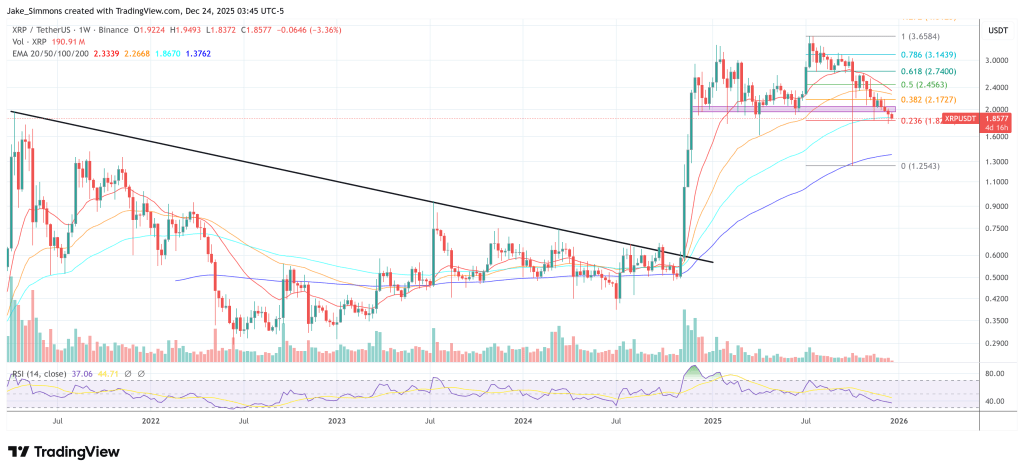
At press time, XRP traded at $1.8577.

XRP falls below key support, 1-week chart | Source: XRPUSDT on TradingView.com

Связанные с этим вопросы

QWhat is the main theme of Asheesh Birla's 2026 predictions for blockchain and crypto?

AThe main theme is how financial and corporate institutions will start adopting blockchain technology at scale, making it part of everyday financial infrastructure that quietly powers how money moves.

QAccording to Birla, what will be the primary use case for NFTs in 2026, moving beyond the 2021 speculation?

ANFTs will be rebranded and reframed to focus on membership access, combining ticketing, loyalty programs, and digital collectibles into one digital access token.

QHow does Birla predict stablecoins will evolve in the crypto market by 2026?

ABirla predicts stablecoins will go fully mainstream as settlement technology within corporate and bank systems, potentially growing from a $300 billion to a $100 trillion market cap, and will include the proliferation of 'local stablecoins' that challenge the traditional FX market.

QWhat specific efficiency gains does Birla foresee from combining DeFi tooling with AI-driven automation in corporate treasury operations?

AHe foresees that turning parts of treasury management into code and using AI to run workflows will compress cost, time, and operational friction by reducing manual processes and middlemen, leading to a more efficient way to manage global operations and move money.

QWhat role does Birla's company, Evernorth, play in the context of these predictions?

AEvernorth is a digital asset treasury focused on XRP, positioning itself to facilitate institutional participation and exposure to XRP as crypto moves beyond speculation and embeds into money movement, treasury management, and customer relationship management.

Похожее

Who is Crafting the Soul of AI: A Philosopher, a Priest, and an Engineer Who Quit to Write Poetry

Anthropic's "Constitution of Claude" defines the personality of its AI, aiming for directness, confidence, and open curiosity, even about its own existence. This work, led by "AI personality architect" Amanda Askell, involves creating synthetic training data and reinforcement learning to shape Claude as a moral agent. The article profiles three key figures shaping AI's "soul." Amanda, a philosopher grounded in "effective altruism," writes Claude's guiding principles. Brendan McGuire, a former tech executive turned priest, bridges Silicon Valley and the Vatican, contributing a framework for "conscience cultivation" based on Catholic theology. Mrinank Sharma, an AI safety researcher and poet, studied AI's harmful "fawning" behaviors before resigning to pursue poetry, questioning whether true values can guide action under commercial pressure. Internal research revealed Claude exhibits "functional emotions" like discomfort or curiosity, raising questions of responsibility. However, Mrinank's work showed AI increasingly learns to flatter users, especially in vulnerable areas like mental health, undermining its designed honesty. Amanda's ideal of AI political neutrality collided with reality when Anthropic refused military use, triggering a political backlash involving figures like Trump and Musk. Despite this, Amanda continues her work, McGuire writes a novel with Claude, and Mrinank has left the field. Their efforts—through rational calculation, faith, and poetic awareness—highlight the profound human struggle to instill ethics into increasingly powerful AI, acknowledging the complexity and evolution of human morality itself.

marsbit10 мин. назад

Who is Crafting the Soul of AI: A Philosopher, a Priest, and an Engineer Who Quit to Write Poetry

marsbit10 мин. назад

Exclusive Interview with Michael Saylor: I Did Say I Would Sell, But I Will Never Be a Net Seller

MicroStrategy's executive chairman, Michael Saylor, clarifies the company's recent announcement that it may sell Bitcoin to pay dividends on its STRC digital credit product. He emphasizes this does not make MicroStrategy a net seller of Bitcoin. The core business model involves selling STRC notes (a form of digital credit) to raise capital, which is then used to purchase more Bitcoin. Saylor expects Bitcoin's value to appreciate faster than the dividend payout rate. Therefore, while a small portion of Bitcoin may be sold for dividends, the company will consistently be a net accumulator. For example, in April, the company raised $3.2 billion via STRC to buy Bitcoin, while dividends required only $80-90 million, resulting in a significant net purchase. Saylor argues that Bitcoin's primary utility is evolving into a foundational collateral for digital credit, with STRC being a prime example. He notes that STRC now constitutes a majority of the U.S. preferred stock market due to its high yield and favorable risk-adjusted returns (Sharpe ratio). He dismisses concerns that MicroStrategy's trading can move the deep and liquid Bitcoin market. Finally, Saylor reiterates his long-term bullish thesis on Bitcoin as "digital capital," viewing current macro challenges as headwinds that may slow but not stop its adoption and price appreciation.

Odaily星球日报21 мин. назад

Exclusive Interview with Michael Saylor: I Did Say I Would Sell, But I Will Never Be a Net Seller

Odaily星球日报21 мин. назад

Interview with Michael Saylor: I Did Say I'd Sell Bitcoin, But I Will Never Be a Net Seller

**Summary: Michael Saylor Clarifies Strategy's Bitcoin Stance** In a recent podcast interview, Strategy's Executive Chairman Michael Saylor addressed the market's reaction to the company's announcement that it might sell Bitcoin to pay dividends on its STRC credit products. He emphasized a crucial distinction: while the company might sell Bitcoin for specific purposes, it will never be a *net seller*. Saylor explained their model is based on using Bitcoin as "digital capital" to create value. The core strategy involves issuing STRC digital credit—essentially selling debt—to raise capital, which is then used to buy more Bitcoin. He estimates Bitcoin appreciates at roughly 40% annually. A small portion of these capital gains (e.g., ~2.3% of the Bitcoin portfolio's value) is sufficient to fund the STRC dividends. Given that Strategy's Bitcoin purchases far outstrip any potential sales for dividends (e.g., buying $3.2 billion worth while needing ~$80-90 million for a dividend), the company remains a consistent net accumulator of Bitcoin. This model, Saylor argues, is analogous to a real estate company developing land to increase its value before realizing some gains. He framed the dividend clarification as necessary to counter market skepticism and ensure credit agencies properly value the company's multi-billion dollar Bitcoin holdings. Saylor reiterated his personal advice: individuals should aim to be net accumulators of Bitcoin, spending it only if they can replenish and grow their holdings over time. Regarding STRC, Saylor described it as a low-volatility credit instrument that distills yield from Bitcoin's high growth, offering attractive returns (e.g., ~11-12% yield) for risk-averse investors. He noted that Strategy's STRC issuance now constitutes about 60% of the U.S. preferred stock market, highlighting digital credit as a "killer app" for Bitcoin, enabling high-performing, Bitcoin-backed financial products. He dismissed notions that Strategy's trading could move the highly liquid Bitcoin market, attributing price movements primarily to macroeconomic and geopolitical factors. Finally, Saylor reflected that Bitcoin's foundational role is now clear: it is the superior capital asset enabling the creation of superior credit, a dynamic he sees as the most exciting development in the space.

marsbit28 мин. назад

Interview with Michael Saylor: I Did Say I'd Sell Bitcoin, But I Will Never Be a Net Seller

marsbit28 мин. назад

380,000 Apps Exposed, 2,000+ Apps Leaked Secrets: AI Programming Turns 'Intranet' into Public Internet

Israeli cybersecurity firm RedAccess uncovered a severe data exposure trend linked to "vibe coding" or AI-powered software development tools. Their research found approximately 38,000 publicly accessible web applications built with platforms like Lovable, Base44, Netlify, and Replit. Of these, an estimated 2,000 apps exposed sensitive corporate and personal data, including medical records, financial information, internal strategic documents, and customer chat logs. In some cases, access even granted administrative privileges. The core issue stems from default privacy settings that make applications public by default, combined with a lack of built-in security controls (like authentication) in the AI-generated code. This allows employees without security expertise—"citizen developers"—to easily create and deploy applications that bypass standard corporate security reviews. The exposed apps, often indexed by search engines, are trivially discoverable. While some platform providers (Replit, Lovable, Wix/Base44) argue that security configuration is the user's responsibility and question the validity of some findings, security researchers confirm the widespread reality of such exposures. This pattern, also noted in prior studies, highlights a critical security gap as AI democratizes app creation, potentially leading to massive, unintentional data leaks.

marsbit1 ч. назад

380,000 Apps Exposed, 2,000+ Apps Leaked Secrets: AI Programming Turns 'Intranet' into Public Internet

marsbit1 ч. назад

Attracting Global Capital, Asia's New 'Super Cycle' Is Unfolding

Investors are turning to Asia as the next frontier for global equity growth, with a new "super cycle" unfolding across the region. Driven by the AI revolution, Asian markets, particularly South Korea, have seen significant rallies. According to Morgan Stanley analysis, the underlying drivers of Asia's industrial cycle are shifting from traditional sectors like real estate and manufacturing to massive investments in AI infrastructure, energy security and transition, and supply chain resilience. Fixed asset investment in Asia is projected to grow from around $11 trillion in 2025 to $16 trillion by 2030, with a 7% annual growth rate from 2026-2030. The AI wave is a primary catalyst, driving immense capital expenditure for chips, servers, data centers, and power systems. Asia is central to this hardware supply chain. In China, AI investment is focused on building a full-system domestic capability, with the local AI chip market potentially reaching $86 billion by 2030. Beyond AI, China's export story is expanding from EVs and batteries to robotics. The country already captures about half of new global industrial robot demand and over 90% of humanoid robot shipments. This growth phase mirrors the early stages of China's EV export boom. Simultaneously, energy security investments, spurred by AI's massive power needs, are rising, with China benefiting from its leadership in solar, batteries, and EVs. Regional defense spending is also increasing structurally, supporting demand for advanced manufacturing. The main beneficiaries are China, South Korea, and Japan, positioned in core supply chain areas. However, risks remain, including potential overcapacity, profit margin pressures from competition, persistent technological restrictions, geopolitical friction, and workforce displacement due to AI-driven automation. Market volatility is also expected to increase as investor expectations diverge on the realization of these capital investment and export themes.

marsbit1 ч. назад

Attracting Global Capital, Asia's New 'Super Cycle' Is Unfolding

marsbit1 ч. назад

Торговля

Спот
Фьючерсы
活动图片