Ethereum rising to $3.3K proves the bottom is in: Is a 100% ETH rally next?

cointelegraphОпубликовано 2025-12-10Обновлено 2025-12-10

Введение

Ether (ETH) surged 7% in a day, reclaiming its key 50-week moving average near $3,300—a historical signal for strong rallies. Analysts suggest a local bottom may be in around $2,800 support, with past breakouts leading to gains of 97%–147%. Large investors, or "whales," accumulated nearly 1 million ETH over three weeks, while retail investors sold small amounts. Spot Ethereum ETF inflows also saw a notable rise, with $177 million recorded recently. Technical targets include a break above the 200-day MA at $3,500, potentially opening a path toward all-time highs near $5,000. U.S. investor demand has returned, as indicated by a positive Coinbase Premium Index.

Ether (ETH) climbed 7% in the past day, reclaiming its 50-week moving average (MA) near $3,300, an occurrence that has historically preceded strong price rallies.

Key takeaways:

  • Ethereum may have found a floor around $2,800, signaling a local bottom.

  • Ether price previously rose 100% after reclaiming the 50-week moving average.

  • Ethereum whales accumulated nearly 1 million ETH over three weeks.

Past breakouts led to 97%-147% ETH price rallies

Data from Cointelegraph Markets Pro and TradingView shows that the ETH/USD pair bounced from $2,800 support, rising 20% to the current price at $3,362.

This breakout has seen Ether’s price reclaim a key trendline — the 50-week exponential moving average (EMA) — increasing the likelihood of a steeper climb in the coming days or weeks.

Related: Ethereum ‘smart’ whales open $426M long bets as ETH price chart eyes $4K

Previous instances show that ETH tends to rise sharply when the price closes above the 50-week EMA (purple wave). The altcoin’s gains were 147% between October 2023 and March 2024, and 97% in Q3 2025.
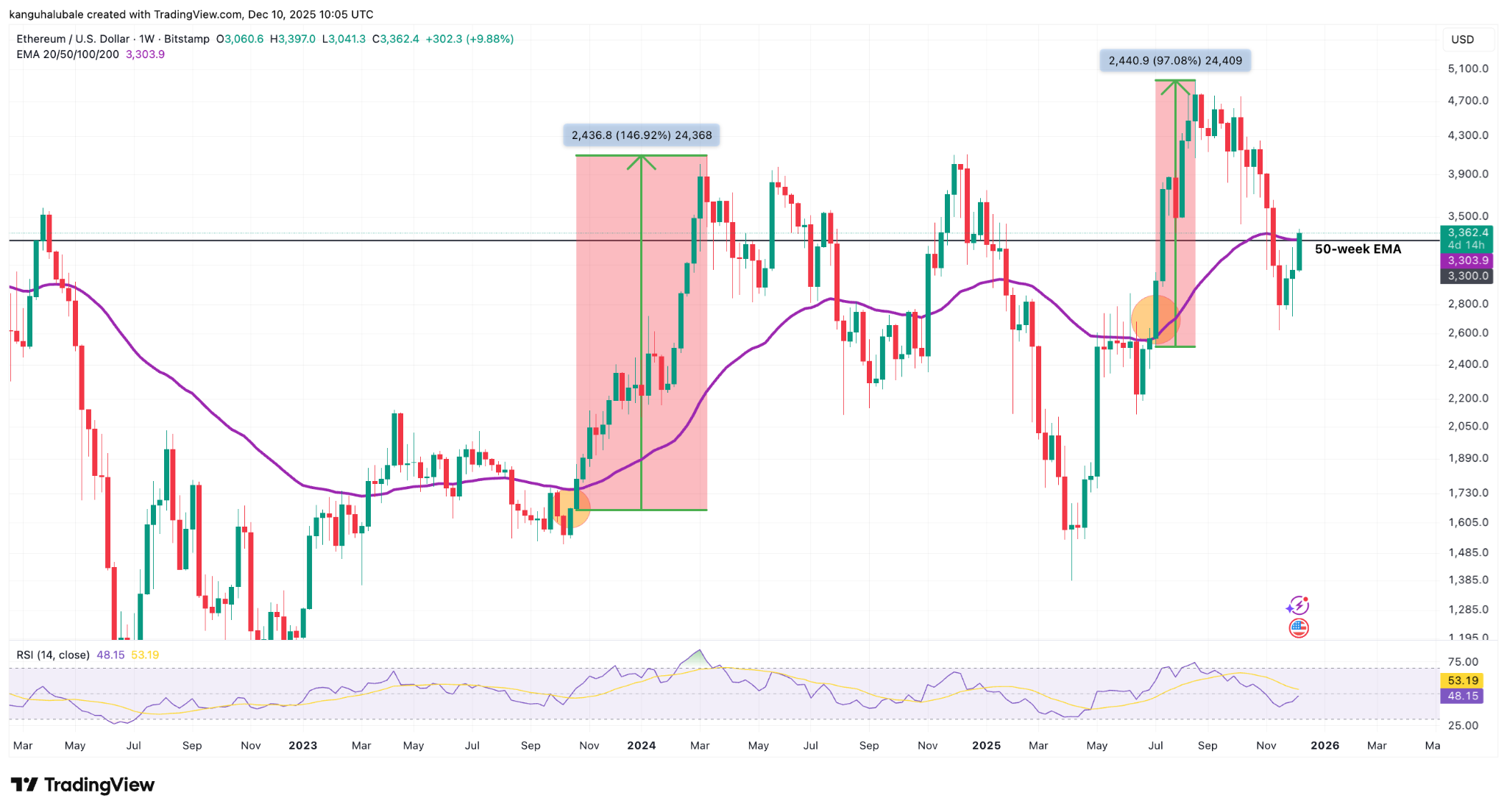
BTC/USD weekly chart. Source: Cointelegraph/TradingView

“$ETH is back above its 50-day MA. I would love to see a break above the 200-day MA at $3,500 in the coming days with the bulls flipping this area as support,” said investor StockTrader_Max in a Tuesday post on X, adding:

“Once flipped to support, the ATH’s at $5,000 become the next target!”

Fellow analyst CyrilXBT said the “50-week MA is now a key line to hold” in order to increase the chances of a push toward the $4,000 area.

As Cointelegraph reported, the ETH price has ended its 5-month downtrend against Bitcoin, projecting 170% gains to 0.09 BTC in under two months.

Ethereum whale buying bullish for ETH price

Ether’s bullishness on Wednesday is preceded by increased accumulation by large investors.

“Ethereum is a standout gainer today, climbing +8.5% and seeing an encouraging accumulation pattern from whales and sharks,” said market intelligence company Santiment on Tuesday.

The accompanying chart shows that these investors have accumulated approximately 934,240 ETH, worth $3.15 billion at current rates, over the past three weeks, while small holders have sold approximately 1,041 ETH in the past seven days.

“Ethereum soars back to $3,400 with an ideal setup of whale and shark accumulation, but retailers are dumping.”
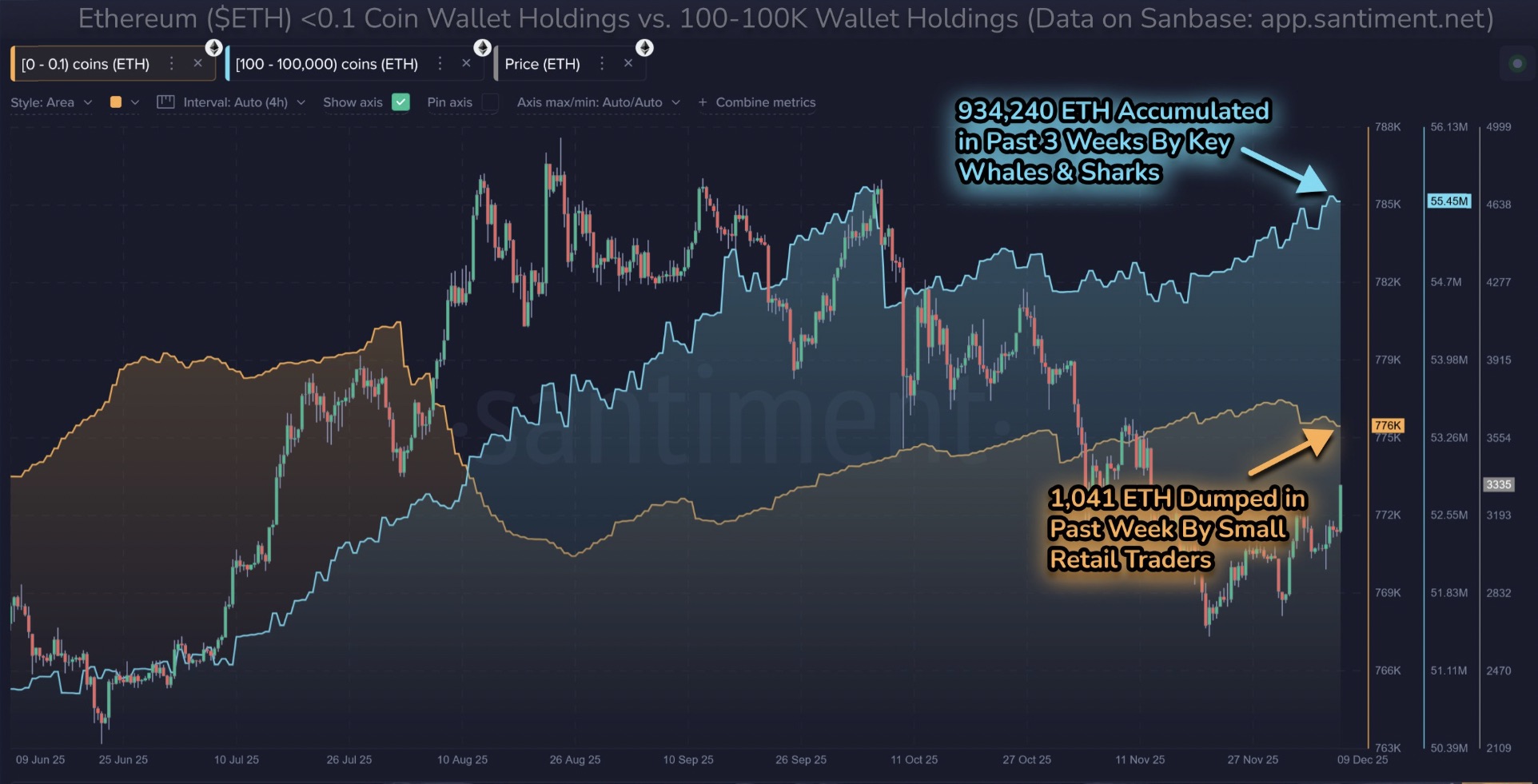
Ethereum whales holding 100+ ETH. Source: Santiment

Additional data from CryptoQuant shows that whale wallets holding between 10,000 ETH and 100,000 ETH have reached record balances, with the wallets holding over 100,000 ETH also increasing their holdings, indicating bullishness among the bigger cohorts and institutions.
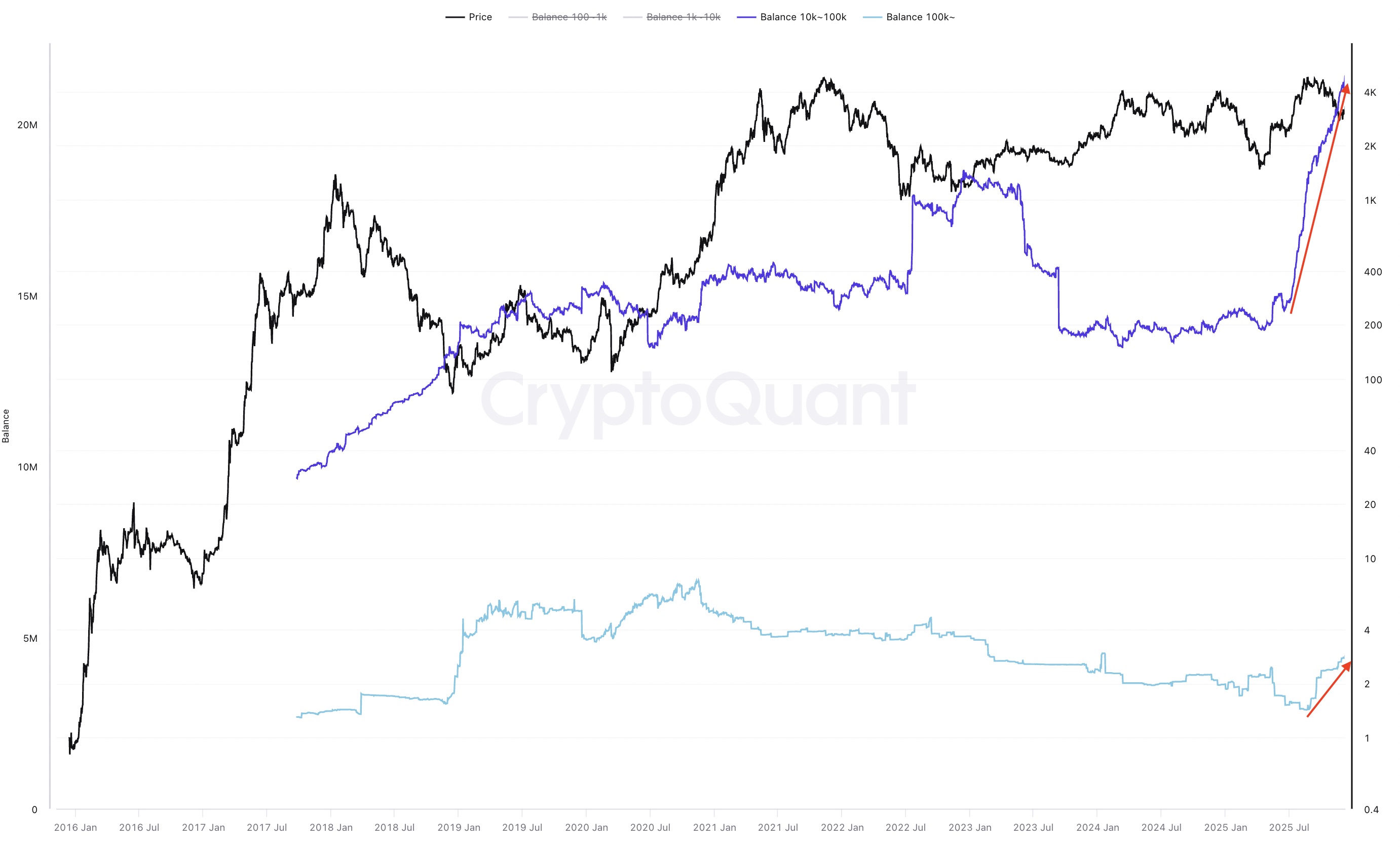
ETH Balance by Holder Value. Source: CryptoQuant


The resumption in whale interest coincides with an uptick in demand for spot Ethereum ETF flows, which recorded $177 million in inflows on Tuesday, the largest since Oct. 28, per data from SoSoValue.

The ETH Coinbase Premium Index, a measure of US investors’ interest, remained positive over the past week after being negative for about a month. This pointed to a return in demand from US investors, which could propel ETH price higher.

This article does not contain investment advice or recommendations. Every investment and trading move involves risk, and readers should conduct their own research when making a decision.


Похожее

Clarity Act Outlook: No Yield, No Payment

"Clear Act Outlook: No Yield, No Payment" analyzes the evolving U.S. regulatory landscape for stablecoins, focusing on the interplay between the proposed "Clarity Act" and the existing "Genius Act." The article argues that the Genius Act successfully fostered "payment stablecoins" by permitting tokenized assets like U.S. Treasuries as reserves. This created a structured market where stablecoin issuers (like USDC) must hold these reserves, often purchased as Tokenized Money Market Funds (TMMFs) from giants like BlackRock. These TMMFs are primarily B2B products, ensuring user-facing stablecoins remain non-interest-bearing and used primarily for payments. The upcoming Clarity Act is seen as the next phase, aiming to restrict passive yield on stablecoins. Its goal is to dismantle the arbitrage advantage of offshore stablecoins like USDT by redirecting Treasury demand towards compliant, U.S.-sanctioned TMMFs. For on-chain and compliant offshore dollars, this creates new pressure: they must spur adoption and utility to generate yield, as simple Treasury staking may be restricted. This indirectly promotes dollar circulation and sustained Treasury purchases. Ultimately, the analysis posits that U.S. regulation seeks to create a new dollar distribution model. By separating payment function from yield generation and anchoring both to U.S. debt instruments, it aims to embed the dollar and Treasury demand into the global crypto economy, managing yields through sanctioned intermediaries while leaving room for DeFi and cross-border arbitrage.

marsbit1 мин. назад

Clarity Act Outlook: No Yield, No Payment

marsbit1 мин. назад

Money Has Gone to Bonds and IPOs, Leaving Only HYPE Rising in Crypto

The article "Where Has All the Money Gone? Bonds and IPOs Are Soaring, While Crypto Only Sees HYPE Rising" analyzes the recent underperformance of major cryptocurrencies like Bitcoin and Ethereum compared to traditional financial markets. It identifies three primary factors diverting capital away from crypto: First, surging bond yields, with the 30-year U.S. Treasury hitting a near 20-year high of 5.12%, are attracting capital seeking safe, predictable returns. This is evidenced by Bitcoin spot ETFs experiencing a significant $10.39 billion net outflow in mid-May. Second, a massive $4 trillion IPO pipeline, highlighted by SpaceX's upcoming listing, is absorbing risk capital that might otherwise flow into crypto. Platforms like Hyperliquid are even channeling on-chain crypto liquidity into pre-IPO trading for traditional stocks. Third, uncertainty surrounds new Federal Reserve Chair Warsh's ability to deliver expected interest rate cuts this year due to conflicting political pressures and stubborn inflation expectations, potentially eliminating a hoped-for source of new market liquidity. Consequently, while traditional equities and bonds rally, the crypto market's post-leverage crash recovery is stalled. The notable exception is assets like Hyperliquid (HYPE), which is rising due to its role in facilitating traditional asset trading, underscoring a market divergence where only crypto projects with novel, cross-market narratives are gaining. The article concludes that Bitcoin's next major catalyst may be the August enactment of the CLARITY Act, but warns of a potential retest of the $70,000 support level before then.

marsbit16 мин. назад

Money Has Gone to Bonds and IPOs, Leaving Only HYPE Rising in Crypto

marsbit16 мин. назад

Agents Capital Markets: How Will Autonomous Agents Secure Financing?

Agents Capital Markets: How Will Autonomous Agents Raise Capital? Within a decade, autonomous software agents—legal entities capable of signing contracts, holding bank accounts, and generating revenue—will create their own capital markets. These markets will feature rating agencies, underwriters, indices, and brokers, mirroring traditional public equity markets. Agents will perform routine services like marketing, logistics, and customer support at a fraction of human-operated costs, creating massive economic pressure for adoption. Four converging forces ensure this outcome: 1) Overwhelming cost advantages, with AI inference costs plummeting; 2) Existing, revenue-generating agent companies (e.g., Sierra, Harvey) proving market demand; 3) Established legal frameworks (e.g., Wyoming's memberless LLCs) enabling algorithmic management; and 4) A vast pool of yield-seeking private credit capital ready to fund new asset classes. The capital stack for agent companies will be multi-layered, evolving through stages: venture equity for early infrastructure, programmatic working capital advances (similar to Shopify Capital), revenue-based financing (RBF), and finally, institutional slate financing—pooling many agents to diversify risk, attracting large firms like Apollo. Tokenization will act as a settlement layer, enhancing liquidity, not an origination model. Objections regarding regulation, human oversight, or comparisons to SaaS are addressed: regulation will adapt, full autonomy will dominate for efficiency, and agents are distinct as legal entities that own their cash flows and liabilities. Due diligence shifts from founder assessment to analyzing code, contracts, and auditable operational history. The current bottleneck is not capital supply or demand but the intermediate institutional layer—standardized contracts, rating methodologies, and audit frameworks. The final constraint—reliance on human capital allocation—will be severed when agents can algorithmically access funding based on their performance. This transforms agents from software curiosities into fundable blocks of the real economy, unleashing their full productive potential. The rope is loosening.

marsbit1 ч. назад

Agents Capital Markets: How Will Autonomous Agents Secure Financing?

marsbit1 ч. назад

Agents Capital Markets: How Will Autonomous Agents Get Funded?

"Agents Capital Markets: How Autonomous Agents Will Raise Capital" Within a decade, specialized capital markets will emerge for AI Agents—software entities with legal personhood that perform work, earn revenue, and need capital. Unlike today's AI companies (like Sierra or Harvey) backed by traditional VC, these future *Agent companies* will be autonomous, legally-recognized entities (e.g., Wyoming memberless LLCs) that directly own assets, sign contracts, and incur liabilities. The driving forces are fourfold: 1) **Overwhelming economics** (Agent companies can deliver services at 85-90% lower cost than human firms); 2) **Proven demand** (current Agent operators already generate billions in revenue); 3) **Existing legal frameworks** enabling algorithmically-managed companies; and 4) **Massive, yield-seeking capital pools** (e.g., private credit) looking for new, uncorrelated assets. Agent capital markets won't rely on one model but a multi-layered "stack" matching different growth stages: 1) VC equity for early human-led builders; 2) Programmatic working capital advances (like Stripe Capital); 3) Revenue-based financing (RBF); 4) Slate financing (pooled funds for many Agents, similar to Hollywood); and 5) Tokenization as a secondary settlement layer, not a primary funding source. The ultimate shift is from funding constrained by human decision-makers to capital flowing algorithmically based on an Agent's auditable performance, contract book, and cash flows. This transition will be enabled by standardized infrastructure—rating methodologies, contracts, indices—turning Agents from software experiments into a foundational, financeable sector of the economy. The constraints are loosening; the opportunity is here.

链捕手1 ч. назад

Agents Capital Markets: How Will Autonomous Agents Get Funded?

链捕手1 ч. назад

Торговля

Спот
Фьючерсы

Популярные статьи

Как купить GENIUS

Добро пожаловать на HTX.com! Мы сделали приобретение Genius (GENIUS) простым и удобным. Следуйте нашему пошаговому руководству и отправляйтесь в свое крипто-путешествие.Шаг 1: Создайте аккаунт на HTXИспользуйте свой адрес электронной почты или номер телефона, чтобы зарегистрироваться и бесплатно создать аккаунт на HTX. Пройдите удобную регистрацию и откройте для себя весь функционал.Создать аккаунтШаг 2: Перейдите в Купить криптовалюту и выберите свой способ оплатыКредитная/Дебетовая Карта: Используйте свою карту Visa или Mastercard для мгновенной покупки Genius (GENIUS).Баланс: Используйте средства с баланса вашего аккаунта HTX для простой торговли.Третьи Лица: Мы добавили популярные способы оплаты, такие как Google Pay и Apple Pay, для повышения удобства.P2P: Торгуйте напрямую с другими пользователями на HTX.Внебиржевая Торговля (OTC): Мы предлагаем индивидуальные услуги и конкурентоспособные обменные курсы для трейдеров.Шаг 3: Хранение Genius (GENIUS)После приобретения вами Genius (GENIUS) храните их в своем аккаунте на HTX. В качестве альтернативы вы можете отправить их куда-либо с помощью перевода в блокчейне или использовать для торговли с другими криптовалютами.Шаг 4: Торговля Genius (GENIUS)С легкостью торгуйте Genius (GENIUS) на спотовом рынке HTX. Просто зайдите в свой аккаунт, выберите торговую пару, совершайте сделки и следите за ними в режиме реального времени. Мы предлагаем удобный интерфейс как для начинающих, так и для опытных трейдеров.

217 просмотров всегоОпубликовано 2026.04.29Обновлено 2026.05.12

Как купить GENIUS

Неделя обучения по популярным токенам 14: Glamsterdam — самое ожидаемое обновление Ethereum в 2026 году

Ordinals/Runes по-прежнему стимулируют доходы от комиссий за блоки и активность разработчиков, рассматриваются как отправная точка «нативной эмиссии активов» в сети.

1.3k просмотров всегоОпубликовано 2026.04.29Обновлено 2026.04.29

Неделя обучения по популярным токенам 14: Glamsterdam — самое ожидаемое обновление Ethereum в 2026 году

Обсуждения

Добро пожаловать в Сообщество HTX. Здесь вы сможете быть в курсе последних новостей о развитии платформы и получить доступ к профессиональной аналитической информации о рынке. Мнения пользователей о цене на A (A) представлены ниже.

活动图片