Ethereum Just Lost The Realized Price, But Here’s What Investors Are Up To

bitcoinistОпубликовано 2026-02-04Обновлено 2026-02-04

Введение

Ethereum's price has dropped sharply, falling below the key realized price level and nearing $2,000 amid heightened market volatility. Despite this decline and widespread unrealized losses, on-chain data indicates that investors—particularly large whales and conviction-driven buyers—continue to accumulate ETH. Notably, accumulation addresses have increased their inflows, suggesting strong confidence in the asset's future. Market expert CW points to this persistent buying as a potential precursor to a significant rebound. Additionally, Ethereum is experiencing heightened social media interest, partly driven by major acquisitions such as BitMine's recent purchase of 20,000 ETH. The company now holds over 4.3 million ETH, representing about 3.56% of the total supply, with a significant portion staked. Despite current pressures, investor behavior and large-scale accumulation suggest underlying strength and potential recovery for Ethereum.

With volatility intensifying in the broader cryptocurrency market, the price of Ethereum has fallen sharply, drawing dangerously close to the $2,000 level. While there are speculations that the ongoing trend is akin to a bear market phase, investors seem to be unshaken by the sharp pullback in ETH’s price, with accumulation not showing signs of slowing down.

Investors’ Behavior After Ethereum’s Drop Below Realized Price

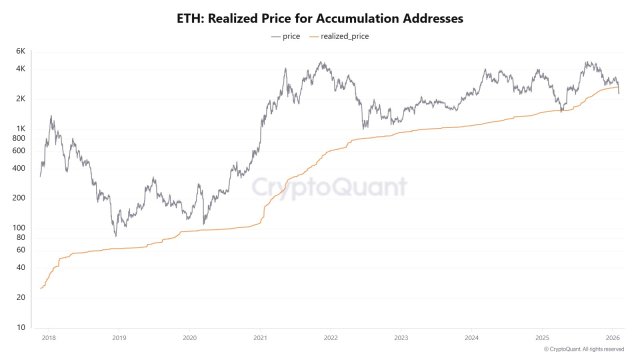
Following the sharp pullback on Tuesday, the Ethereum price has now fallen below a key level regarded as the Realized Price. Despite the price experiencing steady downside movements, investors are moving in the opposite direction, as evidenced by their continued interest in the leading altcoin.

Related Reading: Ethereum Holders Jump 3% In January, Clear 175 Million Milestone

According to CW, a market expert and investor, investors continue to steadily stack the altcoin even with ETH trading below its realized price, which puts a large portion of the market in unrealized loss territory. On-chain data points to continued accumulation from large holders or whales and conviction-driven buyers.

ETH accumulation addresses are still buying | Source: Chart from CW on X

What’s interesting about the whale’s action is that these investors are persistently accumulating Ethereum despite being in a loss. Large investors sitting on unrealized losses are still buying, which is a pattern typically linked to heightened stress and shifting sentiment across the network.

Even with the current pullback, ETH inflows into accumulation addresses have also increased. CW highlighted that Ethereum had previously hit this level in April of last year, but it swiftly recovered before rising again. When the buying power of whales remains intact, this implies that the group has found the current price attractive. As a result, a significant rebound in ETH’s price is expected in the near future.

ETH Seeing Heightened Social Media Interest

Ethereum may be struggling with volatility, but the leading altcoin is experiencing increased interest from investors and social media participants. This is because of price movements, investment strategies, staking, and its potential as a deflationary asset following upgrades like EIP-1559 and the merge.

Related Reading: Here’s How Ethereum Staking Transforms Into A Multi-Billion-Dollar Bet For Bitmine Immersion

Data from Santiment, a popular on-chain data analytics firm, shows that ETH is commonly brought up in flash deals and cryptocurrency trading services, emphasizing its usage across platforms such as Binance, MetaMask, and Trust Wallet.

ETH’s increased social media mentions are attributed to the massive buying activity by BitMine. The company recently bought a large amount of ETH, signaling robust confidence in the altcoin’s future despite ongoing market volatility and unrealized losses.

CW reported that the company has acquired another 20,000 ETH, valued at approximately $46.04 million, through FalconX. With this purchase, Tom Lee’s Bitmine now boasts over 4.305 million ETH, worth a staggering $9.99 billion, which represents about 3.56% of the total ETH supply.

Despite this massive figure, Bitmine’s goal is to own 5% of all ETH supply. Bitmine remains the largest Ethereum treasury company in the world, with 2.87 million of its ETH holdings being locked away in staking. Other coins owned by the company include Bitcoin, of which they hold over 193 BTC.

ETH trading at $2,284 on the 1D chart | Source: ETHUSDT on Tradingview.com

Связанные с этим вопросы

QWhat key price level has Ethereum fallen below according to the article?

AEthereum has fallen below the Realized Price.

QDespite the price drop, what are large investors (whales) doing with Ethereum?

ALarge investors (whales) are persistently accumulating and buying more Ethereum, even while sitting on unrealized losses.

QWhich company made a significant purchase of 20,000 ETH, and what is their ultimate goal for ETH holdings?

AThe company is BitMine (also referred to as Bitmine in the text). Their goal is to own 5% of the total Ethereum supply.

QWhat is the main reason for the increased social media interest in Ethereum mentioned in the article?

AThe increased social media interest is attributed to massive buying activity, specifically by BitMine, and discussions around price movements, investment strategies, staking, and its potential as a deflationary asset.

QWhat does the article suggest is expected for Ethereum's price in the near future based on whale activity?

AThe article suggests that a significant rebound in ETH's price is expected in the near future because whales find the current price attractive and are continuing to buy.

Похожее

Retail Ecology Dwindles, ZKsync Bets on Bank Pilots for a Breakthrough

Amidst declining retail activity, ZKsync is pivoting to target institutional banking as its primary growth strategy. The article explores this shift, contrasting it with the competitive "survival of the fittest" narrative by highlighting a cooperative model inspired by naturalist Peter Kropotkin. ZKsync is developing infrastructure like its private, permissioned Prividium suite for banks (e.g., Deutsche Bank's use case via Memento), enabling private transactions with public verifiability via zero-knowledge proofs. This appeals to institutions needing privacy, compliance, and Ethereum-based settlement security, unlike fully private chains (e.g., JPMorgan's Kinaxis) or consortium models (e.g., R3 Corda). However, this strategic focus has coincided with a steep decline in its public DeFi ecosystem, evidenced by plunging TVL and the departure of major protocols like Aave due to low fees. The network's future now hinges on banking adoption, with upcoming pilots like the Cari Network involving regional banks holding over $600 billion in deposits. A significant challenge is balancing this institutional focus with ZKsync's decentralized governance. Banks must operate on a network where rules and fees (denominated in the volatile ZK token) can be changed via community vote, and where a Security Council holds emergency control—a stark contrast to the predictable, contract-bound environments of traditional finance. The coming 18 months will test whether ZKsync can successfully onboard traditional banks onto a dynamically governed public chain or if institutions will ultimately revert to proprietary solutions.

Foresight News19 мин. назад

Retail Ecology Dwindles, ZKsync Bets on Bank Pilots for a Breakthrough

Foresight News19 мин. назад

The Recursive AI Anthropic Warned About: Tian Yuandong's New Company Has Just Taken the "First Step"

Anthropic recently highlighted the rapid progress toward "recursive self-improvement," where AI systems autonomously design and train their successors. In response, Recursive Superintelligence, a new company co-founded by former Meta researcher Tian Yuan Dong, has publicly demonstrated its first step toward automating AI research. The company released a system designed to autonomously execute the full AI research cycle: generating ideas, implementing code, running experiments, and learning from results. It validated this approach by achieving state-of-the-art results on three diverse benchmarks: 1. **NanoChat Autoresearch:** Optimizing a small language model's validation loss under a fixed 5-minute GPU budget, improving upon the community's best result. 2. **NanoGPT Speedrun:** Reducing the time to train a GPT model to a specific loss on 8 H100 GPUs from 79.7 seconds to 77.5 seconds, beating a highly optimized, human-driven community effort. 3. **SOL-ExecBench:** Improving the overall score on NVIDIA's suite of 235 GPU kernel optimization tasks by 18%, closing the gap to the hardware limit. The system discovered novel optimizations in this highly specialized domain without direct human expertise. Recursive's system operates as a general framework, capable of parallel exploration and cross-task knowledge transfer while incorporating safeguards against reward hacking. The company, backed by $650M in funding and a star-studded team including Richard Socher and Alexey Dosovitskiy, aims to create AI that recursively enhances its own research capabilities. This development represents an early but concrete move toward a new paradigm where AI accelerates its own advancement. It occurs alongside Anthropic's warnings about the need for industry coordination and potential pauses when recursive self-improvement thresholds are reached, highlighting the dual trajectory of rapid technical progress and growing calls for careful stewardship.

marsbit26 мин. назад

The Recursive AI Anthropic Warned About: Tian Yuandong's New Company Has Just Taken the "First Step"

marsbit26 мин. назад

The Gold Buy-on-the-Dip Guide: Watch Interest Rates, Not Just War

"Gold Buying Guide: Focus on Interest Rates, Not Just War" Four months ago, gold buyers likely didn't anticipate buying at a peak that even a war couldn't sustain. After hitting a record high of $5,596 on January 29, gold entered a bear market just 91 days later, its fastest decline since 2008. A key trigger was the Fed's hawkish shift, highlighting that monetary policy, not geopolitics, is the primary driver. The article argues that the traditional "buy gold in turmoil" script has changed. While the US-Iran conflict initially boosted prices, the sustained rally in oil prices heightened inflation fears, forcing central banks to maintain or consider tighter policy. Since gold yields no interest, higher rates increase its opportunity cost, eroding its appeal. This dynamic was evident when gold fell sharply on May 18 despite positive peace talks, as lower oil prices eased inflation and thus rate hike pressures. The recent sell-off is also part of a broader market deleveraging. Correlations between gold, Nasdaq, and Bitcoin spiked as leveraged investors sold liquid assets to cover losses, creating a synchronized downturn. Historically, gold bottoms align with policy shifts, not conflict resolutions. The 2008 and 2022 bear markets ended with shifts to extreme easing and peak inflation expectations, respectively. For potential buyers, the author suggests monitoring three signals: 1) Peak interest rate hike expectations, 2) Reopening of the Strait of Hormuz (to ease oil/inflation pressure), and 3) A return to net inflows for Gold ETFs, indicating the end of forced selling. While predicting the exact bottom is impossible, the author's personal strategy involves scaling into a position across price levels like $4000, $3700, and $3500, committing no more than 30% of the intended total allocation initially, and adding the remainder only if key signals emerge. The core conclusion: In turbulent times, watching interest rates is more crucial than watching wars.

marsbit33 мин. назад

The Gold Buy-on-the-Dip Guide: Watch Interest Rates, Not Just War

marsbit33 мин. назад

Recent On-Chain Review: No Clear Narrative Under U.S. Stock Market Pressure, Just Hype

This article analyzes the current state of the Solana meme coin and community token ecosystem, highlighting a market caught between two dominant forces: attention-based PvP and a gradual return to community-centric projects. The first part explores the "Attention PvP" dynamic, where success is driven by celebrity endorsements, viral events, and speed. Examples include $JOTCHUA, which surged after its meme creator's social media activity, and $WORLDCUP, which outperformed a similar Base chain project ($PITCH) largely due to influencer support. The recent "pump.fun GO" feature, allowing bounty tasks for token promotion, is critiqued for fostering sensationalist and often negative stunts—like people getting token tickers tattooed on their bodies for rewards—reminiscent of old internet shock content. In contrast, the article points to a resurgence of organic, community-driven tokens that survive market volatility through strong holder bases and shared ideology, not just hype. Influencer Ansem is cited, arguing that durable meme coins rely on communities willing to endure losses and promote their core message daily. Examples given are older tokens like $neet (anti-work ethos), $troll, $buttcoin, and $triplet, which have maintained relative price stability. A prime example of this community-build model is the new project $KINS, the token for the browser-based MMORPG Kintara. Its success stems not from advanced graphics but from consistently delivering updates, fostering player trust, and creating genuine engagement (e.g., in-game economies, events, property auctions). It has attracted a growing player base and even notable KOLs as participants, demonstrating that sustainable growth can come from building trust rather than orchestrating pumps. The article concludes by questioning whether the market is ultimately a game of mutual trust or mutual deception, expressing hope that such reflection might lead to a healthier ecosystem.

marsbit33 мин. назад

Recent On-Chain Review: No Clear Narrative Under U.S. Stock Market Pressure, Just Hype

marsbit33 мин. назад

Торговля

Спот
Фьючерсы

Популярные статьи

Manyu: восходящая мем-звезда на Ethereum, готовая открыть новую эру культуры Shiba

Manyu - это мемтокен на Ethereum, который приносит децентрализованную культурную и развлекательную ценность через вирусное влияние в соцсетях и вовлечённость сообщества.

2.0k просмотров всегоОпубликовано 2025.11.27Обновлено 2025.11.27

Manyu: восходящая мем-звезда на Ethereum, готовая открыть новую эру культуры Shiba

Неделя обучения по популярным токенам 14: Glamsterdam — самое ожидаемое обновление Ethereum в 2026 году

Ordinals/Runes по-прежнему стимулируют доходы от комиссий за блоки и активность разработчиков, рассматриваются как отправная точка «нативной эмиссии активов» в сети.

1.5k просмотров всегоОпубликовано 2026.04.29Обновлено 2026.04.29

Неделя обучения по популярным токенам 14: Glamsterdam — самое ожидаемое обновление Ethereum в 2026 году

Обсуждения

Добро пожаловать в Сообщество HTX. Здесь вы сможете быть в курсе последних новостей о развитии платформы и получить доступ к профессиональной аналитической информации о рынке. Мнения пользователей о цене на ETH (ETH) представлены ниже.

活动图片