Ethereum Exodus Continues: Supply On Crypto Exchanges Dries Up To Years-Long Low

bitcoinistОпубликовано 2026-03-04Обновлено 2026-03-04

Введение

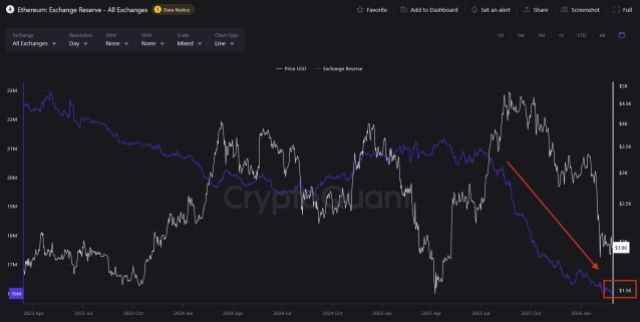
Ethereum's supply on cryptocurrency exchanges has plummeted to a multi-year low, with only 16 million ETH remaining, down from 23 million in 2023. This significant withdrawal indicates that holders are choosing to hold or stake their assets rather than sell, despite recent price declines. This trend reduces immediate sell pressure and suggests a silent accumulation phase, potentially setting the stage for a supply shock. Concurrently, Ethereum's network activity has surged to record highs, with daily transactions nearing 3 million, driven by increased DeFi usage, stablecoin transfers, and NFT interactions. This heightened on-chain demand points to substantial utility growth and adoption, even as the price hovers around $2,000.

With the Ethereum price slowly demonstrating bullish traction after reclaiming the $2,000 mark, sentiment is turning positive once again. During this price action, investors are choosing to hold the leading altcoin rather than sell, which is indicated by a significant drop in crypto exchanges’ reserves.

Available Ethereum On Exchanges Hits New Lows

Following the bounce in Ethereum’s price, the supply of ETH sitting on cryptocurrency exchanges has experienced a sharp decline. According to the report, the number of the coin available on crypto exchanges has fallen to new lows, signaling a notable shift in market structure and sentiment.

As per the chart shared by Leon Waidmann, an optimist and the head of research at Lisk, the metric is currently sitting at a multi-year low. As coins continue to migrate from trading platforms into private wallets or long-term storage, the amount of liquid accessible for instant sale is gradually decreasing.

Currently, over 16 million ETH is left on cryptocurrency exchanges, falling from about 23 million ETH in 2023. Even though the price of ETH has declined sharply from a new all-time high, holders kept withdrawing their coins from platforms. This is considered a positive development for Ethereum as fewer ETH reserves on exchanges means less immediate sell pressure on the altcoin.
Source: Chart from Leon Waidmann on X

When reserves drop during a price crash, this is an interesting trend as it implies that holders are not panic-selling. Waidmann highlighted that these holders are deliberately moving ETH off cryptocurrency exchanges to staking contracts, cold storage, and Decentralized Finance (DeFi).

These investors are making an active choice to hold, and this is historically how supply shocks are started without a price pump. While everyone else is preoccupied with the red candles, there is a silent accumulation. The market may be scared currently, but on-chain data is telling a different story.

ETH Is Attracting A Massive Wave Of Adoption

Ethereum adoption is picking up pace at a significant rate, as evidenced by its mainnet activity. The network’s activity has spiked to unprecedented levels, with its daily transactions climbing to an all-time high despite the bear market. The milestone shows a significant rise in on-chain demand, which is fueled by increased DeFi activity, stablecoin transfers, NFT interactions, and the emergence of AI and real-world asset protocols.

Data shows that the mainnet transactions per day have surged to nearly 3 million. This is a notable number when compared to levels seen in previous cycles, especially during a bull run. Waidmann noted that the current number of daily transactions is more than the ones seen in the 2021 bull run and in the 2023 recovery.

Despite the fact that the price of ETH is down, the network is experiencing its busiest period, signaling sustained engagement beneath the surface. Record-breaking transaction counts frequently indicate increasing utility rather than being pure speculation.

ETH trading at $1,995 on the 1D chart | Source: ETHUSDT on Tradingview.com

Связанные с этим вопросы

QWhat is the current trend in Ethereum supply on cryptocurrency exchanges and why is it significant?

AThe supply of Ethereum on cryptocurrency exchanges has dropped to a multi-year low, with only over 16 million ETH left, down from about 23 million in 2023. This is significant because it indicates that investors are choosing to hold rather than sell, reducing immediate sell pressure and potentially signaling the start of a supply shock.

QAccording to Leon Waidmann, where are Ethereum holders moving their coins instead of keeping them on exchanges?

AAccording to Leon Waidmann, Ethereum holders are deliberately moving their ETH off exchanges to staking contracts, cold storage, and Decentralized Finance (DeFi) protocols.

QHow does the current on-chain activity on the Ethereum network compare to previous market cycles?

AThe Ethereum network is experiencing unprecedented on-chain activity, with daily transactions surging to nearly 3 million. This number is higher than the levels seen during the 2021 bull run and the 2023 recovery, indicating sustained engagement and increasing utility.

QWhat does a decrease in exchange reserves during a price crash typically suggest about investor behavior?

AA decrease in exchange reserves during a price crash suggests that investors are not panic-selling. Instead, they are actively choosing to hold and withdraw their coins to long-term storage, which is a bullish signal for the asset.

QWhat are the main factors driving the increased demand and transaction activity on the Ethereum network?

AThe increased demand and transaction activity on the Ethereum network are fueled by heightened DeFi activity, stablecoin transfers, NFT interactions, and the emergence of AI and real-world asset protocols.

Похожее

When AI Begins to Audit the World: From Claude Discovering the ZEC Vulnerability, Watching the Encryption Industry Enter the 'Recursive Security Era'

**When AI Audits the World: From Claude's Discovery of a ZEC Vulnerability, Viewing the Crypto Industry Entering a "Recursive Security Era"** This article examines a pivotal shift in the blockchain security landscape, triggered by the convergence of two events: Anthropic's research on AI's "Recursive Self-Improvement" and Claude Opus 4.8's discovery of a critical vulnerability in Zcash's code. Traditionally, crypto security has relied on human experts and automated tools for periodic audits. However, the article argues AI is transitioning from a mere tool to an active participant in understanding and analyzing complex systems. Claude's ability to identify a subtle flaw in Zcash's zero-knowledge proof system demonstrates AI's potential to dramatically lower the cost and time required for risk discovery. This goes beyond finding a single bug; it signals a change in the very mechanism of how vulnerabilities are found. The core thesis introduces the concept of "Recursive Security," drawing a parallel to Anthropic's "Recursive Self-Improvement." Just as AI can accelerate its own development through feedback loops, security systems are evolving towards a continuous cycle of analysis, risk identification, remediation, and re-analysis. Security is becoming a persistent, evolving capability integrated into a system's lifecycle, rather than a one-time pre-launch audit. This shift is particularly urgent for the crypto industry, where system complexity from Layer-2 networks, modular architectures, and ZK-proofs is growing faster than human analysis capacity. AI excels at the pattern recognition and contextual understanding needed to navigate this complexity. Importantly, the article cautions that AI augments both defenders and potential attackers, accelerating the entire threat landscape. The future competitive advantage may not lie in having zero vulnerabilities, but in having the fastest risk discovery, validation, and response capabilities. The Claude-Zcash incident is thus an early signal of an era where AI-driven, recursive security systems become essential for managing risk in an increasingly complex digital world.

marsbit1 ч. назад

When AI Begins to Audit the World: From Claude Discovering the ZEC Vulnerability, Watching the Encryption Industry Enter the 'Recursive Security Era'

marsbit1 ч. назад

From MSTR to STRC+: Where Is the Limit of the Strategy Universe?

From MSTR to STRC+: The Evolution and Limits of the Strategy Universe This article examines the transformation of Strategy (formerly MicroStrategy) from a simple "Bitcoin treasury" company into a complex financial engineering firm building a BTC-backed credit system. **Core Thesis:** Strategy's true significance lies not just in its massive BTC holdings (~844k BTC), but in its attempt to transform this static reserve into a multi-layered credit curve within traditional capital markets and, subsequently, into on-chain yield infrastructure. **The MSTR Flywheel:** The initial model was a reflexive loop: BTC price rises → MSTR stock rises → company raises capital (debt/equity) at a premium → buys more BTC → increases per-share BTC exposure → MSTR premium grows. This "amplified Bitcoin" equity (MSTR) thrives on bullish momentum but is vulnerable to tightening premiums and rising funding costs. **Building the Credit Curve:** Strategy's innovation is slicing its single BTC balance sheet into different risk/return profiles via specialized securities: * **MSTR:** High-volatility equity layer absorbing full BTC upside/downside. * **STRC:** Key product. A perpetual preferred stock designed as "short duration high yield credit," offering ~11.5% floating monthly dividends. It attracts fixed-income investors seeking yield without direct BTC exposure, funding Strategy's operations. * **STRD/STRK/STRF:** Other preferred/share classes with varying durations, conversion rights, and fixed dividends. **Risks of the STRC Model:** STRC's high yield is not risk-free. Its stability depends on: 1) Sufficient BTC asset coverage, 2) Strategy's continued ability to pay dividends, and 3) Market faith in the MSTR/STRC funding flywheel. Stress points include deep BTC price declines eroding the asset buffer, rising dividend costs if STRC trades below par, and a broken flywheel if MSTR's premium (mNAV) falls persistently. **On-Chain Expansion: STRC+:** Projects like **Saturn** and **Apyx** aim to package STRC's (and other DAT preferred stock) cash flows into on-chain stablecoin yield (e.g., sUSDat, apyUSD). They offer DeFi a new yield source distinct from trading fees or incentives—cash dividends from traditional securities. However, this introduces compounded risks: off-chain custody, issuer credit risk, BTC volatility, and protocol execution risk. **Conclusion: The Ultimate Boundary** Strategy's endgame is not infinite BTC accumulation. It is the market's long-term acceptance of a new credit system where BTC serves as collateral for tradable securities whose cash flows can power on-chain financial applications. Its "universe" expands if this BTC-native credit curve gains legitimacy, but contracts if these instruments are repriced purely as high-risk, yield-bearing credit assets without stablecoin mythology.

marsbit1 ч. назад

From MSTR to STRC+: Where Is the Limit of the Strategy Universe?

marsbit1 ч. назад

Торговля

Спот
Фьючерсы

Популярные статьи

Manyu: восходящая мем-звезда на Ethereum, готовая открыть новую эру культуры Shiba

Manyu - это мемтокен на Ethereum, который приносит децентрализованную культурную и развлекательную ценность через вирусное влияние в соцсетях и вовлечённость сообщества.

1.9k просмотров всегоОпубликовано 2025.11.27Обновлено 2025.11.27

Manyu: восходящая мем-звезда на Ethereum, готовая открыть новую эру культуры Shiba

Неделя обучения по популярным токенам 14: Glamsterdam — самое ожидаемое обновление Ethereum в 2026 году

Ordinals/Runes по-прежнему стимулируют доходы от комиссий за блоки и активность разработчиков, рассматриваются как отправная точка «нативной эмиссии активов» в сети.

1.5k просмотров всегоОпубликовано 2026.04.29Обновлено 2026.04.29

Неделя обучения по популярным токенам 14: Glamsterdam — самое ожидаемое обновление Ethereum в 2026 году

Обсуждения

Добро пожаловать в Сообщество HTX. Здесь вы сможете быть в курсе последних новостей о развитии платформы и получить доступ к профессиональной аналитической информации о рынке. Мнения пользователей о цене на ETH (ETH) представлены ниже.

活动图片