Ethereum Cements RWA Dominance As Amundi Tokenizes $100M SAFO Fund

bitcoinistОпубликовано 2026-03-20Обновлено 2026-03-20

Введение

Europe's largest asset manager, Amundi, has launched a tokenized fund, the Spiko Amundi Overnight Swap Fund (SAFO), with $100 million in initial assets. The fund, built on Ethereum and Stellar, is designed for corporate treasury and collateral management, offering low-risk, overnight liquidity and multi-currency support. It uses smart contracts and Chainlink’s oracle network for real-time data and interoperability. This move reinforces Ethereum’s dominance in institutional real-world asset (RWA) tokenization, joining other major players like BlackRock in shifting toward on-chain financial products.

Amundi, Europe’s largest asset manager, is launching the Spiko Amundi Overnight Swap Fund (SAFO), a tokenized fund on Ethereum and Stellar starting with about $100 million in committed assets.

A Traditional Fund With A Tokenized Wrapper

Institutions historically related to TradFi have found a way to not to be left behind on the crypto curve in tokenized assets. In a statement published on Amundi’s website, the investment fund announced its collaboration with Spiko, a French-law regulated specialist tokenization platform, to launch SAFO as a tokenized sub-fund of SPIKO SICAV.

Structurally, SAFO it’s a traditional fund, just with a tokenized wrapper: it’s designed for corporate treasury and collateral management, an “on‐chain cash parking” with low risk and overnight liquidity. The fund invests using fully collateralized total return swaps with top‐tier banks, aiming to deliver stable yields slightly above risk‐free rates while still letting investors get their money back on an overnight basis. It supports multiple currencies (EUR, USD, GBP, CHF) and can be subscribed from as little as 1 unit, which is unusually low for institutional‐grade cash products.

The firm highlighted that the fund enables almost immediate settlement, supports multiple ways to hold assets, provides live visibility into the shareholder register, and allows fund shares to move globally around the clock, with automated access through APIs or smart contracts.

In the statement, Jean-Jacques Barbéris, Head of Institutional and Corporate Clients, and ESG at Amundi, said:

SAFO provides professional investors with a fast and transparent access to cash management solutions. This initiative is part of our ambition to contribute to the rise of tokenized solutions.

Where Ethereum Comes In

The shareholder register and fund shares live on Ethereum and Stellar, with Ethereum chosen for its smart‐contract and DeFi composability, while Stellar supports faster, lower‐cost transfers and 24/7 transferability of fund units. Chainlink’s network of data providers puts SAFO’s fund value directly on the blockchain and acts as the connector between Ethereum, Stellar, and traditional systems. This gives tokenized funds a secure, standardized way to share information, building on tests Chainlink has already run with DTCC and other major institutions.

SAFO is Amundi’s second tokenized fund in a few months. Back in November, the fund rolled out a tokenized share class of a money market fund on Ethereum, working together with CACEIS, one of Europe’s top asset-servicing providers and transfer agents, as reported by Bitcoinist.

Amundi’s new venture adds to a growing universe of tokenized money‐market products from players like BlackRock, the world’s largest asset manager, and Franklin Templeton, and reinforcing Ethereum’s position as the primary settlement layer for institutional RWAs.

A €2.3 trillion incumbent plugging into Ethereum and Chainlink cements the thesis that the next leg of the crypto cycle is driven by tokenized cash, bonds, and funds rather than purely speculative DeFi.

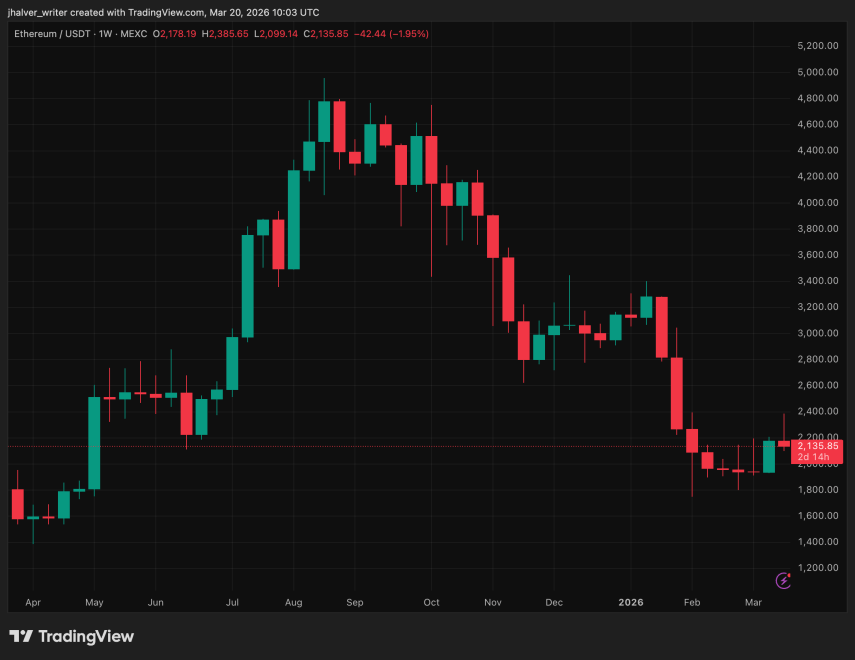
ETH trades for $2k on the daily chart. Source: ETHUSDT on Tradingview

Cover image from Perplexity, ETHUSDT chart from Tradingview

Связанные с этим вопросы

QWhat is the name of the tokenized fund launched by Amundi and Spiko, and on which blockchains is it built?

AThe tokenized fund is called the Spiko Amundi Overnight Swap Fund (SAFO). It is built on the Ethereum and Stellar blockchains.

QWhat is the primary purpose of the SAFO fund, and what type of investor is it target?

AThe SAFO fund is designed for corporate treasury and collateral management, acting as an 'on-chain cash parking' solution with low risk and overnight liquidity. It is targeted at professional investors.

QWhich key infrastructure provider is used to put the fund's value on the blockchain and connect the different systems?

AChainlink's network of data providers is used to put the fund's value on the blockchain and acts as the connector between Ethereum, Stellar, and traditional systems.

QHow does this new fund contribute to Ethereum's position in the market, according to the article?

AThe article states that Amundi's venture reinforces Ethereum's position as the primary settlement layer for institutional Real-World Assets (RWAs).

QWhat was notable about Amundi's previous tokenization effort mentioned in the article?

AIn November, prior to SAFO, Amundi rolled out a tokenized share class of a money market fund on Ethereum in collaboration with CACEIS, a top European asset-servicing provider.

Похожее

Michael Saylor's Latest Long Read: Who Defines the Soul of Bitcoin?

Michael Saylor's essay outlines four key ideological factions within the Bitcoin community, each shaping its future. **Bitcoin Maximalists** view Bitcoin as the dominant monetary network—a breakthrough offering superior property rights and sound money. They focus on its moral imperative and resist dilution. **Bitcoin Capitalists** believe Bitcoin's full potential is unlocked through deep integration with the global economy—into capital markets, corporate treasuries, and financial instruments. Their risk is excessive financialization. **Bitcoin Technologists** advocate for ongoing protocol improvements in scalability, privacy, and security to meet evolving demands and threats. Their core risk is destabilizing changes to the foundational layer. **Bitcoin Fundamentalists** prioritize protecting Bitcoin's core principles: self-custody, running nodes, decentralization, and its use as money. They guard against corruption, capture, and compromise. The essay argues that Bitcoin's success requires a balanced synthesis of these perspectives: maintaining its sacred core (Fundamentalists), recognizing its dominance (Maximalists), enabling global integration (Capitalists), and allowing carefully considered innovation (Technologists). The goal is disciplined expansion where most innovation occurs in higher layers, preserving the integrity of the base protocol while making Bitcoin useful for all.

marsbit1 ч. назад

Michael Saylor's Latest Long Read: Who Defines the Soul of Bitcoin?

marsbit1 ч. назад

SpaceX's Blazingly Hot IPO Breaks Records; The Previous Record Holder Was a Chinese Company

SpaceX's upcoming IPO has ignited a feverish market response, poised to break records as the largest in US and global history with a targeted valuation of $1.77 trillion and fundraising of $75 billion. Elon Musk's assertive stance, rewriting IPO rules by allocating 30% of new shares to retail investors—far exceeding the typical 5-10%—and slashing underwriting fees below 0.75%, has fueled the frenzy. This event surpasses the previous US IPO fundraising record set by Chinese e-commerce giant Alibaba in 2014. Alibaba's landmark 2014 NYSE listing raised over $25 billion, crowning it the world's fourth-largest tech company. It symbolized China's rising consumer class and digital economy, ushering in a golden era for US-listed Chinese tech firms and even prompting Hong Kong's exchange to reform its listing rules. However, Alibaba's fortunes shifted post-2020 peak. It faced a record antitrust fine for "choosing one from two" practices, internal cultural crises, and strategic missteps. A focus on premium consumption eroded its core e-commerce market share to around 30%, while costly expansions into new retail and media incurred massive losses. In late 2023, its market value was overtaken by PDD (Pinduoduo). Now, Alibaba is pivoting to AI as a new growth engine. Its Tongyi Qianwen model boasts high user engagement, and Alibaba Cloud remains China's leading public cloud provider, with AI-related revenue growing significantly. The company is integrating AI across its ecosystem. Yet challenges persist, including strong competition from ByteDance's Doubao model, talent retention issues, and an unclear strategic focus between consumer and enterprise AI. Alibaba's journey—from its record-setting IPO peak, through periods of regulatory scrutiny and strategic overreach, to its current AI-driven recalibration—highlights the cyclical fate of tech giants and underscores the critical role of core technological innovation in navigating industry shifts.

marsbit1 ч. назад

SpaceX's Blazingly Hot IPO Breaks Records; The Previous Record Holder Was a Chinese Company

marsbit1 ч. назад

Why Does Ethereum Still Need Kohaku? Privacy Concerns Aren't Just in Transactions

The article "Why Ethereum Still Needs Kohaku: Privacy Issues Extend Beyond Transactions" explains the Kohaku initiative as a suite of privacy-first tools designed to improve user privacy on the Ethereum network. It addresses the problem that while Ethereum's transparency enables innovation, it also exposes users' financial activities, asset holdings, and social connections when they reuse a single address. Kohaku aims to bridge the gap between existing privacy protocols (like Railgun, Privacy Pools) and practical user experience by integrating privacy features into wallets, developer tools, and daily interactions. Key focuses include: enabling wallets to manage multiple accounts for different purposes ("many accounts, many you"), facilitating controlled visibility for transactions instead of full transparency, protecting user data during RPC queries and network activity, and providing developers with easier ways to integrate privacy. The article clarifies that Kohaku is not a single product but an ongoing effort to make privacy a default, usable component of the ecosystem, moving beyond complex protocols to practical application. It counters common misconceptions, arguing that privacy is a fundamental user right for normal activities, not just for anonymity, and that it can coexist with compliance through selective disclosure. Ultimately, Kohaku represents an essential step for Ethereum's maturation, ensuring users can participate in the open network while maintaining control over their personal information boundaries.

marsbit1 ч. назад

Why Does Ethereum Still Need Kohaku? Privacy Concerns Aren't Just in Transactions

marsbit1 ч. назад

Торговля

Спот
Фьючерсы

Популярные статьи

Manyu: восходящая мем-звезда на Ethereum, готовая открыть новую эру культуры Shiba

Manyu - это мемтокен на Ethereum, который приносит децентрализованную культурную и развлекательную ценность через вирусное влияние в соцсетях и вовлечённость сообщества.

1.9k просмотров всегоОпубликовано 2025.11.27Обновлено 2025.11.27

Manyu: восходящая мем-звезда на Ethereum, готовая открыть новую эру культуры Shiba

Неделя обучения по популярным токенам 14: Glamsterdam — самое ожидаемое обновление Ethereum в 2026 году

Ordinals/Runes по-прежнему стимулируют доходы от комиссий за блоки и активность разработчиков, рассматриваются как отправная точка «нативной эмиссии активов» в сети.

1.5k просмотров всегоОпубликовано 2026.04.29Обновлено 2026.04.29

Неделя обучения по популярным токенам 14: Glamsterdam — самое ожидаемое обновление Ethereum в 2026 году

Обсуждения

Добро пожаловать в Сообщество HTX. Здесь вы сможете быть в курсе последних новостей о развитии платформы и получить доступ к профессиональной аналитической информации о рынке. Мнения пользователей о цене на ETH (ETH) представлены ниже.

活动图片