El Salvador’s Bitcoin aspirations were brought closer to earth in 2025

cointelegraphОпубликовано 2025-12-24Обновлено 2025-12-24

Введение

El Salvador, the first country to adopt Bitcoin as legal tender in 2021, faced significant challenges in 2025 as its ambitious crypto plans met economic and institutional resistance. Despite initial efforts like the state-backed Chivo Wallet and $30 sign-up incentives, public usage remained low. The country’s need for a $1.4 billion IMF loan forced a policy shift: Bitcoin acceptance became voluntary, and taxes were required in US dollars. However, President Nayib Bukele continued purchasing Bitcoin, accumulating 6,367 BTC (worth over $588 million) by December 2025, despite IMF pressure. While crypto businesses like Tether and Bitfinex expanded operations in El Salvador due to favorable regulations, critics argued that without broader public education and adoption, the government’s Bitcoin strategy primarily benefited itself rather than the people.

El Salvador, the first country in the world to recognize Bitcoin as legal tender, was seen by many in the industry as a pioneer. In 2025, the small country’s Bitcoin ambitions met reality.

The Central American country made waves in 2021 when the Legislative Assembly approved a bill that required all merchants, stores and places of business to accept Bitcoin (BTC) as a form of payment. Proponents believed it would set off a chain of Bitcoin adoption and be a boon for the country’s economy.

Ambitious adoption plans, including the issuance of bonds to fund a “Bitcoin City,” met lukewarm adoption from Salvadorans. Adoption was further muddied by concerns from the International Monetary Fund (IMF).

These worries came to a head in 2025, when El Salvador had to take a second look at its Bitcoin policy.

Bitcoin adoption in El Salvador off to a lukewarm start

The passage of El Salvador’s Bitcoin Law was quickly followed by the rollout of the Chivo Wallet, the official Bitcoin wallet of El Salvador. Citizens were even incentivized to sign up with addresses pre-loaded with $30 of Bitcoin. But for many, they just took the free money and ran, never using the app again.

By law, Bitcoin should be accepted everywhere, but attempts to use Bitcoin in El Salvador were met with limited success by those who tried.

On-the-ground adoption concerns aside, there was one other looming issue, and that was El Salvador’s debt and the IMF’s position on Bitcoin and cryptocurrencies.

El Salvador was seeking a $1.4-billion loan from the IMF, as its public finances and debt needed reinforcement to be sustainable. Its external reserves and economic buffers were also wearing thin and needed strengthening against potential shocks.

The IMF didn’t want El Salvador to recognize Bitcoin as legal tender amid concerns about its risks to financial stability. It stated that widespread government use of Bitcoin, like El Salvador’s Bitcoin buying plan, can expose the state budget to contingent liabilities that depend on BTC price movements.

Bukele makes “deal with the devil” but keeps buying Bitcoin

Amid these concerns, the IMF made granting the requested loan conditional on El Salvador narrowing the scope of its Bitcoin Law. El Salvador’s economic needs were greater than the government’s Bitcoin ideals, and it repented.

In January, El Salvador made accepting Bitcoin voluntary and ensured taxes would only be paid in US dollars, the country’s de facto currency.

Many crypto industry observers were despondent. Kadan Stadelmann, chief technology officer of Komodo Platform, wrote in an opinion article for Cointelegraph that “the revolution is dead in El Salvador” after President Nayib Bukele made a “deal with the devil” — i.e., the IMF.

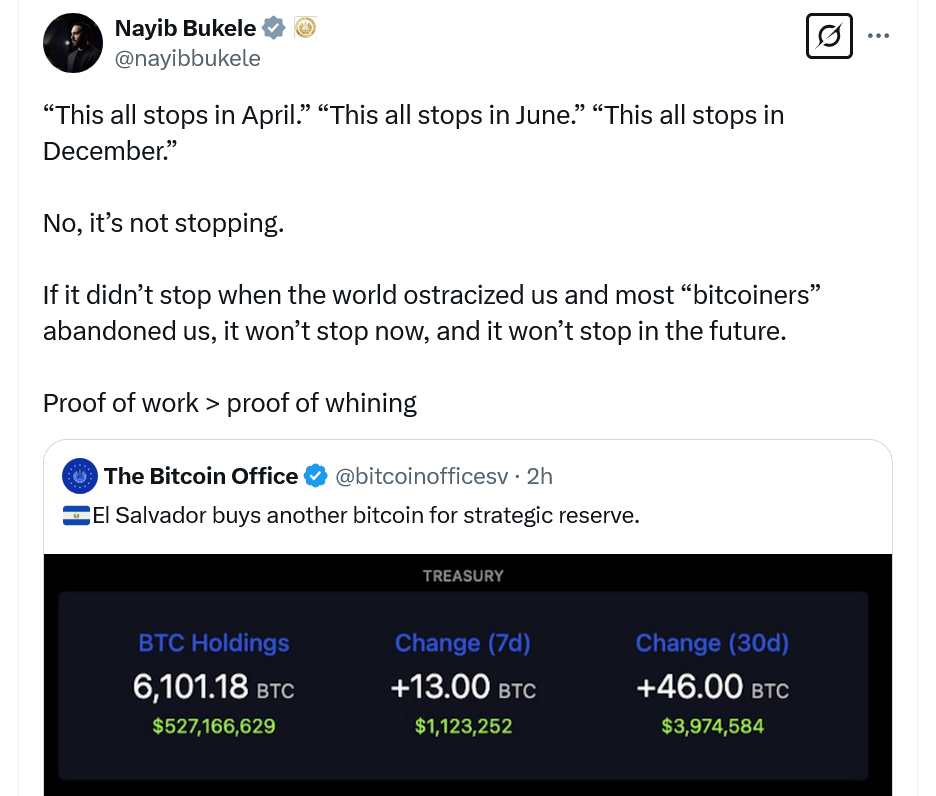
Bukele didn’t walk back his orange-pilled position entirely. In March, despite several requests from the IMF that El Salvador cease its Bitcoin purchases, El Salvador steamed ahead. Bukele wrote on X at the time:

Source: Nayib Bukele

Observers like John Dennehy, an El Salvador-based Bitcoin activist and educator, said this could be the government making its last accumulations before the IMF deal goes into effect. Anonymous financial commentator Unseen Finance suggested there could be “some remaining pools of funds, maybe allocated in the government in some subaccounts of different agencies, entities, maybe even some state-owned-enterprises, that had kind of been pre-allocated and set aside.”

Related: How can Bukele still stack Bitcoin after IMF loan agreement?

The question of how El Salvador could continue its Bitcoin purchases despite the IMF deal would resurface several more times. In April, El Salvador bought seven BTC, but Rodrigo Valdes, director of the Western Hemisphere Department at the IMF, said that the country was still in compliance. By May, when the IMF delivered the first $120 million of its loan, it said that El Salvador must make efforts to stop purchasing Bitcoin.

El Salvador apparently didn’t hear this because just a month later, it bought 240 BTC. Anndy Lian, author and intergovernmental blockchain adviser, told Cointelegraph at the time, “The IMF’s ‘flexible interpretation’ suggests purchases may involve non-public sector entities or reclassified assets, maintaining technical compliance.” This alternative approach allowed the country to continue purchasing Bitcoin.

By November, when El Salvador bought around $100 million in Bitcoin, the IMF told Cointelegraph it was “not going to provide a running commentary on each Bitcoin-related announcement.” A spokesperson said they’d address El Salvador’s commitments “in due course.”

As of Dec. 12, El Salvador holds 6,367 BTC, according to DropsTab’s El Salvador portfolio tracker. It’s worth over $588 million and is $267 million in profit.

Data current as of Dec. 12, 2025.

What’s ahead for the Bitcoin business in El Salvador?

On-the-ground Bitcoin adoption may have slowed to a crawl, but some crypto businesses still find El Salvador a friendly place to do business.

In January, both Tether and Bitfinex Derivatives announced they’d be moving offices to El Salvador after securing the necessary licensing from local authorities. Tether said it chose the country for its “forward-thinking policies, favorable regulatory environment, and ... growing Bitcoin-savvy community.” Bitfinex Derivatives similarly lauded the government’s pro-crypto policies in its announcement.

In August, Juan Carlos Reyes, president of El Salvador’s Commission of Digital Assets, said that investment banks that wanted to hold Bitcoin were moving to El Salvador.

He told Cointelegraph at the time, “The new Investment Banking Law allows private investment banks to operate in legal tender and foreign currencies for ‘Sophisticated Investors’ and to engage in digital assets like Bitcoin with a Digital Asset Service Provider (PSAD) license. With a PSAD license, a bank could choose to operate entirely as a Bitcoin bank.”

Related: Pro-Bitcoin restaurant Steak 'n Shake announces El Salvador expansion

El Salvador has also influenced its neighbors. In July, the Central Bank of Bolivia signed a memorandum of understanding with El Salvador to accelerate crypto adoption. Bolivia’s central bank called crypto a “viable and reliable alternative” to fiat currency.

In May, Panama City Mayor Mayer Mizrachi hinted at the idea of establishing a Bitcoin reserve after meeting with Max Keiser and Stacy Herbert, two El Salvador-based Bitcoin policy leaders.

Who benefits from El Salvador buying Bitcoin?

Crypto businesses may still be attracted to El Salvador’s forward-thinking crypto policies, even after they revised the Bitcoin Law. The government may also be finding a way to have its cake and eat it, too: receiving the IMF loan and continuing to stack BTC.

Quentin Ehrenmann, general manager at My First Bitcoin — a non-governmental organization focused on Bitcoin adoption — said that continued accumulations, without education or adoption, don’t help anyone.

“Since the government entered into this contract with the IMF, Bitcoin is no longer legal tender, and we haven’t seen any other effort to educate people. The government, apparently, continues to accumulate Bitcoin, which is beneficial for the government — it’s not directly good for the people.”

Whether Bukele’s Bitcoin policy is good for the people, the government or Bitcoin adoption, it’s unlikely to change soon. Reforms to the presidential elections in 2025 have allowed Bukele to run for election indefinitely.

Opposition lawmaker Marcela Villatoro said this “brings an accumulation of power and weakens democracy ... there’s corruption and clientelism because nepotism grows and halts democracy and political participation.”

In 2025, the scope of El Salvador’s Bitcoin ambitions narrowed. Part of this was due to the necessary politics of dealing with the IMF. How and at what rate actual Bitcoin adoption will continue in 2026 depends on whether they are willing to educate and foster everyday people on how to use it.

Magazine: Big questions: Would Bitcoin survive a 10-year power outage?


Связанные с этим вопросы

QWhat was the main reason El Salvador had to scale back its Bitcoin Law in 2025?

AEl Salvador had to scale back its Bitcoin Law primarily due to pressure from the International Monetary Fund (IMF) as a condition for securing a $1.4 billion loan. The IMF expressed concerns about the risks Bitcoin posed to financial stability and the country's public finances.

QHow did the IMF's loan conditions specifically affect El Salvador's Bitcoin policy?

AThe IMF made granting the loan conditional on El Salvador narrowing the scope of its Bitcoin Law. As a result, in January 2025, El Salvador made accepting Bitcoin voluntary for businesses and ensured that taxes would only be paid in US dollars.

QDespite the IMF agreement, how was El Salvador able to continue purchasing Bitcoin throughout 2025?

AEl Salvador continued purchasing Bitcoin by using alternative approaches, such as having non-public sector entities or reclassified assets make the purchases. This allowed the country to maintain technical compliance with the IMF agreement while still accumulating BTC.

QWhat is the current status of Bitcoin adoption among the general public in El Salvador according to the article?

AOn-the-ground Bitcoin adoption among the general public in El Salvador was described as 'lukewarm' and had 'slowed to a crawl.' Many citizens who signed up for the government's Chivo wallet for the $30 incentive never used the app again, and attempts to use Bitcoin for payments met with limited success.

QWhich major crypto companies announced moves to El Salvador in 2025, and what was their reason?

ATether and Bitfinex Derivatives both announced they were moving offices to El Salvador in January 2025. They cited the country's 'forward-thinking policies, favorable regulatory environment, and growing Bitcoin-savvy community' as reasons for their move.

Похожее

How Many Tokens Away Is Yang Zhilin from the 'Moon Chasing the Light'?

The article explores the intense competition between two leading Chinese AI companies, DeepSeek and Kimi (Moon Dark Side), and the mounting pressure on Yang Zhilin, the founder of Kimi. While DeepSeek re-emerged after 15 months of silence with its powerful V4 model—boasting 1.6 trillion parameters and low-cost, long-context capabilities—Kimi has been focusing on long-context processing and multi-agent systems with its K2.6 model. Yang faces a threefold challenge: technological rivalry, commercialization pressure, and investor expectations. Despite Kimi’s high valuation (reaching $18 billion), its revenue heavily relies on a single product with low paid conversion rates, while DeepSeek’s strategic silence and open-source influence have strengthened its market position and valuation prospects, now targeting over $20 billion. Both companies reflect broader trends in China’s AI ecosystem: Kimi aims for global influence through open-source contributions and agent-based advancements, while DeepSeek prioritizes foundational innovation and hardware independence, notably shifting to Huawei’s chips. Their competition is seen as vital for China’s AI progress, with the gap between top Chinese and U.S. models narrowing to just 2.7% on the Elo rating scale. Ultimately, the article argues that this rivalry, though anxiety-inducing for leaders like Zhilin, is essential for driving innovation and solidifying China’s role in the global AI landscape.

marsbit6 ч. назад

How Many Tokens Away Is Yang Zhilin from the 'Moon Chasing the Light'?

marsbit6 ч. назад

TechFlow Intelligence Bureau: ChatGPT Helps Amateur Mathematician Crack 60-Year-Old Problem, CFTC Sues New York Regulator Over Coinbase and Gemini

An amateur mathematician, with the assistance of ChatGPT, has solved a combinatorial mathematics puzzle originally proposed by Hungarian mathematician Paul Erdős in the 1960s. This marks another milestone in AI-aided mathematical research, demonstrating the evolving capabilities of large language models in formal reasoning. In other AI developments, OpenAI introduced a new privacy filter tool for enterprise API usage, automatically screening sensitive data. Meanwhile, the Qwen3.6-27B model achieved 100 tokens per second on a single RTX 5090 GPU using quantization, significantly lowering the cost barrier for local AI deployment. In crypto and Web3, the U.S. CFTC sued New York’s financial regulator, challenging its oversight of Coinbase and Gemini—a first-of-its-kind federal-state regulatory clash. Following a vulnerability, KelpDAO and major DeFi protocols established a recovery fund. Tether froze $344 million in assets linked to Iran’s central bank upon U.S. Treasury request, highlighting the centralized control risks in stablecoins. Separately, Litecoin underwent a 3-hour chain reorganization to undo a privacy-layer exploit. In the U.S., former President Trump invoked the Defense Production Act to address power grid bottlenecks affecting AI data centers and dismissed the entire National Science Board, raising concerns over research independence. A retail trader gained 250% on a $600k Intel options bet amid AI-related speculation. Xiaomi announced its first performance electric vehicle, targeting rivals like Tesla. Meanwhile, iPhone users reported devices automatically reinstalling a hidden app daily, suspected to be MDM-related. A Chinese securities report noted that A-share institutional crowding has reached its second-longest streak since 2007, signaling high valuations and potential style rotation. The day’s developments reflect a dual narrative: AI is enabling unprecedented individual breakthroughs, while centralized power structures—whether governmental or corporate—are becoming more assertive, underscoring that decentralization is as much a political-economic challenge as a technical one.

marsbit6 ч. назад

TechFlow Intelligence Bureau: ChatGPT Helps Amateur Mathematician Crack 60-Year-Old Problem, CFTC Sues New York Regulator Over Coinbase and Gemini

marsbit6 ч. назад

Торговля

Спот
Фьючерсы

Популярные статьи

Как купить S

Добро пожаловать на HTX.com! Мы сделали приобретение Sonic (S) простым и удобным. Следуйте нашему пошаговому руководству и отправляйтесь в свое крипто-путешествие.Шаг 1: Создайте аккаунт на HTXИспользуйте свой адрес электронной почты или номер телефона, чтобы зарегистрироваться и бесплатно создать аккаунт на HTX. Пройдите удобную регистрацию и откройте для себя весь функционал.Создать аккаунтШаг 2: Перейдите в Купить криптовалюту и выберите свой способ оплатыКредитная/Дебетовая Карта: Используйте свою карту Visa или Mastercard для мгновенной покупки Sonic (S).Баланс: Используйте средства с баланса вашего аккаунта HTX для простой торговли.Третьи Лица: Мы добавили популярные способы оплаты, такие как Google Pay и Apple Pay, для повышения удобства.P2P: Торгуйте напрямую с другими пользователями на HTX.Внебиржевая Торговля (OTC): Мы предлагаем индивидуальные услуги и конкурентоспособные обменные курсы для трейдеров.Шаг 3: Хранение Sonic (S)После приобретения вами Sonic (S) храните их в своем аккаунте на HTX. В качестве альтернативы вы можете отправить их куда-либо с помощью перевода в блокчейне или использовать для торговли с другими криптовалютами.Шаг 4: Торговля Sonic (S)С легкостью торгуйте Sonic (S) на спотовом рынке HTX. Просто зайдите в свой аккаунт, выберите торговую пару, совершайте сделки и следите за ними в режиме реального времени. Мы предлагаем удобный интерфейс как для начинающих, так и для опытных трейдеров.

1.2k просмотров всегоОпубликовано 2025.01.15Обновлено 2025.03.21

Как купить S

Sonic: Обновления под руководством Андре Кронье – новая звезда Layer-1 на фоне спада рынка

Он решает проблемы масштабируемости, совместимости между блокчейнами и стимулов для разработчиков с помощью технологических инноваций.

2.2k просмотров всегоОпубликовано 2025.04.09Обновлено 2025.04.09

Sonic: Обновления под руководством Андре Кронье – новая звезда Layer-1 на фоне спада рынка

HTX Learn: Пройдите обучение по "Sonic" и разделите 1000 USDT

HTX Learn — ваш проводник в мир перспективных проектов, и мы запускаем специальное мероприятие "Учитесь и Зарабатывайте", посвящённое этим проектам. Наше новое направление .

1.8k просмотров всегоОпубликовано 2025.04.10Обновлено 2025.04.10

HTX Learn: Пройдите обучение по "Sonic" и разделите 1000 USDT

Обсуждения

Добро пожаловать в Сообщество HTX. Здесь вы сможете быть в курсе последних новостей о развитии платформы и получить доступ к профессиональной аналитической информации о рынке. Мнения пользователей о цене на S (S) представлены ниже.

活动图片