Dubai’s $280M Diamond Tokenization Sets RWA Precedent as Bitcoin Hyper Secures $31.2M

bitcoinistОпубликовано 2026-02-04Обновлено 2026-02-04

Введение

Dubai's $280 million diamond tokenization initiative, led by the Dubai Multi Commodities Centre (DMCC), is setting a significant precedent for moving high-value real-world assets (RWAs) onto the blockchain. This move aims to solve long-standing liquidity, verification, and transfer issues associated with physical diamonds by making them divisible, instantly transferable, and transparent on a decentralized ledger. However, existing blockchain infrastructure, particularly Bitcoin’s, lacks the speed and programmability required for institutional-grade asset tokenization. Bitcoin Hyper ($HYPER) has raised over $31.2 million in its presale by addressing this gap. It integrates the Solana Virtual Machine (SVM) into a Bitcoin Layer 2 solution, combining Bitcoin’s security with high-speed smart contract capabilities. This allows for thousands of transactions per second, making it suitable for hosting complex financial products like tokenized commodities. The project has attracted significant whale investment, indicating strong institutional confidence. As Dubai advances its digital asset infrastructure, Bitcoin Hyper emerges as a key technical solution for the future of RWA tokenization on Bitcoin.

Trusted Editorial content, reviewed by leading industry experts and seasoned editors. Ad Disclosure

Quick Facts:

  • ➡️ Dubai’s $280M diamond tokenization validates the trend of moving high-value physical assets onto the blockchain for better liquidity.
  • ➡️ Bitcoin Hyper utilizes the Solana Virtual Machine (SVM) to bring high-speed smart contracts to Bitcoin, solving the network’s historical speed limitations.
  • ➡️ The project has raised over $31.2M in presale, with whale wallets accumulating significant positions ahead of the public launch.
  • ➡️ The combination of Bitcoin’s security and SVM speed positions this Layer 2 as a prime candidate for hosting future institutional financial products.

The United Arab Emirates is ditching petrodollars for digital infrastructure, fast. The latest move? A massive initiative to tokenize $280 million worth of diamonds in Dubai. Led by the Dubai Multi Commodities Centre (DMCC), this isn’t just a fancy ledger entry; it’s the ‘welcome’ mat for Real World Assets (RWAs) entering the institutional blockchain space.

By putting physical gems on a decentralized ledger, Dubai is tackling a liquidity nightmare that has plagued traders for centuries. Diamonds are notoriously hard to move, verification is slow, shipping is risky, and fees are high. Tokenization changes the game. It renders them divisible, instantly transferable, and transparent.

That matters because it provides a blueprint for how trillions of dollars in traditional assets, from real estate to fine art, will eventually migrate on-chain.

But there’s a snag. The infrastructure to handle institutional assets barely exists. While Ethereum ran the early pilots, smart money is looking toward the deepest liquidity pool in crypto: Bitcoin. The problem? Bitcoin doesn’t do complex programmability well, and it’s too slow for modern finance.

That gap has sparked a rush toward Layer 2 solutions capable of handling the load, fueling the rapid ascent of Bitcoin Hyper ($HYPER).

As Dubai creates demand for high-value asset tokenization, the market is funding the technical solution. Bitcoin Hyper has emerged as a frontrunner, bridging the gap between Bitcoin’s security and the speed institutions demand.

Get your $HYPER today.

SVM Integration Redefines Bitcoin Scalability

The main bottleneck preventing Bitcoin from hosting high-frequency trading is the network’s 10-minute block time. Wall Street needs sub-second finality. Bitcoin Hyper ($HYPER) addresses this (somewhat radically) by integrating the Solana Virtual Machine (SVM) directly into a Bitcoin Layer 2 framework.

This architectural pivot is crucial. Rather than building a sluggish EVM-compatible layer on top of Bitcoin, Bitcoin Hyper leverages the SVM’s parallel processing. The result? Thousands of transactions per second, a prerequisite for any platform aiming to handle tokenized commodities like Dubai’s diamond initiative.

The project operates as a modular blockchain, using Bitcoin L1 strictly for settlement while the SVM L2 does the heavy lifting.

For developers, this opens the door to writing smart contracts in Rust. It enables complex DeFi applications, high-speed payments, and NFT platforms secured by Bitcoin’s hash power. Plus, the Decentralized Canonical Bridge ensures that $BTC transfers remain trustless, solving a critical vulnerability that plagued previous generation bridges.
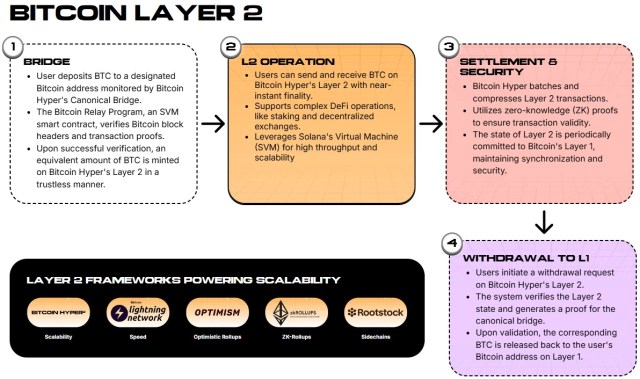
Market observers note that this ,best of both worlds, approach, Bitcoin’s security plus Solana’s speed, is exactly the environment RWAs need to flourish on the Bitcoin network.

Whale Accumulation Accelerates as Presale Hits $31.2M

Money talks, and right now, the capital flows suggest the market is betting big on this infrastructure play. According to official data, Bitcoin Hyper ($HYPER) has raised a staggering $31.2M in its ongoing presale. The token, currently priced at $0.0136751, is attracting serious attention from investors seeking exposure to the Bitcoin Layer 2 narrative before the network goes public.
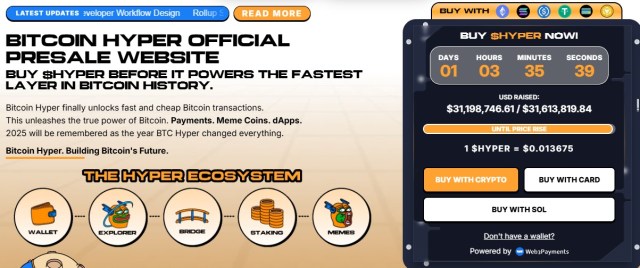
On-chain analysis suggests high-net-worth individuals are positioning themselves aggressively. This specific concentration of capital from ‘smart money’ wallets often precedes broader retail interest, suggesting insiders are betting on the protocol’s long-term utility rather than a quick flip.

The tokenomics structure supports this outlook. With a staking model that offers high APY immediately after the Token Generation Event (TGE), the protocol incentivizes holding. Presale stakers face a reasonable 7-day vesting period, a mechanism designed to prevent immediate sell pressure and stabilize the price during discovery.

As Dubai proves the utility of tokenizing $280 million in hard assets, the protocols that can actually support that volume on Bitcoin are becoming the sector’s most watched assets.

Buy your $HYPER today.

Disclaimer: This article is for informational purposes only and does not constitute financial advice. Cryptocurrency investments, including presales, carry inherent risks. Always perform your own due diligence before making investment decisions.

Editorial Process for bitcoinist is centered on delivering thoroughly researched, accurate, and unbiased content. We uphold strict sourcing standards, and each page undergoes diligent review by our team of top technology experts and seasoned editors. This process ensures the integrity, relevance, and value of our content for our readers.

patrubogdan

Follow

Full Profile

Related Posts

Criptomoneda prometedora para invertir mientras cambia el sentimiento del mercado: Bitcoin Hyper redefine la Capa 2

Crypto Market Structure Bill Nears Key Moment As CFTC Chair Signals Progress Within Months

Bitcoin Dominance Shifts: Crypto Usage Spreads Beyond Bitcoin as $HYPER Keeps Gaining

Aave Scraps Avara and Family Wallet as SUBBD Momentum Builds

Binance Crushes Competition With $155B Asset Surge; $HYPER Emerging as Bitcoin L2 Leader

Criptomoneda prometedora para invertir ante el cambio de sentimiento: el auge de la infraestructura Bitcoin

Связанные с этим вопросы

QWhat is the significance of Dubai's $280 million diamond tokenization initiative?

ADubai's $280 million diamond tokenization, led by the Dubai Multi Commodities Centre (DMCC), sets a precedent for moving high-value physical assets onto the blockchain. It addresses liquidity issues in the diamond trade by making assets divisible, instantly transferable, and transparent, providing a blueprint for tokenizing other traditional assets like real estate and fine art.

QHow does Bitcoin Hyper ($HYPER) solve Bitcoin's scalability limitations for institutional use?

ABitcoin Hyper integrates the Solana Virtual Machine (SVM) into a Bitcoin Layer 2 framework, enabling high-speed smart contracts and thousands of transactions per second. This combines Bitcoin's security with Solana's parallel processing speed, making it suitable for high-frequency trading and institutional financial products like tokenized assets.

QWhat amount has Bitcoin Hyper raised in its presale, and what does whale activity indicate?

ABitcoin Hyper has raised over $31.2 million in its presale. On-chain analysis shows significant accumulation by high-net-worth 'whale' wallets, indicating strong insider confidence in the protocol's long-term utility and potential for growth ahead of its public launch.

QWhy is the integration of the Solana Virtual Machine (SVM) crucial for Bitcoin Hyper's architecture?

AThe SVM integration allows Bitcoin Hyper to leverage parallel processing for high-speed transactions, overcoming Bitcoin network's 10-minute block time limitation. This enables complex DeFi applications, fast payments, and NFT platforms secured by Bitcoin's hash power, essential for institutional-grade asset tokenization.

QHow does tokenization improve liquidity for physical assets like diamonds?

ATokenization converts physical assets into digital tokens on a blockchain, making them divisible, easily transferable, and transparent. This reduces verification times, shipping risks, and high fees associated with traditional asset trading, thereby enhancing liquidity and accessibility for high-value commodities like diamonds.

Похожее

Has the 'Digital Gold' Narrative for BTC Failed?

**Title: Has the "Digital Gold" Narrative for Bitcoin Failed?** The article argues that Bitcoin's "digital gold" narrative remains valid despite a recent sharp price decline (from a peak near $126k in Oct 2025 to briefly under $61k in Feb 2026). It presents a long-term investment framework based on three core points: **1. Viewing Bitcoin as an Asset:** Bitcoin is presented as a superior potential store of value compared to gold. Key arguments are its absolute scarcity (21 million cap), superior portability, and transparent auditability via its public ledger. While acknowledging its current use in early, volatile stages (~3-4% global adoption), the author draws parallels to the early, disruptive phases of the internet and e-commerce. **2. Understanding the Recent Downturn:** The current ~50% correction is framed as a predictable, consensus-driven cycle following its post-halving peak (the 2024 halving preceded the Oct 2025 high). A crucial factor is a historic "changing of hands": the influx of new institutional buyers via ETFs allowed early, low-cost holders (miners, OG believers) to take profits. The author notes that while severe, Bitcoin's historical drawdowns (e.g., 93% in 2011, 77% in 2021-22) have been progressively smaller, suggesting maturing holder structure and decreasing volatility over time. **3. The Long-Term Perspective:** The long-term thesis hinges on Bitcoin capturing a portion of gold's market value. With Bitcoin's market cap at ~$1.4 trillion (at $70k) versus gold's ~$20 trillion, significant upside potential exists if the "digital gold" narrative is partially realized. However, the author strongly cautions that short-term risks remain, the bottom is unpredictable, and high volatility is inherent. The real risk is not Bitcoin failing but poor personal position management (over-leverage, wrong capital) and a lack of deep understanding, which can force investors out during severe downturns. The conclusion uses Amazon's 95% crash post-2000 dot-com bubble and subsequent 42x recovery as an analogy. The ultimate question is not if Bitcoin's price will rise, but if an investor's strategy and conviction can withstand the volatility to see the long-term play out. The recent divergence (gold up, Bitcoin down) is posed not as a narrative failure, but as potential evidence of this ongoing, painful transition from a speculative asset to a mainstream allocation.

marsbit3 ч. назад

Has the 'Digital Gold' Narrative for BTC Failed?

marsbit3 ч. назад

Has BTC's 'Digital Gold' Narrative Failed?

The article discusses Bitcoin's "digital gold" narrative, its recent price drop, and long-term outlook through the perspective of "Jason". It argues the narrative is not a failure but that Bitcoin represents a superior, new asset class due to its fixed supply (21 million), portability, and auditability. The piece compares its current ~3-4% global adoption rate to early internet/e-commerce, suggesting significant growth potential. Regarding the 2025-2026 price decline (from ~$126k to briefly under $61k), the author views it as a predictable, consensus-driven sell-off within Bitcoin's ~4-year cycle post-halving, exacerbated by a major "handover" from early, low-cost holders to new institutional buyers via ETFs. A key observation is that historical peak-to-trough drawdowns have lessened over time (e.g., 93% in 2011 to ~50% in 2026), indicating maturing volatility as holder structure changes. For the long term, the author uses a simple framework: Bitcoin's total market cap (~$1.4T at $70k) is only about 7% of gold's (~$20T). Even capturing 30-50% of gold's value would imply substantial upside. However, the article strongly cautions against viewing this as investment advice, emphasizing extreme volatility and the critical importance of risk management, position sizing, and deep fundamental understanding to survive severe drawdowns. It concludes by drawing a parallel to Amazon's 95% crash in 2000 and subsequent 42x recovery, stressing that the key is surviving market cycles to realize long-term potential.

链捕手4 ч. назад

Has BTC's 'Digital Gold' Narrative Failed?

链捕手4 ч. назад

From Code to Cognition: A Ten-Thousand-Word Guide to the Evolution of the Robot Brain

"From Code to Cognition: The Evolution of Robot Brains" The journey of robotic intelligence has shifted dramatically from manually coded systems to AI-driven brains. For decades, robots relied on layered software stacks—perception, state estimation, planning, control—each handcrafted. While predictable, they lacked adaptability. The 2010s saw deep learning revolutionize perception (e.g., object detection) and control (via reinforcement learning), but learned skills remained narrow. The arrival of Large Language Models (LLMs) marked a turning point. LLMs acted as high-level planners, interpreting natural language instructions and generating sequences of actions for traditional robotic systems to execute. However, true integration came with Visual-Language-Action (VLA) models, which fused vision, language, and motion prediction into a single network. Pioneered by models like RT-2 and open-source projects like OpenVLA, VLAs enable robots to reason and act directly from visual input and commands. The most advanced humanoid robots now employ a "dual-brain" architecture: a slow-thinking, large VLA (System 2) for reasoning and planning, and a fast-reacting, small network (System 1) for high-frequency motion control, sometimes with an even lower-level System 0 for balance. This split balances cognition with the physics of real-time movement. Computation is split between onboard hardware (e.g., NVIDIA Jetson) for safety-critical control loops and cloud/edge servers for non-critical tasks like learning and interfaces. A crucial driver is the open-source ecosystem—models like GR00T and OpenVLA allow startups to build upon pre-trained brains and fine-tune them with their own data, accelerating development. Despite progress, current systems struggle with recovery from errors, sample inefficiency, and long-horizon tasks. This has spurred the rise of **World Models**—neural networks that predict the consequences of actions. By simulating possible futures before acting (like NVIDIA Cosmos or Meta V-JEPA), robots can plan, recover, and generalize better. This represents the next frontier: shifting intelligence from learned reactions to an internal model of physics and cause-and-effect. The field is rapidly evolving. While not yet at its "ChatGPT moment," the convergence of cheaper hardware, scalable simulation, and world models points toward robots that are increasingly capable, adaptive, and useful. The question is shifting from "what can robots do?" to "what *should* they do?"

marsbit4 ч. назад

From Code to Cognition: A Ten-Thousand-Word Guide to the Evolution of the Robot Brain

marsbit4 ч. назад

AI Bubble Is Bursting

The AI Bubble is Bursting: A Necessary Purge on the Path to Ubiquitous Intelligence Market volatility has reignited debates about an AI bubble, with figures like Ray Dalio pointing to high valuations. However, this parallels the dot-com bubble, which, despite its crash, laid the physical infrastructure for today's internet era. The current AI investment frenzy, with tech giants planning trillions in infrastructure spending far outstripping current AI application revenues, appears similarly imbalanced. This 'bubble' is seen as an inevitable phase for a disruptive technology, paying the "innovation tax." Critically, AI inference costs have plummeted over 99.7% since 2023, making intelligence nearly free at the margin. This hasn't reduced spending but has instead unlocked massive new demand, as seen in enterprise AI cloud expenditure tripling. This follows the Jevons Paradox: efficiency gains lead to greater total consumption. The market is now entering a cleansing phase, weeding out speculative ventures lacking real moats. The deeper shift is a move from capital expenditure (CapEx) on hardware to value creation in operational expenditure (OpEx) through AI applications that solve real industry problems. While infrastructure valuations are high, rapid earnings growth from widespread AI adoption across sectors—from manufacturing and finance to law and healthcare—may digest these valuations over time. Ultimately, this creative destruction will leave behind robust infrastructure and optimized models, cheaply powering an AI-augmented future for all industries, much as the internet became indispensable after its own bubble burst. The core productive potential remains undiminished.

链捕手4 ч. назад

AI Bubble Is Bursting

链捕手4 ч. назад

Торговля

Спот
Фьючерсы

Популярные статьи

Тест по Bitcoin Биткоина

HTX Learn: Изучите Bitcoin halving и Заработаете Токены USDT

3.1k просмотров всегоОпубликовано 2024.04.16Обновлено 2024.04.16

Тест по Bitcoin  Биткоина

Что такое $BITCOIN

ЦИФРОВОЕ ЗОЛОТО ($BITCOIN): Комплексный анализ Введение в ЦИФРОВОЕ ЗОЛОТО ($BITCOIN) ЦИФРОВОЕ ЗОЛОТО ($BITCOIN) — это проект на основе блокчейна, работающий в сети Solana, который стремится объединить характеристики традиционных драгоценных металлов с инновациями децентрализованных технологий. Хотя он носит имя Биткойн, часто называемого “цифровым золотом” из-за его восприятия как средства хранения ценности, ЦИФРОВОЕ ЗОЛОТО является отдельным токеном, предназначенным для создания уникальной экосистемы в ландшафте Web3. Его цель — позиционировать себя как жизнеспособный альтернативный цифровой актив, хотя детали его применения и функциональности все еще развиваются. Что такое ЦИФРОВОЕ ЗОЛОТО ($BITCOIN)? ЦИФРОВОЕ ЗОЛОТО ($BITCOIN) — это токен криптовалюты, специально разработанный для использования в блокчейне Solana. В отличие от Биткойна, который выполняет широко признанную роль хранения ценности, этот токен, похоже, сосредоточен на более широких приложениях и характеристиках. Примечательные аспекты включают: Инфраструктура блокчейна: Токен построен на блокчейне Solana, известном своей способностью обрабатывать высокоскоростные и недорогие транзакции. Динамика предложения: ЦИФРОВОЕ ЗОЛОТО имеет максимальное предложение, ограниченное 100 квадриллионами токенов (100P $BITCOIN), хотя детали о его обращающемся предложении в настоящее время не раскрыты. Утилита: Хотя точные функциональные возможности не описаны, есть указания на то, что токен может быть использован для различных приложений, потенциально связанных с децентрализованными приложениями (dApps) или стратегиями токенизации активов. Кто создатель ЦИФРОВОГО ЗОЛОТА ($BITCOIN)? На данный момент личность создателей и команды разработчиков, стоящих за ЦИФРОВЫМ ЗОЛОТОМ ($BITCOIN), остается неизвестной. Эта ситуация типична для многих инновационных проектов в области блокчейна, особенно тех, которые связаны с децентрализованными финансами и феноменом мем-криптовалют. Хотя такая анонимность может способствовать культуре, ориентированной на сообщество, она усиливает опасения по поводу управления и ответственности. Кто инвесторы ЦИФРОВОГО ЗОЛОТА ($BITCOIN)? Доступная информация указывает на то, что у ЦИФРОВОГО ЗОЛОТА ($BITCOIN) нет известных институциональных спонсоров или значительных венчурных капиталовложений. Проект, похоже, функционирует по модели пирингового взаимодействия, сосредоточенной на поддержке и принятии сообществом, а не на традиционных путях финансирования. Его активность и ликвидность в основном сосредоточены на децентрализованных биржах (DEX), таких как PumpSwap, а не на устоявшихся централизованных торговых платформах, что еще больше подчеркивает его подход, ориентированный на grassroots. Как работает ЦИФРОВОЕ ЗОЛОТО ($BITCOIN) Операционные механизмы ЦИФРОВОГО ЗОЛОТА ($BITCOIN) можно подробно описать на основе его дизайна блокчейна и характеристик сети: Механизм консенсуса: Используя уникальный механизм доказательства истории (PoH) Solana в сочетании с моделью доказательства доли (PoS), проект обеспечивает эффективную валидацию транзакций, что способствует высокой производительности сети. Токеномика: Хотя конкретные дефляционные механизмы не были подробно описаны, большое максимальное предложение токенов подразумевает, что оно может быть предназначено для микротранзакций или нишевых случаев использования, которые еще предстоит определить. Интероперабельность: Существует потенциал для интеграции с более широкой экосистемой Solana, включая различные платформы децентрализованных финансов (DeFi). Однако детали относительно конкретных интеграций остаются неуточненными. Хронология ключевых событий Вот хронология, которая подчеркивает значимые вехи, касающиеся ЦИФРОВОГО ЗОЛОТА ($BITCOIN): 2023: Первоначальное развертывание токена происходит в блокчейне Solana, отмеченное его адресом контракта. 2024: ЦИФРОВОЕ ЗОЛОТО приобретает видимость, когда оно становится доступным для торговли на децентрализованных биржах, таких как PumpSwap, позволяя пользователям обменивать его на SOL. 2025: Проект наблюдает спорадическую торговую активность и потенциальный интерес к инициативам, возглавляемым сообществом, хотя на данный момент не зафиксировано никаких значительных партнерств или технических достижений. Критический анализ Сильные стороны Масштабируемость: Основная инфраструктура Solana поддерживает высокие объемы транзакций, что может повысить полезность $BITCOIN в различных сценариях транзакций. Доступность: Потенциально низкая цена торговли за токен может привлечь розничных инвесторов, способствуя более широкому участию благодаря возможностям дробного владения. Риски Отсутствие прозрачности: Отсутствие публично известных спонсоров, разработчиков или процесса аудита может вызвать скептицизм относительно устойчивости и надежности проекта. Волатильность рынка: Торговая активность сильно зависит от спекулятивного поведения, что может привести к значительной волатильности цен и неопределенности для инвесторов. Заключение ЦИФРОВОЕ ЗОЛОТО ($BITCOIN) является интригующим, но неоднозначным проектом в быстро развивающейся экосистеме Solana. Хотя он пытается использовать нарратив “цифрового золота”, его отход от установленной роли Биткойна как средства хранения ценности подчеркивает необходимость более четкого различения его предполагаемой утилиты и структуры управления. Будущее принятие и усвоение, вероятно, будут зависеть от решения текущей непрозрачности и более четкого определения его операционных и экономических стратегий. Примечание: Этот отчет охватывает синтезированную информацию, доступную на октябрь 2023 года, и с тех пор могут произойти события.

99 просмотров всегоОпубликовано 2025.05.13Обновлено 2025.05.13

Что такое $BITCOIN

Fractal Bitcoin: масштабирование Биткоина с помощью рекурсивной системы

Fractal Bitcoin — масштабное Layer-1-решнение, созданное на базе кода Биткоина, позволяющего достигать бесконечного масштабирования с помощью рекурсивного подхода.

2.3k просмотров всегоОпубликовано 2025.06.30Обновлено 2025.06.30

Fractal Bitcoin: масштабирование Биткоина с помощью рекурсивной системы

Обсуждения

Добро пожаловать в Сообщество HTX. Здесь вы сможете быть в курсе последних новостей о развитии платформы и получить доступ к профессиональной аналитической информации о рынке. Мнения пользователей о цене на BTC (BTC) представлены ниже.

活动图片