Dell Soars, Which Stocks Will This Wave of AI Sentiment Spread To?

marsbitОпубликовано 2026-05-29Обновлено 2026-05-29

Введение

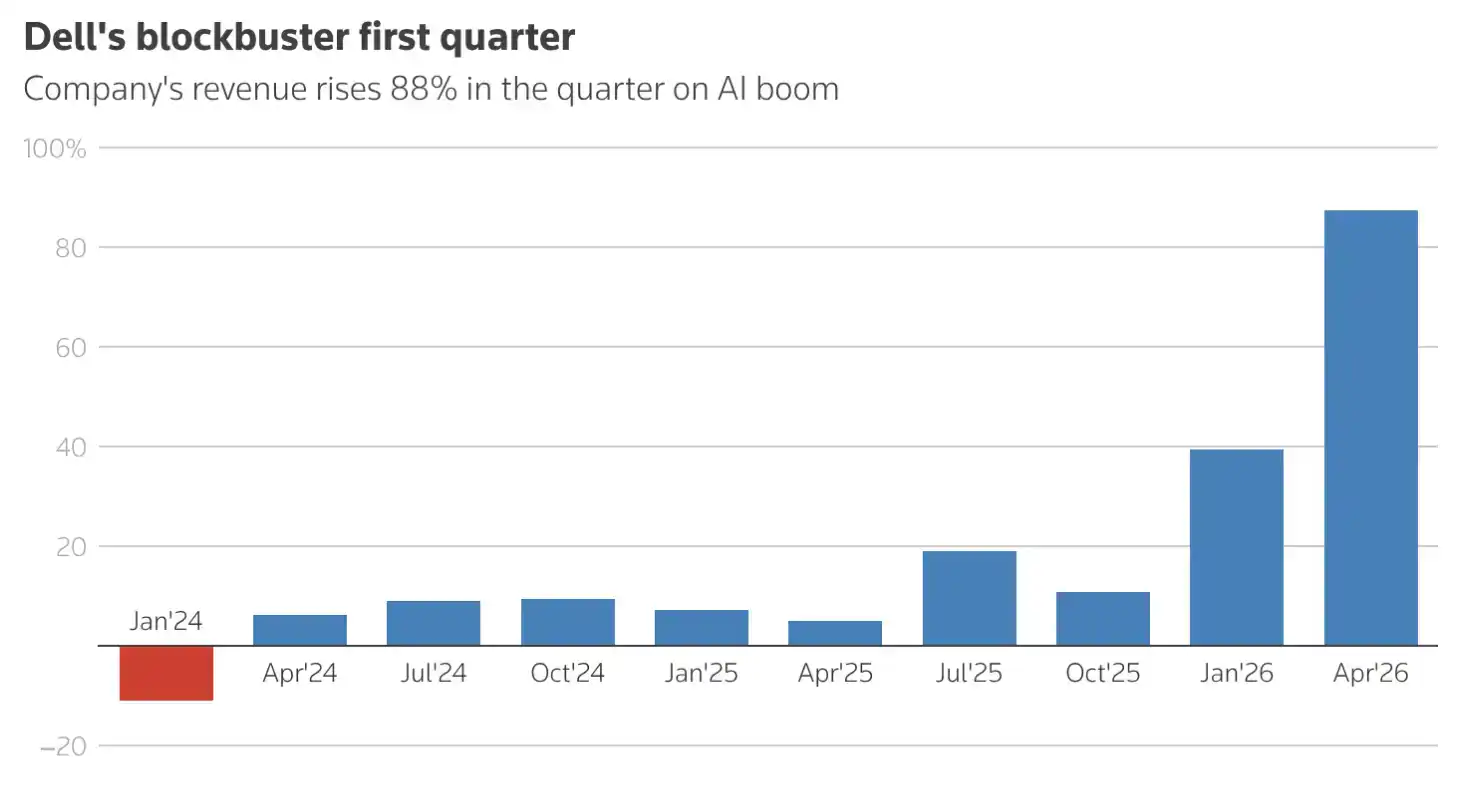
Dell's stock surged in after-hours trading after the company reported a strong earnings beat and significantly raised its full-year guidance, driven by soaring demand for AI-optimized servers. First-quarter revenue jumped 88% to $43.84 billion, far exceeding expectations. The company increased its fiscal 2027 AI server revenue forecast from $50 billion to approximately $60 billion, citing intense demand from clients like CoreWeave and tech giants Alphabet and Amazon who are making massive AI infrastructure investments. This indicates the AI boom is expanding beyond chips and models to downstream hardware and data center infrastructure providers. Dell's infrastructure unit, which includes servers and storage, saw revenue grow 181%. The company also announced a $9.7 billion U.S. Department of Defense contract, boosting confidence in its order pipeline. Dell's performance highlights its position as a key beneficiary in the AI supply chain, leveraging its scale, supplier relationships, and ability to navigate component shortages.

Editor's Note: Dell's after-hours stock surge is not merely due to earnings beating expectations, but rather the market is re-pricing the value of the AI infrastructure chain.

Driven by demand for AI data center construction, Dell's first-quarter revenue increased 88% year-over-year to $43.84 billion, and the company raised its fiscal 2027 AI server revenue expectation from $50 billion to approximately $60 billion. After the earnings release, the company's stock price rose about 39% in after-hours trading.

This indicates that the AI boom is further extending from models and chips to servers, memory, storage, and data center equipment. As tech giants like Alphabet and Amazon continue to increase their investments in AI infrastructure, hardware vendors like Dell, which possess supply chain capabilities, customer relationships, and delivery strength, are becoming direct beneficiaries in this new cycle of AI capital expenditure.

Additionally, a subsidiary of Dell securing a $9.7 billion contract with the U.S. Department of Defense has further strengthened market expectations for its order growth and revenue certainty. For investors, Dell's rise signifies that the AI trade is entering a more downstream and tangible phase: those who can turn chips into deliverable data center infrastructure are likely to receive the next round of valuation re-rating.

The following is the original text:

TL;DR

Dell raises full-year AI server revenue expectation to $60 billion

The company's Q2 guidance is higher than market expectations

Q1 revenue grew 88% YoY to $43.84 billion

Stock price rose about 39% in after-hours trading

A Dell subsidiary secures a $9.7 billion contract from the U.S. Department of Defense

Dell (Dell) on Thursday raised its full-year revenue and profit forecasts, showing that customer data center expansion is driving demand for its AI-optimized servers. These servers are equipped with Nvidia's advanced chips.

Dell's clients include CoreWeave, Honeywell International, and Samsung Electronics. After the earnings release, the company's stock rose about 39% in after-hours trading.

U.S. tech giants including Alphabet and Amazon plan to invest over $700 billion in AI infrastructure this year, which will boost demand for servers and data center equipment from suppliers like Dell and Super Micro Computer.

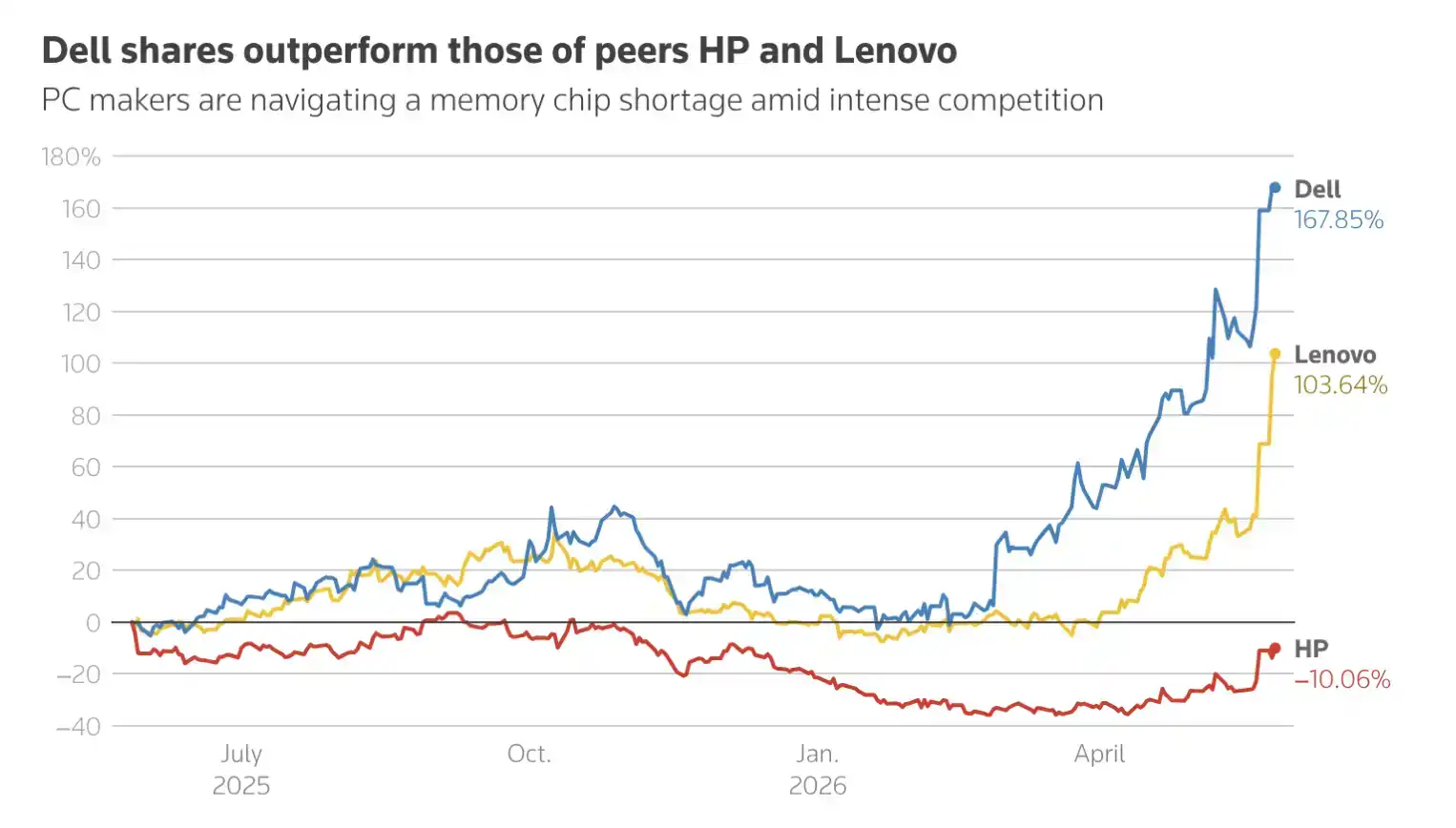
The strong results show that Dell has become one of the biggest beneficiaries of the generative AI boom. The company has navigated the memory chip shortage crisis relatively well through price increases and supply chain adjustments.

Dell's Chief Operating Officer, Jeff Clarke, said on the earnings call: "We feel like we're repricing almost daily. I think customers feel that too. Unfortunately, I don't think that's going to change, given the inflationary environment we're in."

Dell stated that it now expects fiscal 2027 AI server revenue to be approximately $60 billion, up from its previous expectation of $50 billion.

The company also raised its full-year revenue forecast to $165 billion - $169 billion, a significant increase from the previous forecast of $138 billion - $142 billion.

Concurrently, Dell raised its full-year adjusted EPS forecast from $12.90 to $17.90.

In the first quarter, Dell's revenue grew 88% year-over-year to $43.84 billion, significantly higher than the LSEG consensus analyst estimate of $35.43 billion. Adjusted EPS was $4.86, also above the market expectation of $2.94.

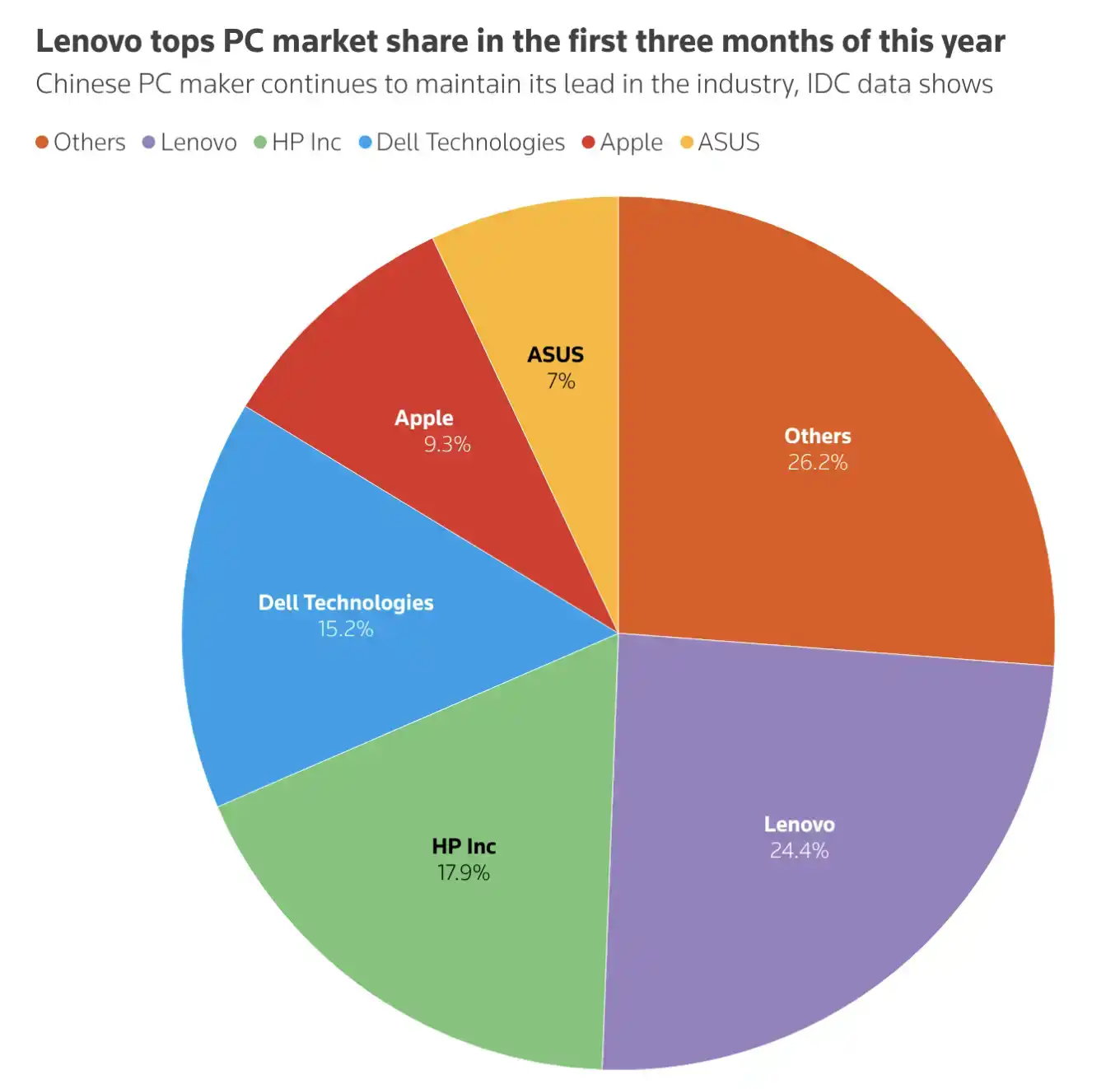
Melissa Otto, Head of Research at S&P Global Visible Alpha, said: "Dell is in a better position relative to competitors due to its scale, supplier relationships, and ability to prioritize demand, which has helped it gain market share during the memory shortage."

Revenue for Dell's Infrastructure Solutions Group, which includes storage, software, and server businesses, grew 181% for the quarter. Meanwhile, sales for the Client Solutions Group, which includes the PC business, increased 17%.

The company also provided Q2 revenue and adjusted EPS guidance that exceeded market expectations.

On Wednesday, the U.S. Department of Defense awarded a five-year, $9.7 billion contract to a Dell subsidiary to assist with managing Microsoft software licenses.

Связанные с этим вопросы

QWhy did Dell's stock surge after its earnings report?

ADell's stock surged because its first-quarter revenue grew 88% to $43.84 billion, significantly exceeding expectations, and the company raised its full-year revenue and profit guidance. This was driven by strong demand for AI-optimized servers, leading the company to also raise its fiscal 2027 AI server revenue expectation from $50 billion to about $60 billion.

QWhat does Dell's performance indicate about the current AI market trend?

ADell's performance indicates that the AI boom is expanding downstream from models and chips to servers, memory, storage, and data center equipment. It shows that hardware companies with supply chain, customer relationships, and delivery capabilities are becoming direct beneficiaries of the new cycle of AI capital expenditure.

QWhat are Dell's updated financial expectations for fiscal 2027?

AFor fiscal 2027, Dell now expects AI server revenue to be about $60 billion, up from a prior expectation of $50 billion. The company also raised its full-year revenue forecast to $165 billion to $169 billion and its adjusted earnings per share forecast to $17.90.

QWhich other companies are mentioned as beneficiaries of increased AI infrastructure spending?

AThe article mentions that increased AI infrastructure spending by tech giants like Alphabet and Amazon (planning over $700 billion) will boost demand for suppliers including Dell and Super Micro Computer.

QWhat major contract did a Dell subsidiary recently secure?

AA subsidiary of Dell was recently awarded a five-year, $9.7 billion contract by the U.S. Department of Defense to help manage Microsoft software licenses.

Похожее

US Government Lifts Ban on Crypto Perpetual Contracts for the First Time: What Does It Mean for the Market?

The U.S. Commodity Futures Trading Commission (CFTC) has issued guidance permitting 24/7 trading and clearing for crypto asset derivatives, effectively opening the U.S. market to crypto perpetual contracts for the first time. This move ends the previous ban and allows American individuals and institutions to trade these instruments around the clock. Direct beneficiaries include Kalshi, which received approval to list a Bitcoin perpetual contract; Coinbase, now the first CFTC-regulated futures commission merchant for U.S. clients to access global crypto derivatives; and CME, which will transition its Bitcoin futures and options to 24/7 trading. The CFTC emphasized this is a specific allowance for crypto assets, noting that traditional commodities like agriculture may not be suitable for non-stop trading. It also requires platforms to undergo case-by-case reviews for compliance and risk management. Industry leaders like Michael Saylor and Brian Armstrong praised the decision for integrating Bitcoin into capital markets and granting U.S. users access to a major global market segment. However, consumer advocacy group Better Markets criticized the CFTC for allegedly neglecting investor protection and favoring the industry it regulates. Other platforms like Kraken have announced plans to launch regulated perpetual futures for the U.S. market. The policy shift is expected to redirect significant liquidity and institutional participation to the newly accessible U.S. crypto derivatives landscape.

Odaily星球日报6 ч. назад

US Government Lifts Ban on Crypto Perpetual Contracts for the First Time: What Does It Mean for the Market?

Odaily星球日报6 ч. назад

How the CLARITY Act Reshapes the Stablecoin Yield Economy

The CLARITY Act, recently advanced by the U.S. Senate Banking Committee, fundamentally reshapes the stablecoin yield economy by closing loopholes left by the earlier GENIUS Act. Its Section 404 expands the ban on "hold-to-earn" rewards to all Digital Asset Service Providers (DASPs) and their affiliates, prohibiting any passive, interest-like yield. Crucially, it introduces a legal distinction, permitting "use-to-earn" rewards based on actual activities like spending, trading, or staking. In anticipation of this regulatory shift, major Wall Street asset managers—Morgan Stanley, BlackRock, and JPMorgan—have launched a series of tokenized money market funds (e.g., BlackRock's BRSRV, JPMorgan's JLTXX) designed explicitly for stablecoin reserve assets. These products represent a new, compliant yield layer: the stablecoin issuer earns interest from the underlying tokenized fund, which can then be passed to users through redesigned activity-based rewards. This marks a paradigm shift from a "hold-to-earn" to a "use-to-earn" market. While pathways remain for exchanges to redesign rewards (Path A) and for DeFi protocols to offer yield (Path B), the tokenized reserve asset layer (Path C) emerges as the most robust and strategically positioned infrastructure. However, this concentration—exemplified by BlackRock's BUIDL fund backing over 90% of USDtb's reserves—introduces new systemic risks. The final outcome hinges on regulatory decisions, particularly the OCC's proposed 20% cap on tokenized assets in reserves, which will determine the scalability of this new financial infrastructure layer.

marsbit7 ч. назад

How the CLARITY Act Reshapes the Stablecoin Yield Economy

marsbit7 ч. назад

Торговля

Спот
Фьючерсы

Популярные статьи

Как купить S

Добро пожаловать на HTX.com! Мы сделали приобретение Sonic (S) простым и удобным. Следуйте нашему пошаговому руководству и отправляйтесь в свое крипто-путешествие.Шаг 1: Создайте аккаунт на HTXИспользуйте свой адрес электронной почты или номер телефона, чтобы зарегистрироваться и бесплатно создать аккаунт на HTX. Пройдите удобную регистрацию и откройте для себя весь функционал.Создать аккаунтШаг 2: Перейдите в Купить криптовалюту и выберите свой способ оплатыКредитная/Дебетовая Карта: Используйте свою карту Visa или Mastercard для мгновенной покупки Sonic (S).Баланс: Используйте средства с баланса вашего аккаунта HTX для простой торговли.Третьи Лица: Мы добавили популярные способы оплаты, такие как Google Pay и Apple Pay, для повышения удобства.P2P: Торгуйте напрямую с другими пользователями на HTX.Внебиржевая Торговля (OTC): Мы предлагаем индивидуальные услуги и конкурентоспособные обменные курсы для трейдеров.Шаг 3: Хранение Sonic (S)После приобретения вами Sonic (S) храните их в своем аккаунте на HTX. В качестве альтернативы вы можете отправить их куда-либо с помощью перевода в блокчейне или использовать для торговли с другими криптовалютами.Шаг 4: Торговля Sonic (S)С легкостью торгуйте Sonic (S) на спотовом рынке HTX. Просто зайдите в свой аккаунт, выберите торговую пару, совершайте сделки и следите за ними в режиме реального времени. Мы предлагаем удобный интерфейс как для начинающих, так и для опытных трейдеров.

1.4k просмотров всегоОпубликовано 2025.01.15Обновлено 2025.03.21

Как купить S

Sonic: Обновления под руководством Андре Кронье – новая звезда Layer-1 на фоне спада рынка

Он решает проблемы масштабируемости, совместимости между блокчейнами и стимулов для разработчиков с помощью технологических инноваций.

2.3k просмотров всегоОпубликовано 2025.04.09Обновлено 2025.04.09

Sonic: Обновления под руководством Андре Кронье – новая звезда Layer-1 на фоне спада рынка

HTX Learn: Пройдите обучение по "Sonic" и разделите 1000 USDT

HTX Learn — ваш проводник в мир перспективных проектов, и мы запускаем специальное мероприятие "Учитесь и Зарабатывайте", посвящённое этим проектам. Наше новое направление .

1.8k просмотров всегоОпубликовано 2025.04.10Обновлено 2025.04.10

HTX Learn: Пройдите обучение по "Sonic" и разделите 1000 USDT

Обсуждения

Добро пожаловать в Сообщество HTX. Здесь вы сможете быть в курсе последних новостей о развитии платформы и получить доступ к профессиональной аналитической информации о рынке. Мнения пользователей о цене на S (S) представлены ниже.

活动图片