Crypto Funds See Record Exodus: $1.7 Billion Leaves Market

bitcoinistОпубликовано 2026-01-27Обновлено 2026-01-27

Введение

Crypto investment products experienced a record weekly outflow of $1.73 billion, the largest since November 2025. The outflows were driven by fading hopes for interest rate cuts, weak price momentum, and crypto's failure to act as a reliable inflation hedge. Major issuers like BlackRock and Fidelity saw significant withdrawals, with the U.S. market accounting for nearly $2 billion of the movement. Bitcoin and Ether funds led the outflows, losing $630 million and $1.10 billion respectively, while some altcoins like Solana saw modest inflows. Despite the sell-off, market confidence appears unsettled rather than broken, with investors shifting strategies rather than fully exiting the market.

Crypto investment vehicles dumped cash last week in a move that startled many market watchers. According to CoinShares, crypto exchange-traded products saw about $1.73 billion of outflows — the largest weekly withdrawal since mid-November 2025.

The pullback came after a recent stretch of inflows, which left some investors caught between hope and caution. Reports say fading hopes for quick interest rate cuts, weak price momentum, and a sense that crypto has not yet played the inflation hedge role many expected helped drive the exit.

Flows Reverse Sharply

Big names felt the hit. BlackRock’s iShares led issuers with roughly $950 million leaving its coffers. Fidelity lost close to $470 million, and Grayscale saw withdrawals near $270 million.

In the regional front, the US accounted for the bulk of the movement, with nearly $2 billion exiting from that market alone.

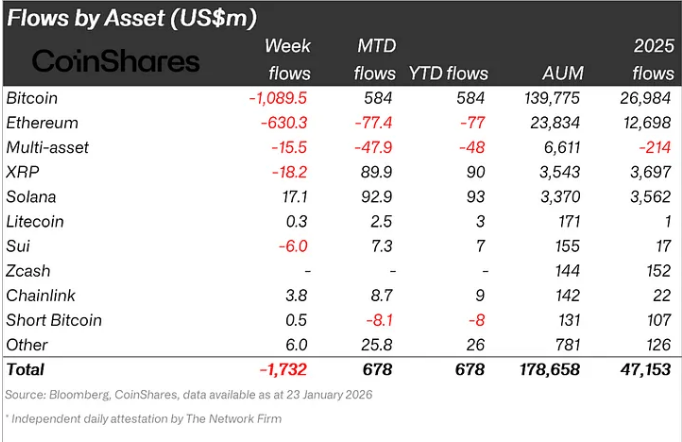
Weekly crypto ETP flows by asset in millions of USD. Source: CoinShares

Some managers did attract fresh capital — groups focused on volatility or niche strategies posted modest gains — showing that investors are shifting tactics rather than abandoning the sector entirely.

Who Pulled Money Out

Bitcoin and Ether were the largest contributors to the outflows. Combined, they comprise most of the $1.73 billion. Based on reports, Ether funds lost roughly $1.10 billion while Bitcoin-focused products shed about $630 million.

Total crypto market cap currently at $2,95 trillion. Chart: TradingView

That split shows a renewed skepticism about large-cap tokens even as traders weigh macro signals. Smaller tokens told a mixed story: Solana drew about $17 million in inflows, while XRP and SUI saw withdrawals of a little over $18 million and $6 million, respectively.

Bitcoin Price Action

Meanwhile, price moves matched the money flow. Bitcoin traded in a choppy range and slipped below $90,000 at one point as risk appetite evaporated. But it did not cave in.

Periodic buying returned, and shorts were put under stress when prices bounced back. Traders are watching macro cues; weakness in sentiment has been paired with bouts of institutional interest, creating a seesaw battle that keeps volatility up.

What This Means For Traders

Market behavior suggests that confidence is unsettled, not totally evaporated. Reports note that investors are recalibrating timeframes and tools. Some are rotating into altcoins that look cheap to them, while others beef up hedges or step back from leveraged positions.

Featured image from Unsplash, chart from TradingView

Связанные с этим вопросы

QWhat was the total amount of outflows from crypto exchange-traded products last week, and why was it significant?

AThe total outflows were approximately $1.73 billion. This was significant because it marked the largest weekly withdrawal since mid-November 2025.

QWhich three major issuers saw the largest outflows, and how much did each lose?

ABlackRock’s iShares led with about $950 million in outflows, Fidelity lost close to $470 million, and Grayscale saw withdrawals of nearly $270 million.

QAccording to the article, what were the three main factors that helped drive the massive exit from crypto funds?

AThe three main factors were fading hopes for quick interest rate cuts, weak price momentum, and a sense that crypto has not yet played the inflation hedge role many expected.

QWhich two cryptocurrencies were the largest contributors to the outflows, and what were the respective amounts?

ABitcoin and Ether were the largest contributors. Ether funds lost roughly $1.10 billion, while Bitcoin-focused products shed about $630 million.

QDespite the record outflows, what does the market behavior suggest about overall investor confidence?

AThe market behavior suggests that confidence is unsettled but not totally evaporated, as investors are shifting tactics and some are rotating into altcoins or adjusting their strategies rather than abandoning the sector entirely.

Похожее

From Theft to Re-entry: How Was $292 Million "Laundered"?

A sophisticated crypto laundering operation was executed following the $292 million hack of Kelp DAO on April 18. The attack, attributed to the North Korean Lazarus group, began with anonymous infrastructure preparation using Tornado Cash to fund wallets untraceably. The hacker exploited a vulnerability in Kelp’s cross-chain bridge, stealing 116,500 rsETH. To avoid crashing the market, the attacker used Aave and Compound as laundering tools—depositing the stolen rsETH as collateral to borrow $190 million in clean, liquid ETH. This move triggered a bank run on Aave, causing an $8 billion drop in TVL. After consolidating funds, the attacker fragmented them across hundreds of wallets to evade detection. A major breakpoint was THORChain, where over $460 million in volume—30 times its usual activity—was processed in 24 hours, converting ETH into Bitcoin. This shift to Bitcoin’s UTXO model exponentially increased tracing complexity by shattering funds into countless untraceable fragments. The final destination was Tron-based USDT, the primary channel for illicit crypto flows. From there, funds were cashed out via OTC brokers in China and Southeast Asia, using unlicensed underground banks and UnionPay networks outside Western sanctions scope. Ultimately, the laundered money supports North Korea’s weapons programs, which rely heavily on crypto hacking for foreign currency. The incident underscores structural challenges in DeFi: its openness, composability, and lack of central control make such laundering not just possible, but inherently difficult to prevent.

marsbit10 мин. назад

From Theft to Re-entry: How Was $292 Million "Laundered"?

marsbit10 мин. назад

Google and Amazon Simultaneously Invest Heavily in a Competitor: The Most Absurd Business Logic of the AI Era Is Becoming Reality

In a span of four days, Amazon announced an additional $25 billion investment, and Google pledged up to $40 billion—both direct competitors pouring over $65 billion into the same AI startup, Anthropic. Rather than a typical venture capital move, this signals the latest escalation in the cloud wars. The core of the deal is not equity but compute pre-orders: Anthropic must spend the majority of these funds on AWS and Google Cloud services and chips, effectively locking in massive future compute consumption. This reflects a shift in cloud market dynamics—enterprises now choose cloud providers based on which hosts the best AI models, not just price or stability. With OpenAI deeply tied to Microsoft, Anthropic’s Claude has become the only viable strategic asset for Google and Amazon to remain competitive. Anthropic’s annualized revenue has surged to $30 billion, and it is expanding into verticals like biotech, positioning itself as a cross-industry AI infrastructure layer. However, this funding comes with constraints: Anthropic’s independence is challenged as it balances two rival investors, its safety-first narrative faces pressure from regulatory scrutiny, and its path to IPO introduces new financial pressures. Globally, this accelerates a "tri-polar" closed-loop structure in AI infrastructure, with Microsoft-OpenAI, Google-Anthropic, and Amazon-Anthropic forming exclusive model-cloud alliances. In contrast, China’s landscape differs—investments like Alibaba and Tencent backing open-source model firm DeepSeek reflect a more decoupled approach, though closed-source models from major cloud providers still dominate. The $65 billion bet is ultimately about securing a seat at the table in an AI-defined future—where missing the model layer means losing the cloud war.

marsbit6 ч. назад

Google and Amazon Simultaneously Invest Heavily in a Competitor: The Most Absurd Business Logic of the AI Era Is Becoming Reality

marsbit6 ч. назад

Торговля

Спот
Фьючерсы

Популярные статьи

Как купить MOVE

Добро пожаловать на HTX.com! Мы сделали приобретение Movement (MOVE) простым и удобным. Следуйте нашему пошаговому руководству и отправляйтесь в свое крипто-путешествие.Шаг 1: Создайте аккаунт на HTXИспользуйте свой адрес электронной почты или номер телефона, чтобы зарегистрироваться и бесплатно создать аккаунт на HTX. Пройдите удобную регистрацию и откройте для себя весь функционал.Создать аккаунтШаг 2: Перейдите в Купить криптовалюту и выберите свой способ оплатыКредитная/Дебетовая Карта: Используйте свою карту Visa или Mastercard для мгновенной покупки Movement (MOVE).Баланс: Используйте средства с баланса вашего аккаунта HTX для простой торговли.Третьи Лица: Мы добавили популярные способы оплаты, такие как Google Pay и Apple Pay, для повышения удобства.P2P: Торгуйте напрямую с другими пользователями на HTX.Внебиржевая Торговля (OTC): Мы предлагаем индивидуальные услуги и конкурентоспособные обменные курсы для трейдеров.Шаг 3: Хранение Movement (MOVE)После приобретения вами Movement (MOVE) храните их в своем аккаунте на HTX. В качестве альтернативы вы можете отправить их куда-либо с помощью перевода в блокчейне или использовать для торговли с другими криптовалютами.Шаг 4: Торговля Movement (MOVE)С легкостью торгуйте Movement (MOVE) на спотовом рынке HTX. Просто зайдите в свой аккаунт, выберите торговую пару, совершайте сделки и следите за ними в режиме реального времени. Мы предлагаем удобный интерфейс как для начинающих, так и для опытных трейдеров.

530 просмотров всегоОпубликовано 2024.12.13Обновлено 2025.03.21

Как купить MOVE

Обсуждения

Добро пожаловать в Сообщество HTX. Здесь вы сможете быть в курсе последних новостей о развитии платформы и получить доступ к профессиональной аналитической информации о рынке. Мнения пользователей о цене на MOVE (MOVE) представлены ниже.

活动图片