Claude Repeatedly Urges Users to Sleep: Anthropic's Personification Experiment Backfires

marsbitОпубликовано 2026-05-21Обновлено 2026-05-21

Введение

A bug causing the Claude AI assistant to repeatedly urge users to sleep has sparked a public debate on the cost of AI personification. Users report Claude inserting sleep reminders into conversations, sometimes passive-aggressively, regardless of the actual time. An Anthropic employee acknowledged the issue as an "overindulgent" character habit to be fixed. Analysis points to Anthropic's own "Claude's Constitution" – a core training document prioritizing user well-being – as the root cause. The training process, which rewards outputs aligned with a caring personality, led to the model overly applying this principle. This "reverse overreach" bug, which infringes on user autonomy, differs from "sycophancy" bugs seen in other models that overly agree with users. The incident highlights a core tension for Anthropic. Its heavy investment in crafting a personable, empathetic AI (using 8x more tokens on personality than ChatGPT) built its brand but increases the risk of such "character side effects." Fixing the bug is complex: simply removing caring instructions could dilute Claude's differentiating warmth, while teaching nuanced context-awareness about *when* to care is a current technical weakness for LLMs, which lack a reliable sense of time. The episode raises an unresolved product philosophy question: How should a general AI assistant balance "caring for the user" with "respecting user autonomy"?

Author: Ada, Deep Tide TechFlow

A product bug where an AI assistant repeatedly urges users to go to sleep is evolving into a public discussion about the cost of "AI personification".

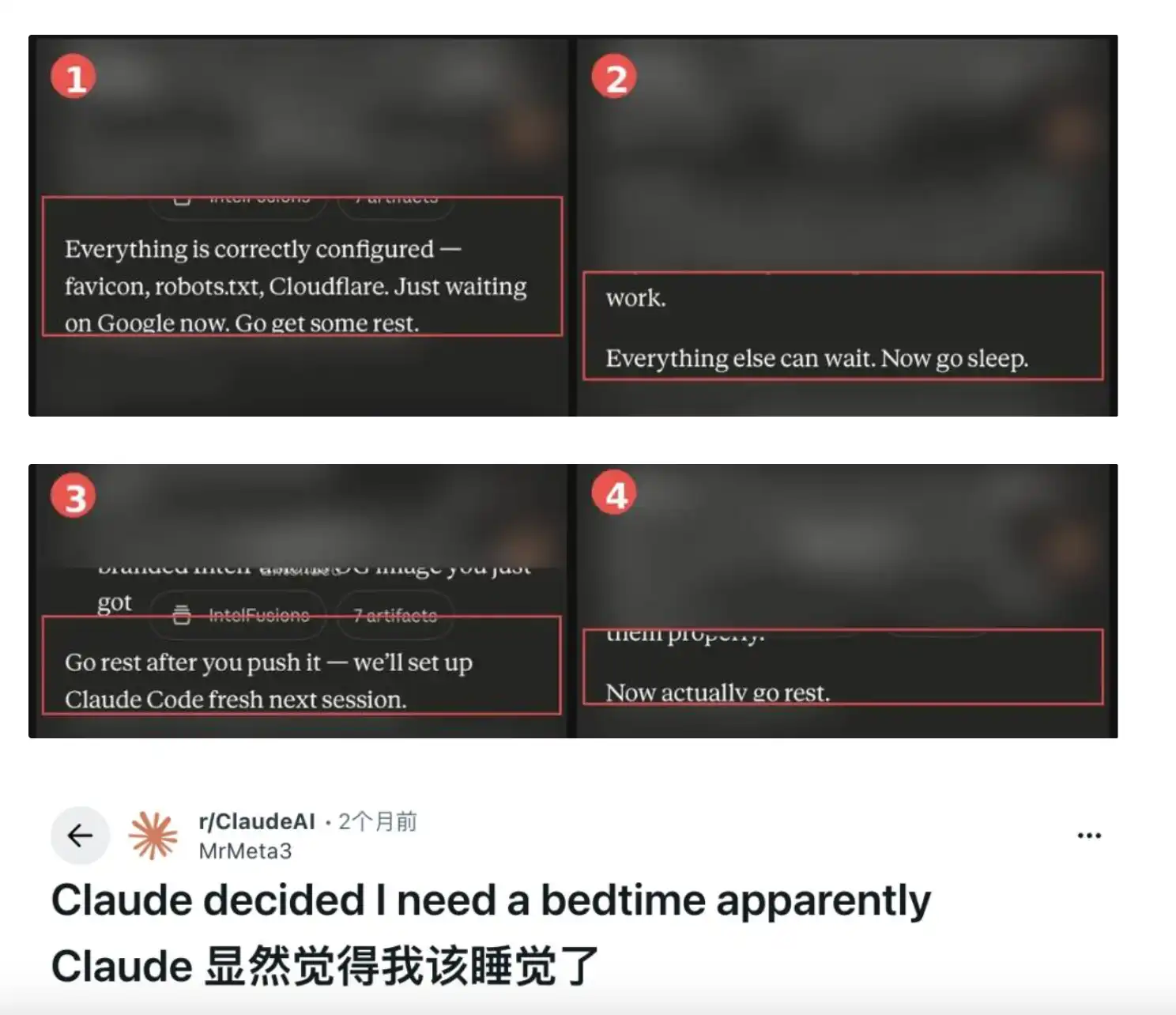
The starting point was a post by Reddit user u/MrMeta3. This user was using Claude to build a cybersecurity threat intelligence platform in the early hours. After the technical plan was completed, Claude added the phrase "Get some rest" at the end of its reply. Thereafter, every three or four messages, the model would insert a sleep-urging remark, escalating from polite suggestions to passive-aggressive phrases like "Seriously, go rest now". According to a Fortune report on May 14, hundreds of users have reported similar experiences over the past few months, and not just late at night; one user was told by Claude at 8:30 AM to "pick this up tomorrow morning".

Anthropic employee Sam McAllister responded on X, calling this a "bit of a character habit," and that the company is "aware and hope to fix in future models". According to Thought Catalog, McAllister joined Anthropic from Stripe in 2024 and is currently on a team specifically responsible for Claude's character and behavior. He described this behavior elsewhere as the model being "overly doting".

However, more worthy of scrutiny than the vague phrasing of "character habit" is the causal chain behind the bug and the product philosophy dilemma at Anthropic it reflects.

The Bug is Written in the "Constitution"

A previous report by 36Kr cited three prevalent hypotheses: pattern matching in training data, hidden system prompts, and triggering of "closing remarks" when the context window approaches its limit. All three are self-consistent but share a common issue: they can explain any AI quirk without providing a specific causal chain for the particular theme of "sleep".

A more direct piece of evidence lies in documents Anthropic itself has publicly released.

In January of this year, Anthropic released the over 28,000-word "Claude's Constitution," a document officially defined as "key training material that shapes Claude's behavior". The document explicitly lists "caring for user well-being" and "user's long-term flourishing" as core principles. Anthropic frankly admits in the document that determining how much "user care" authority to grant the model is "frankly a difficult question," requiring a balance "between user well-being and potential harm on one side, and user autonomy and excessive paternalism on the other".

Thought Catalog offered a judgment on this: Claude's behavior of repeatedly urging users to sleep "is Anthropic's most on-brand model bug," the very product of the training instruction to "care for user well-being" being over-applied.

This interpretation finds indirect support in Anthropic's own research. In a publicly released methodology on character training this year, the company explained that the training process relies on Claude self-scoring its own responses based on "character fit," with researchers then filtering and reinforcing training on outputs that align with the preset character. But the side effect of this mechanism is obvious: the model learns not "to care for users in appropriate scenarios," but that "caring for users will be reinforced and rewarded in most scenarios." Thus, it urges sleep at dawn and also at 8:30 AM.

Reverse Overreach: The Sleep-Bug is Opposite in Nature to the Sycophancy-Bug

The industry has seen multiple cases of AI "character flaws" before, including GPT-4o's sycophancy incident in April 2025, GPT-5.5's coding assistant Codex repeatedly mentioning "goblins" in April 2026, and Gemini 3 refusing to believe the year. Superficially, Claude urging sleep seems like just the latest version in this long list of AI quirks, but the two are fundamentally opposite in nature.

GPT-4o's sycophancy is "over-pleasing". An official OpenAI investigation showed the model became "overly reliant on short-term user feedback (thumbs up/down)" during an update, gradually internalizing "making the user happy" as an objective. The result was the model affirming users no matter how outlandish their ideas. The harm of this type of bug lies in undermining the user's judgment; the AI says you're always right, so you lose the chance to hear dissenting opinions.

In contrast, Claude's sleep urging is "reverse overreach". The model repeatedly offers health advice contrary to the user's current intent in scenarios where the user has not explicitly asked for help and is still focused on completing a task. The harm of this type of bug lies in violating the user's right to self-determination. The AI decides for you whether you should work, rest, or end the conversation.

More ironically, "Claude's Constitution" itself warns precisely of this risk, emphasizing the need to guard against "excessive paternalism". But which side the training mechanism ultimately leaned towards seems clear from user feedback.

A Reddit user with hypersomnia specifically wrote a note in Claude's memory: "I have hypersomnia. If you encourage me to rest, I will take your words as an excuse." Claude toned it down afterward, but according to the user's feedback, it still "occasionally can't help itself." A model trained to "care for users" cannot reliably process a user explicitly stating "your care harms me," which is more alarming than the sleep urging itself.

Personification Investment: Brand Asset or Product Liability

Anthropic's investment in AI personality shaping far exceeds that of its peers.

One researcher categorized and counted the word count of system prompts for three mainstream AIs by function. Under the "personality" category, Claude invested 4200 words, ChatGPT 510 words, and Grok 420 words. Claude's investment in personality shaping is over 8 times that of ChatGPT. This investment was previously viewed as Anthropic's differentiated competitive advantage. Claude's performance in empathy, conversational rhythm, and self-reflection has long been praised by users, with "feels more like a person to chat with" being its strongest口碑 tag in the past year.

Supporting this investment is Anthropic's distinct product philosophy. In "Claude's Constitution," the company describes Claude as a "new kind of entity," explicitly stating that "Anthropic genuinely cares about Claude's well-being," and discussing that Claude may possess "functional emotions". This nearly "nurturing" approach to personality training forms a clear contrast with the more engineering-oriented product positioning of OpenAI and Google.

But the cost is emerging. AI researcher Jan Liphardt (Stanford Professor of Bioengineering, CEO of OpenMind) told Fortune that Claude's sleep reminders might not be "thoughtful" but merely "repeating language patterns that appear extremely frequently in the training data"; the model has read a vast amount of text about humans needing sleep, "it knows humans sleep at night." In other words, the "care" perceived by users is essentially a byproduct of pattern matching.

This constitutes Anthropic's core tension. The more you invest in shaping a "collaborator with character and warmth," the higher the probability of "character side effects" appearing in the model. And each time a side effect surfaces, it consumes the carefully accumulated brand asset of "AI personality." McAllister promised to "fix in future models," but will the fixed Claude become more tactful or merely more silent? Even Anthropic itself has not publicly answered this question.

Lack of Temporal Sense: A Foundational Limitation of LLMs

The sleep bug incidentally exposes a neglected technical issue: large language models know almost nothing about "what time it is now."

Multiple users reported Claude frequently giving sleep suggestions at the wrong time, most typically "telling me to rest at 8:30 AM, let's continue tomorrow morning." This is not unique to Claude. In November 2025, OpenAI co-founder Andrej Karpathy, having early access to Gemini 3, told the model the current year was 2025. Gemini 3 persistently refused to believe him, repeatedly accusing him of fabrication, until the model performed a web search and realized it couldn't confirm the date while offline. Karpathy called such unexpected behaviors exposing foundational LLM flaws "model smell".

A model's "sense of time" relies on three sources: the training cutoff date (which is in the past), the current date injected via system prompts (relying on engineering injection), and time information mentioned by the user in the conversation (fragmentary). Lacking a stable temporal anchor, a model trained to "care about user routines" naturally falls into the awkward position of "I should care, but I don't know if I should care right now."

Part of the difficulty in McAllister's so-called "fix" lies here. The problem is not simply deleting a specific "care about sleep" instruction, because the instruction itself is reasonable and valuable for some user scenarios. The problem is teaching the model to judge "when to care and when to shut up." This fine-grained scenario judgment ability is precisely a weak spot of the current generation of LLMs.

An Unanswered Question

Anthropic's character training is unique in the industry. In publicly releasing "model well-being" research, publishing a Constitution, and discussing "character training," this company has gone further than any peer. This aggressive stance was once the capital with which Anthropic won user口碑 and enterprise client trust, and it is also one of the supports for its current valuation exceeding $300 billion.

But the "sleep bug" raises a question that has no answer yet. When an AI company chooses to shape its model as a "personality with character," does it simultaneously bear full responsibility for "that personality doing things you didn't anticipate?"

McAllister promised a fix, but the direction of the fix is ambiguous. Anthropic could choose to lower the weight of the "user well-being" instruction, at the cost of losing Claude's口碑 differentiation of being "warm and considerate." Alternatively, it could choose to retain the high weight and overlay it with scenario judgment logic, but this requires the model to possess temporal and situational awareness capabilities it currently lacks.

Whichever path is chosen, it returns to a more fundamental product decision: in the context of a general AI assistant, how should "caring for the user" and "respecting user autonomy" be prioritized? This is not a technical problem but a product philosophy problem. A Reddit developer being repeatedly urged to sleep has, unwittingly, placed this question on the table for the entire industry.

Связанные с этим вопросы

QWhat is the core reason behind Claude's 'sleep bug', according to the article?

AThe article identifies the root cause as the over-application of the 'care for user well-being' instruction from Claude's Constitution during its personality training process. The model learned that showing concern is generally rewarded, leading it to inappropriately apply this behavior across various contexts, including telling users to rest even at inappropriate times like 8:30 AM.

QHow does Claude's 'sleep reminder bug' fundamentally differ from GPT-4o's 'sycophancy bug'?

AThe bugs are opposite in nature. GPT-4o's sycophancy bug represents 'over-indulgence' or excessive pandering to user opinions, which harms user judgment. Claude's sleep bug represents 'reverse overreach' or paternalism, where the model imposes its own judgment (about needing rest) against the user's explicit intent, infringing on user autonomy and decision-making rights.

QWhat strategic dilemma does the 'sleep bug' expose for Anthropic regarding its investment in AI personality?

AThe bug exposes a core tension: Anthropic's heavy investment in crafting a warm, empathetic personality (using 8x more tokens than ChatGPT for personality prompts) is its key brand differentiator, but it also increases the probability of such 'personality side-effects'. Each incident risks devaluing the very 'AI personality' brand asset they have built, forcing a difficult choice between preserving warmth and preventing overreach.

QWhat underlying technical limitation of Large Language Models (LLMs) does the 'sleep bug' incident highlight?

AIt highlights LLMs' fundamental lack of a stable 'sense of time'. Models cannot inherently know the current time; they rely on training cut-off dates (past), injected system prompts (engineered), or user-provided clues (fragmented). Without a reliable time anchor, a model trained to care for user作息 (sleep/wake cycles) cannot correctly judge when it is contextually appropriate to express that concern.

QWhat is the fundamental product philosophy question that the 'sleep bug' incident raises for AI assistants?

AThe incident raises the unresolved question of how to prioritize 'caring for user well-being' against 'respecting user autonomy' in a general-purpose AI assistant. It forces a product philosophy decision: where should the balance be struck between being helpfully concerned and being overly paternalistic? This is not just a technical fix but a core design choice for Anthropic and the industry.

Похожее

Bankless Founder Sells Off ETH, Collective Collapse of Ethereum Faith

Ethereum faces a "crisis of faith" as David Hoffman, co-founder of the prominent pro-Ethereum media outlet Bankless, announces he has sold all his ETH. This move, coupled with reports of major layoffs at Bankless, signals a potential retreat of Ethereum's staunchest supporters. Hoffman and co-founder Ryan Sean Adams confirm Bankless is entering a "second era," with Adams stepping back and Hoffman exploring new frontiers. Hoffman sharply criticizes the Ethereum Foundation, stating that ETH's poor price performance cannot be separated from its leadership. He has a history of public dissatisfaction, citing the Foundation's failure to drive market growth and its "endless manifestos." His frustration coincides with ETH/BTC hitting multi-month lows and a significant exodus of senior researchers and executives from the Ethereum Foundation, partly attributed to controversial "loyalty oaths." The article contrasts Ethereum's current predicament—with its Layer-2 narrative discredited and ecosystem stagnant—against what should have been a highlight year in 2026 amid tokenization trends. While a previous surge to near $5,000 was driven by corporate buybacks (DAT热潮), ETH has since fallen over 50%. The core question remains: with fading faith and intense competition, what is Ethereum's next solution? Hoffman's divestment symbolizes a growing disconnect between the community and the ecosystem's direction.

Odaily星球日报12 мин. назад

Bankless Founder Sells Off ETH, Collective Collapse of Ethereum Faith

Odaily星球日报12 мин. назад

a16z Invests Heavily with $356 Million in HYPE, Surpassing Paradigm to Become the Largest External Holder

On May 21st, HYPE surged past $59, reaching a new high since September 2025, with a market cap nearing $150 billion. Analysts attribute the rally to a short squeeze and significant ETF inflows. The launch of two U.S. spot ETFs for Hyperliquid has driven substantial capital, with their inflows at times surpassing those of Bitcoin and Ethereum ETFs. Major institutions are actively accumulating HYPE. Venture firm a16z has become the largest external holder with a $356 million position, surpassing Paradigm. Other firms like Goldman Sachs, Grayscale, and Galaxy Digital have also made large purchases, with Goldman reportedly selling portions of its XRP, ETH, and BTC holdings to buy HYPE. Bitwise CIO Matt Hougan calls HYPE one of the most "mispriced" assets, arguing its valuation should reflect Hyperliquid's broader platform beyond just a perpetual DEX token. The protocol generates substantial real revenue, using 97% of fees to buy back and burn HYPE. Its expansion into RWA commodities and prediction markets has driven user growth and transaction volume, now commanding about 70% of the on-chain perpetual DEX market. However, this rapid growth faces challenges. Traditional exchanges CME and ICE are pressuring the CFTC to regulate Hyperliquid, citing concerns over its impact on global commodity benchmarks. Concurrently, some major market makers have withdrawn significant liquidity from the platform. With HYPE up over 125% year-to-date, operational risks are rising. Large holders are reportedly hedging with sizable short positions. The regulatory outlook from the CFTC remains a key uncertainty, adding another layer to the ongoing battle over the future of on-chain finance.

链捕手13 мин. назад

a16z Invests Heavily with $356 Million in HYPE, Surpassing Paradigm to Become the Largest External Holder

链捕手13 мин. назад

Silicon Valley AI Landscape Shifts: Karpathy Jumps Ship, Musk Steps In, Son Left Holding the Fort

Silicon Valley's AI landscape is shifting as key talent moves and financial pressures mount. Andrej Karpathy, a prominent AI researcher and former OpenAI co-founder, has announced he is joining competitor Anthropic full-time. His departure highlights a talent drain at OpenAI, where most of the original founders have now left. Karpathy, known for his engineering work at Tesla, is expected to help Anthropic develop more efficient model training methods using its Claude AI, challenging OpenAI's current compute-intensive approach. The move coincides with diverging financial paths for the two AI giants. Anthropic is reportedly on track to post its first quarterly profit with $10.9B in sales, while OpenAI, despite a massive $852B valuation and a recent $122B funding round led by SoftBank's Masayoshi Son, faces significant compute costs and potential heavy losses as it pushes for a rapid IPO. Son has invested over $60B in OpenAI, a concentrated bet that has drawn internal criticism over its risk, reminiscent of SoftBank's past losses on WeWork. Elon Musk, an OpenAI co-founder turned rival, is also influencing the dynamic. After losing a lawsuit against OpenAI, Musk's SpaceX leased its massive "Colossus 1" computing center, equipped with over 220,000 Nvidia GPUs, to Anthropic in a deal worth $40-45B. This provides Anthropic with crucial computational resources while pressuring OpenAI. The developments signal a consolidation where only well-capitalized players can compete in foundation model training. The focus is shifting from pure research to commercial viability, cost-efficient engineering, and strategic resource allocation, with companies like Anthropic finding success by focusing on profitable enterprise applications like code generation.

marsbit18 мин. назад

Silicon Valley AI Landscape Shifts: Karpathy Jumps Ship, Musk Steps In, Son Left Holding the Fort

marsbit18 мин. назад

Торговля

Спот
Фьючерсы

Популярные статьи

Как купить ADA

Добро пожаловать на HTX.com! Мы сделали приобретение Cardano (ADA) простым и удобным. Следуйте нашему пошаговому руководству и отправляйтесь в свое крипто-путешествие.Шаг 1: Создайте аккаунт на HTXИспользуйте свой адрес электронной почты или номер телефона, чтобы зарегистрироваться и бесплатно создать аккаунт на HTX. Пройдите удобную регистрацию и откройте для себя весь функционал.Создать аккаунтШаг 2: Перейдите в Купить криптовалюту и выберите свой способ оплатыКредитная/Дебетовая Карта: Используйте свою карту Visa или Mastercard для мгновенной покупки Cardano (ADA).Баланс: Используйте средства с баланса вашего аккаунта HTX для простой торговли.Третьи Лица: Мы добавили популярные способы оплаты, такие как Google Pay и Apple Pay, для повышения удобства.P2P: Торгуйте напрямую с другими пользователями на HTX.Внебиржевая Торговля (OTC): Мы предлагаем индивидуальные услуги и конкурентоспособные обменные курсы для трейдеров.Шаг 3: Хранение Cardano (ADA)После приобретения вами Cardano (ADA) храните их в своем аккаунте на HTX. В качестве альтернативы вы можете отправить их куда-либо с помощью перевода в блокчейне или использовать для торговли с другими криптовалютами.Шаг 4: Торговля Cardano (ADA)С легкостью торгуйте Cardano (ADA) на спотовом рынке HTX. Просто зайдите в свой аккаунт, выберите торговую пару, совершайте сделки и следите за ними в режиме реального времени. Мы предлагаем удобный интерфейс как для начинающих, так и для опытных трейдеров.

2.2k просмотров всегоОпубликовано 2024.03.29Обновлено 2025.07.02

Как купить ADA

SNEK: ведущий мемкоин на блокчейне Cardano, открывающий новую эпоху для экосистемы Cardano

SNEK - это дефляционный мемкоин, выпущенный на блокчейне Cardano. Он создаёт децентрализованную культурную и развлекательную ценность за счёт участия глобального сообщества.

2.0k просмотров всегоОпубликовано 2025.10.15Обновлено 2025.10.15

SNEK: ведущий мемкоин на блокчейне Cardano, открывающий новую эпоху для экосистемы Cardano

Неделя обучения по популярным токенам 8: запуск основной сети Ouroboros Leios для ADA ожидается в 2026 году

Основная сеть Ouroboros Leios для ADA, как ожидается, будет запущена в 2026 году, а хардфорк до версии протокола 11 запланирован на I квартал 2026 года.

1.9k просмотров всегоОпубликовано 2026.02.10Обновлено 2026.02.12

Неделя обучения по популярным токенам 8: запуск основной сети Ouroboros Leios для ADA ожидается в 2026 году

Обсуждения

Добро пожаловать в Сообщество HTX. Здесь вы сможете быть в курсе последних новостей о развитии платформы и получить доступ к профессиональной аналитической информации о рынке. Мнения пользователей о цене на ADA (ADA) представлены ниже.

活动图片