Cathie Wood's Remarks Spark Rare Reputation Crisis for Binance and CZ

marsbitОпубликовано 2026-01-28Обновлено 2026-01-28

Введение

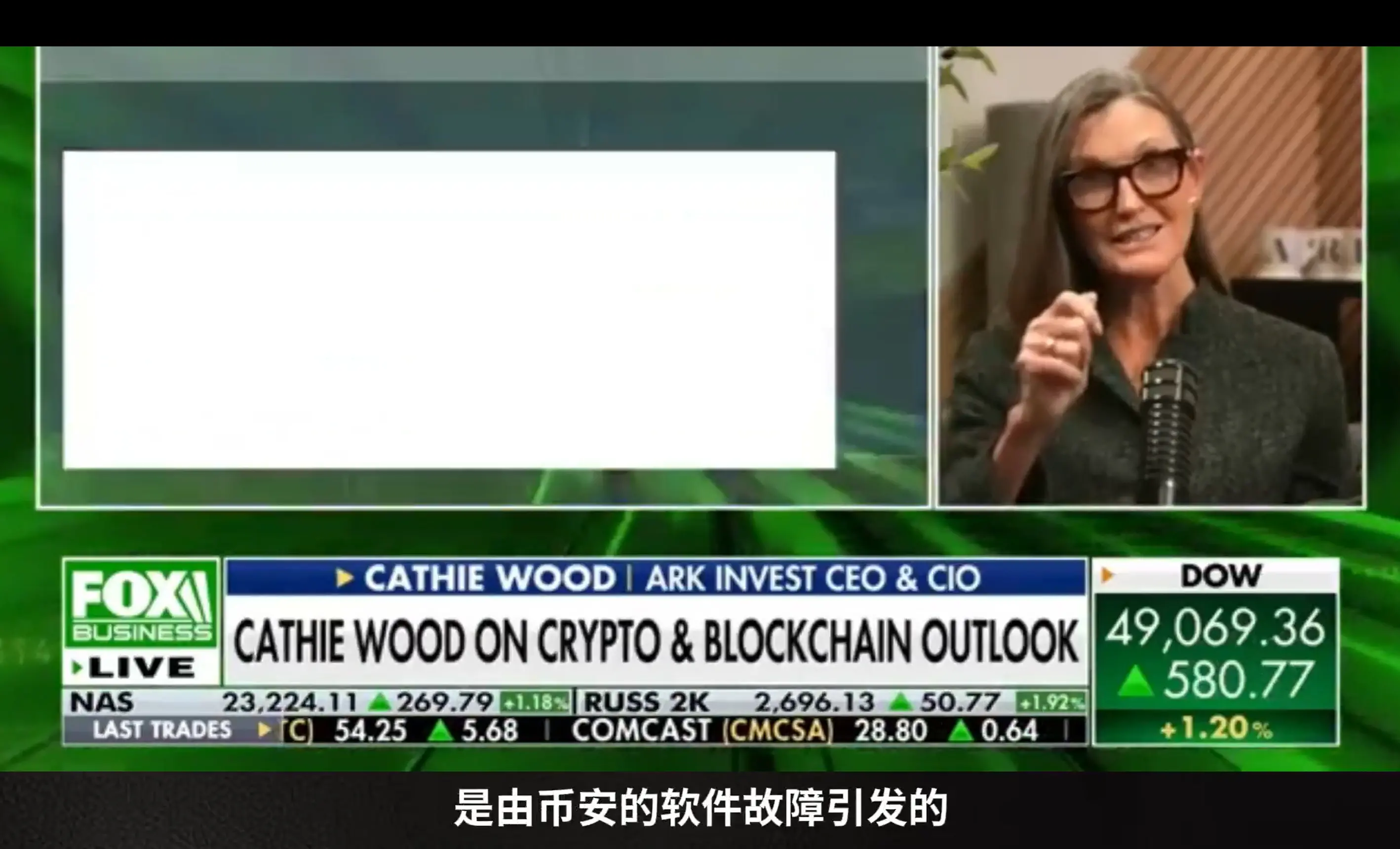
Wood's comments on a recent program, where she linked Bitcoin's decline to a $28 billion deleveraging event caused by a Binance software glitch on October 10, have sparked widespread criticism against Binance and its founder Changpeng Zhao (CZ) on social media platform X. Many KOLs are labeling CZ a "scammer," accusing him of a "collapsed public image" and facing a "backlash of influence." The criticism primarily focuses on the "1011 event," where Bitcoin and other cryptocurrencies crashed, resulting in over $500 billion wiped from the global crypto market cap and more than $19 billion in leveraged positions liquidated. Mainstream opinion holds that Binance's abnormal liquidation mechanism was closely related to the incident, and the exchange later modified the price charts for some tokens. Due to Wood's significant influence in both traditional finance and crypto, her remarks reignited painful memories of the 1011 event among investors, further aggravating sentiment in the already sluggish market. Early critics, including Leonidas, co-founder of Zap/Ord.io, and trader Anglio, sharply condemned CZ, calling him the "biggest fraud in human history" and blaming him for the massive liquidations. The backlash, initially concentrated in English-language circles, eventually spread to Chinese communities on X, where influential figures also began criticizing Binance. OKX founder Star Xu commented that the incident caused real and lasting damage to the industry, urging leading comp...

Author: Hu Tao, ChainCatcher

Nearly three months later, the impact of the 1011 incident continues to ferment, even bringing an unprecedented reputation crisis to Binance and its founder Changpeng Zhao.

In recent days, on the crypto-related timelines of social platform X, almost all are filled with a large amount of criticism and attacks against Changpeng Zhao, with many KOLs calling him a "scammer," and he is widely considered to have suffered a "collapse of public image" and "backlash from influence."

The incident originated from remarks made by "Cathie Wood" in a program, where she pointed out that the recent high-level pullback of Bitcoin was affected by the $28 billion deleveraging event triggered by a Binance software malfunction on October 10. She analyzed that the current market selling pressure has basically ended, and as institutional investors focus on the turning point of the "four-year cycle," it is expected that Bitcoin will consolidate at the bottom in the range of $80,000 to $90,000 before ending the downward trend and resuming its upward trend.

In the previous 1011 incident, Bitcoin and other cryptocurrencies plummeted, with the total market capitalization of the global crypto market evaporating more than $500 billion, and leveraged positions liquidated exceeding $19 billion, making it the largest leveraged liquidation event in the history of the crypto industry. From a large number of ordinary users to many well-known market makers and VCs, all suffered heavy losses in the incident. One of the mainstream views is that the occurrence of the incident is closely related to the abnormal liquidation mechanism of Binance. After the incident, Binance also modified the K-line trends of some coins with abnormal changes.

Since Cathie Wood has deep influence in both traditional finance and the crypto field, and is also an early investor in Coinbase and Bitcoin, her remarks brought the painful situation of the 1011 incident back into the sight of a large number of crypto users, which once again stung the emotions of investors in the current continuously sluggish crypto market.

Among the early speakers, Leonidas, co-founder of Zap/Ord.io, was one of the most influential figures. He fiercely said on Twitter that Changpeng Zhao is not only the biggest cryptocurrency scammer in history but also the biggest scammer in the history of human civilization. The world has never seen fraud, manipulation, and corruption on the scale of Binance now. Send this man back to jail!

Crypto trader Anglio also tweeted that CZ is the culprit behind the 10/10 liquidation case. Just because he wanted to kill HYPE, he ended up killing his own space. CZ is a complete criminal. The comments section also had a large number of tweets like "You scam others, destroy people's lives, destroy the market, and still pretend to be a good guy."

The focus of these remarks is on the 1011 liquidation incident, believing that Binance bears the main responsibility in this incident but has never publicly released an investigation report or admitted the problem. At the same time, almost all of the large number of new coins listed by Binance last year have fallen sharply, causing heavy losses to investors. Therefore, Changpeng Zhao, as the largest shareholder of Binance, has become their target.

Perhaps due to Binance's long-term accumulation in KOL relationship maintenance and the information cocoon created by X's recommendation logic, such voices were hardly spread in the Chinese X circle in the early days. But starting from the 28th, the huge negative energy accumulated in the English-speaking discussion inevitably spread to the Chinese X circle, and many well-known bloggers also began to sharply criticize Binance.

Well-known crypto trader Chuanmu tweeted, When will you come out to apologize and compensate all exchange users for October 11th? This Binance couple has been diverting attention and remaining silent about this day to evade responsibility. They harvested tens of billions of dollars in assets from users and market makers in one day, turning the entire industry into an assembly line of the Dubai scam park!

OKX founder Star Xu also tweeted on the 28th that the incident has caused real and lasting damage to the industry. Leading companies in the industry should focus on strengthening core infrastructure construction, building trust with global users and regulators, and protecting the company's long-term interests.

However, Binance founder Changpeng Zhao and He Yi hold a rebuttal attitude towards all external criticism. Changpeng Zhao first linked many negative critical tweets to organized attacks, pointing out that some previously unfamiliar accounts posted highly similar content in a short period of time, showing obvious characteristics of copying and amplification. The overall behavior is closer to systematic operation rather than natural discussion.

Later, Changpeng Zhao tweeted again in response to the质疑 of low listing quality. He pointed out that in any industry, most companies/projects will fail. A few successful cases will grow exponentially. No one can predict the future development of a project. Exchanges should try to give hard-working projects a chance. Not every project listed on the exchange has to be bought by you.

He Yi further linked these criticisms to the changes of the times and conflicts of interest. "When promoting changes in the world, it is often accompanied by a lot of discussion,质疑, and different voices. This is not unique to a certain industry, but a process in history that all structural changes have repeatedly appeared." He Yi said, "The discussions surrounding the crypto industry and Binance have complex sources, including emotional fluctuations brought by market cycles, as well as differences in business competition, models, and positions."

Some KOLs are also附和 the views of He Yi and Changpeng Zhao. For example, Crypto Orange believes that this matter may be a stage in the process of competition and division between Eastern and Western crypto. Cathie Wood has always been the mouthpiece of Western capital. Her remarks are often bolder, more direct, and exaggerated. During the Bitcoin surge, it was also Cathie Wood who publicly shouted for a million dollars, fueling the trend. She is like a signal gun. This time firing at Binance may also be as a mouthpiece for some top Western capital.

But in today's舆论 environment, completely shirking one's own responsibility and attributing the problem entirely to troll attacks and business competition has become a behavior that greatly reduces user favor. This will not only not stop the related controversies but will only further amplify the negative emotions of investors. The relevant discussions on platform X are still further扩散.

In a持续 sluggish market, investors are always inclined to find an outlet for their negative emotions. For a long time, Changpeng Zhao and others, as the industry's largest beneficiaries, have not shouldered their responsibilities well. They have一味 called on everyone to Hodl on Twitter and have been quite controversial in areas such as listing review and industry ecosystem construction. Therefore, under the fuse, they quickly became the target of public opinion attacks. However, demonizing Changpeng Zhao alone as the "industry's biggest scammer," ignoring the market cycle, users' own responsibilities, and the platform's scale effect, does not seem fair either.

In the final analysis, in this track that is still in the stage of野蛮 growth, in this highly volatile, strong-cycle investment field, there is no pure "savior," and there is no eternal "demon."

Связанные с этим вопросы

QWhat was the trigger for the recent reputational crisis faced by Binance and its founder Changpeng Zhao (CZ)?

AThe trigger was a statement by Cathie Wood ('ARK Invest's木头姐') on a program, where she linked Bitcoin's recent price decline to a $28 billion deleveraging event caused by a software glitch on Binance on October 10th.

QWhat was the '1011 event' mentioned in the article, and what was its impact?

AThe '1011 event' refers to the market crash on October 11th, where Bitcoin and other cryptocurrencies plummeted. It resulted in the global crypto market losing over $500 billion in value and saw leveraged positions liquidated to the tune of over $19 billion, making it one of the largest liquidation events in crypto history.

QHow did Changpeng Zhao (CZ) and Binance co-founder He Yi respond to the widespread criticism?

ACZ dismissed the criticism as an organized, systematic attack with coordinated accounts posting similar content. He Yi framed the discussions as part of the structural changes in the industry, stemming from market cycles and business competition. CZ also defended Binance's listing practices, stating that most projects fail in any industry and that exchanges should give hard-working projects a chance.

QAccording to the article, what are the main reasons critics are targeting CZ and Binance?

ACritics are targeting them primarily for Binance's perceived primary responsibility in the 1011 liquidation event without providing a public investigation report, and for the significant financial losses users suffered from many newly listed tokens on Binance that plummeted in value.

QWhat perspective does the article suggest is missing from the intense criticism against CZ?

AThe article suggests that demonizing CZ as the 'industry's biggest scammer' overlooks other factors like the natural market cycle, the users' own responsibility for their investments, and the platform's scale effects, which is an unfair oversimplification of a complex situation.

Похожее

Has Hook Summer Really Arrived? sato, Lo0p, FLOOD Ignite the New Narrative of Uniswap v4

"Hook Summer" Arrives? Sato, Lo0p, FLOOD Ignite Uniswap v4 Narrative Amidst a slight market recovery, attention within the Ethereum ecosystem has shifted to Meme coins built on Uniswap v4's Hook protocol. Following ASTEROID, tokens like sato, sat1, Lo0p, and FLOOD have become market focal points, with market caps ranging from millions to tens of millions, bringing concentrated liquidity to a narrative-dry market. Uniswap v4 Hooks are "plugin smart contracts" that allow developers to inject custom logic at key points in a liquidity pool's lifecycle (initialization, adding/removing liquidity, swaps, etc.), making the AMM programmable. Recent representative projects include: * **sato**: Market cap peaked over $38M; uses a v4 curve mechanism for minting/burning, locking ETH as reserve. * **sat1**: Market cap briefly exceeded $10M, positioning as an "optimized sato," but later declined significantly. * **Lo0p**: Market cap neared $6.6M; a "lending AMM protocol" allowing users to borrow ETH against deposited LO0P tokens without immediate selling pressure. * **FLOOD**: Market cap approached $6M; channels trading reserves into Aave v3 to generate yield, which is retained in the pool. The emergence of these Hook-based tokens could drive long-term growth for the Uniswap ecosystem by attracting users and liquidity to v4 pools. Combined with Uniswap's activated fee switch (partially used to burn UNI), the long-term outlook for UNI appears positive. However, short-term UNI price appreciation is not directly guaranteed. Factors include the sustainability and lifecycle of these new tokens, their price volatility, overall market conditions, and regulatory pressures. Currently, Uniswap v4's TVL ($595M) lags behind v3 and v2, indicating Hook adoption still requires time to mature. In summary, the Hook ecosystem serves as "long-term nourishment" for UNI, but acts more as a "catalyst" than a direct "booster" in the short term. Note: These are early-stage experimental tokens and may carry unknown risks.

marsbit26 мин. назад

Has Hook Summer Really Arrived? sato, Lo0p, FLOOD Ignite the New Narrative of Uniswap v4

marsbit26 мин. назад

Has Hook Summer Truly Arrived? sato, Lo0p, FLOOD Ignite the New Uniswap v4 Narrative

With the broader market showing signs of recovery, a new wave of interest has emerged around Ethereum-based meme coins. Following ASTEROID, tokens like sato, sat1, Lo0p, and FLOOD, built upon the Uniswap v4 Hook protocol, are capturing market attention. Their market capitalizations range from millions to tens of millions of dollars, injecting much-needed focused liquidity into a market lacking narratives. This article explores whether this trend signifies an incoming "Hook Summer" and its potential impact on UNI's price. Hooks are essentially plug-in smart contracts for Uniswap v4 liquidity pools, allowing developers to inject custom logic at key points in a pool's lifecycle (like initialization, adding/removing liquidity, swaps). This transforms the AMM into programmable building blocks. Key highlighted projects include: * **sato**: Peaked over $38M market cap. It utilizes a v4 curve for minting/burning; buying locks ETH as reserve to mint new tokens, while selling redeems ETH from the reserve and burns tokens. * **sat1**: Market cap briefly exceeded $10M, promoted as an "optimized sato," but later declined significantly. * **Lo0p**: Reached nearly $6.6M. It's a lending AMM protocol where buying LO0P tokens locks them as collateral, allowing users to borrow ETH from the pool reserve at 40% LTV, aiming to improve capital efficiency for idle ETH in LPs. * **FLOOD**: Peaked near $6M. Its mechanism directs asset reserves from buys into Aave v3 to generate yield, with fees and interest retained in the pool to potentially influence the token's price long-term. In the long term, the development of the Hook ecosystem can attract users and liquidity to Uniswap v4, benefiting UNI's fundamentals—especially combined with the recent activation of the protocol fee switch, where a portion of fees is used to burn UNI. However, in the short term, these Hook-based tokens are unlikely to directly drive significant UNI price appreciation. Their impact is moderated by factors like token sustainability, price volatility, and broader market and regulatory conditions. Currently, Uniswap v4's TVL ($595M) still trails behind v2 and v3, indicating adoption and growth will take time. The article concludes that while the Hook ecosystem provides long-term "nourishment" for UNI, its short-term role is more of a "catalyst" than a "booster." Readers are cautioned that these are early-stage experimental tokens and may carry unknown risks.

Odaily星球日报38 мин. назад

Has Hook Summer Truly Arrived? sato, Lo0p, FLOOD Ignite the New Uniswap v4 Narrative

Odaily星球日报38 мин. назад

Interview with Michael Saylor: I Did Say I Would Sell Bitcoin, But Never a Net Sale

Interview with Michael Saylor: I Said We'd Sell Bitcoin, But Never Be a Net Seller In a recent podcast, MicroStrategy Executive Chairman Michael Saylor clarified the company's stance on potentially selling Bitcoin. Following MicroStrategy's earnings call statement about being prepared to sell BTC to fund dividends for its STRC (Strategic) credit product, Saylor emphasized the distinction between selling and being a "net seller." Saylor explained the core business model: MicroStrategy sells credit instruments like STRC and uses the proceeds to buy Bitcoin, which is viewed as "digital capital" expected to appreciate around 30-40% annually. A portion of these capital gains can then be used to pay the dividends on the credit products. He stressed that even if the company sells some Bitcoin for dividends, it simultaneously buys much more with new credit issuance. For example, after raising $3.2 billion from STRC sales in April, the dividend obligation was only $80-90 million, making the company a net buyer. The clarification aims to counter market narratives questioning the value of Bitcoin on MicroStrategy's balance sheet if it were never sold, and to dismiss claims of a "Ponzi scheme." Saylor reiterated his personal philosophy for investors: "Don't be a net seller of bitcoin" and ensure your Bitcoin holdings increase each year. Saylor also discussed Bitcoin's role as the foundation for "digital credit," noting that STRC has become the largest and most liquid preferred stock issue in the U.S., offering high risk-adjusted returns (Sharpe ratio). He highlighted Bitcoin's deep liquidity, stating that even large purchases by MicroStrategy do not move the market significantly, which is driven by macro factors, geopolitical tensions, and capital flows from ETFs and credit products. Finally, Saylor reflected on his early inspiration from sci-fi books, which motivated his path to MIT, and maintained his fundamental thesis on Bitcoin remains unchanged: it is superior digital capital enabling superior digital credit.

链捕手42 мин. назад

Interview with Michael Saylor: I Did Say I Would Sell Bitcoin, But Never a Net Sale

链捕手42 мин. назад

Торговля

Спот
Фьючерсы

Популярные статьи

Как купить S

Добро пожаловать на HTX.com! Мы сделали приобретение Sonic (S) простым и удобным. Следуйте нашему пошаговому руководству и отправляйтесь в свое крипто-путешествие.Шаг 1: Создайте аккаунт на HTXИспользуйте свой адрес электронной почты или номер телефона, чтобы зарегистрироваться и бесплатно создать аккаунт на HTX. Пройдите удобную регистрацию и откройте для себя весь функционал.Создать аккаунтШаг 2: Перейдите в Купить криптовалюту и выберите свой способ оплатыКредитная/Дебетовая Карта: Используйте свою карту Visa или Mastercard для мгновенной покупки Sonic (S).Баланс: Используйте средства с баланса вашего аккаунта HTX для простой торговли.Третьи Лица: Мы добавили популярные способы оплаты, такие как Google Pay и Apple Pay, для повышения удобства.P2P: Торгуйте напрямую с другими пользователями на HTX.Внебиржевая Торговля (OTC): Мы предлагаем индивидуальные услуги и конкурентоспособные обменные курсы для трейдеров.Шаг 3: Хранение Sonic (S)После приобретения вами Sonic (S) храните их в своем аккаунте на HTX. В качестве альтернативы вы можете отправить их куда-либо с помощью перевода в блокчейне или использовать для торговли с другими криптовалютами.Шаг 4: Торговля Sonic (S)С легкостью торгуйте Sonic (S) на спотовом рынке HTX. Просто зайдите в свой аккаунт, выберите торговую пару, совершайте сделки и следите за ними в режиме реального времени. Мы предлагаем удобный интерфейс как для начинающих, так и для опытных трейдеров.

1.3k просмотров всегоОпубликовано 2025.01.15Обновлено 2025.03.21

Как купить S

Sonic: Обновления под руководством Андре Кронье – новая звезда Layer-1 на фоне спада рынка

Он решает проблемы масштабируемости, совместимости между блокчейнами и стимулов для разработчиков с помощью технологических инноваций.

2.2k просмотров всегоОпубликовано 2025.04.09Обновлено 2025.04.09

Sonic: Обновления под руководством Андре Кронье – новая звезда Layer-1 на фоне спада рынка

HTX Learn: Пройдите обучение по "Sonic" и разделите 1000 USDT

HTX Learn — ваш проводник в мир перспективных проектов, и мы запускаем специальное мероприятие "Учитесь и Зарабатывайте", посвящённое этим проектам. Наше новое направление .

1.8k просмотров всегоОпубликовано 2025.04.10Обновлено 2025.04.10

HTX Learn: Пройдите обучение по "Sonic" и разделите 1000 USDT

Обсуждения

Добро пожаловать в Сообщество HTX. Здесь вы сможете быть в курсе последних новостей о развитии платформы и получить доступ к профессиональной аналитической информации о рынке. Мнения пользователей о цене на S (S) представлены ниже.

活动图片