Cardano Gains Institutional Momentum as Smart Contract Fund Exposure Surges

bitcoinistОпубликовано 2026-02-25Обновлено 2026-02-25

Введение

Institutional investors are increasing their exposure to smart contract platforms, with Cardano (ADA) becoming a central focus. Grayscale Investments has raised its ADA allocation in its Smart Contract Fund to 20.2%, making it the fund's third-largest holding behind Ethereum and Solana. This signals growing institutional confidence in Cardano's long-term ecosystem, despite ongoing market weakness and ADA's price trading near key support at $0.24. Additionally, Cardano has integrated with LayerZero, enabling cross-chain interoperability with over 80 blockchains. This aims to improve liquidity and DeFi access by allowing direct asset and data transfers between networks like Ethereum and Solana. Further roadmap upgrades focus on scalability, privacy sidechains, and stablecoin integrations to attract institutional use cases. While technical indicators remain cautious, the institutional accumulation and ecosystem developments suggest strengthened long-term positioning.

Institutional investors are improving exposure to smart contract platforms amid ongoing market volatility, with Cardano (ADA) increasingly becoming a central focus. Recent portfolio adjustments by major crypto asset managers suggest long-term positioning is gaining priority over short-term price movements.

Related Reading: Strategy Makes 100th Bitcoin Purchase, Total Holdings Reach 717,722 BTC

Digital asset manager Grayscale Investments has steadily increased its allocation to Cardano’s ADA token within its Smart Contract Fund, signaling growing institutional interest in the network’s evolving ecosystem and infrastructure strategy.

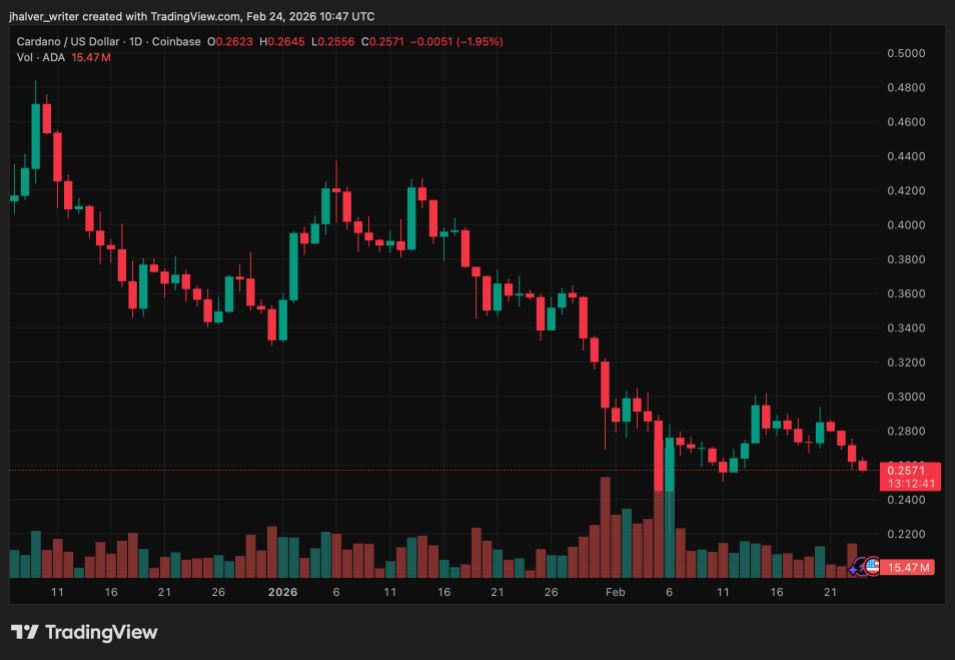
ADA's price trends to the downside on the daily chart. Source: ADAUSD on Tradingview 

Institutional ADA Allocation Expands Despite Market Weakness

Grayscale’s latest rebalancing shows ADA accounting for roughly 20.2% of the Smart Contract Platform Select Capped Index (SCPXC), up from about 18.55% at the start of the year. The increase makes Cardano the third-largest holding in the fund, behind Ethereum and Solana, which each command allocations above 28%.

The fund maintains diversified exposure across several smart contract networks, including Hedera, Avalanche, and Sui, while managing approximately $1.8 million in assets under management with a net asset value of $5.81 per share.

The rising allocation comes amid macro-driven pressure on crypto markets, with risk sentiment weakening across major tokens. Despite the downturn, institutional positioning suggests investors are reassessing long-term blockchain infrastructure plays rather than reducing exposure entirely.

Cardano-LayerZero Integration Strengthens Ecosystem Outlook

Alongside institutional accumulation, Cardano (ADA) has introduced technical developments to expand its interoperability. The network recently integrated with LayerZero, enabling cross-chain messaging and asset transfers across more than 80 blockchain networks.

The upgrade allows dApps on Cardano to interact directly with ecosystems such as Ethereum and Solana, addressing long-standing liquidity fragmentation challenges. Developers can now move assets and data across chains without relying heavily on wrapped tokens or centralized bridges, potentially widening DeFi access.

Additional roadmap initiatives, including protocol upgrades, privacy-focused sidechains, and stablecoin integrations, are designed to improve scalability and attract institutional-grade use cases over the coming year.

Price Structure Remains Fragile Near Key Support

While institutional signals have strengthened, ADA’s market structure remains under pressure. The token is trading around $0.25 after a prolonged downtrend from January highs around $0.42.

Analysts are closely monitoring the $0.24 level, a long-standing demand zone that has historically attracted buyers during periods of heavy selling.

Related Reading: CZ Eyes Binance US Expansion Following Withdrawal Of SEC’s Lawsuit – Report

Technical indicators remain cautious, with resistance forming near the $0.30–$0.31 range. A sustained move above that zone could shift short-term sentiment, while a breakdown below support may expose lower historical price areas.

Cover image from ChatGPT, ADAUSD chart on Tradingview

Связанные с этим вопросы

QWhat is the main reason for the increased institutional interest in Cardano (ADA) according to the article?

AInstitutional investors are increasing exposure to Cardano due to its evolving ecosystem and infrastructure strategy, prioritizing long-term positioning over short-term price movements.

QWhich asset manager has significantly increased its allocation to ADA in its Smart Contract Fund?

AGrayscale Investments has steadily increased its allocation to Cardano's ADA token within its Smart Contract Fund.

QWhat recent technical development has improved Cardano's interoperability with other blockchains?

ACardano has integrated with LayerZero, enabling cross-chain messaging and asset transfers across more than 80 blockchain networks.

QWhat is ADA's current ranking by allocation size in Grayscale's Smart Contract Platform Select Capped Index?

AADA is the third-largest holding in the fund, behind Ethereum and Solana, with an allocation of approximately 20.2%.

QWhat key price level are analysts monitoring for ADA amid its current downtrend?

AAnalysts are closely monitoring the $0.24 level, which is a long-standing demand zone that has historically attracted buyers during periods of heavy selling.

Похожее

From Code to Cognition: A Ten-Thousand-Word Guide to the Evolution of the Robot Brain

"From Code to Cognition: The Evolution of Robot Brains" The journey of robotic intelligence has shifted dramatically from manually coded systems to AI-driven brains. For decades, robots relied on layered software stacks—perception, state estimation, planning, control—each handcrafted. While predictable, they lacked adaptability. The 2010s saw deep learning revolutionize perception (e.g., object detection) and control (via reinforcement learning), but learned skills remained narrow. The arrival of Large Language Models (LLMs) marked a turning point. LLMs acted as high-level planners, interpreting natural language instructions and generating sequences of actions for traditional robotic systems to execute. However, true integration came with Visual-Language-Action (VLA) models, which fused vision, language, and motion prediction into a single network. Pioneered by models like RT-2 and open-source projects like OpenVLA, VLAs enable robots to reason and act directly from visual input and commands. The most advanced humanoid robots now employ a "dual-brain" architecture: a slow-thinking, large VLA (System 2) for reasoning and planning, and a fast-reacting, small network (System 1) for high-frequency motion control, sometimes with an even lower-level System 0 for balance. This split balances cognition with the physics of real-time movement. Computation is split between onboard hardware (e.g., NVIDIA Jetson) for safety-critical control loops and cloud/edge servers for non-critical tasks like learning and interfaces. A crucial driver is the open-source ecosystem—models like GR00T and OpenVLA allow startups to build upon pre-trained brains and fine-tune them with their own data, accelerating development. Despite progress, current systems struggle with recovery from errors, sample inefficiency, and long-horizon tasks. This has spurred the rise of **World Models**—neural networks that predict the consequences of actions. By simulating possible futures before acting (like NVIDIA Cosmos or Meta V-JEPA), robots can plan, recover, and generalize better. This represents the next frontier: shifting intelligence from learned reactions to an internal model of physics and cause-and-effect. The field is rapidly evolving. While not yet at its "ChatGPT moment," the convergence of cheaper hardware, scalable simulation, and world models points toward robots that are increasingly capable, adaptive, and useful. The question is shifting from "what can robots do?" to "what *should* they do?"

marsbit7 мин. назад

From Code to Cognition: A Ten-Thousand-Word Guide to the Evolution of the Robot Brain

marsbit7 мин. назад

AI Bubble Is Bursting

The AI Bubble is Bursting: A Necessary Purge on the Path to Ubiquitous Intelligence Market volatility has reignited debates about an AI bubble, with figures like Ray Dalio pointing to high valuations. However, this parallels the dot-com bubble, which, despite its crash, laid the physical infrastructure for today's internet era. The current AI investment frenzy, with tech giants planning trillions in infrastructure spending far outstripping current AI application revenues, appears similarly imbalanced. This 'bubble' is seen as an inevitable phase for a disruptive technology, paying the "innovation tax." Critically, AI inference costs have plummeted over 99.7% since 2023, making intelligence nearly free at the margin. This hasn't reduced spending but has instead unlocked massive new demand, as seen in enterprise AI cloud expenditure tripling. This follows the Jevons Paradox: efficiency gains lead to greater total consumption. The market is now entering a cleansing phase, weeding out speculative ventures lacking real moats. The deeper shift is a move from capital expenditure (CapEx) on hardware to value creation in operational expenditure (OpEx) through AI applications that solve real industry problems. While infrastructure valuations are high, rapid earnings growth from widespread AI adoption across sectors—from manufacturing and finance to law and healthcare—may digest these valuations over time. Ultimately, this creative destruction will leave behind robust infrastructure and optimized models, cheaply powering an AI-augmented future for all industries, much as the internet became indispensable after its own bubble burst. The core productive potential remains undiminished.

链捕手17 мин. назад

AI Bubble Is Bursting

链捕手17 мин. назад

Торговля

Спот
Фьючерсы

Популярные статьи

Как купить ADA

Добро пожаловать на HTX.com! Мы сделали приобретение Cardano (ADA) простым и удобным. Следуйте нашему пошаговому руководству и отправляйтесь в свое крипто-путешествие.Шаг 1: Создайте аккаунт на HTXИспользуйте свой адрес электронной почты или номер телефона, чтобы зарегистрироваться и бесплатно создать аккаунт на HTX. Пройдите удобную регистрацию и откройте для себя весь функционал.Создать аккаунтШаг 2: Перейдите в Купить криптовалюту и выберите свой способ оплатыКредитная/Дебетовая Карта: Используйте свою карту Visa или Mastercard для мгновенной покупки Cardano (ADA).Баланс: Используйте средства с баланса вашего аккаунта HTX для простой торговли.Третьи Лица: Мы добавили популярные способы оплаты, такие как Google Pay и Apple Pay, для повышения удобства.P2P: Торгуйте напрямую с другими пользователями на HTX.Внебиржевая Торговля (OTC): Мы предлагаем индивидуальные услуги и конкурентоспособные обменные курсы для трейдеров.Шаг 3: Хранение Cardano (ADA)После приобретения вами Cardano (ADA) храните их в своем аккаунте на HTX. В качестве альтернативы вы можете отправить их куда-либо с помощью перевода в блокчейне или использовать для торговли с другими криптовалютами.Шаг 4: Торговля Cardano (ADA)С легкостью торгуйте Cardano (ADA) на спотовом рынке HTX. Просто зайдите в свой аккаунт, выберите торговую пару, совершайте сделки и следите за ними в режиме реального времени. Мы предлагаем удобный интерфейс как для начинающих, так и для опытных трейдеров.

2.3k просмотров всегоОпубликовано 2024.03.29Обновлено 2026.06.02

Как купить ADA

SNEK: ведущий мемкоин на блокчейне Cardano, открывающий новую эпоху для экосистемы Cardano

SNEK - это дефляционный мемкоин, выпущенный на блокчейне Cardano. Он создаёт децентрализованную культурную и развлекательную ценность за счёт участия глобального сообщества.

2.1k просмотров всегоОпубликовано 2025.10.15Обновлено 2025.10.15

SNEK: ведущий мемкоин на блокчейне Cardano, открывающий новую эпоху для экосистемы Cardano

Неделя обучения по популярным токенам 8: запуск основной сети Ouroboros Leios для ADA ожидается в 2026 году

Основная сеть Ouroboros Leios для ADA, как ожидается, будет запущена в 2026 году, а хардфорк до версии протокола 11 запланирован на I квартал 2026 года.

2.0k просмотров всегоОпубликовано 2026.02.10Обновлено 2026.02.12

Неделя обучения по популярным токенам 8: запуск основной сети Ouroboros Leios для ADA ожидается в 2026 году

Обсуждения

Добро пожаловать в Сообщество HTX. Здесь вы сможете быть в курсе последних новостей о развитии платформы и получить доступ к профессиональной аналитической информации о рынке. Мнения пользователей о цене на ADA (ADA) представлены ниже.

活动图片